High-Intensity 4v4 Transitions: The Ultimate Small-Sided Game
Master the chaotic moments of the game by teaching your players how to react instantly upon winning or losing the ball in this fast-paced 4v4 small-sided game.

Equipment Needed
Overview
Transitions are the most critical moments in modern football. The few seconds immediately after the ball is won or lost often dictate the outcome of a match. This high-intensity 4v4 small-sided game (SSG) is specifically designed to overload players with transitional moments, forcing them to react instinctively, organize rapidly, and exploit disorganized opponents.
By playing in a tight, confined space, players are constantly engaged. There is no time to rest; the moment possession changes, the mentality must shift instantly from attacking to defending, or defending to attacking. This drill will improve your team's tactical understanding of defensive recovery runs, offensive counter-attacks, and overall physical conditioning.
Setup
Pitch Dimensions
- Length: 30 metres
- Width: 20 metres
- Note: Standard full-size pitches are 100-110m x 64-75m. This drill uses a significantly reduced area to increase touches and transitional frequency.
Equipment Needed
- 8-10 marker cones to outline the pitch boundaries
- 2 small pop-up goals or mini-goals (approximately 1.5m to 2m wide), placed at opposite ends
- A large supply of footballs (at least 8-10) placed near the coach on the touchline to keep the game flowing
- 2 sets of coloured training bibs (e.g., Red and Blue)
Player Positions
- 8 players divided into two teams of 4 (Team A and Team B).
- No dedicated goalkeepers are required for this specific variation, though one player on each team should naturally assume a deeper 'sweeper' role when defending.
- Example setup: 1 deeper defender, 2 wide midfielders, 1 high forward.
Step-by-Step Instructions
- Establish the Playing Area: Mark out the 30x20m pitch using cones. Place one small goal at each end.
- Divide the Teams: Split your 8 players into two even teams of 4 (Red vs. Blue).
- Initiate Play: The coach starts the drill by playing a ball into the centre of the pitch. Both teams immediately compete for possession.
- Normal Play: Once a team gains possession, they attempt to score in the opponent's goal. Normal football rules apply (throw-ins or kick-ins can be used depending on preference, though kick-ins keep the tempo higher).
- The Transition Trigger: The core of the drill happens when possession changes hands (e.g., a tackle, interception, or a shot goes wide).
- Attacking Transition: The team that just won the ball must immediately look to play forward and exploit the disorganized defense.
- Defensive Transition: The team that just lost the ball must immediately counter-press or drop into a compact defensive shape to deny the counter-attack.
- Continuous Flow: When a goal is scored or the ball goes out of play, the coach immediately feeds a new ball to the team that should have possession, or into a neutral area to restart the chaos. Do not allow players to reset comfortably.
- Duration: Play intense blocks of 3-4 minutes, followed by a 1-2 minute rest. Complete 4-5 blocks.
Tactical Diagrams
Attacking Phase and Defensive Shape
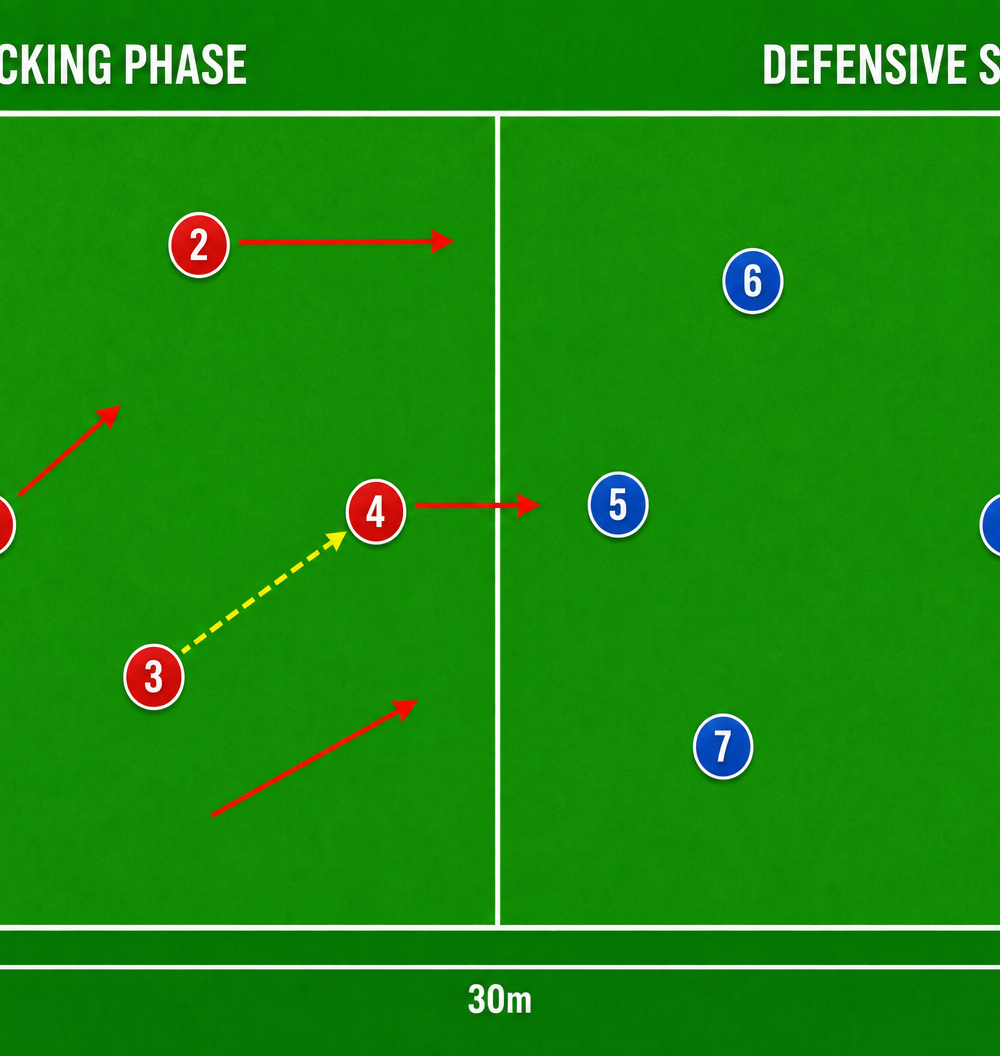
In this first diagram, Team A (Red) is in an established attacking phase. Player 1 acts as the deepest player, while Players 2 and 3 provide width. Player 4 is the focal point. Team B (Blue) is organized in a compact defensive shape, looking to intercept the pass from Player 3 to Player 4.
The Transition Moment: Counter-Attack
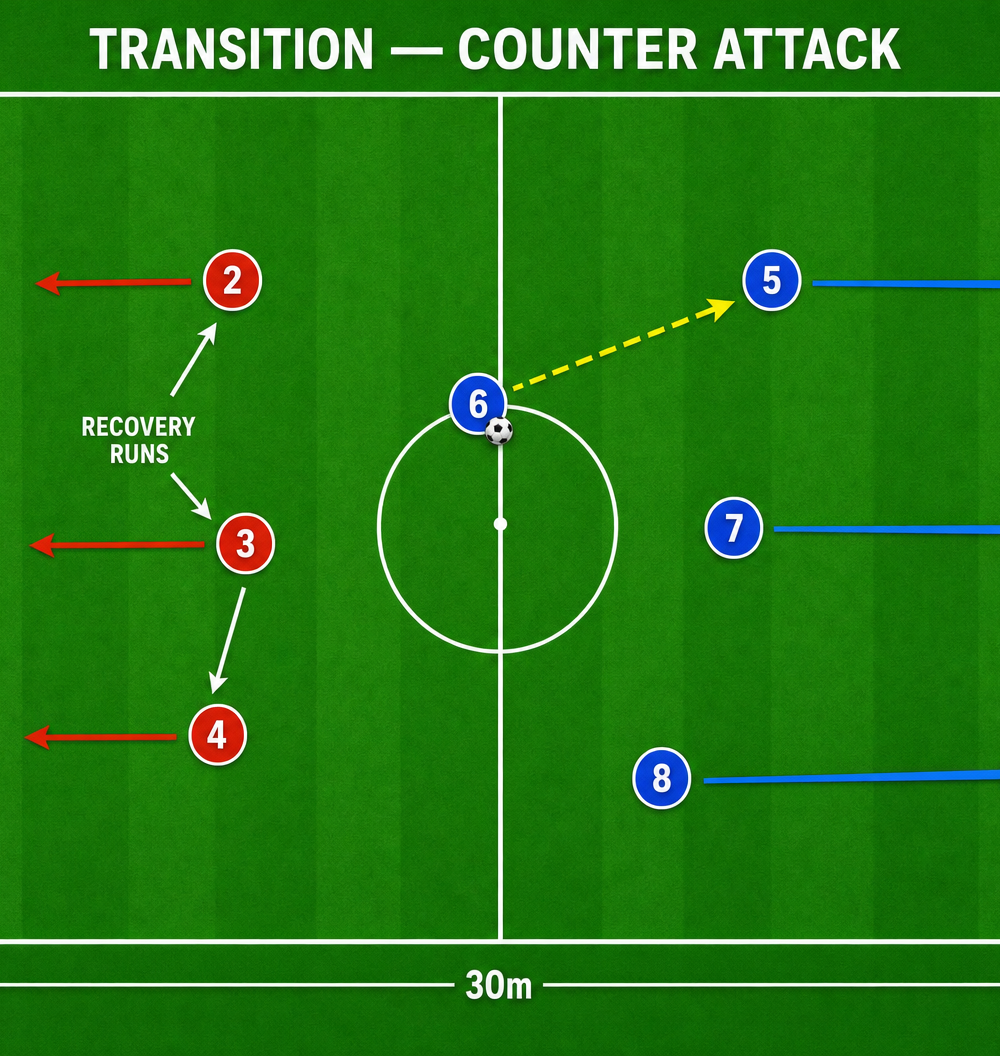
This second diagram illustrates the critical transition moment. Team B (Blue) has intercepted the ball via Player 6. Instantly, Players 5, 7, and 8 make explosive forward runs. Player 6 plays a quick pass to the right wing (Player 5). Meanwhile, Team A (Red) must make desperate recovery runs to protect their goal, with Player 1 dropping deep as the last line of defense.
Key Coaching Points
- Instant Reaction (The 3-Second Rule): Demand that players react within the first 3 seconds of losing the ball. They must either press the ball carrier aggressively or sprint back into a defensive block.
- First Pass Forward: Upon winning the ball, the first thought should be: "Can I play forward?" Encourage players to look for early passes that break lines before the opposition can organize.
- Compactness in Defense: When the ball is lost, the team must shrink the pitch. Players should get close together to deny space through the middle, forcing the opposition wide.
- Communication: Constant talking is required. Players must organize each other during the chaotic transitional moments (e.g., "Drop!", "Press!", "Man on!").
- Explosive Movement: Transitions require sprinting, not jogging. Ensure players are moving at maximum intensity during the turnover phases.
Common Mistakes
- Dwelling on the Ball: Players taking too many touches after winning the ball, allowing the opposition time to recover their defensive shape.
- Jogging Back: Defenders failing to make high-intensity recovery runs when the ball is lost, leaving their teammates exposed to a numerical disadvantage.
- Lack of Width in Attack: Upon winning the ball, the attacking team fails to spread out quickly, making it easy for the defending team to press them in a confined space.
- Silence: Players failing to communicate, leading to two players pressing the same man or leaving dangerous attackers completely unmarked.
Variations & Progressions
- Add Goalkeepers (5v5): Increase the pitch size slightly (40x25m) and add full-size goals with goalkeepers. This adds realism to the finishing phase of the counter-attack.
- Touch Limit: Impose a 2-touch or 3-touch limit. This forces quicker decision-making and faster ball circulation, making transitions even more frequent.
- Neutral Players (4v4 + 2): Add two neutral players ('bumpers') on the outside of the pitch who play with the team in possession. This creates an attacking overload (6v4) and makes the defensive transition much harder.
Age Adaptations
- Under 8 / Under 10: Focus primarily on the reaction to losing the ball. Don't worry too much about complex defensive shapes. Just encourage them to try and win it back immediately.
- Under 12 / Under 14: Introduce the concept of the 'first pass forward' upon winning the ball. Start demanding better spatial awareness and width during the attacking transition.
- Under 16 / Open: Demand tactical perfection. The defensive shape must be compact, the counter-press must be coordinated, and the counter-attacks must be ruthless and efficient. Fitness levels should allow for sustained high intensity.