

Football
High-Intensity Pressing Triggers and Rapid Recovery Drill
Master the art of identifying pressing triggers to win the ball high up the pitch, while drilling the rapid defensive recovery required when the initial press is broken.

What you need
1 Full-size goal, 10-12 Cones or flat markers, 6-8 Footballs, Bibs in two colors
1. Overview
Modern football demands not only the ability to press high and aggressively but also the tactical discipline to recover shape instantly when that press is bypassed. The High-Intensity Pressing Triggers and Rapid Recovery Drill is designed to train your team in recognizing the exact moments to initiate a collective press (the 'triggers') and, crucially, how to react when the opposition successfully plays through the initial wave of pressure.
This drill bridges the gap between attacking transition and defensive solidity. It is ideal for teams looking to implement a proactive, front-foot defensive style while maintaining a compact structure against counter-attacks. By simulating realistic match scenarios, players learn to communicate effectively, move as a cohesive unit, and understand the spatial relationships required for effective pressing and recovery.
2. Setup

To ensure this drill runs smoothly and mirrors match conditions, proper setup is essential.
- Pitch Area: Utilize one half of a standard football pitch (approximately 50m x 70m). Mark out a central 'Compact Block' zone (around 30m x 40m) using flat markers to provide a visual reference for the defensive recovery shape.
- Players Required: 14 players minimum (can be scaled). This includes:
- 1 Goalkeeper (GK)
- 6 Defenders/Midfielders for the pressing team (e.g., Back 4 + 2 Central Midfielders)
- 7 Attackers for the team in possession (e.g., Back 4 + 3 Midfielders simulating building from the back)
- Equipment:
- 1 Full-size goal
- 10-12 Cones or flat markers (for zones and starting positions)
- Supply of footballs (at least 6-8) placed near the halfway line for quick restarts
- Bibs in two distinct colors (e.g., Red for pressing team, Blue for possession team)
3. Step-by-Step Instructions


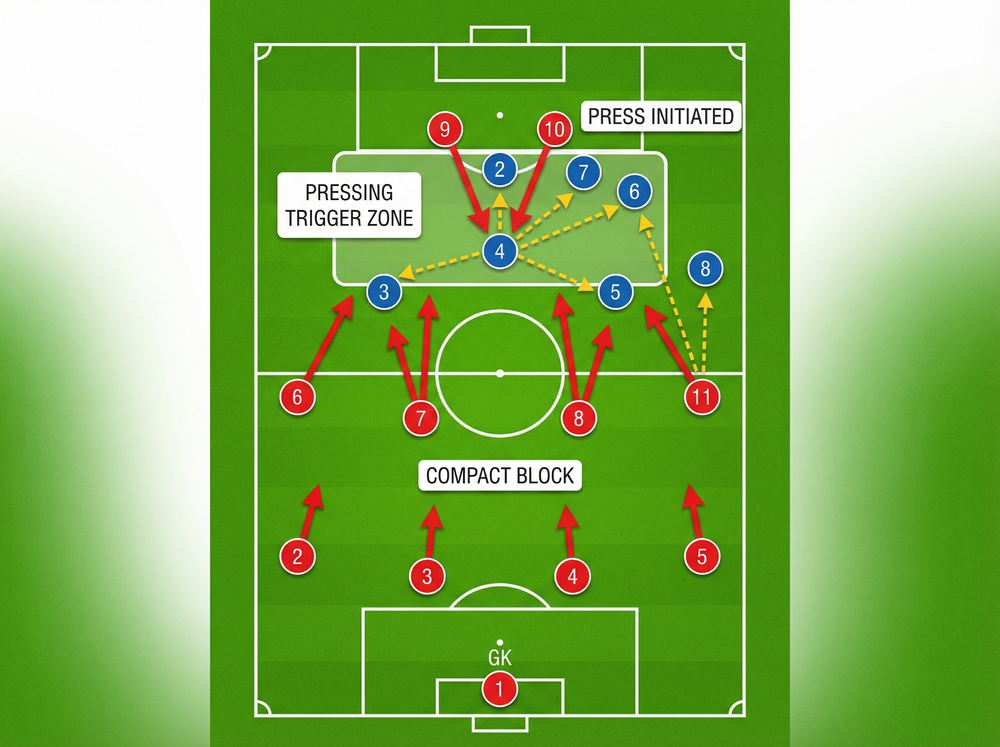
- Starting Positions: The Blue team (in possession) starts with the ball near the halfway line, simulating a build-up phase. The Red team (pressing team) sets up in a compact mid-block shape, ensuring they are not easily played through centrally.
- The Trigger: The coach calls out a specific pressing trigger, or the Blue team simulates one. Common triggers include:
- A slow, looping pass between center-backs.
- A pass played to a full-back who has a poor body angle (facing their own goal).
- A heavy touch by an opposition midfielder.
- Initiating the Press: Upon recognizing the trigger, the designated Red players (e.g., the two highest pressing players, numbers 9 and 10 in the diagram) aggressively close down the ball carrier. The rest of the Red team must step up simultaneously to compress the space and cut off passing lanes, acting as a cohesive unit.
- Scenario A - Successful Press: If the Red team wins possession within 5 seconds of initiating the press, they immediately transition to attack, attempting to score in the full-size goal within 3 passes or 8 seconds.
- Scenario B - The Press is Broken: This is the critical recovery phase.

- The Recovery Run: If the Blue team successfully completes 3 passes or plays a progressive pass that bypasses the initial pressing line, the coach blows the whistle loudly (or shouts "Recover!").
- Restoring Shape: The entire Red team must immediately abandon the high press and execute high-speed recovery runs. They must drop back and re-establish their compact defensive shape within the designated central 'Compact Block' zone before the Blue team can mount an attack.
- Reset and Repeat: Once the Red team has successfully recovered their shape and stopped the immediate threat, the drill resets from the halfway line with a new ball.
4. Key Coaching Points
- Collective Movement: The press must be initiated as a unit. If one player triggers the press, the supporting players must follow immediately to close the space. A disjointed press is easily bypassed.
- Body Shape and Angling: When closing down, players must approach with an angled body shape to force the ball carrier in a specific direction (usually towards the touchline or into a crowded midfield area), making play predictable.
- Communication is Vital: Players behind the initial pressing line must communicate clearly, dictating when to step up, who to mark, and when to drop back. The goalkeeper and center-backs are crucial in orchestrating the recovery.
- Sprint to Recover: The transition from pressing to recovery must be instantaneous. Players must sprint back into position, not jog. The goal is to get behind the ball and re-establish the defensive block as quickly as possible.
- Identify the Threat: During recovery, players must prioritize protecting the center of the pitch and the space behind the defensive line. Wide areas are a secondary concern until the central structure is secure.
5. Common Mistakes

- Pressing in Isolation: A single player pressing aggressively while the rest of the team remains deep. This wastes energy and opens up massive gaps for the opposition to exploit.
- Slow Reaction to the Trigger: Hesitation when a pressing trigger occurs allows the opposition time to settle and make a better decision. The reaction must be automatic.
- Jogging During Recovery: Failing to sprint back into position after the press is broken. This leaves the defense exposed and vulnerable to quick counter-attacks.
- Ball Watching: Focusing solely on the ball carrier and losing track of opposition runners during the recovery phase.
6. Variations & Progressions
- Progression 1: Add a Time Limit for Recovery: Introduce a strict 5-second rule for the pressing team to re-establish their compact block once the press is broken. If they fail, the possession team gets a free shot on goal.
- Progression 2: Multiple Triggers: Instead of a single, obvious trigger, introduce complex scenarios where players must decide whether to press or hold based on multiple cues (e.g., the position of the opposing full-backs combined with the quality of the pass).
- Variation 1: Smaller Pitch, Higher Intensity: Reduce the pitch size to increase the frequency of transitions and the physical demands of the drill. This emphasizes quick decision-making and rapid changes of direction.
7. Age Adaptations
- Under 10 - Under 12: Focus heavily on the basic concept of moving together as a unit. Simplify the triggers (e.g., just pressing when the ball goes to a specific zone) and reduce the intensity of the recovery runs. Emphasize fun and basic positional awareness.
- Under 14 - Under 16: Introduce more complex triggers and demand faster reaction times. Focus on the tactical understanding of why they are pressing and the importance of body shape. The recovery phase should be demanding.
- Open / Senior: Run the drill at match intensity. Demand flawless communication, perfect execution of the pressing traps, and instantaneous, high-speed recovery runs. Introduce complex variations and tactical nuances specific to your team's game model.
