

Basketball
Horns Set Play: Creating Open Three-Pointers
Master the classic Horns set to manipulate the defense, create spacing, and generate high-percentage three-point shots for your best shooters.
What you need
1 Basketball, Half-court setup
1. Overview
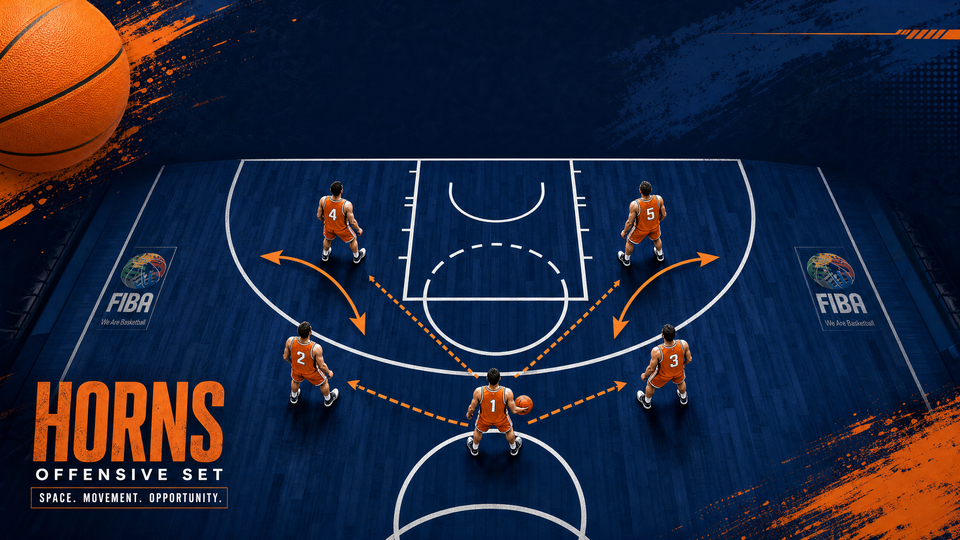
The Horns set is a staple in modern basketball, widely utilized from youth leagues to the professional level. Its primary objective is to pull the opposing bigs away from the basket, thereby opening up the paint and creating advantageous spacing. By positioning two players at the high post (elbows) and two in the corners, the offense forces the defense into difficult decision-making scenarios. This specific variation focuses on leveraging the initial high pick-and-roll action to trigger a sequence that results in an open three-point shot. It is an excellent set play to run when you need a crucial perimeter basket or when you want to exploit a defense that over-helps on dribble penetration.
2. Setup
Court Dimensions: Standard FIBA Court (28m x 15m)
Equipment Needed: 1 Basketball, half-court setup.
Initial Player Positions:
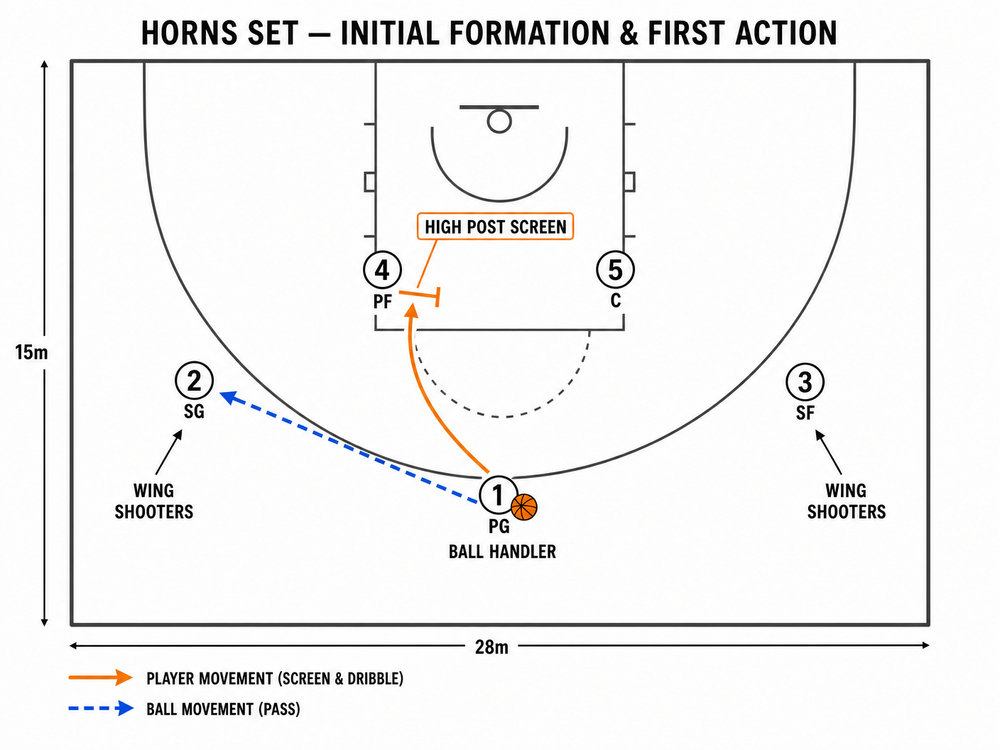
- 1 (Point Guard): Starts at the top of the key, near the free-throw line extended, handling the basketball.
- 2 (Shooting Guard): Positioned deep in the left corner, spacing the floor.
- 3 (Small Forward): Positioned deep in the right corner, spacing the floor.
- 4 (Power Forward): Positioned at the left elbow (high post).
- 5 (Center): Positioned at the right elbow (high post).
3. Step-by-Step Instructions
Step 1: The Initial Action
The play begins with the 1 (Point Guard) dribbling toward either the 4 or the 5 to initiate a high pick-and-roll. In this example, 4 steps out to set a solid screen for 1. 1 attacks the screen aggressively, forcing the defense to react.
Step 2: The Dribble Hand-Off (DHO)
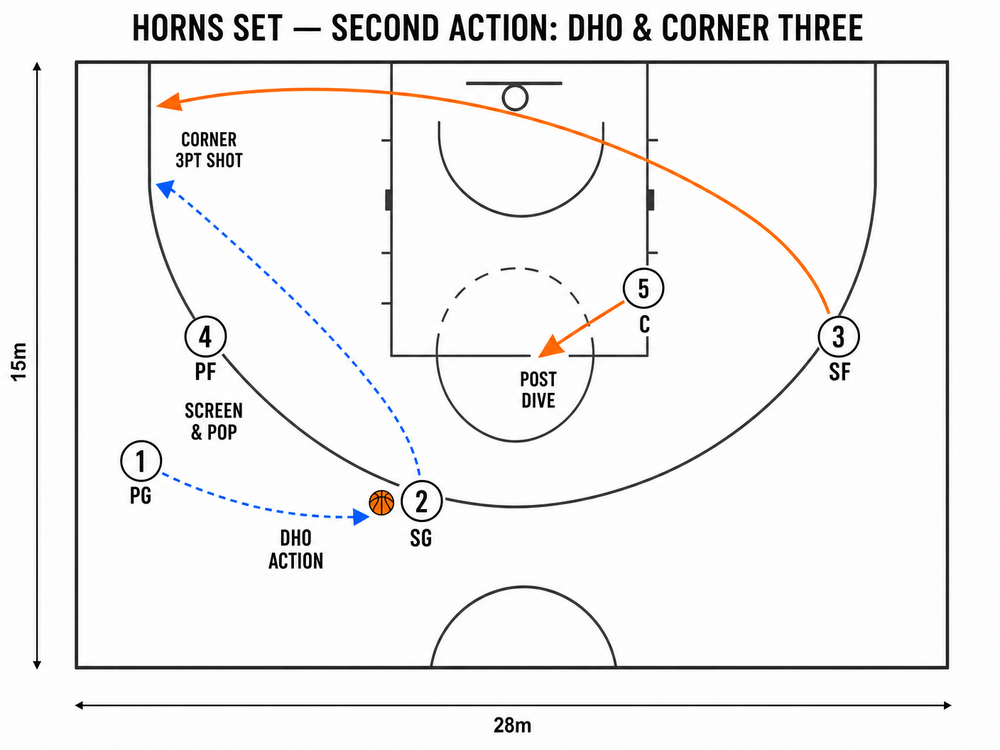
As 1 comes off the screen, 2 lifts from the left corner toward the wing area. 1 dribbles toward 2 and executes a precise dribble hand-off (DHO). Simultaneously, 4 pops out to the three-point line to maintain spacing, and 5 begins a hard dive toward the rim.
Step 3: The Weak-Side Action
While the DHO is occurring on the strong side, the weak-side action develops. 3, initially in the right corner, reads the defense. As 5 dives to the rim, drawing the attention of the interior defenders, 3 cuts hard along the baseline or lifts toward the wing/top of the key, depending on the defensive rotation.
Step 4: The Shot Creation
2, now possessing the ball after the DHO, evaluates the floor. If 2's defender goes under the DHO, 2 can immediately shoot the three-pointer. If the defense over-commits to 2, 2 looks to pass to the popping 4, the diving 5, or the relocating 3 for an open three-point attempt. The primary read in this variation is to hit the relocating 3 for the open shot.
4. Key Coaching Points
- Patience and Timing: The ball handler must wait for the screen to be fully set before attacking. Premature movement often leads to offensive fouls or ineffective screens.
- Aggressive Attack: The point guard must attack the screen with intent, forcing the screener's defender to commit. This is crucial for creating the initial advantage.
- Quality of the Screen: The screener must have a wide base and be stationary upon contact. The angle of the screen dictates the direction of the play.
- Spacing: The players in the corners must stay wide to stretch the defense. If they drift inward, they bring their defenders closer to the primary action, clogging the driving lanes.
- Reading the Defense: The player receiving the DHO must be able to read the defender's positioning instantly to decide whether to shoot, drive, or pass.
5. Common Mistakes
- Rushing the Action: Players executing the DHO too quickly, resulting in a fumbled exchange or a turnover.
- Poor Spacing: Corner players drifting toward the paint, allowing their defenders to help on the pick-and-roll or DHO action.
- Weak Screens: The high post players setting 'slip' screens too early instead of making solid contact, failing to force a defensive rotation.
- Telegraphing Passes: The ball handler staring down their intended target, allowing the defense to anticipate and intercept the pass.
6. Variations & Progressions
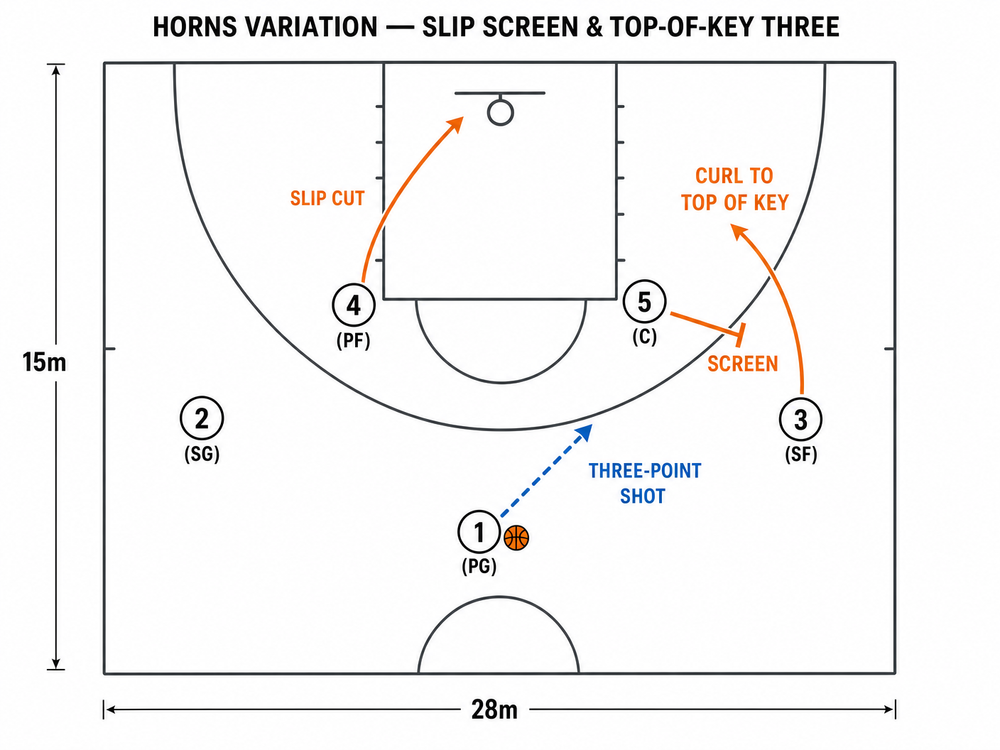
- Slip Screen: Instead of setting a solid screen, the high post player (4 or 5) fakes the screen and immediately slips to the basket. This is highly effective against teams that aggressively switch or hedge hard on ball screens.
- Double Screen (Staggered): Both 4 and 5 set staggered screens for the point guard, creating more confusion and requiring complex defensive communication.
- Horns Flare: After the initial screen, the screener receives a flare screen from the opposite high post player, creating an open shot on the weak side.
7. Age Adaptations
- Under 10/12: Focus heavily on the fundamental mechanics of setting and using a screen, as well as the execution of the dribble hand-off. Simplify the reads to just one or two options.
- Under 14/16: Introduce the concept of reading the defense. Teach the players how to react based on whether the defense switches, hedges, or drops.
- Open/Advanced: Implement complex variations like the slip screen or flare actions. Emphasize quick decision-making and precise execution at game speed.
