

Netball
The Iron Triangle: Defensive Zone Intercept Drill
Master the art of zone defence by teaching your players how to read the play, bait the pass, and execute the perfect flying intercept.
What you need
1 Netball, 4-6 marker cones, 2 sets of coloured bibs
1. Overview
Zone defence is a critical tactical element in modern Netball. Unlike one-on-one marking, a zone defence requires players to protect space, communicate seamlessly, and work as a unit to force errors or create intercept opportunities.
The Iron Triangle Defensive Zone Intercept Drill is designed to teach your defensive unit (typically WD, GD, and GK) how to set up a cohesive structure, dictate the attacking team's ball movement, and execute high-impact intercepts. By the end of this session, your players will understand how to 'bait' a pass—leaving just enough space to tempt the feeder—before driving hard to take the ball at full extension.
This drill is highly effective when preparing to face a team with a dominant holding shooter, as it disrupts the feed before it even reaches the goal circle.
2. Setup
Equipment Needed:
- 1 Netball
- 4-6 marker cones (optional, to mark the initial zone boundaries)
- 1 set of bibs for attackers (Red), 1 set for defenders (Blue)
Court Setup:
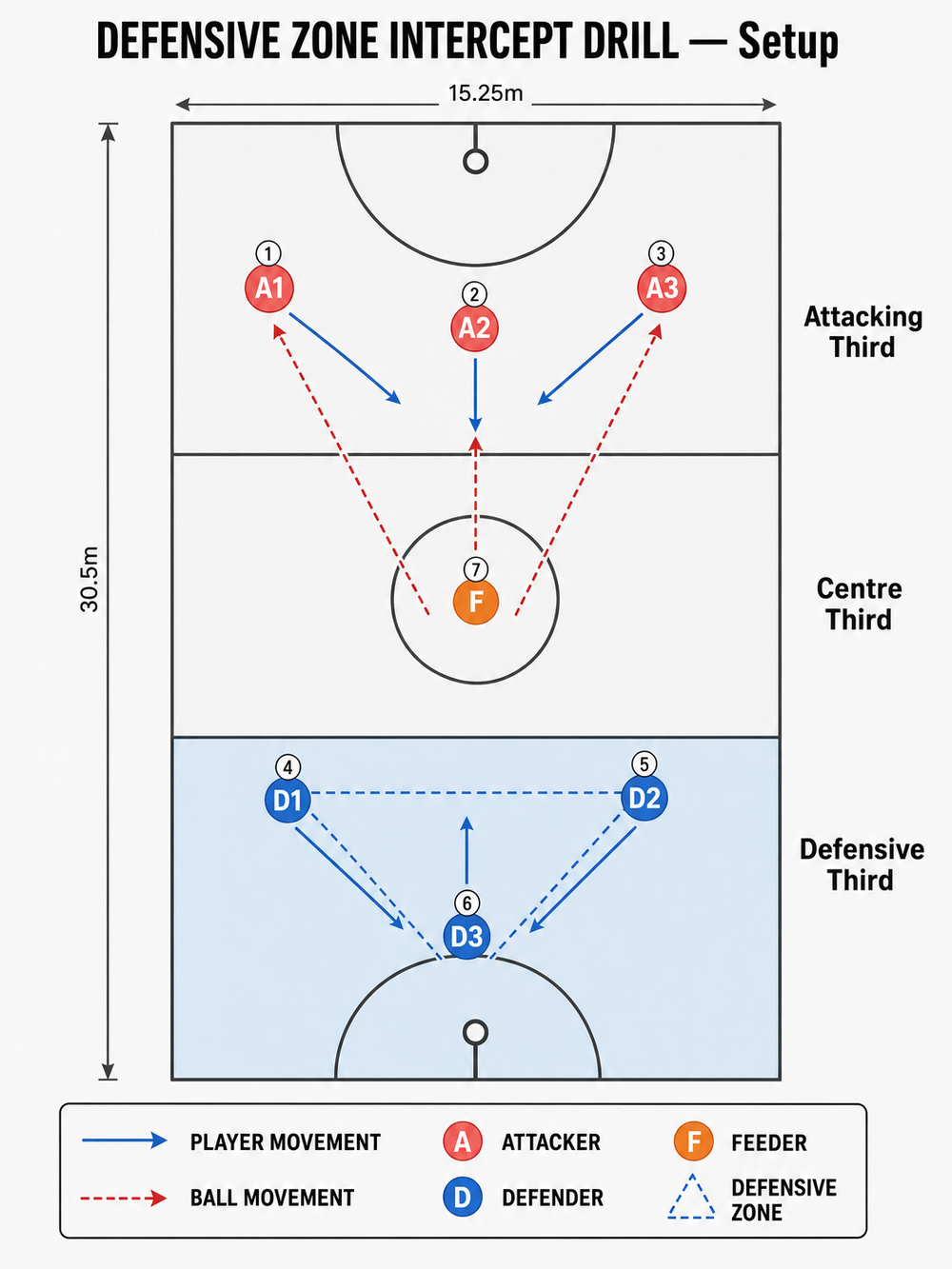
We will use the Centre Third and one Defensive Third of a standard 30.5m x 15.25m Netball court.
Player Positions:
- Defenders (Blue): 3 players (D1, D2, D3) setting up a triangular zone in the Defensive Third. D1 and D2 position themselves near the transverse line, while D3 drops back to protect the top of the goal circle.
- Attackers (Red): 3 players (A1, A2, A3) starting in the Attacking Third, looking to drive into the Centre Third to receive the ball.
- Feeder (Orange): 1 player (F) starting in the Centre Third with the ball.
3. Step-by-Step Instructions
- Initial Setup: The Feeder (F) starts with the ball in the middle of the Centre Third. The three Defenders (D1, D2, D3) establish their triangular zone just inside the Defensive Third, communicating their positions to ensure no gaps.
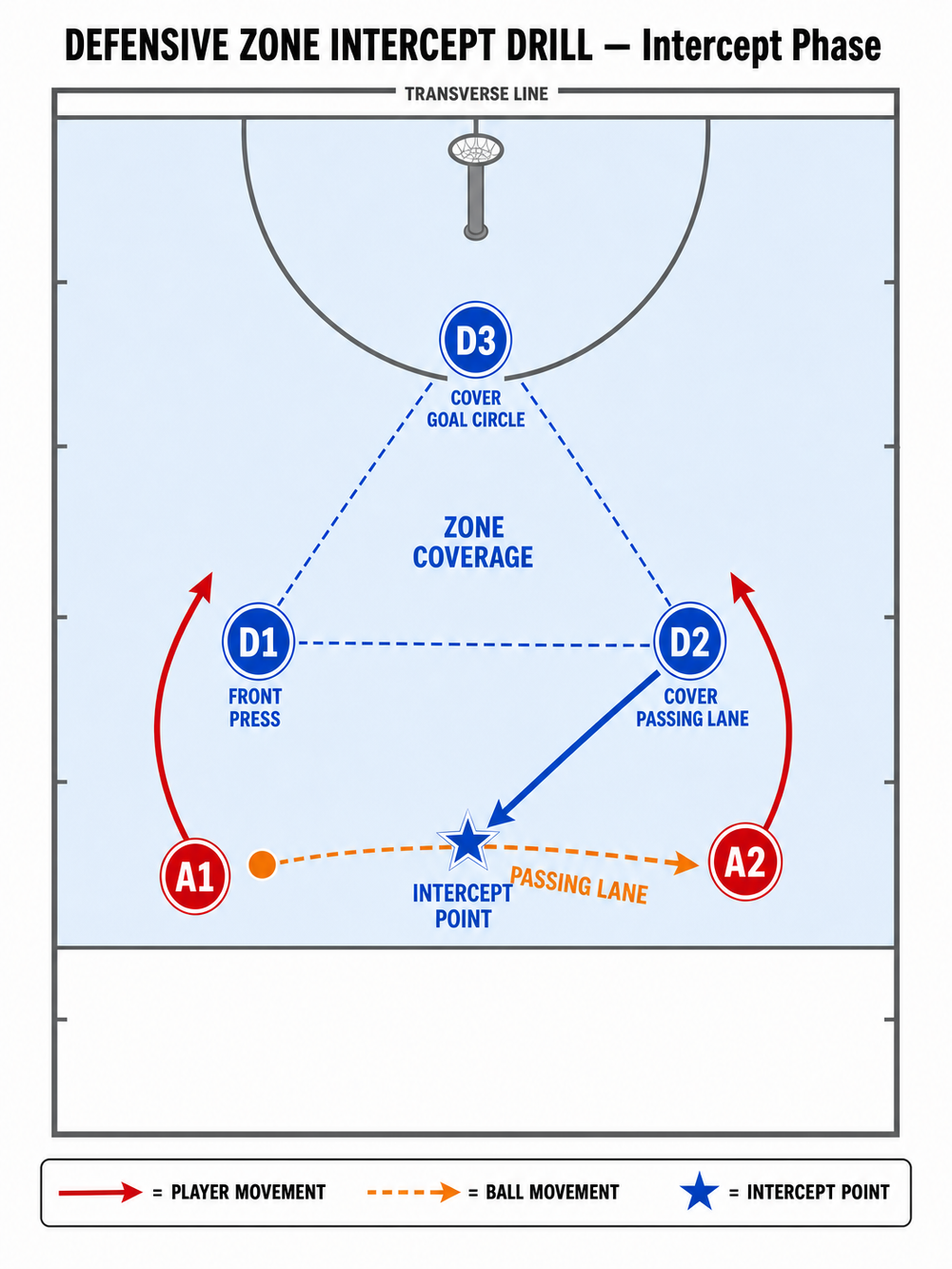
- The Drive: On the coach's whistle, Attackers A1 and A2 make dynamic, curved drives toward the transverse line, attempting to find open space to receive a pass from the Feeder.
- The Press: D1 steps up to apply front-pressing pressure on A1, forcing the Feeder to look for an alternative option.
- The Bait: D2 intentionally leaves a slight gap (the 'passing lane') between themselves and A2, tempting the Feeder to make a long, cross-court pass.
- The Intercept: As soon as the ball leaves the Feeder's hands, D2 explodes from their position, cutting across the passing lane to take a flying intercept before the ball reaches A2.
- The Reset: If the intercept is successful, the defenders quickly transition the ball back to the Feeder. If the pass is completed, the defenders must rapidly reset their zone to prevent a pass into the goal circle (where D3 is waiting).
4. Key Coaching Points
- Vision and Awareness: Defenders must maintain 'open body' positioning, allowing them to see both the player they are zoning and the player with the ball. Never turn your back on the feeder.
- Timing is Everything: The intercepting player must not move too early. If they commit before the ball is released, the feeder will simply choose another option. Wait for the ball to leave the hands.
- Explosive First Step: The drive for the intercept must be aggressive and at a 45-degree angle toward the ball, taking it at the highest possible point.
- Communication: The back player (D3) acts as the 'eyes' of the zone. They must constantly talk to D1 and D2, calling out attacking drives and shifting the triangle as needed.
- Landing and Recovery: After the intercept, the player must land cleanly (1-2 step) and immediately look for a safe clearing pass. If they miss the intercept, they must recover instantly to avoid leaving a gaping hole in the defence.
5. Common Mistakes
- Ball Watching: Defenders become fixated on the ball and lose track of the attackers moving through their zone, allowing easy back-door passes.
- Moving Too Early: The intercepting defender breaks from the zone before the pass is thrown, giving the feeder time to adjust and pass elsewhere.
- Flat Footing: Defenders stand flat-footed rather than on the balls of their feet, delaying their reaction time when the pass is finally made.
- Silent Defence: A lack of communication causes two defenders to commit to the same attacker, leaving another attacker completely unmarked.
6. Variations & Progressions
- Progression 1 (Add a Shooter): Introduce an Attacker inside the goal circle. The zone must now actively prevent the feed while D3 manages the holding shooter.
- Progression 2 (Continuous Play): Instead of resetting after one pass, allow the attackers to keep possession if the intercept fails. The defenders must maintain the zone structure for 3-4 consecutive passes before forcing an error.
- Variation 1 (The Trap): Instead of D2 taking the intercept, D1 and D2 force the pass wide, allowing D3 to come flying out of the circle for the intercept.
7. Age Adaptations
- Under 10s: Focus purely on the concept of 'protecting space' rather than individual marking. Use cones to define the zones clearly and allow them to intercept slow, lobbed passes.
- Under 14s: Introduce the concept of 'baiting' the pass. Emphasize footwork and the explosive 45-degree drive for the ball.
- Open/Seniors: Run the drill at high intensity with minimal reset time. Introduce complex attacking structures (e.g., screens and splits) to challenge the defensive unit's communication and adaptability.
