The 'Lightning Strike' Centre Pass Set Play
A fast, aggressive centre pass set play designed to bypass the transverse line defense and deliver the ball directly to the Goal Shooter in three quick passes.
Equipment Needed
1. Overview
The 'Lightning Strike' is an aggressive, high-tempo centre pass set play designed to catch the opposition's midcourt defense off-guard. Its primary objective is to move the ball from the centre circle to the goal circle edge in under three seconds, using rapid, pre-planned diagonal movements.
This play is highly effective against teams that employ a strong, flat zone defense across the transverse line. By using the Wing Attack (WA) to drag the defense to one side, it opens up a clear channel for the Goal Attack (GA) and Goal Shooter (GS) to exploit the opposite side of the court. Use this play when you need a quick momentum shift or when your standard centre passes are being bogged down by tight one-on-one marking.
2. Setup
Equipment Needed:
- 1 Netball
- Minimum 7 players (full team preferred for opposed practice)
- Training bibs
Court Setup & Player Positions:
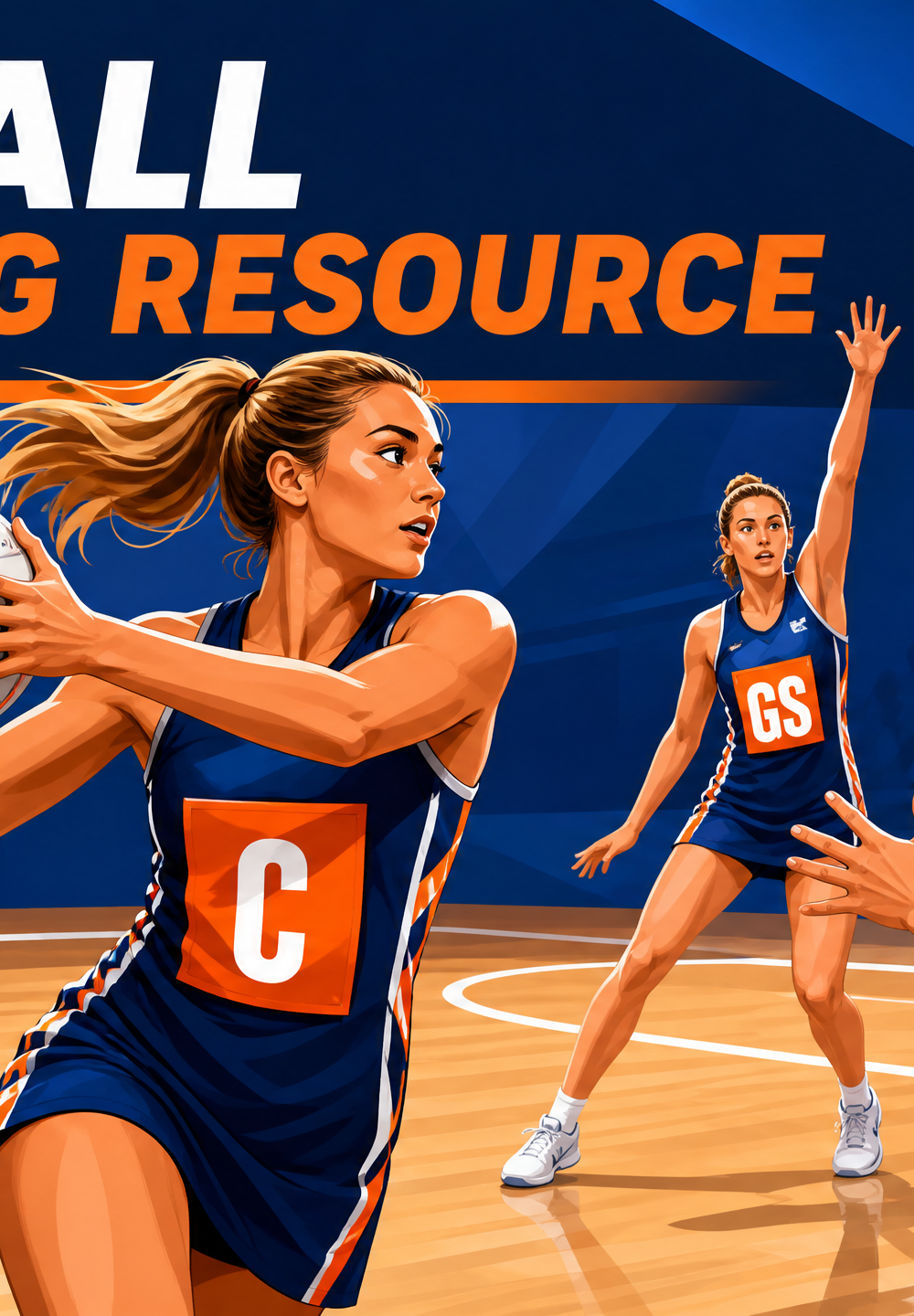
The setup relies on overloading the attacking structure to force the defense into a decision.
- Centre (C): Starts in the centre circle, holding the ball, ready to pass immediately on the whistle.
- Wing Attack (WA): Starts on the transverse line, slightly to the left side of the centre third.
- Goal Attack (GA): Starts wide on the right side of the transverse line, creating maximum width.
- Goal Shooter (GS): Positions themselves centrally, just inside the attacking third, ready to drop or hold.
- Defenders (WD, GD): Provide backup options in the defensive half.
3. Step-by-Step Instructions
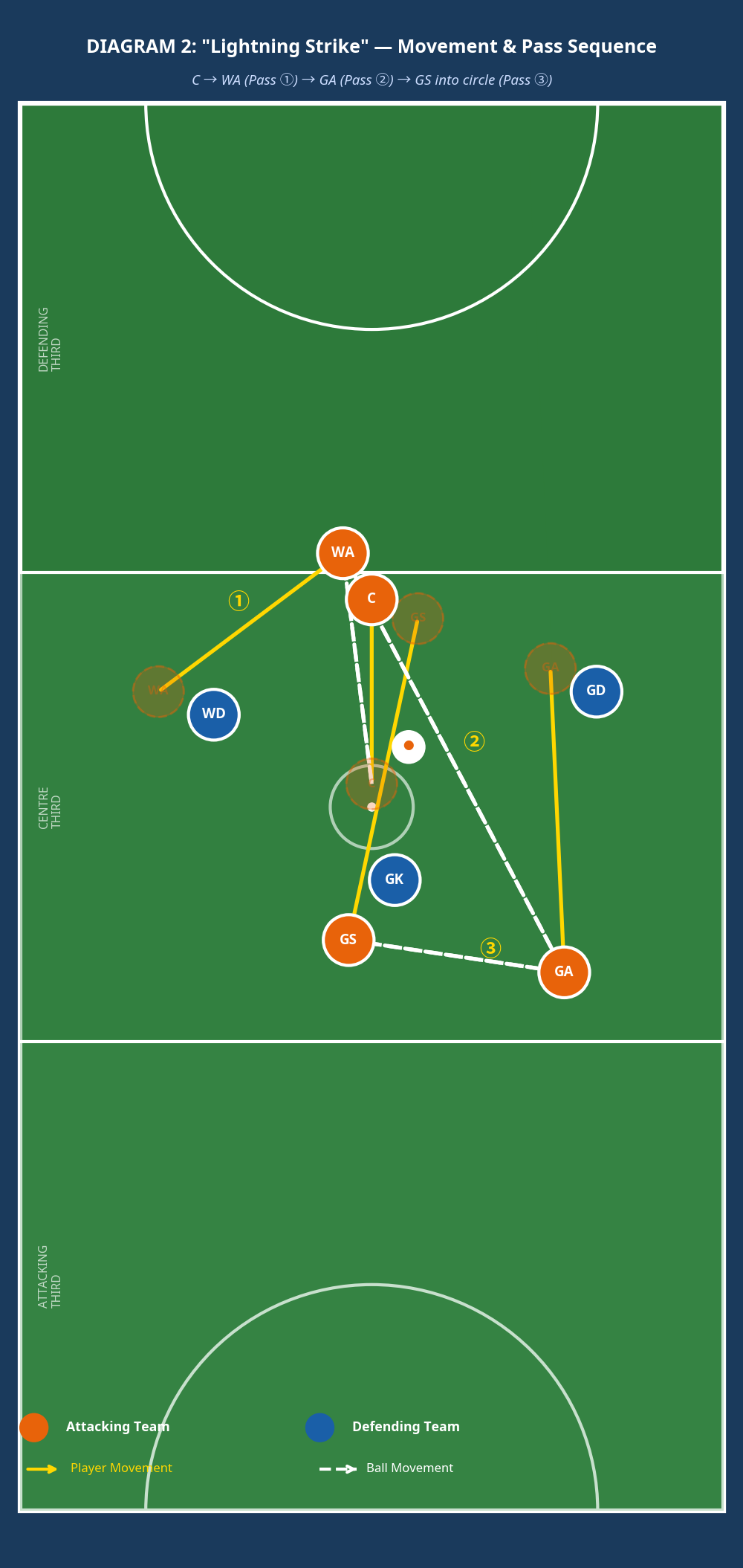
- The Trigger: On the umpire's whistle, the WA makes a hard, aggressive diagonal cut from the left side of the transverse line toward the middle of the centre third.
- Pass 1: The C immediately passes the ball to the WA hitting the top of the circle. The pass must be flat and fast.
- The Switch: As the ball is traveling to the WA, the GA drives hard from their wide right position, cutting diagonally inward toward the top of the goal circle.
- Pass 2: The WA receives the ball and, in one motion, turns and delivers a fast, flat pass to the driving GA.
- The Delivery: While the GA is receiving the ball, the C (who has followed their pass) drives down the middle to occupy the opposing WD. Simultaneously, the GS drops to the edge of the goal circle to receive the final pass.
- Pass 3: The GA lands, spots the GS, and delivers the ball into the shooting circle for a quick attempt on goal.
4. Key Coaching Points
- Timing is Everything: The WA must not cross the transverse line before the whistle. The GA must time their drive so they are hitting the space just as the WA receives the first pass.
- Flat, Hard Passes: Loopy or high passes will allow the defense time to recover. Emphasize strong shoulder passes or fast bounce passes.
- Eye Contact: The WA must have their head up and be looking for the GA before they even catch the ball.
- Decisive Movements: Players must commit 100% to their drives. Hesitation will collapse the play.
- Follow the Pass: The Centre must follow their initial pass to offer a reset option if the primary play breaks down.
5. Common Mistakes
- Breaking Early: Players crossing the transverse line before the whistle, resulting in a free pass to the opposition.
- Crowding the Space: The GA driving too early and arriving in the space before the WA has secured the ball, leading to a clustered midcourt.
- Telegraphing the Pass: The Centre staring directly at the WA before the whistle, allowing the defending WD to anticipate and intercept the first pass.
- Static Shooter: The GS remaining static in the circle rather than actively working to get front position or dropping to the circle edge.
6. Variations & Progressions
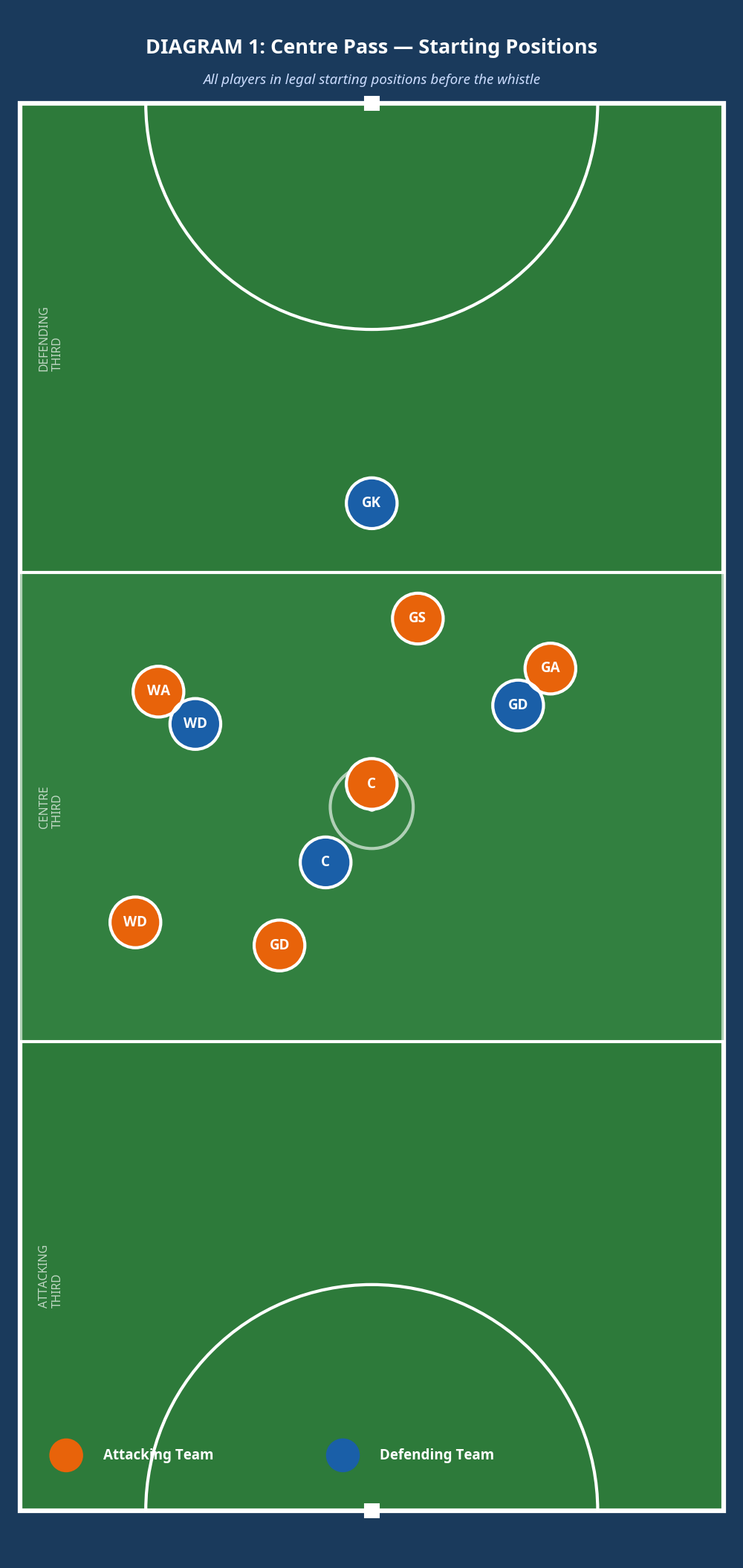
Variation: The "Overload Right" (Decoy & Screen)
If the defense catches onto the primary play, use the WA as a decoy.
- The WA drives hard left, dragging the defending WD with them.
- The C bypasses the WA entirely and passes directly to the GA who has cut sharply inside.
- The GS sets a screen on the GK, allowing the GA to deliver the ball to the GS who rolls off the screen along the baseline.
Progression: Opposed Pressure
Introduce passive defenders (arms down) to walk through the timing. Gradually increase the defensive pressure until the play is executed against a full, active defense.
7. Age Adaptations
- Under 10s: Focus purely on the timing of the first pass (C to WA). Simplify the secondary movements. Emphasize catching, pivoting, and looking before passing.
- Under 12s / Under 14s: Introduce the full three-pass sequence but allow slightly more time between passes. Focus on the quality of the drives and the accuracy of the passes.
- Under 16s / Open: Execute the play at full match speed. Demand high-intensity drives, flat passes, and split-second decision making. Introduce the variations to keep the defense guessing.