

Basketball
Mastering the 2-3 Zone Defense: Core Rotations and Slides
Teach your team the essential slides, bumps, and closeouts required to run an impenetrable 2-3 zone defense.
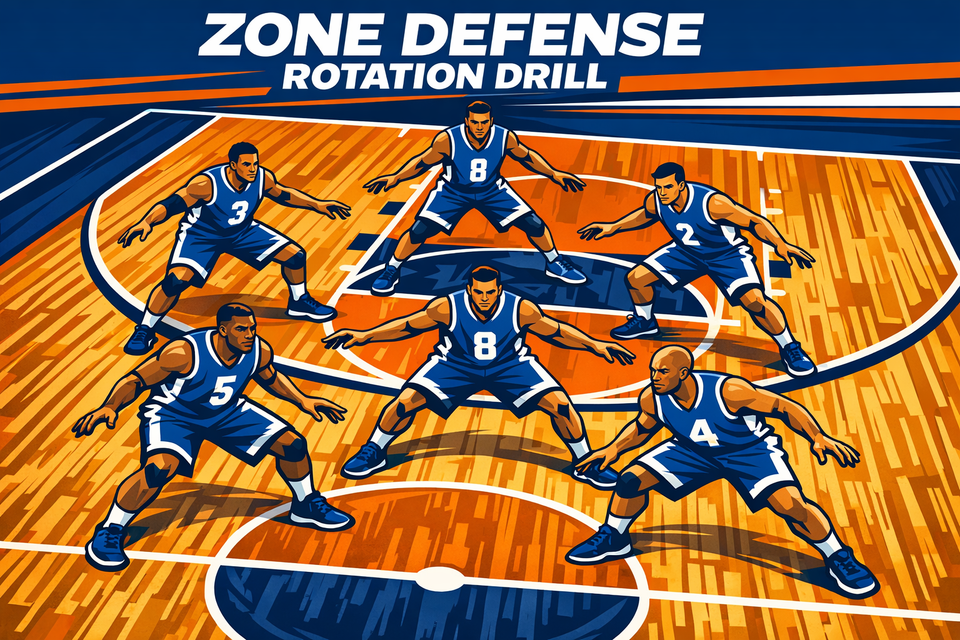
What you need
1 Basketball, Half-court
1. Overview
The 2-3 zone is one of the most fundamental and effective defensive schemes in basketball. However, a zone is only as strong as its weakest rotation. This drill is designed to teach players the precise slides, communication, and positioning required when the ball moves around the perimeter. It emphasizes moving as a single cohesive unit, protecting the paint, and executing high-hand closeouts without surrendering straight-line drives.
Use this drill early in the season to establish your zone rules, or as a mid-season refresher when defensive rotations become sluggish.
2. Setup
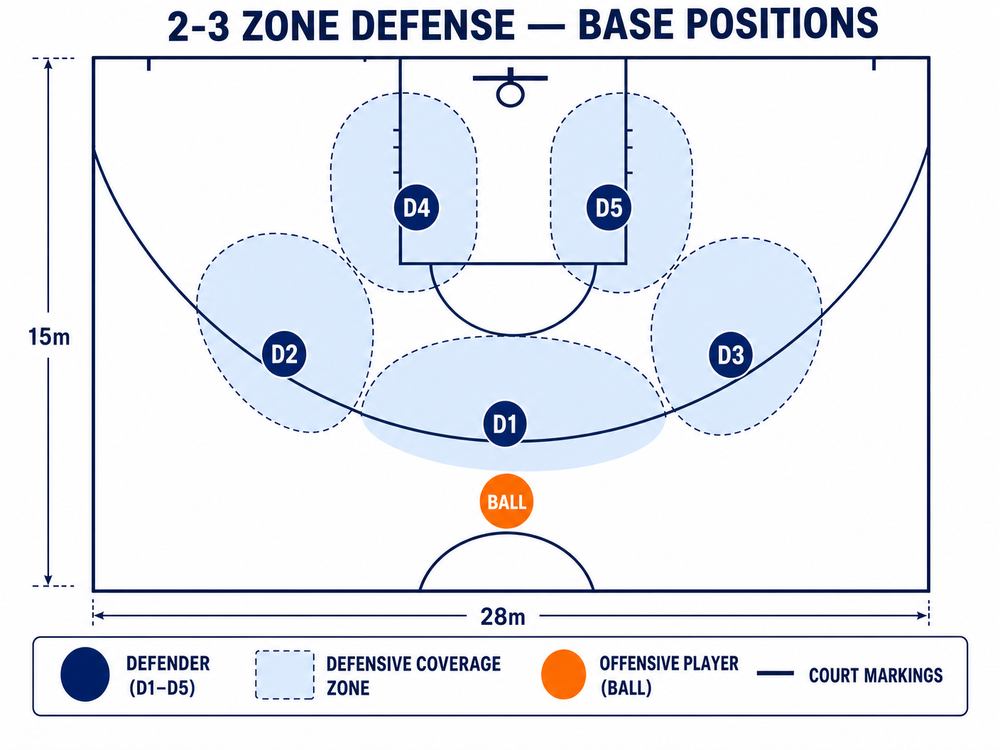
Court Dimensions: Half-court (standard FIBA 28m x 15m markings).
Players:
- 5 Defensive players (D1, D2, D3, D4, D5) starting in base 2-3 formation.
- 3 to 5 Offensive players (O1, O2, O3, etc.) positioned around the perimeter to pass the ball.
Equipment: 1 Basketball.
Base Positioning
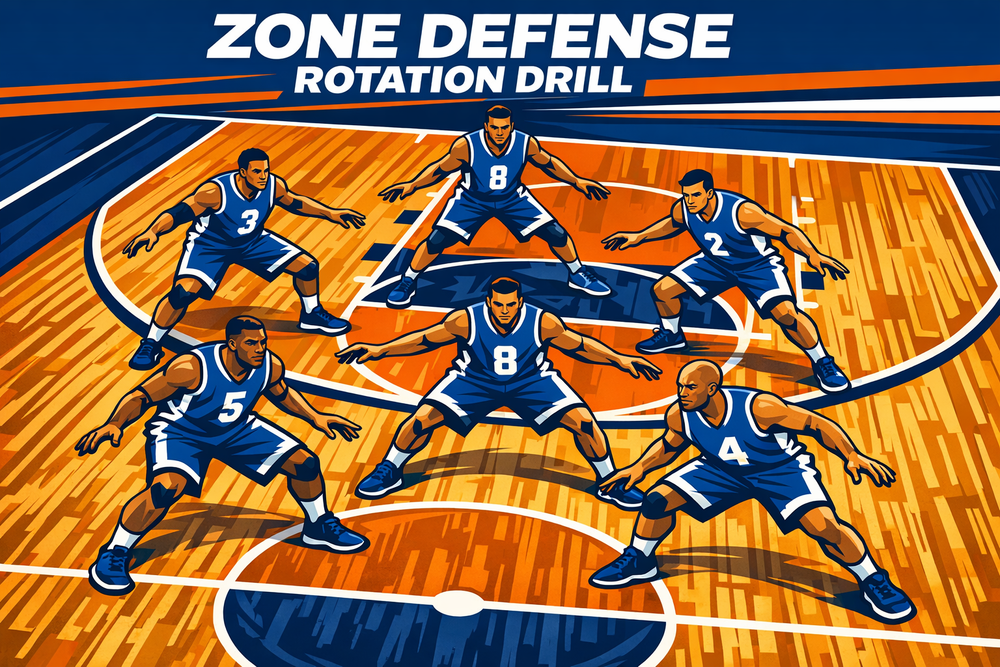
- D1 & D2 (Guards): Positioned at the top of the key/elbows. Responsible for the top of the arc and high post.
- D3 & D4 (Forwards): Positioned outside the lane blocks. Responsible for the wings and corners.
- D5 (Center): Positioned in the middle of the paint. The anchor of the defense, responsible for the low post and rim protection.
3. Step-by-Step Instructions
Step 1: Ball at the Top
- The drill begins with an offensive player holding the ball at the top of the key.
- D1 and D2 communicate to decide who takes the ball. Typically, the guard on the side of the ball handler's dominant hand steps up.
- The other guard drops slightly to cover the high post area.
- The backline (D3, D4, D5) remains compact, with D3 and D4 ready to close out on the wings.
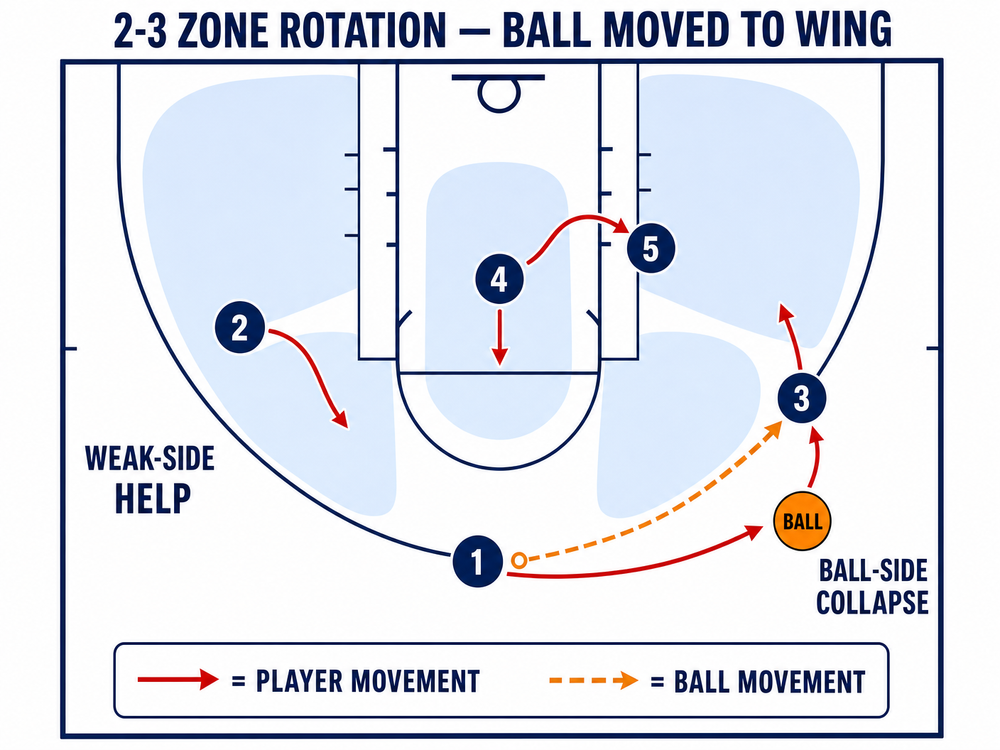
Step 2: Ball Passed to the Wing
- As the ball is passed to the right wing, D3 must execute a sprint-to-chop closeout, arriving with high hands to contest a shot while forcing the ball handler toward the baseline or middle (depending on your specific team rules).
- D1 sprints to the ball-side elbow to prevent middle penetration and deny the high post.
- D2 drops to the weak-side elbow/nail area, acting as help-side defense.
- D5 shifts to the strong-side block.
- D4 slides to the middle of the paint, directly under the rim, to protect against lob passes and weak-side cuts.
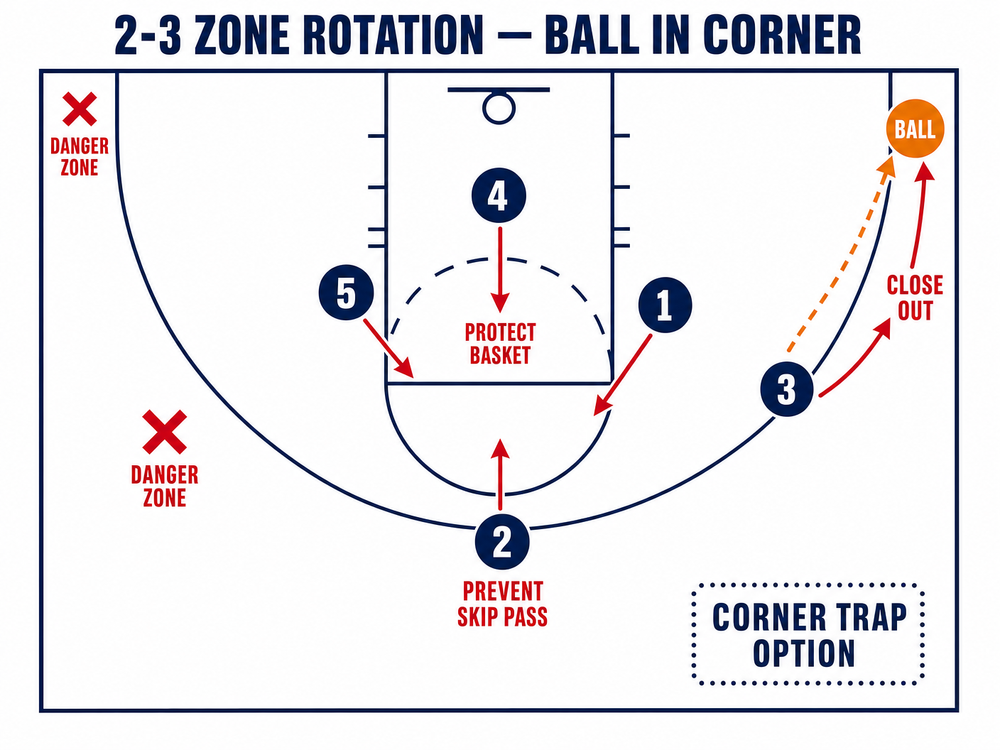
Step 3: Ball Passed to the Corner
- When the ball goes to the right corner, D3 (or D5, depending on your scheme—for this drill, D3 chases) closes out to the corner.
- D5 drops hard to the strong-side low block to front the post or prevent baseline drives.
- D4 remains anchored in the middle of the paint.
- D1 drops to the strong-side elbow.
- D2 shifts to the top of the key to prevent the quick skip pass to the weak-side wing.
Step 4: Reversal and Repetition
- The offense passes the ball back out to the wing, then to the top, and swings it to the left side.
- The defense must sprint back to their base positions and execute the mirrored rotations for the left side of the floor.
- Run the drill for 30-45 seconds per defensive group before rotating new players in.
4. Key Coaching Points
- "Ball in the Air, Feet in the Air": Defenders must move while the ball is in flight, not after it is caught. Arriving late breaks the zone.
- High Hands on Closeouts: The first two steps should be a sprint, the last two should be short, choppy steps with hands up to contest the shot and deter the immediate pass.
- Talk on Every Pass: The defense must be loud. Players should call out "Ball!", "Help!", "High Post!", and "Skip!" to keep the unit connected.
- Stick to the Bump: When the ball is reversed, players must "bump" their teammates back to their original zones to avoid two players guarding the same area.
- Protect the Paint First: The primary goal of the 2-3 zone is to force contested perimeter shots. Never sacrifice paint positioning for a gamble on the perimeter.
5. Common Mistakes
- Following the Ball Instead of the Zone: Players chasing the ball out of their designated area, leaving massive gaps in the defense.
- Flat-Footed Closeouts: Closing out with hands down or leaping past the offensive player, allowing easy straight-line drives.
- Losing Sight of the Weak Side: The weak-side forward (D4) drifting too far out, leaving the backside of the rim completely unprotected against lob passes or offensive rebounds.
- Silence: A quiet zone is a broken zone. Lack of communication leads to missed assignments on the high post and skip passes.
6. Variations & Progressions
- Skip Pass Drill: Force the offense to make skip passes (e.g., corner to opposite wing). The defense must execute "long closeouts" and scramble to re-establish the zone.
- Add Penetration: Allow the offense to take one or two dribbles to attack the gaps. The defense must practice stunting, recovering, and providing gap help without over-committing.
- Live Play: Transition the drill into 5v5 live play where the offense actively tries to score using ball screens and overload concepts against the zone.
7. Age Adaptations
- Under 10 / Under 12: Focus purely on the base positioning and the initial slide to the wing. Keep it simple: "When the ball moves, we all move." Emphasize staying between the ball and the basket.
- Under 14 / Under 16: Introduce the complexities of defending the high post and executing proper bumps on ball reversals. Demand loud communication.
- Open / Advanced: Incorporate trapping options (e.g., corner traps) and rapid closeouts on skip passes. Hold players strictly accountable for precise footwork and angle management.
