

Basketball
Mastering the 2-3 Zone: The 'String' Rotation Drill
A dynamic, high-repetition drill designed to build instinctive team defensive rotations, elite communication, and paint protection in a 2-3 zone.
What you need
1 Basketball, 5 Cones (optional), Half court (28m x 15m FIBA)
1. Overview
The 'String' Rotation Drill is a foundational defensive exercise designed to teach and refine the mechanics of a 2-3 zone defense. The core concept is that all five defensive players are connected by an invisible string; when the ball moves, the entire unit must shift together to maintain structural integrity. This drill focuses on rapid closeouts, protecting the paint, denying high-percentage passing lanes, and building the vocal communication necessary for an elite zone defense. Use this drill early in the season to establish zone rules, and revisit it regularly to sharpen rotation speed and defensive connectivity.
2. Setup
Equipment Needed:
- 1 Basketball
- 5 Cones or spots (optional, for marking offensive positions)
- Full or half court (28m x 15m FIBA dimensions)
Player Positions:
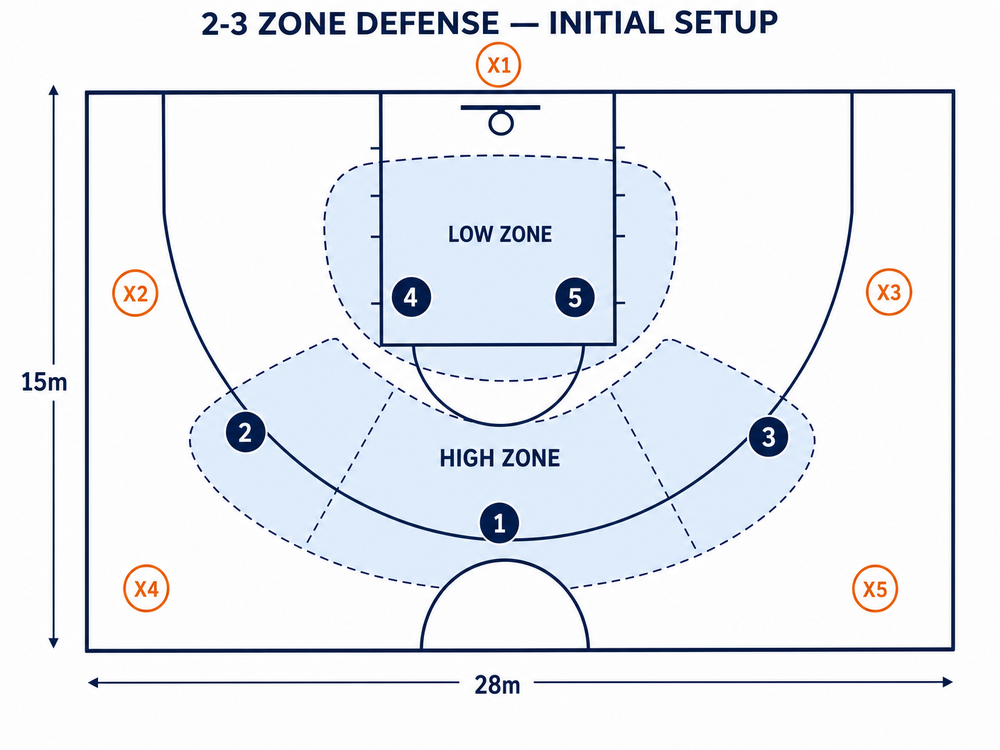
- Defense: 5 players in a standard 2-3 zone formation.
- Player 1 (PG) & Player 2 (SG) at the top (High Zone).
- Player 3 (SF), Player 4 (PF), & Player 5 (C) across the baseline/blocks (Low Zone).
- Offense: 5 players (or coaches) positioned around the perimeter (Top of key, both wings, both corners).
3. Step-by-Step Instructions
- Initial Alignment: Begin with the ball at the top of the key. The two top defenders (1 and 2) pinch the high post, while the three bottom defenders (3, 4, 5) protect the paint.
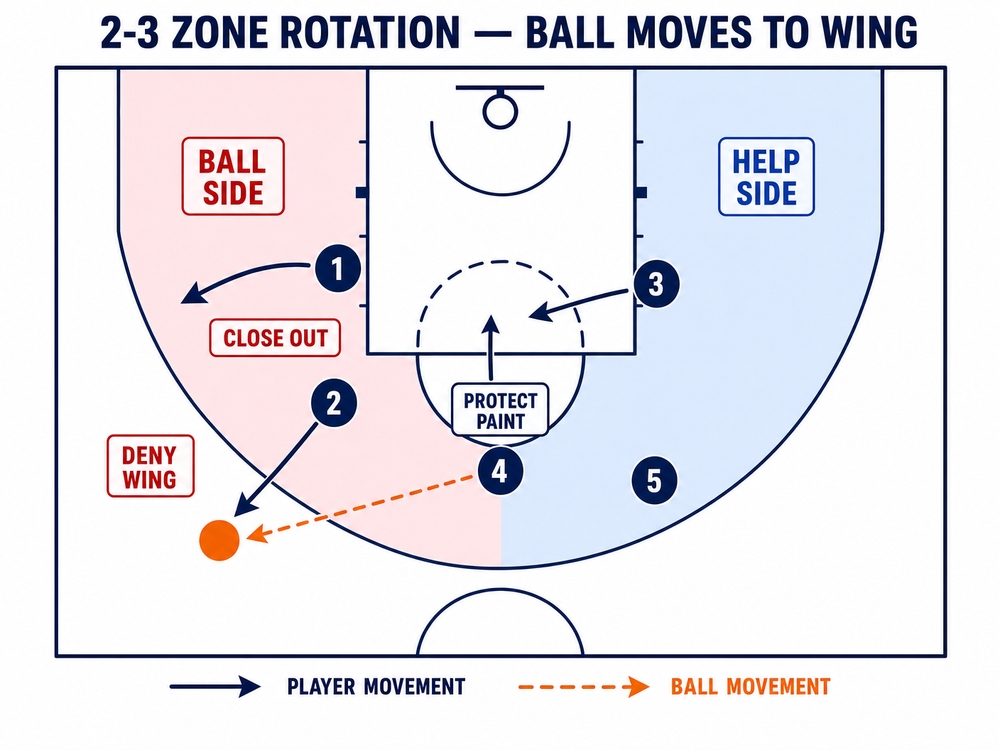
- Pass to the Wing: The offensive player at the top passes to the left wing.
- Rotation: Player 2 sprints to close out on the ball with high hands. Player 1 drops to the high post area to deny middle penetration. Player 4 slides up from the low block to front the post. Player 5 holds the middle of the paint. Player 3 drops to the weak-side block (help side).
- Pass to the Corner: The wing passes down to the left corner.
- Rotation: Player 4 sprints out to close out the corner, ensuring no baseline drive. Player 5 slides over to the strong-side block. Player 3 slides to the middle of the paint. Player 2 drops back slightly to deny the return pass to the wing. Player 1 drops further into the lane.
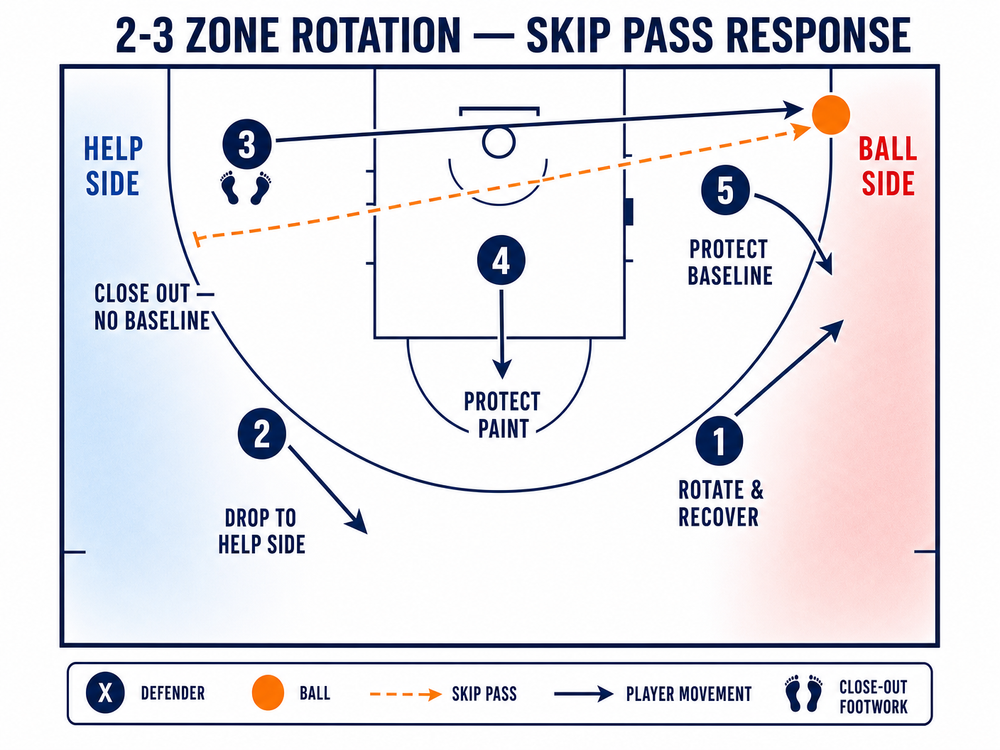
- Skip Pass Response: The corner player throws a skip pass across the court to the right wing.
- Rotation: This is the critical 'string' movement. Player 3 must sprint from the middle of the paint to close out the right wing. Player 5 sprints back to the middle of the paint. Player 4 sprints from the left corner back to the left block. Player 1 shifts to cover the high post on the right side. Player 2 drops to the weak-side high post.
- Continuous Movement: Continue moving the ball around the perimeter. The defense must rotate on the flight of the ball, arriving on the catch.
4. Key Coaching Points
- Move on the Flight of the Ball: Defenders must anticipate and move while the ball is in the air, not after it is caught. Arrive on the catch.
- High Hands on Closeouts: Close out with short, choppy steps and hands high to contest the shot and deter easy passes into the post.
- Loud, Constant Communication: Players must call out ball location ("Ball!", "Help!", "Dead!") and their rotations. Silence is the enemy of a good zone.
- Protect the Paint First: The primary goal of the 2-3 zone is to force contested outside shots. Never sacrifice paint positioning for a risky steal on the perimeter.
- No Baseline Drives: When closing out to the corner, the defender's top foot must be high to force the ball handler toward the middle where the help defense is waiting.
5. Common Mistakes
- Ball Watching: Defenders staring at the ball and losing track of offensive players cutting through their zone.
- Late Rotations: Reacting after the pass is caught, leading to open shots or driving lanes.
- Poor Closeout Technique: Flying past the shooter or closing out with hands down, allowing easy rhythm shots.
- Lack of Communication: Assuming teammates know where to go, resulting in two players guarding the ball or leaving a zone completely uncovered.
6. Variations & Progressions
- Progression 1: Live Offense: Allow the offense to attack the gaps, dribble penetrate, and look for scoring opportunities. The defense must rotate, stop penetration, and recover.
- Progression 2: Overload Concept: Put four offensive players on one side of the court to force the defense to adjust their standard rotations and communicate through the overload.
- Variation 1: Add a Shot Clock: Implement a 14-second or 24-second shot clock to simulate game pressure and force the defense to sustain their intensity for a full possession.
7. Age Adaptations
- Under 12: Focus heavily on the basic initial setup and the first rotation (pass to the wing). Emphasize moving together and shouting "Ball!". Keep the ball movement slow and predictable.
- Under 14: Introduce the skip pass rotation. Demand faster closeouts and proper footwork. Start introducing the concept of bumping cutters.
- Under 16 & Open: Run the drill at full game speed. Introduce complex offensive actions (screens against the zone, flash cuts) and demand elite, proactive communication.
