

Football
Mastering the Back-Four Offside Trap: A Comprehensive Drill
Equip your back four with the timing, communication, and synchronization needed to execute a flawless offside trap and catch attackers off guard.

What you need
1 full-size goal, 10-12 marker cones, 5-6 footballs, training bibs (two colours)
1. Overview
The back-four offside trap is a high-risk, high-reward defensive tactic designed to catch opposing attackers offside by abruptly moving the defensive line forward just before the ball is played. When executed correctly, it neutralizes through balls and disrupts the opponent's attacking rhythm. This drill focuses on the synchronization, communication, and trigger recognition required for a flat back four to step up as a cohesive unit.
2. Setup
- Pitch Dimensions: Use a standard half-pitch (approximately 50m x 70m).

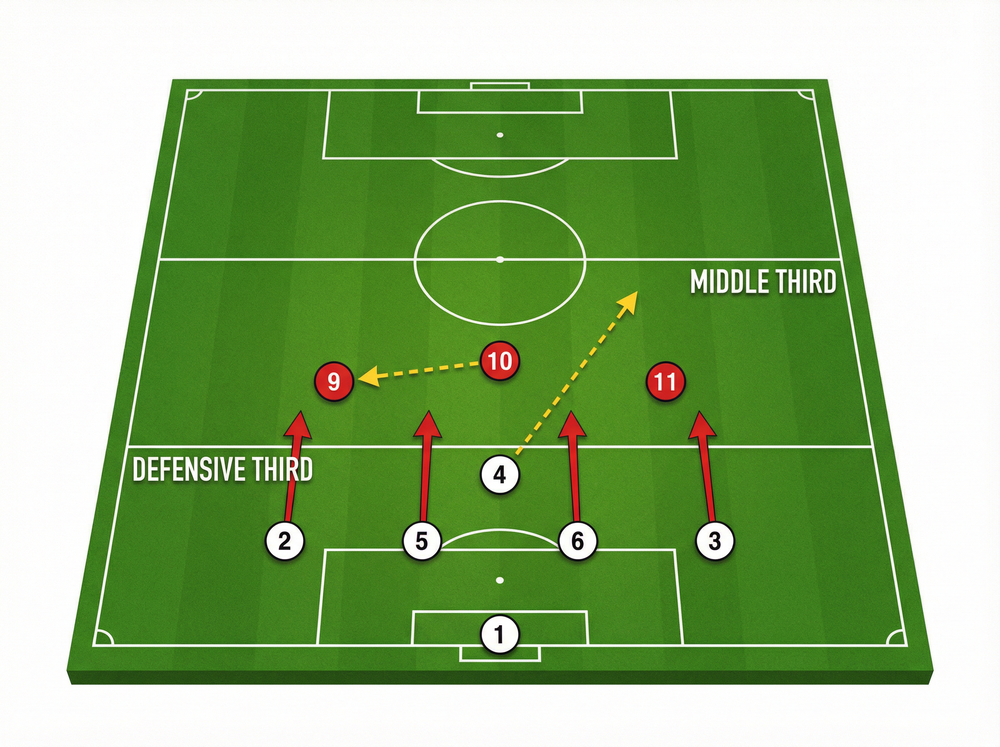
- Players Required: 11 players (1 Goalkeeper, 4 Defenders, 1 Defensive Midfielder, 3 Attackers, 2 Central Midfielders for the attacking team).
- Equipment: 1 full-size goal, 10-12 marker cones, 5-6 footballs, and training bibs (two colours).
- Positions:
- Defensive Team: GK (1), RB (2), RCB (5), LCB (6), LB (3), CDM (4).
- Attacking Team: ST (9), CAM (10), RW (11), LW (7), CM (8).
3. Step-by-Step Instructions
- Initial Positioning: Set the defensive back four in a flat line approximately 30-35 metres from the goal. The defensive midfielder sits just in front of them to screen passes.

- Attacking Build-up: The attacking team starts with the ball near the halfway line. The central midfielders circulate the ball, looking for an opportunity to play a through ball to the strikers or wingers.
- Trigger Recognition: The defensive line must read the body language of the player on the ball. The primary trigger to step up is when the attacking player lowers their head and pulls their leg back to play a long pass or through ball.
- The Call: The designated leader of the defensive line (usually one of the centre-backs, 5 or 6) shouts a clear, pre-agreed command such as "STEP!" or "UP!".
- Synchronized Step-Up: Upon the command, all four defenders must sprint forward 2-3 metres simultaneously in a straight line, leaving the attackers in an offside position.
- Goalkeeper Sweeping: The goalkeeper must anticipate the play and start in a high starting position (near the penalty spot) to act as a sweeper-keeper in case the trap fails or the ball is played over the top.
- Reset and Repeat: After each sequence, whether successful or not, reset the defensive line quickly to the starting position.

4. Key Coaching Points
- Visual Cues: Defenders must keep their eyes on the ball carrier, not just the runners. The trigger is the passer's body mechanics.

- Vocal Leadership: A single, authoritative voice must dictate the movement. Hesitation or conflicting calls will break the line.
- Body Shape: Defenders should adopt a side-on body stance. This allows them to quickly drop back if the trap cannot be executed or step forward explosively.
- Compactness: The distance between the full-backs and centre-backs must remain tight (no more than 8-10 metres) to prevent gaps from being exploited if the trap is beaten.
- Pressure on the Ball: The offside trap is most effective when there is pressure on the ball carrier. The defensive midfielder must actively press to force rushed passes.
5. Common Mistakes
- Staggered Line: One defender dropping deeper than the rest (often a full-back on the weak side) plays the attackers onside.

- Late Stepping: Stepping up after the ball has already been kicked, which is too late and allows the attacker a free run at goal.
- Ignoring the Sweeper-Keeper: The goalkeeper staying rooted to the goal line instead of sweeping behind the high defensive line.
- Overuse: Attempting the trap on every single attack makes it predictable. It should be used selectively.
6. Variations & Progressions
- Add Wide Threats: Introduce wide midfielders for the attacking team to practice trapping against diagonal runs from the flanks.
- Passive to Active Pressure: Start with passive attackers to allow the defense to master the timing, then progress to full-speed, match-realistic scenarios.
- Transition to Attack: If the trap is successful and the ball is turned over, require the defensive team to complete three passes to transition into an attacking phase.
7. Age Adaptations
- Under-12: Focus purely on maintaining a flat line and basic communication. Introduce the concept of offside without the aggressive step-up.
- Under-14: Begin teaching the trigger cues (head down, leg back) and practice the synchronized step-up at a jogging pace.
- Under-16 and Open: Implement full-speed drills with complex attacking movements. Emphasize the sweeper-keeper role and recovery runs if the trap fails.
