

Football
Mastering the Back-Four Offside Trap: Synchronization and Timing
Teach your defensive line how to execute a perfectly timed offside trap to catch attackers off guard and compress the playing space.

What you need
1 full-size goal, 10-12 cones or flat markers, 8-10 footballs, Bibs (2 colors)
1. Overview
The offside trap is a high-risk, high-reward defensive maneuver that requires impeccable timing, communication, and synchronization from your back four. When executed correctly, it immediately neutralizes an opponent's attack by catching their forwards in an offside position, while simultaneously compressing the space in the midfield. This drill is designed to train the defensive line to recognize the specific visual cues—the 'triggers'—that indicate when to step up as a cohesive unit. It is particularly effective for teams that prefer to play with a high defensive line and press aggressively. By practicing this drill, coaches can ensure their defenders act instinctively and as a single entity when the moment arises.
2. Setup

Pitch Dimensions: Utilize a standard half-pitch setup, approximately 50-55 meters in length and 64-75 meters in width, utilizing the penalty area and extending to the halfway line.
Equipment:
- 1 full-size goal.
- 10-12 cones or flat markers to delineate the starting offside line and reference points.
- A supply of 8-10 footballs positioned with the coach/server.
- Bibs for attackers (e.g., blue) and defenders (e.g., red).
Player Positions:
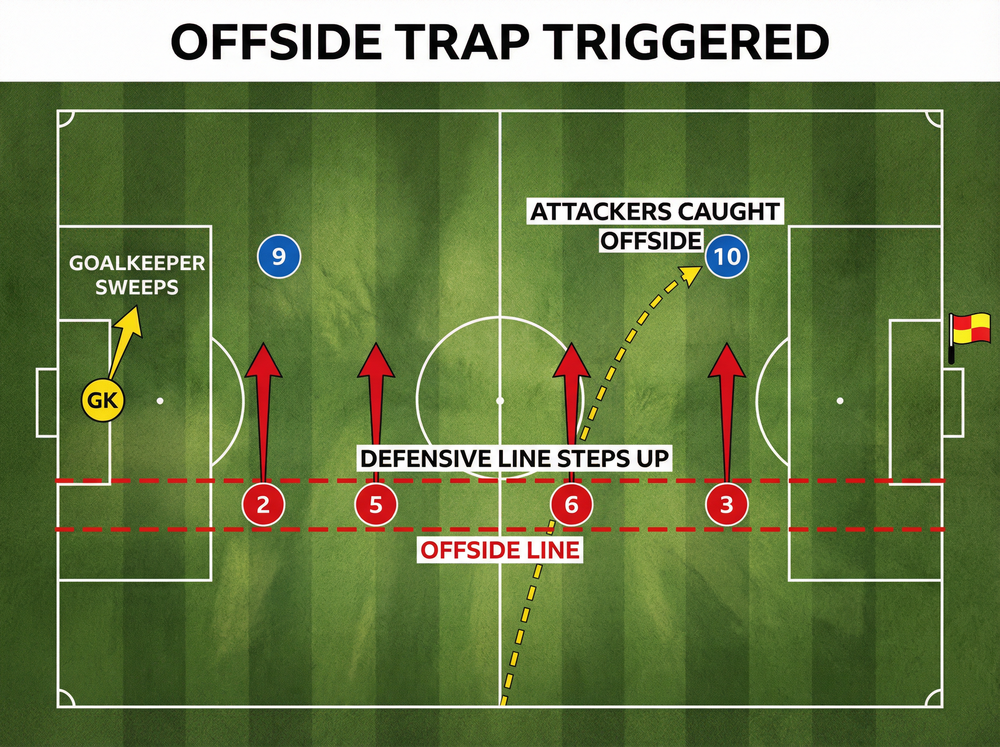
- Defenders: Place your starting back four (numbered 2, 5, 6, 3) in a flat, compact line approximately 35 meters from the goal line. They should be spaced evenly, maintaining good distances between the fullbacks and center-backs.
- Attackers: Position 2-3 attacking players (numbered 9, 10) roughly 5 meters ahead of the defensive line, actively looking to make runs in behind.
- Server/Coach: Position yourself (marked 'C') in a central or slightly wide midfield area with the supply of footballs, acting as the opposition playmaker.
- Goalkeeper: Position the goalkeeper (GK) at the edge of the 6-yard box or slightly higher, ready to act as a sweeper-keeper if the trap fails.

3. Step-by-Step Instructions

- The Starting Phase: The drill begins with the coach (C) in possession of the ball in the midfield area. The attackers (9, 10) make subtle movements, trying to pull the defenders out of position. The defensive line (2, 5, 6, 3) must maintain a perfectly flat shape, constantly scanning the ball and the attackers.
- Identifying the Trigger: The key to the trap is recognizing the trigger. This occurs when the coach puts their head down to play a long pass, or when an attacker makes a pronounced, early run before the ball is played. The designated leader of the defense (usually one of the center-backs, 5 or 6) must identify this cue.
- The Call and the Step: Upon recognizing the trigger, the defensive leader shouts a clear, pre-agreed command (e.g., 'STEP!', 'UP!', or 'OUT!'). Instantly, all four defenders must step forward aggressively and simultaneously, moving up 8-10 meters in a straight line.
- Catching the Attackers: As the defenders step up, the coach plays the ball over the top or through the lines. If timed correctly, the attackers will be caught behind the newly established defensive line when the ball is played, rendering them offside.
- The Goalkeeper's Role: If the trap is sprung too late or an attacker breaks through from an onside position, the goalkeeper must be prepared to rush out and sweep the ball clear.
4. Key Coaching Points

- Clear Communication: The trigger command must be loud, decisive, and initiated by a single, designated leader to avoid confusion.
- Absolute Synchronization: The entire back four must move as one entity. A single player lagging behind or dropping deep will play the attackers onside and destroy the trap.
- Body Shape and Readiness: Defenders should be on their toes, with their body shape slightly open, ready to sprint forward instantly upon hearing the command.
- Reading the Cues: Train defenders to watch the server's body language—head down, leg drawn back—rather than just reacting to the ball leaving the foot.
- Goalkeeper Integration: The goalkeeper must maintain a high starting position and be vocal, acting as the ultimate safety net if the trap is breached.
5. Common Mistakes

- Hesitation: Defenders waiting a fraction of a second too long after the call, allowing the attacker to stay onside.
- Uneven Line: One fullback dropping deeper than the rest of the line, creating an onside pocket for the attackers to exploit.
- Ignoring the Ball: Defenders focusing solely on the attackers and missing the visual cues from the player on the ball, leading to poor timing.
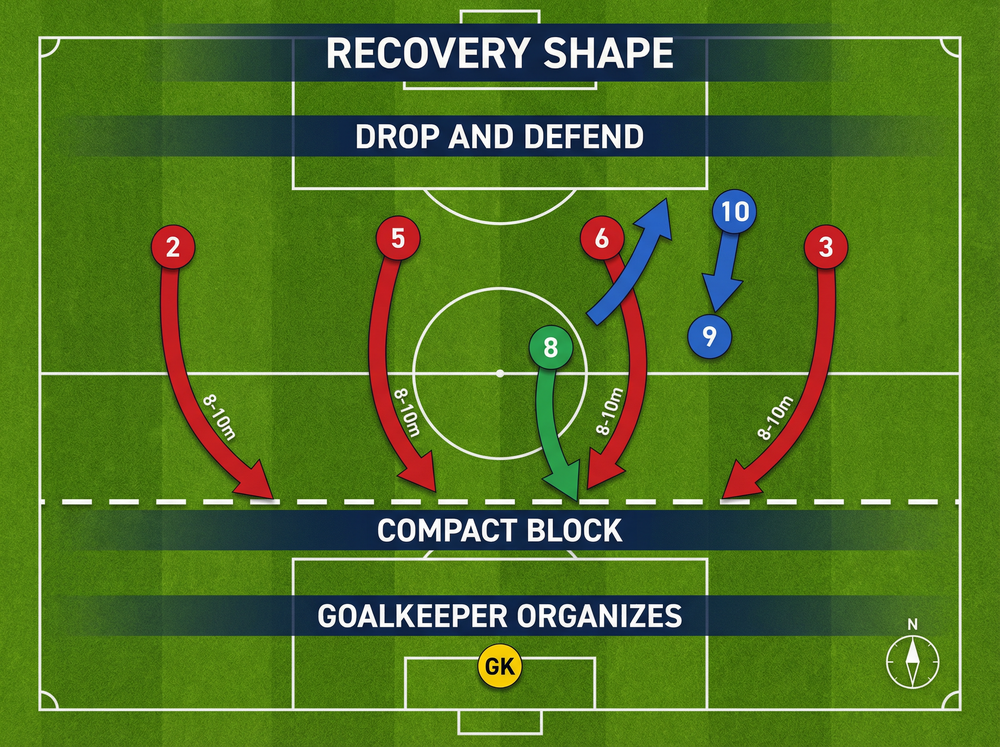
- Lack of Recovery: If the trap fails and the attacker is onside, defenders failing to immediately drop and sprint back toward their own goal.
6. Variations & Progressions

- Progression 1: Active Midfielders: Introduce 2-3 opposition midfielders who can pass among themselves before attempting the through ball. This forces the defense to constantly adjust their line and identify the trigger in a more dynamic, game-like scenario.
- Progression 2: Wide Deliveries: Move the server to the flanks to practice springing the trap against early crosses or diagonal balls from wide areas.
- Variation: The 'Drop and Step': Have the defense initially drop 5 meters as the ball is circulated, then aggressively step up 10 meters when the trigger is identified, creating a more pronounced trap.
7. Age Adaptations

- Under-12: Focus heavily on the basic concept of maintaining a flat line and moving together on a simple command. Do not overcomplicate with complex triggers; use a whistle or a simple hand signal from the coach.
- Under-14/16: Introduce the concept of reading the server's body language. Practice the trap against active attackers making varied runs. Emphasize the role of the defensive leader in making the call.
- Open/Senior: Run the drill at full match intensity with a complete midfield in front of the back four. The trap must be instantaneous and flawless, with the goalkeeper fully integrated as a sweeper.
