

Netball
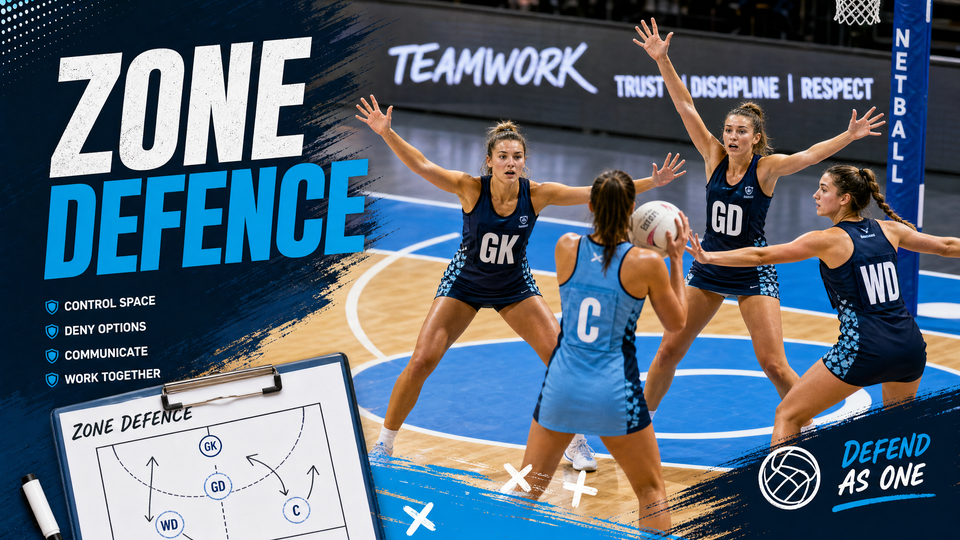
Mastering the Box Zone Defence: Controlling the Goal Third
Learn how to implement a suffocating box zone defence in the goal third to force errors, deny passing lanes, and create high-percentage interception opportunities.
What you need
Standard netball court, Netballs, Bibs (2 contrasting colours), Cones (optional)
1. Overview
The Box Zone Defence is a structured defensive set play designed to disrupt the opposition's attacking rhythm as they transition the ball into their goal third. Unlike traditional one-on-one (man-to-man) marking, this system requires players to defend specific areas of the court (zones) rather than tracking individual opponents.
This strategy is particularly effective against teams with a dominant holding shooter or a fast, direct feeding style. By setting up a coordinated defensive wall, your team can dictate where the ball goes, force the attackers into wide, low-percentage areas, and create predictable passes that are ripe for interception.
2. Setup
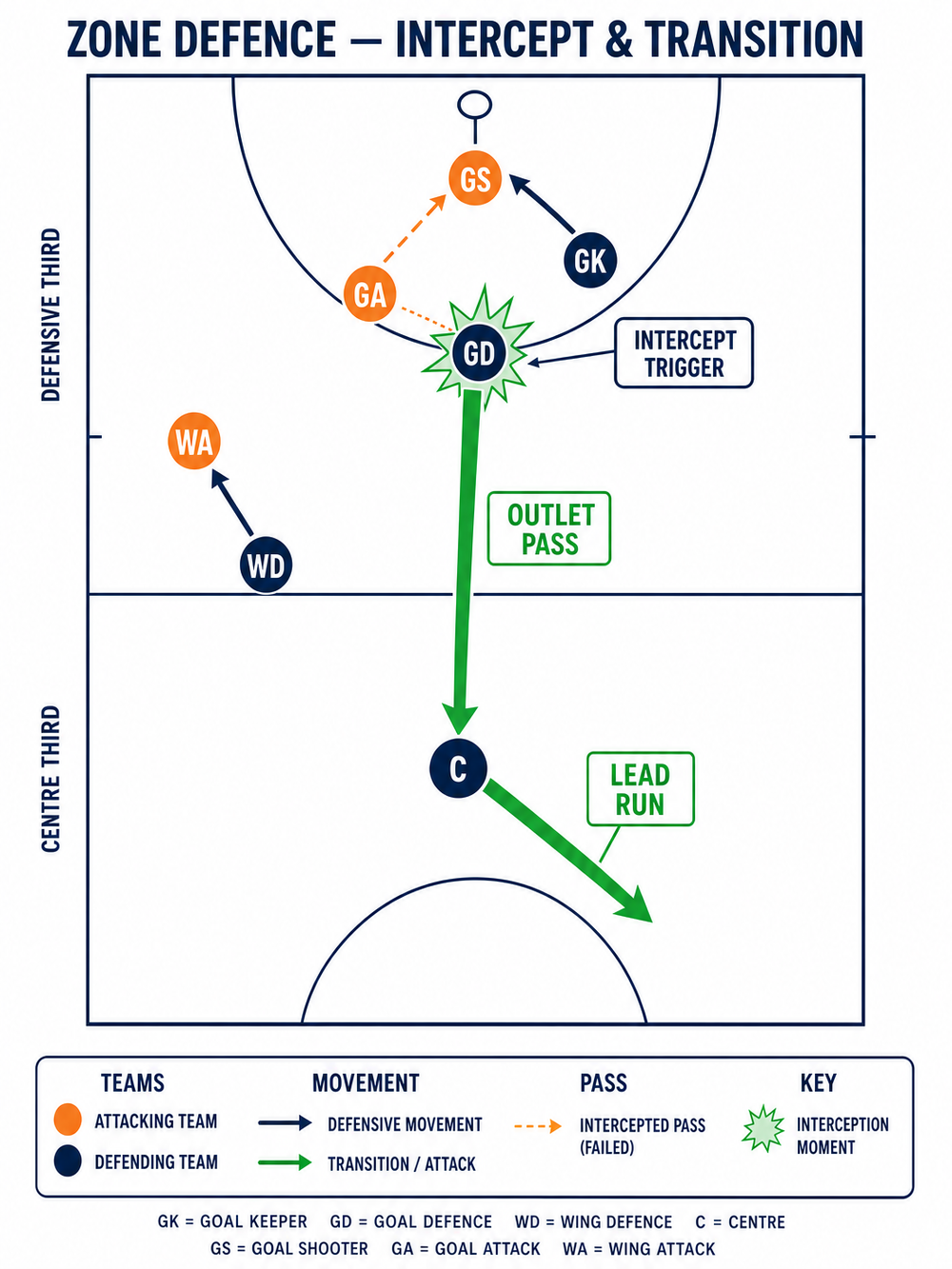
Court Area: Defensive Goal Third and Centre Third.
Players Involved: Goal Keeper (GK), Goal Defence (GD), Wing Defence (WD), and Centre (C).
Equipment Needed:
- Standard netball court (30.5m x 15.25m)
- Netballs (1 per group)
- Bibs for two teams (Attack vs Defence)
- Cones (optional, for marking zone boundaries during early learning phases)
Initial Positioning:
As the ball crosses the transverse line into the centre third, the defensive unit must quickly drop back and establish the 'box' formation.
- GK: Drops deep, positioning slightly in front of the goal post to protect the baseline and back space.
- GD: Sets up at the top of the shooting circle (4.9m radius), anchoring the front of the zone.
- WD: Positions on the left side of the defensive third, covering the channel between the transverse line and the circle edge.
- C: Positions on the right side of the defensive third, mirroring the WD.
3. Step-by-Step Instructions
Implementing the zone requires precise timing, communication, and collective movement. Follow these steps to execute the play:
Step 1: The Drop and Set
As soon as possession is lost or a centre pass is taken by the opposition, the GK, GD, WD, and C must immediately sprint back into the defensive third. Do not get caught ball-watching. Establish the box formation before the ball reaches the transverse line.
Step 2: Dictating the First Pass
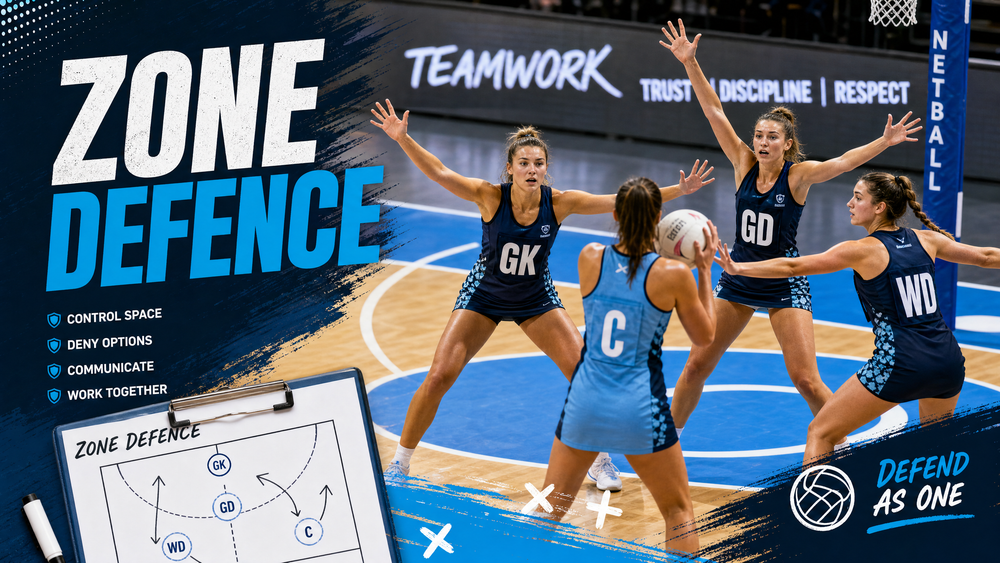
The objective is to deny easy passes through the middle corridor. The GD, WD, and C must hold their ground, arms up (maintaining the 0.9m distance), forcing the attackers to pass the ball wide to the sidelines.
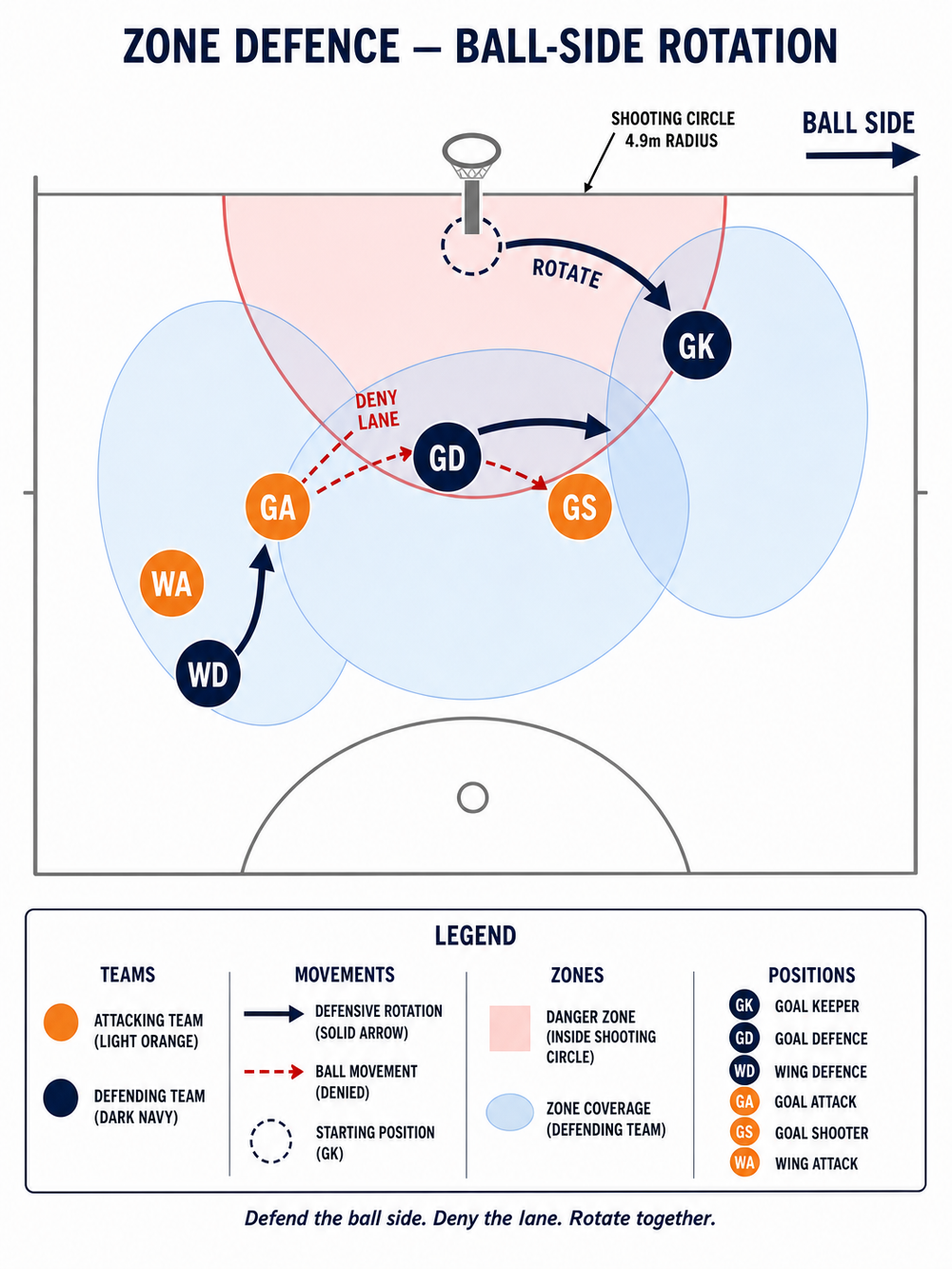
Step 3: Ball-Side Shift (The Slide)
Once the ball is forced wide, the entire defensive unit must shift collectively toward the ball side.
- If the ball goes to the right sideline, the C steps up to apply pressure on the ball carrier.
- The GD slides across to deny the pass into the top of the circle.
- The GK shifts to cover the front space of the shooter on the ball side.
- The WD drops slightly and shifts centrally to cover the weak side and intercept any cross-court passes.
Step 4: The Trap and Intercept
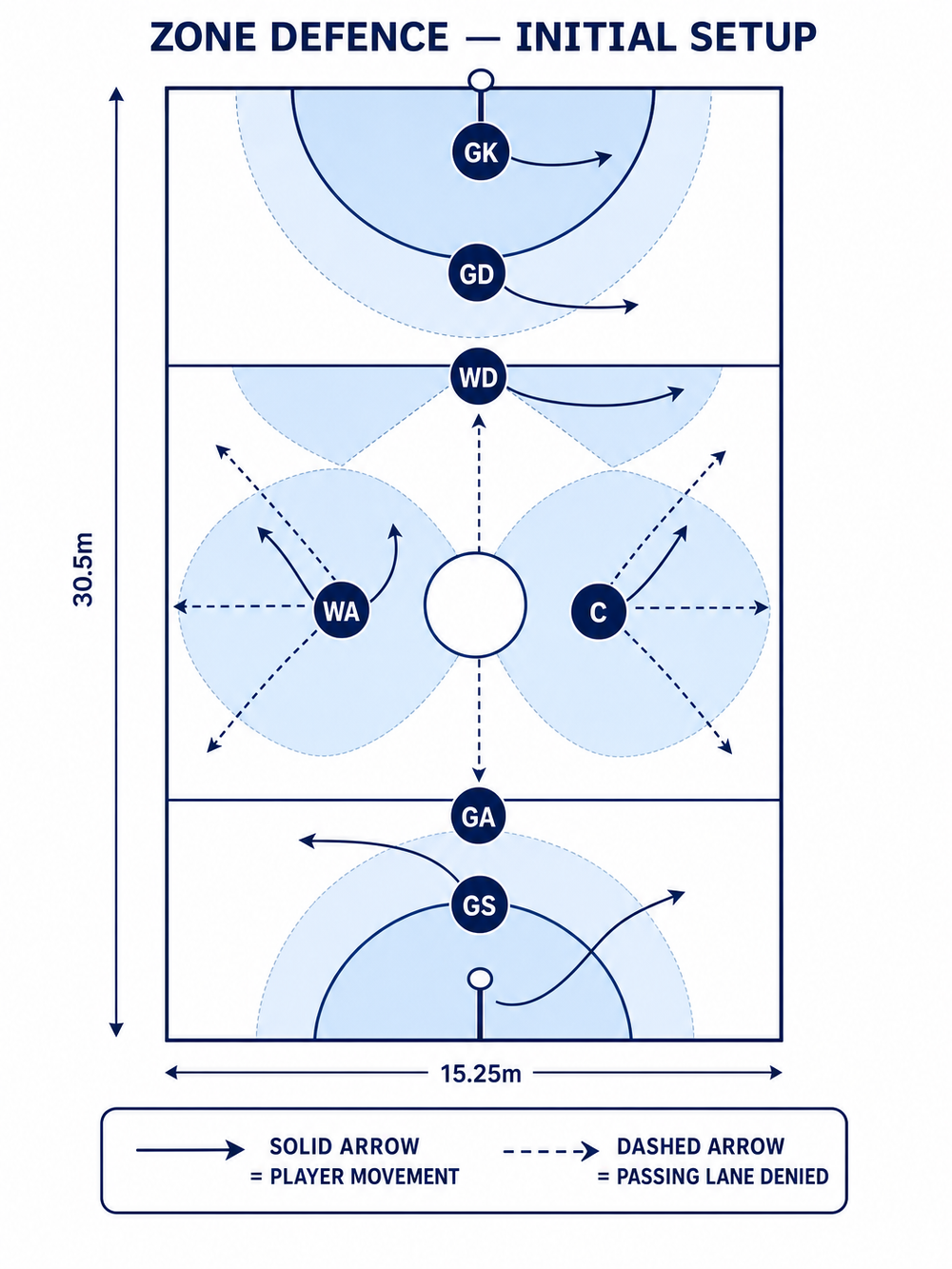
As the ball carrier on the sideline looks for an option, the defensive pressure should force a high, looping pass or a rushed pass into a crowded area. The GD or the off-side wing defender (WD in this scenario) must anticipate the pass, explode out of their zone, and attack the ball for the interception.
Step 5: Transition to Attack
Immediately upon securing the interception, the team must transition. The player who intercepts the ball (e.g., GD) should look downcourt. The C and WA must make strong lead runs into the centre third to provide an outlet pass, transitioning rapidly from defence to attack.
4. Key Coaching Points
- Communication is Non-Negotiable: Players must constantly talk. The GK, having the whole court in front of them, should act as the director, calling out attacker movements and initiating the slide.
- Defend the Space, Not the Face: Players must resist the urge to chase their individual opponent. Trust the structure and stay disciplined within the designated zone.
- Active Arms and Vision: All defenders must have their arms up to block passing lanes and maintain peripheral vision to see both the ball and the attackers entering their zone.
- Move as a Unit: The zone is only effective if the players move together like a pendulum. If one player shifts and another stays static, gaps will appear for the attackers to exploit.
- Attack the Ball: The zone is designed to create an opportunity. When the predictable pass is thrown, the defender must commit 100% to taking the interception, not just getting a deflection.
5. Common Mistakes
- Getting Caught in 'No Man's Land': Players standing between two attackers but not close enough to pressure either. They must commit to a space or a passing lane.
- Following the Player: A defender gets dragged out of their zone by an attacker's decoy run, opening up the middle of the court.
- Late Transition: Failing to set up the zone quickly enough after a turnover, allowing the attackers to penetrate the goal third before the defensive structure is established.
- Passive Defence: Setting up the zone but failing to apply pressure on the ball carrier, allowing them time to pick a pass through the structure.
6. Variations & Progressions
- Progression 1: Overload the Attack: Run the drill with 5 attackers against the 4 defenders (GK, GD, WD, C) to force the defenders to work harder on their communication and sliding.
- Progression 2: The Half-Court Trap: Instead of dropping back to the goal third, initiate the zone defence higher up the court, trapping the ball carrier just as they cross the transverse line into the centre third.
- Variation: The Triangle Zone: If the opposition only uses one dominant holding shooter, switch to a triangle zone with the GK at the back, and the GD and WD/C forming the front line, leaving one midcourter free to roam and hunt for intercepts.
7. Age Adaptations
- Under 10s / Under 12s: Focus purely on the concept of 'guarding a space' rather than a player. Use cones to physically mark out the zones on the court so players understand their boundaries. Keep it simple: "If the ball comes in here, it's yours."
- Under 14s / Under 16s: Introduce the sliding mechanism. Focus heavily on communication and moving together as a unit. Begin to teach the triggers for when to leave the zone to hunt for the interception.
- Open / Advanced: Implement complex variations like the half-court trap. Focus on the speed of transition from the intercept into the attacking phase. Expect high-intensity pressure and flawless communication.
