

Basketball
Mastering the Flex Offense: A Complete Continuity Playbook
Learn how to implement the classic Flex Offense, a structured continuity play designed to create high-percentage shots through relentless screening and cutting.

What you need
1 Basketball, Half-court or full-court (28m x 15m FIBA dimensions)
1. Overview
The Flex Offense is one of the most resilient and proven continuity offenses in basketball history. It is a structured, pattern-based system that relies on constant player movement, precise screening, and fundamentally sound passing. The primary objective of the Flex Offense is to create high-percentage scoring opportunities near the basket through a repetitive cycle of baseline flex screens and down screens. Because it is a continuity offense, the pattern can be run continuously from one side of the court to the other until the defense breaks down or a scoring opportunity arises.
This set play is particularly effective against aggressive man-to-man defenses. It forces defenders to constantly communicate, navigate screens, and defend multiple actions in sequence. The Flex Offense is ideal for teams that prioritize discipline, teamwork, and execution over isolation basketball. It ensures that all five players are involved in the action, making it an excellent developmental tool for youth teams and a highly effective weapon for advanced programs.
2. Setup

To effectively run the Flex Offense, coaches must ensure the court is properly spaced and players understand their initial positions. The setup requires all five players to be engaged and aware of their roles.
Equipment: 1 Basketball, full court or half court with standard FIBA markings (28m x 15m).
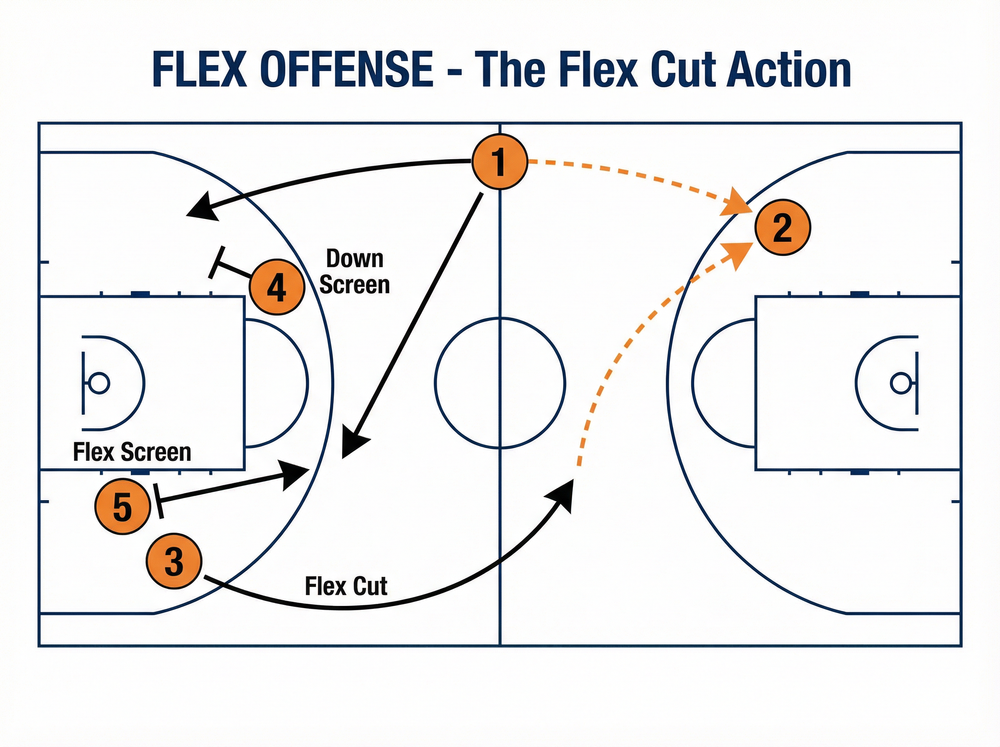
Player Positions: The initial alignment is a 3-out, 2-in set. All positions are referenced from the offensive half of the court:
| Position | Player | Starting Location |
|---|---|---|
| 1 — Point Guard | PG | Top of the key, offset to the right |
| 2 — Shooting Guard | SG | Right wing, level with the free-throw line extended |
| 3 — Small Forward | SF | Deep left corner, approximately 1m inside the baseline |
| 4 — Power Forward | PF | Right low post (right block) |
| 5 — Center | C | Left low post (left block) |

3. Step-by-Step Instructions

The execution of the Flex Offense requires precise timing and coordinated movements. The sequence is broken down into the initial pass, the flex cut, and the subsequent down screen to reset the continuity.
The Entry Pass: Player 1 (Point Guard) makes a firm, accurate pass to Player 2 (Shooting Guard) on the right wing. This pass is the trigger for the entire continuity sequence. Player 1 should use a two-handed chest pass or a bounce pass, delivered within 1–2 seconds of receiving the ball at the top.
The Flex Screen: Immediately upon the pass from Player 1 to Player 2, Player 5 (Center) steps away from the left block and sets a baseline screen — the flex screen — for Player 3 (Small Forward). Player 5 must establish a wide, solid base at the edge of the paint, with feet shoulder-width apart and arms crossed across the chest.
The Flex Cut: Player 3 uses the screen set by Player 5 to make a hard, decisive cut across the baseline toward the ball-side low block (right block). The cut must be shoulder-to-shoulder with the screener. Player 2 must look immediately to pass the ball to Player 3 for a high-percentage layup or short jump shot. This is the primary scoring option of the offense.
The Down Screen: If Player 3 is not open on the initial flex cut, the offense transitions to the next phase. Player 4 (Power Forward), who was positioned on the right low post, steps up toward the free-throw line to set a down screen for Player 1 at the top of the key.
The Replacement Cut: Player 1 uses the down screen from Player 4 to cut toward the right elbow or wing area, becoming a new passing target. Simultaneously, Player 4 pops out to the top of the key after setting the screen, becoming the new ball handler.

- The Continuity Reset: If no scoring opportunity has materialized, the offense is now perfectly positioned to run the exact same sequence on the opposite side of the court. Player 2 reverses the ball to Player 1 (now on the wing), who passes to Player 4 at the top of the key. The ball is swung to the left side, and the flex screen and down screen actions repeat — this time with Player 4 setting the flex screen and Player 5 setting the down screen. The offense continues in this pattern indefinitely until a quality shot is generated.

4. Key Coaching Points

To maximize the effectiveness of the Flex Offense, coaches must emphasize the following critical teaching points during every practice session:
Screening Angles are Everything. Screeners must set their screens at the correct angle to force the defender into the screen. The flex screener should have their back facing the baseline, creating a solid wall for the cutter. A poorly angled screen is as good as no screen at all.
Cut Hard, Cut Shoulder-to-Shoulder. Cutters must sprint shoulder-to-shoulder off the screen, leaving no gap for the defender to slip through. A lazy cut invites the defense to go over the top and deny the pass. Emphasize urgency — every cut should look like the player is going to score.
Patience and Floor Spacing. The offense requires patience. Players must allow the screens to be set before making their cuts. Proper spacing — maintaining 4–5 metres between perimeter players — is essential to stretch the defense and open up passing lanes into the paint.
Read the Defense on Every Action. Players must be taught to read how the defense is playing the screens. If the defense switches, the screener should immediately seal their new defender and look for the ball inside. If the defender trails the cutter, the cutter should curl tightly to the basket. If the defender goes under the screen, the cutter should pop out for a mid-range jumper.
Crisp, Decisive Passing. The success of the continuity relies on sharp, accurate passing. Perimeter players must use pass fakes to shift the defense and deliver the ball on time and on target to the cutters. A hesitant pass kills the timing of the entire sequence.
Screeners Must Roll or Pop Immediately. After setting the screen, the screener must immediately execute their next action — rolling to the basket or popping to the perimeter. A stationary screener becomes a liability and reduces the offense to a 4-on-5 situation.
5. Common Mistakes

Coaches should be vigilant in identifying and correcting these frequent errors when implementing the Flex Offense:
Setting Weak or Moving Screens. Players often rush to set screens without establishing a solid, wide base, resulting in ineffective screens or offensive fouls. Drill the habit of coming to a complete stop, planting the feet, and absorbing contact before the cutter arrives.
Cutting Too Early. Cutters who move before the screen is fully set disrupt the timing of the play and allow defenders to easily navigate the action. Use the coaching cue: "Wait for contact, then go."
Poor Spacing on the Perimeter. If perimeter players drift too close to the paint or cluster near the ball, the defense can easily recover and disrupt the passing lanes. Maintain wide spacing to force long closeouts and keep the defense honest.
Telegraphing Passes. The ball handler must not stare down the primary cutter. They must survey the entire floor, use their eyes to manipulate the defense, and deliver the pass only when the cutter is clearly open.
Ignoring the Screener After the Screen. One of the most common missed opportunities in the Flex Offense is failing to look for the screener after the screen is set. If the defense switches or overcommits to the cutter, the screener is often wide open at the elbow or on the roll to the basket.
6. Variations & Progressions

To keep the defense off balance and add layers of complexity, coaches can introduce the following variations to the standard Flex Offense pattern:
Flex to Pick and Roll. Instead of reversing the ball for the continuity, the player receiving the down screen can flow directly into a side pick-and-roll with the screener. This is particularly effective when the defense is overplaying the ball reversal.
Post Entry Option. If the flex cutter is denied, the ball handler can look to feed the post player (the original flex screener) who has sealed their defender after setting the initial flex screen. This turns the screener's seal into a direct scoring opportunity.
Dribble Entry. Instead of a pass to initiate the offense, Player 1 can dribble toward the wing, pushing Player 2 to the corner and triggering a different set of screening actions before flowing into the flex continuity. This variation is useful against teams that deny the initial wing entry pass.
7. Age Adaptations
The Flex Offense can be adapted to suit different age groups and skill levels, making it one of the most versatile systems available to coaches:
Under 10 / Under 12: Focus exclusively on the fundamental mechanics of setting and using screens. Simplify the continuity by only running the flex cut and down screen on one side of the court before resetting with a coach's pass. Emphasize spacing, basic passing, and the concept of "cutting hard." Use walk-through drills at half speed before progressing to live action.
Under 14 / Under 16: Introduce reading the defense. Teach players how to react when the defense switches or goes under screens. Incorporate the post entry variation and the dribble entry to add complexity. Begin running the full continuity at game speed in 5-on-5 settings.
Open / Advanced: At the highest levels, the Flex Offense should be run with precision and pace. Emphasize advanced reads, such as slipping screens and back-cutting when overplayed. The offense should flow seamlessly into secondary actions and quick-hitters. Introduce film sessions to help players identify defensive tendencies and exploit them within the system.
