Mastering the Goal Kick: Playing Out from the Back
A comprehensive guide for coaches on how to successfully build out from the back starting with a goal kick, bypassing the opposition press to create attacking opportunities.
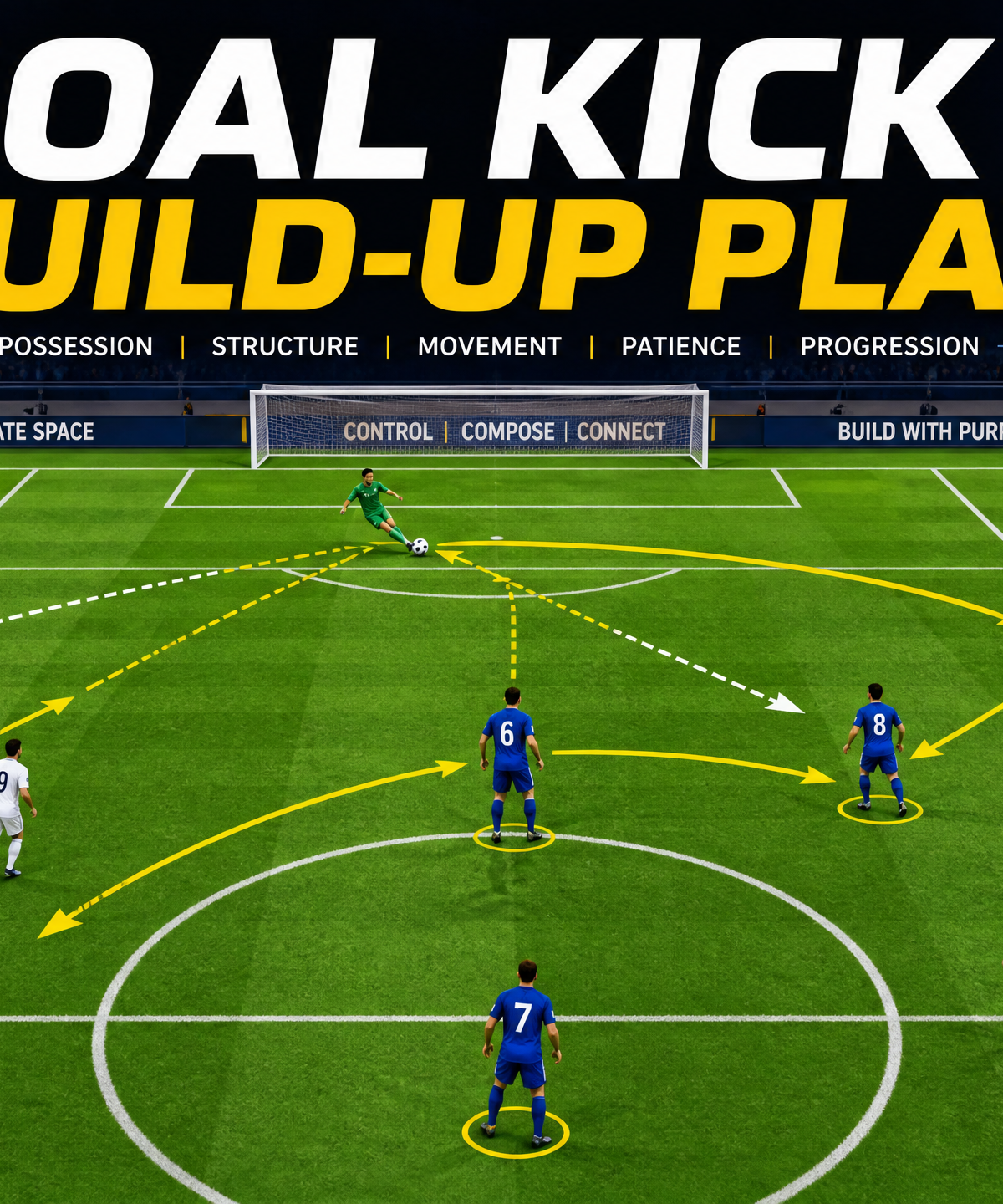
Equipment Needed
1. Overview
Playing out from the back has become a fundamental principle of modern football. When executed correctly, starting your build-up from a goal kick allows your team to draw the opposition press, create numerical superiorities in the defensive and middle thirds, and exploit the space left behind. This resource details a structured approach to goal kick build-up play, specifically focusing on a 4-3-3 formation against a mid-to-high pressing opponent. The goal is to provide a reliable framework that players can understand and execute under pressure, transitioning the team from deep defence into a structured attack.
2. Setup
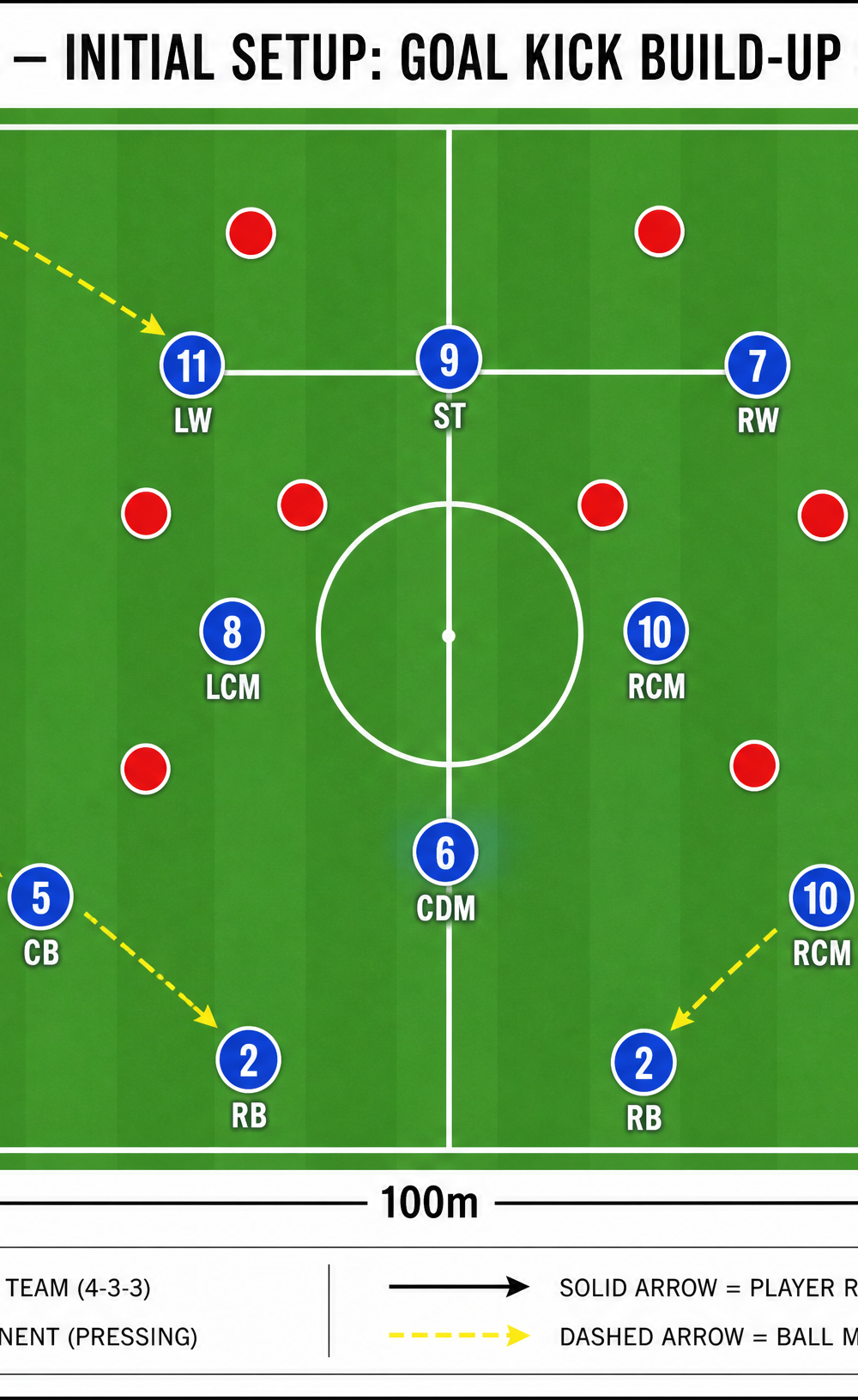
Pitch Dimensions: Full pitch (100-110m x 64-75m) or a scaled-down version for younger age groups (e.g., 70m x 50m for 9v9).
Equipment Needed:
- 1 full-size goal
- 10-15 footballs (placed in the goal or with the goalkeeper to maintain tempo)
- 10-12 cones or markers to designate starting positions and target zones
- Bibs for two teams (if running as an opposed practice)
Player Positions (4-3-3 System):
- GK (1): Central in the goal area, ready to distribute.
- CBs (4 & 5): Split wide, approximately 15m from the goal line, on the edge of the penalty area or just outside.
- Fullbacks (2 & 3): Pushed high and wide, roughly 20-25m from the goal line, hugging the touchlines.
- CDM (6): Positioned centrally, about 25-30m from the goal line, acting as the pivot.
- CMs (8 & 10): Positioned in the half-spaces, 35-40m from the goal line.
- Wingers (7 & 11): High and wide near the halfway line, pinning the opposition fullbacks.
- Striker (9): Central, high up the pitch near the halfway line, providing depth.
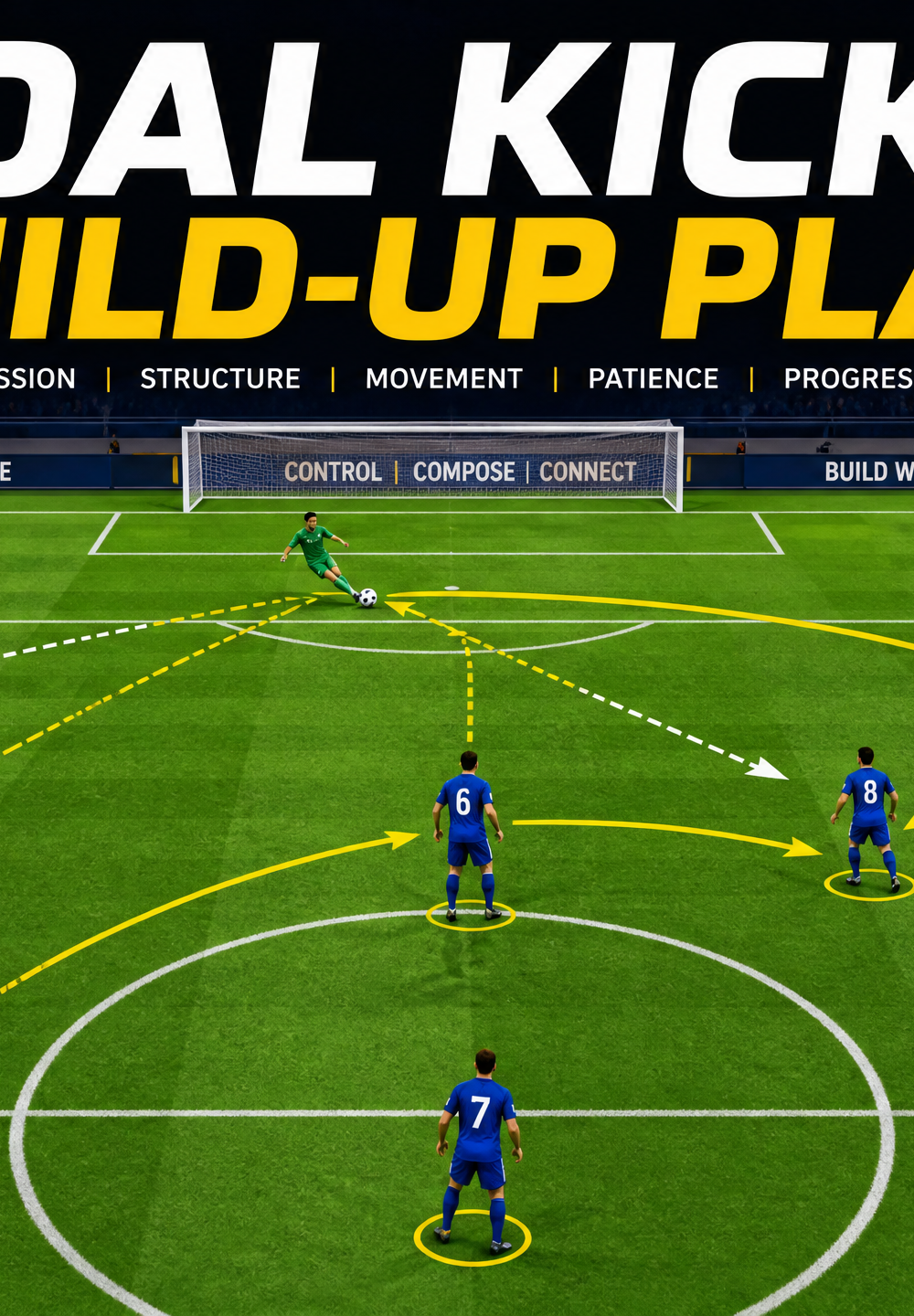
3. Step-by-Step Instructions
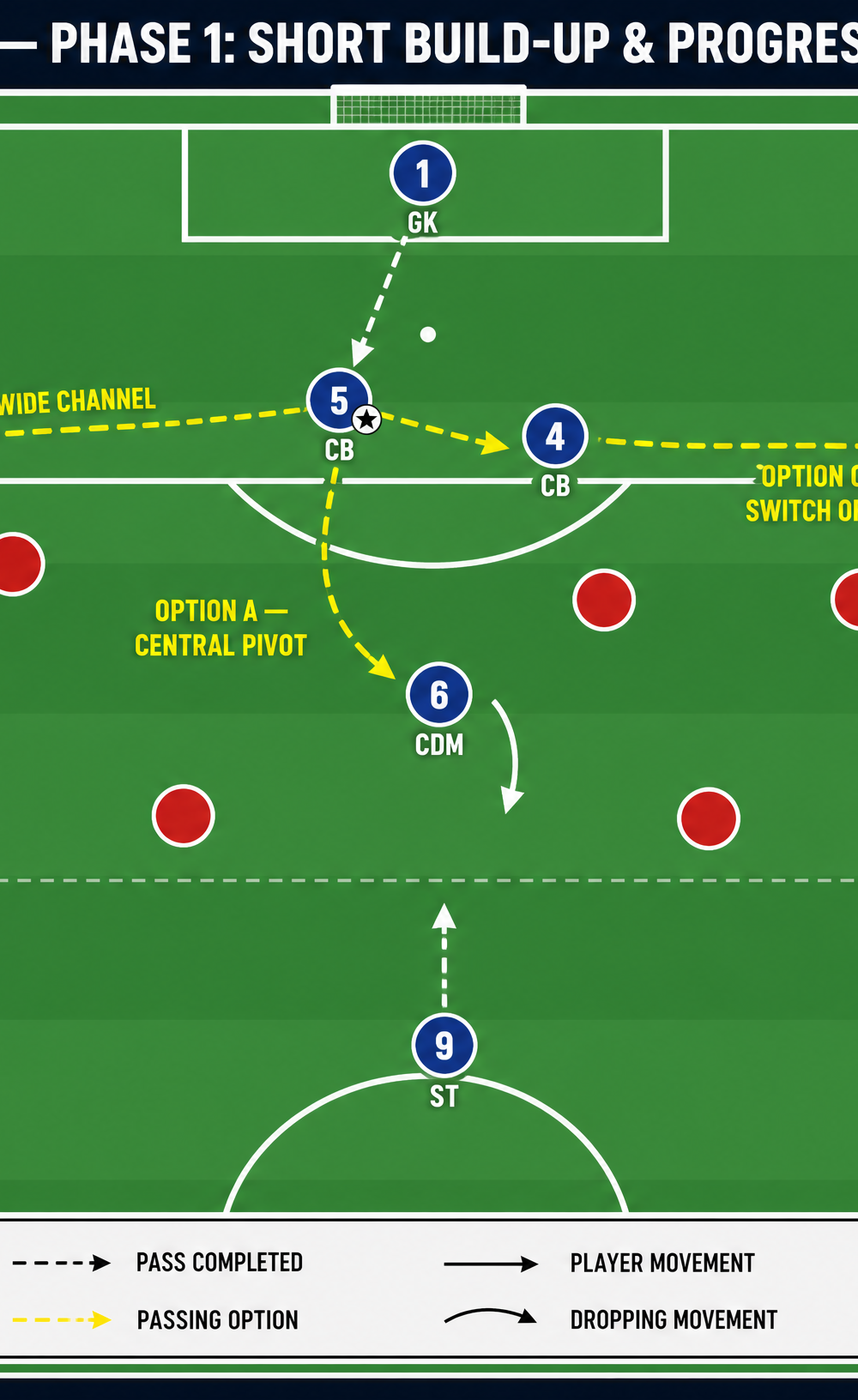
Phase 1: The Initial Distribution (Short Build-Up)
- The Trigger: The goalkeeper places the ball and signals readiness. The CBs split to the edges of the penalty box.
- The First Pass: The GK plays a firm, accurate pass along the ground to the strong-side CB (e.g., CB 5).
- Receiving Under Pressure: As CB 5 receives the ball, they must adopt an open body shape, allowing them to see the entire pitch and the pressing opponent.
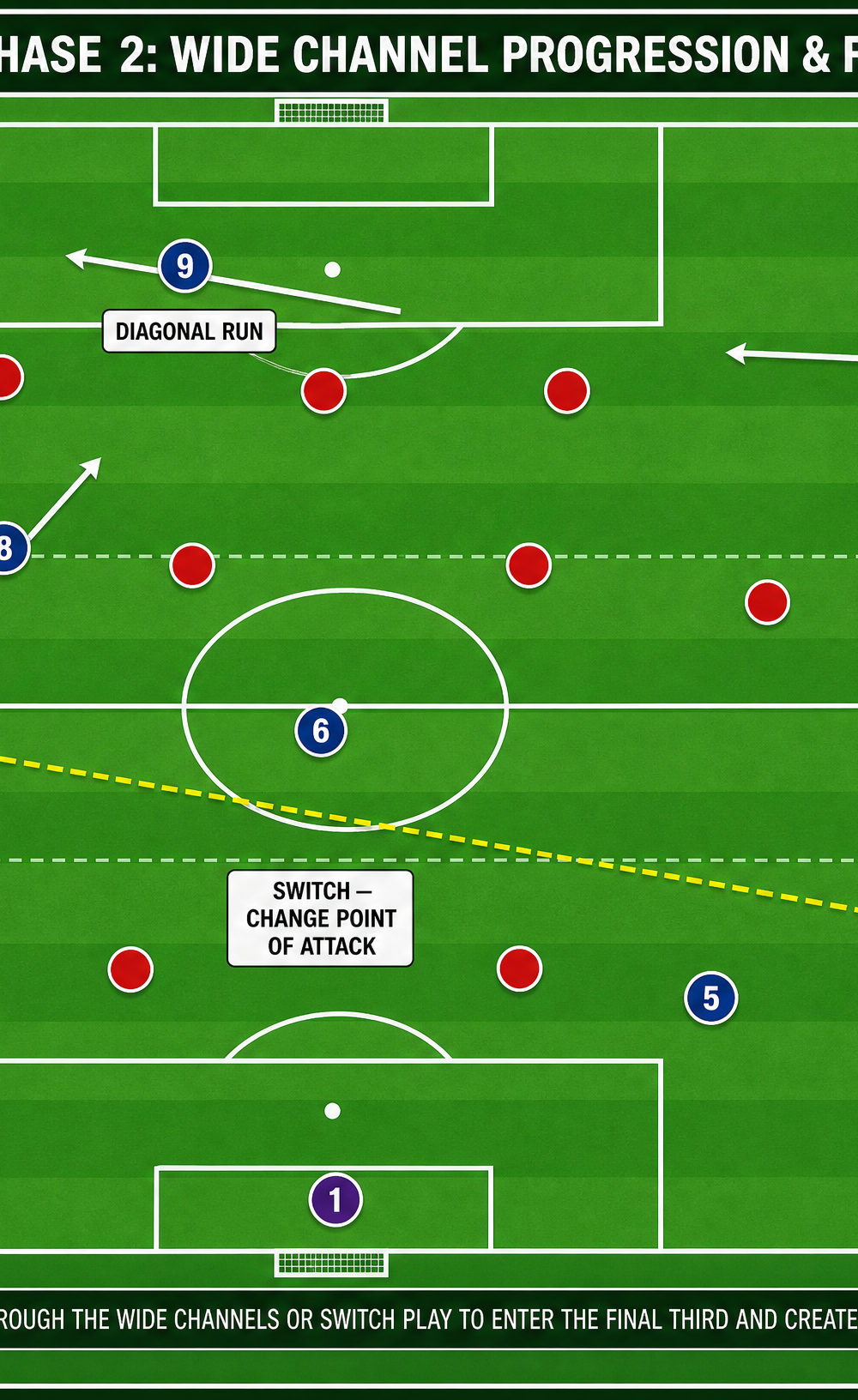
Phase 2: Breaking the First Line of Press
Once the CB has the ball, they have three primary options depending on the opposition's press:
- Option A (Central Pivot): If the opposition presses wide, the CDM (6) drops into the space created centrally to receive a pass, turning to face forward.
- Option B (Wide Channel): If the opposition presses centrally, the CB plays a firm pass out to the Fullback (3) who has pushed high and wide into the channel.
- Option C (Switch of Play): If the opposition commits heavily to the ball side, the CB switches play to the opposite CB (4), who then drives forward or plays to the opposite Fullback (2).
Phase 3: Progression and Final Third Entry
Assuming the ball has been progressed to the Fullback (LB 3) in the wide channel, the focus shifts to entering the final third:
- The Overlap/Underlap: As the LB drives forward, the Winger (LW 11) can make an overlapping run down the touchline, or the CM (LCM 8) can make an underlapping run into the half-space.
- The Diagonal Run: The Striker (9) makes a diagonal run across the defensive line to create space or receive a through ball.
- Execution: The LB selects the best passing option (overlap, underlap, or a central pass to the Striker) to penetrate the opposition's defensive line and create a goal-scoring opportunity.
4. Key Coaching Points
- Body Shape and Awareness: Players receiving the ball (especially CBs and the CDM) must adopt an open body shape, scanning over their shoulder before receiving to assess pressure and passing options.
- Pass Quality and Ball Speed: Passes must be firm, accurate, and played to the correct foot (usually the back foot) to allow the receiver to play forward immediately.
- Movement to Create Space: Off-the-ball movement is critical. The CDM must time their drop, and fullbacks must push high to stretch the opposition.
- Composure Under Pressure: Players must remain calm when pressed. Encourage them to trust the structure and use the goalkeeper as an extra outfield player to retain possession if forward options are blocked.
- Recognising the Press: Players must identify the opposition's pressing triggers (e.g., a heavy touch, a slow pass) and adjust their positioning accordingly.
5. Common Mistakes
- Forcing the Pass: Playing a risky pass into a congested area instead of resetting through the goalkeeper or switching play.
- Poor Body Shape: Receiving the ball facing their own goal, limiting vision and increasing the risk of losing possession in dangerous areas.
- Lack of Movement: Static players make it easy for the opposition to press. Constant, coordinated movement is required to create passing lanes.
- Goalkeeper Hesitation: The GK taking too long to distribute, allowing the opposition to set their press. Quick, decisive distribution is essential.
6. Variations & Progressions
- Progression 1: Add Opposition (Shadow Play to Fully Opposed): Start with shadow play (no opposition) to groove the patterns. Progress to passive opposition, and finally to fully opposed (e.g., 8v6 or 11v11) to test the build-up under match conditions.
- Progression 2: Time Limit: Introduce a time limit (e.g., 10 seconds) to progress the ball past the halfway line, encouraging quicker decision-making and ball speed.
- Variation 1: The Long Option: If the opposition presses extremely high with a man-to-man system, the GK can bypass the press entirely with a driven pass to the Striker or Wingers in the space left behind.
7. Age Adaptations
- Under-8 to Under-10: Focus heavily on the technical execution of the first pass and receiving with an open body shape. Keep the structure simple (e.g., GK to wide defenders in a 7v7 format). Reduce pitch size.
- Under-12 to Under-14: Introduce the concept of the central pivot (CDM dropping in) and switching play. Begin to focus on decision-making under passive pressure.
- Under-16 to Open: Implement the full tactical structure, focusing on exploiting specific spaces left by the opposition's press. Emphasize ball speed, third-man runs, and quick transitions.