

Rugby
Mastering the Offload in Contact
Develop your team's ability to keep the ball alive and break defensive lines with this comprehensive offloading in contact drill.
What you need
10-12 Cones, 2-3 Rugby Balls, Tackle Shields (Optional), Bibs (2 colors)
1. Overview
The "Offloading in Contact" drill is designed to teach players how to maintain momentum and keep the ball alive when faced with a defender. Offloading is a critical skill in modern rugby, allowing attacking teams to break defensive lines before the defense can reset. This drill focuses on the ball carrier's ability to win the collision, manage the ball securely, and execute a precise pass to a supporting player, while also emphasizing the support players' timing and communication. It is ideal for developing continuity in play and exploiting gaps created by the initial contact.
2. Setup
To run this drill effectively, you will need the following setup:
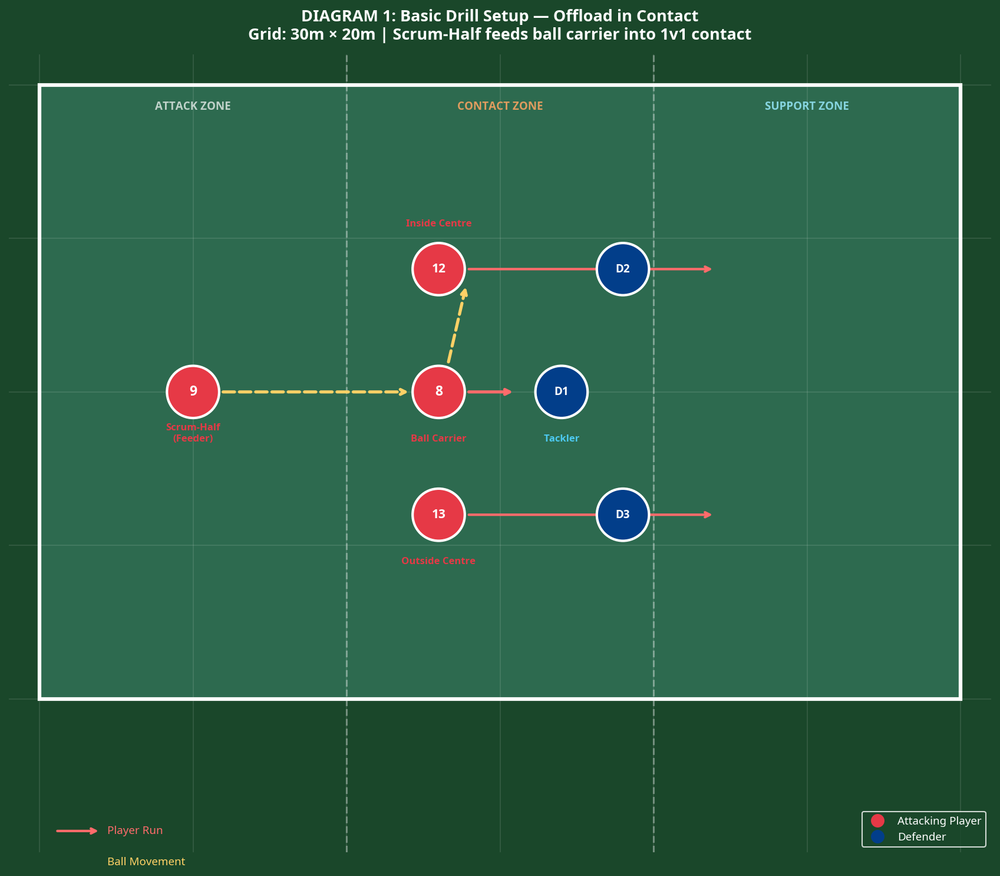
- Pitch Area: Create a grid of 30m × 20m using cones. Divide the grid into three zones: an Attack Zone (10m), a Contact Zone (10m), and a Support Zone (10m).
- Equipment: 10-12 cones for marking the grid and starting positions, 2-3 rugby balls, and tackle shields or hit pads for the defenders (optional, depending on the desired intensity).
- Players Required: Minimum of 6 players per group.
- Positions:
- 1 Scrum-half (9) acting as the feeder.
- 1 Ball Carrier (e.g., No.8).
- 2 Support Players (e.g., Inside Centre 12, Outside Centre 13).
- 2 Defenders (D1, D2).
3. Step-by-Step Instructions
- Starting Position: The Scrum-half (9) starts at the base cone with the ball. The Ball Carrier (8) stands 5m away in the Attack Zone. The two Support Players (12 and 13) position themselves on the left and right shoulders of the Ball Carrier, slightly deeper.
- The Feed: On the coach's whistle, the Scrum-half passes the ball to the advancing Ball Carrier.
- The Approach: The Ball Carrier runs aggressively into the Contact Zone, targeting the inside shoulder of the primary Defender (D1).
- The Collision: The Ball Carrier initiates contact, focusing on staying square and keeping the ball secure (two hands on the ball). They must drive their legs to win the gain line.
- The Offload: As the Ball Carrier draws the defender and commits them to the tackle, they free their arms and look for support.
- The Support Run: Support Player 12 runs a hard, communicative line into the space created by the contact, calling for the ball.
- The Execution: The Ball Carrier executes a pop pass or a one-handed offload to Support Player 12.
- The Finish: Support Player 12 catches the ball at pace and accelerates through the Support Zone to score, while the secondary defender (D2) attempts to cover.
4. Key Coaching Points
- Win the Collision First: The ball carrier must not compromise their body height or leg drive looking for the offload too early. Secure the contact, dominate the tackle area, and then look to pass.
- Ball Security: Keep the ball tucked securely until the last possible moment. Only extend the arms when the support player is identified and the passing lane is clear.
- Support Timing and Depth: Support players must not overrun the ball carrier. They should hold their depth, read the contact situation, and accelerate onto the ball only when the offload is guaranteed.
- Communication: Loud, clear, and early calls from the support players ("Left!", "Right!", "Pop!") are essential to guide the ball carrier, whose vision may be restricted during the tackle.
- Square Shoulders: The ball carrier should aim to keep their shoulders square to the try line through the contact, which makes the offload easier to execute and harder to defend.
5. Common Mistakes
- Forcing the Pass: Attempting an offload when the defender has securely wrapped the ball or arms, leading to knock-ons or turnovers.
- Poor Support Lines: Support players running too flat or too close to the ball carrier, removing the space needed to execute the pass and catch the ball at pace.
- Taking the Eye off the Ball: Support players looking at the defender or the space ahead before securing the catch, resulting in dropped balls.
- Losing Momentum: The ball carrier stopping before contact to look for the pass, allowing the defense to dominate the collision.
6. Variations & Progressions
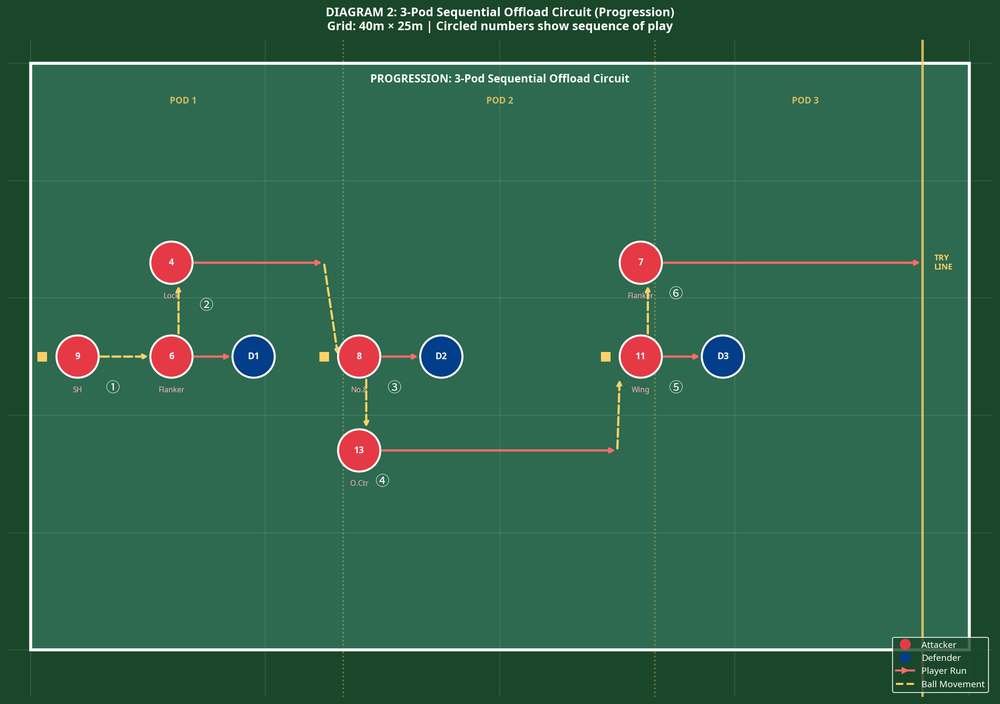
- Progression 1: 3-Pod Sequential Circuit: As shown in Diagram 2, link three pods together in a wider 40m x 25m grid. The ball moves from Pod 1 to Pod 2 to Pod 3, requiring continuous realignment and multiple offloads in a single sequence.
- Variation 1: Live Defense: Remove the tackle shields and allow the defenders to make full tackles. This increases the pressure and forces the ball carrier to make realistic decisions about whether to offload or go to ground and present the ball.
- Variation 2: Unbalanced Support: Start with only one support player but give them the freedom to choose which side to run on, forcing the ball carrier to scan and react dynamically.
7. Age Adaptations
- Under 8s - Under 10s: Focus heavily on the "pop pass" before contact rather than in the tackle. Use two-handed touches instead of tackles. The emphasis is on passing to a player in space rather than offloading out of a tackle.
- Under 12s - Under 14s: Introduce tackle bags. Focus on body height and the mechanics of freeing the arms. Emphasize that going to ground and presenting the ball is always a safe and acceptable option if the offload isn't clear.
- Under 16s - Open: Full contact. High intensity. Focus on decision-making under extreme pressure, advanced offloading techniques (e.g., out the back door), and complex support lines.
