

Cricket
Mastering the Quick Single: Comprehensive Running Between Wickets Drill
Develop elite communication, awareness, and explosive turning speed with this structured running between the wickets progression drill.

What you need
2 bats, 4 sets of stumps, 6-10 cricket balls, Marker cones, Batting pads and gloves
1. Overview
Running between the wickets is often the difference between a competitive total and a match-winning one. This comprehensive drill session is designed to build the foundational mechanics of running, enhance communication under pressure, and develop elite spatial awareness on the 22-yard pitch. Use this session during pre-season conditioning or as a high-intensity fielding and batting crossover drill during the season.
2. Setup
Equipment Needed:
- 2 bats
- 4 sets of stumps (or cones if stumps are unavailable)
- 6-10 cricket balls
- Marker cones (different colors for zones)
- Batting gloves and pads (optional but recommended for realism)
Pitch & Field Setup:
Set up a standard 22-yard pitch. Mark the popping creases clearly. If working on an outfield, measure exactly 22 yards to replicate match conditions. Place marker cones to designate fielding positions and calling zones as detailed in the progressions below.
3. Step-by-Step Instructions
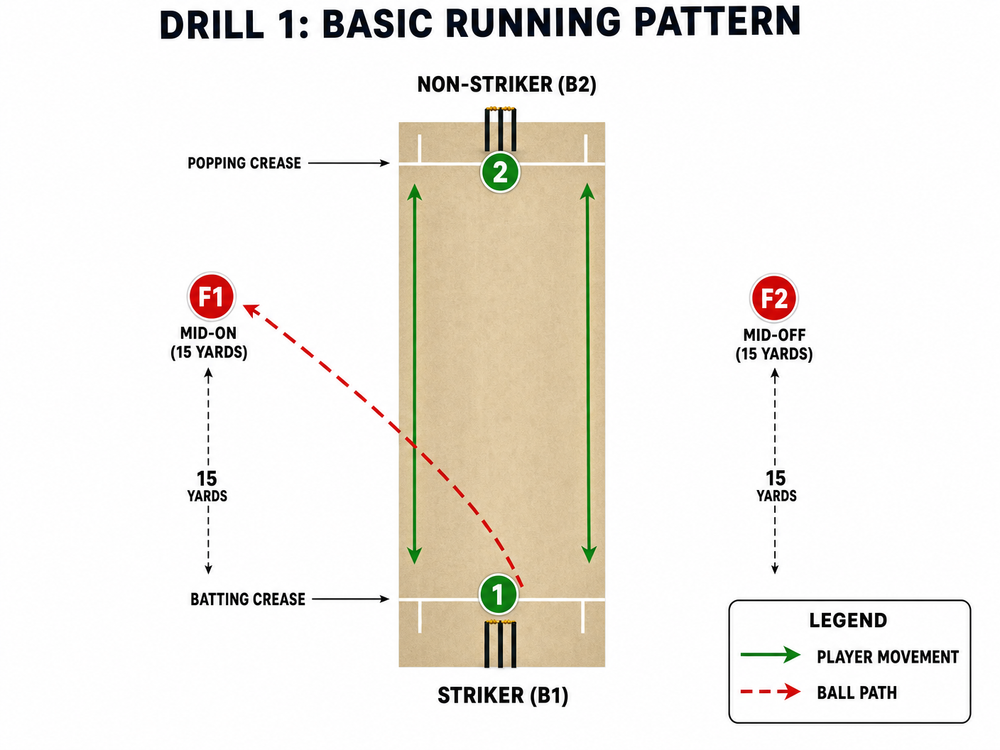
Progression 1: The Basic Running Pattern

This initial phase focuses purely on mechanics—running in straight lines, grounding the bat, and turning efficiently.
- Positioning: Place a Striker (B1) at the batting end and a Non-Striker (B2) at the bowling end.
- The Call: On the coach's command of "YES!", both players sprint to the opposite end.
- The Turn: Players must ground their bat across the popping crease, pivot quickly, and immediately face the play.
- The Return: Once turned, they sprint back for a second run without needing another call.
- Rotation: After completing two runs, rotate new players in. Focus on ensuring the non-striker is backing up correctly before the initial call.
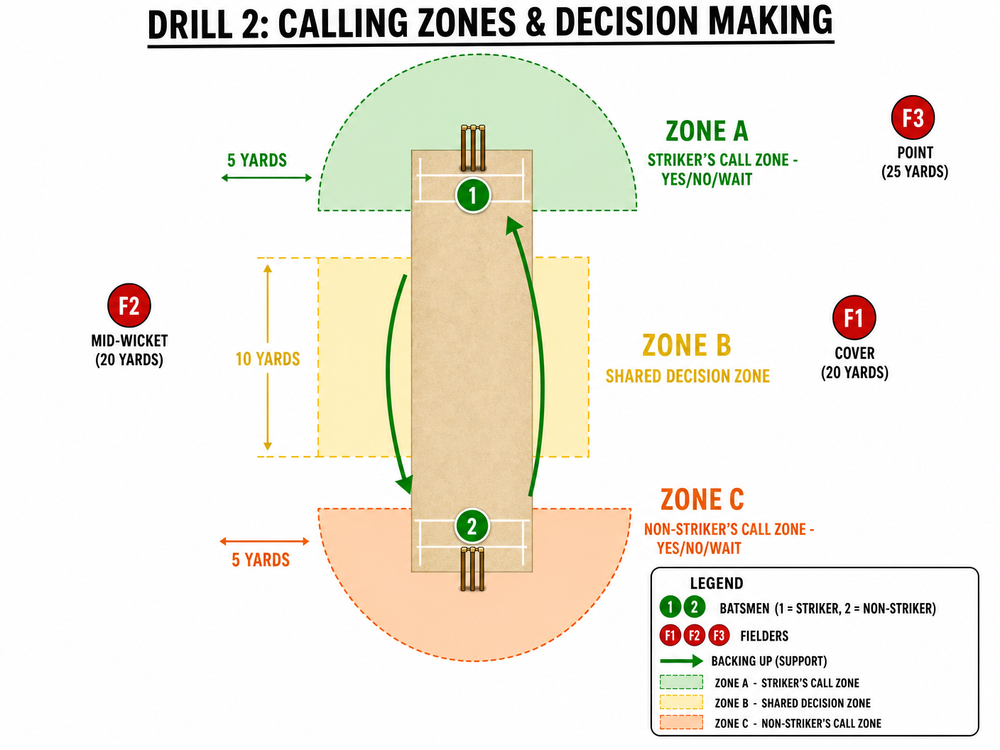
Progression 2: Calling Zones and Decision Making
Introduce communication protocols based on where the ball is hit.
- Zone Marking: Use cones to mark out the Striker's Call Zone (Zone A), the Shared Decision Zone (Zone B), and the Non-Striker's Call Zone (Zone C).
- The Feed: The coach feeds a ball (underarm throw or soft drop) into one of the designated zones.
- The Decision: The player responsible for that zone must immediately call "YES", "NO", or "WAIT".
- Execution: Both players must react instantly to the call. If "YES", complete the run. If "NO", return quickly to the crease. If "WAIT", take a few steps down the pitch, assess, and make a final call.
- Emphasis: Ensure calls are loud, clear, and authoritative. The non-striker must be backing up (walking in with the bowler) to gain momentum.
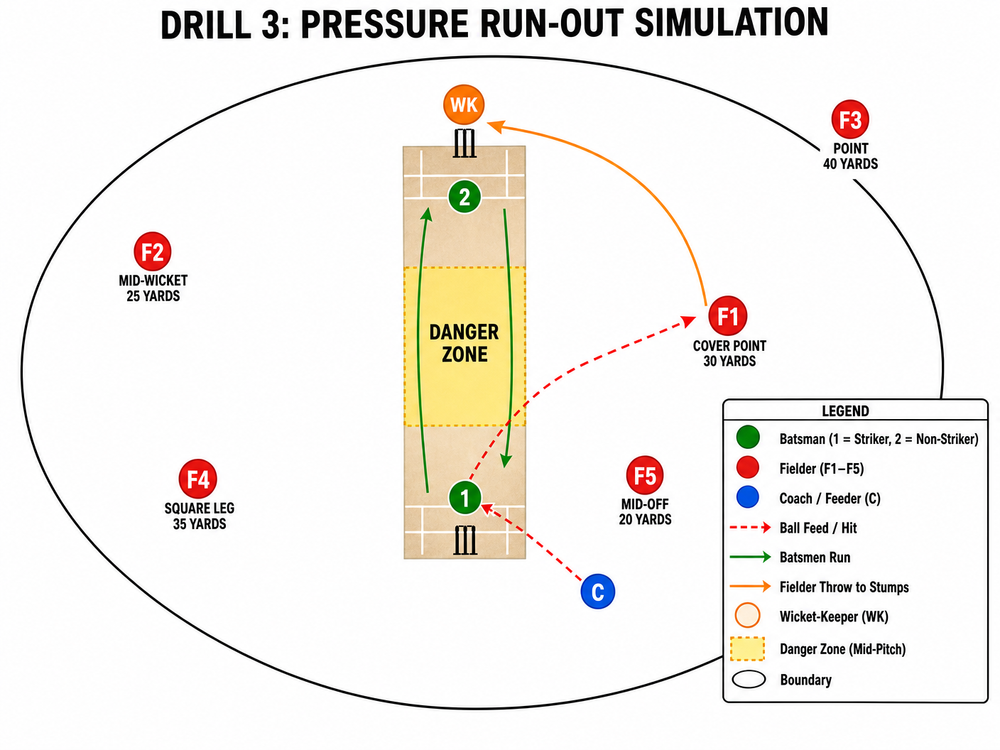
Progression 3: Pressure Run-Out Simulation
Apply match-like pressure by introducing active fielders.
- Fielder Placement: Position 4-5 fielders in an inner ring (e.g., Cover, Mid-Wicket, Point, Square Leg, Mid-Off) approximately 20-30 yards from the pitch.
- The Hit: The coach feeds the ball to the Striker, who hits it towards one of the fielders.
- The Race: The batsmen must judge the run and attempt a quick single.
- The Field: The fielder attacks the ball and attempts a run-out at either the striker's or non-striker's end (a wicket-keeper or coach can stand at the stumps to receive throws).
- The Danger Zone: Emphasize the importance of clear communication when the ball is hit into the "Danger Zone" (mid-pitch areas where the run is tightest).
4. Key Coaching Points
- Loud, Clear Calls: Only three calls are acceptable: "YES", "NO", or "WAIT". Ambiguity causes run-outs.
- Backing Up: The non-striker must leave the crease as the ball is released, taking 2-3 steps down the pitch to gain a head start.
- Run in Straight Lines: Avoid running in arcs. The shortest distance between two points is a straight line. Run on the edge of the pitch to avoid damaging the protected area.
- Grounding the Bat: Slide the bat into the crease early. Do not run past the crease before turning.
- Turn Blind/Face the Ball: When turning for a second run, always turn facing the side the ball was hit so you never lose sight of the play.
5. Common Mistakes
- Head Down Running: Players watching their feet instead of their partner or the ball, leading to collisions or missed calls.
- Bat Carried Too High: Running with the bat tucked under the arm rather than extended forward ready to slide into the crease.
- Hesitation: Taking stutter steps after a call is made. Once a call is accepted, commit fully.
- Poor Turning Technique: Running in a wide circle to turn rather than stopping, dropping the center of gravity, and pivoting sharply.
6. Variations & Progressions
- The Blind Call: Have the batsmen face away from each other. The coach calls the run, forcing them to react without visual cues, relying entirely on vocal communication.
- Fatigue Factor: Run this drill at the end of a session when players are tired to simulate late-innings pressure where mental errors often occur.
- Handicap Running: Have the batsmen run in full gear (pads, helmet, gloves) while fielders are fresh, increasing the physical demand.
7. Age Adaptations
- Under 10s: Focus primarily on the basic mechanics of holding the bat correctly while running and making loud "YES/NO" calls. Keep distances shorter if necessary.
- Under 14s: Introduce the concept of "WAIT" and emphasize the importance of backing up. Begin integrating fielders for pressure.
- Under 16s & Open: Run the full pressure simulations with strict penalties for poor communication or sloppy turns. Focus on marginal gains like sliding the bat earlier and turning faster.
