

Cricket
Mastering Spin Bowling Variations: The Mystery Spinner Drill
A comprehensive drill designed to help spin bowlers develop and execute variations with disguise, improving their ability to deceive batsmen in match situations.

What you need
6-8 cricket balls, Target cones/markers, 1 set of stumps, Batting net
1. Overview
Spin bowling is an art form that relies heavily on deception and variation. The 'Mystery Spinner Drill' is designed to help bowlers develop and execute different variations—such as the topspinner, arm ball, or doosra/googly—without telegraphing their intentions to the batsman. This drill focuses on maintaining a consistent action while subtly altering grip and release points to create different trajectories and spin directions. It is ideal for use during middle-phase net sessions when bowlers need to practice specific match scenarios and field settings.
2. Setup
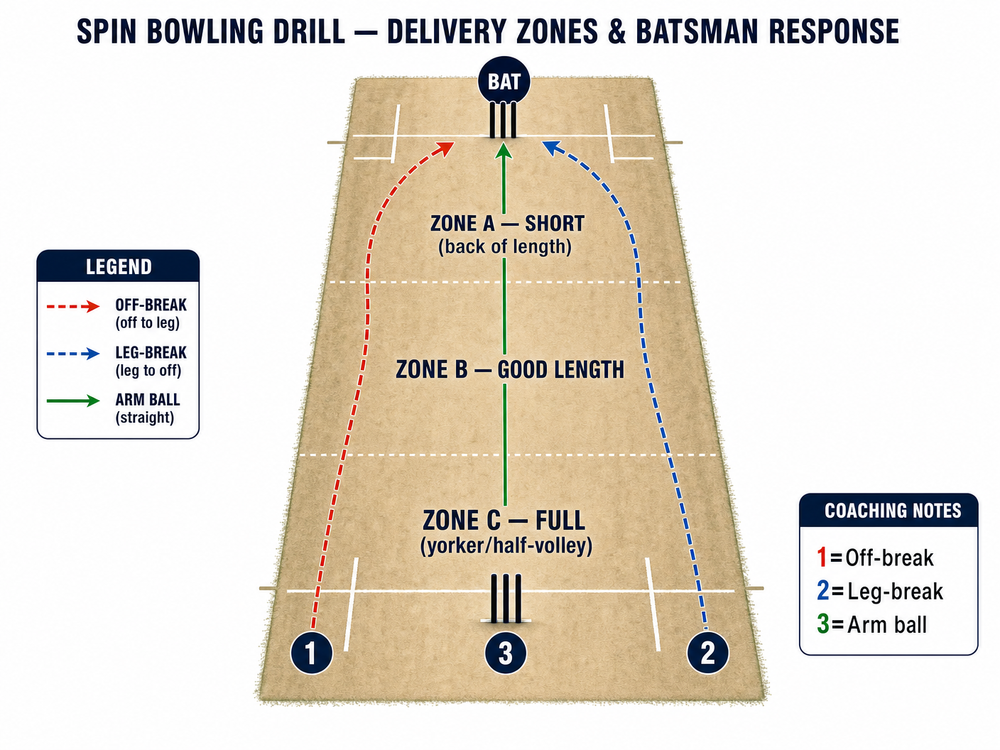
Equipment Needed
- 6-8 cricket balls (preferably of varying wear to simulate different match conditions)
- Target cones or markers (flat discs are ideal)
- 1 set of stumps (with bails)
- Batting net or open middle practice area
Pitch & Field Setup
Set up on a standard 22-yard cricket pitch. Place target markers on a 'good length' area (approximately 4-5 meters from the batting crease, depending on the bowler's pace and trajectory). Create three distinct target zones:
- Zone 1: Outside off stump (for stock deliveries)
- Zone 2: Middle and off stump (for straighter variations)
- Zone 3: Leg stump line (for specific tactical variations)

Player Positions
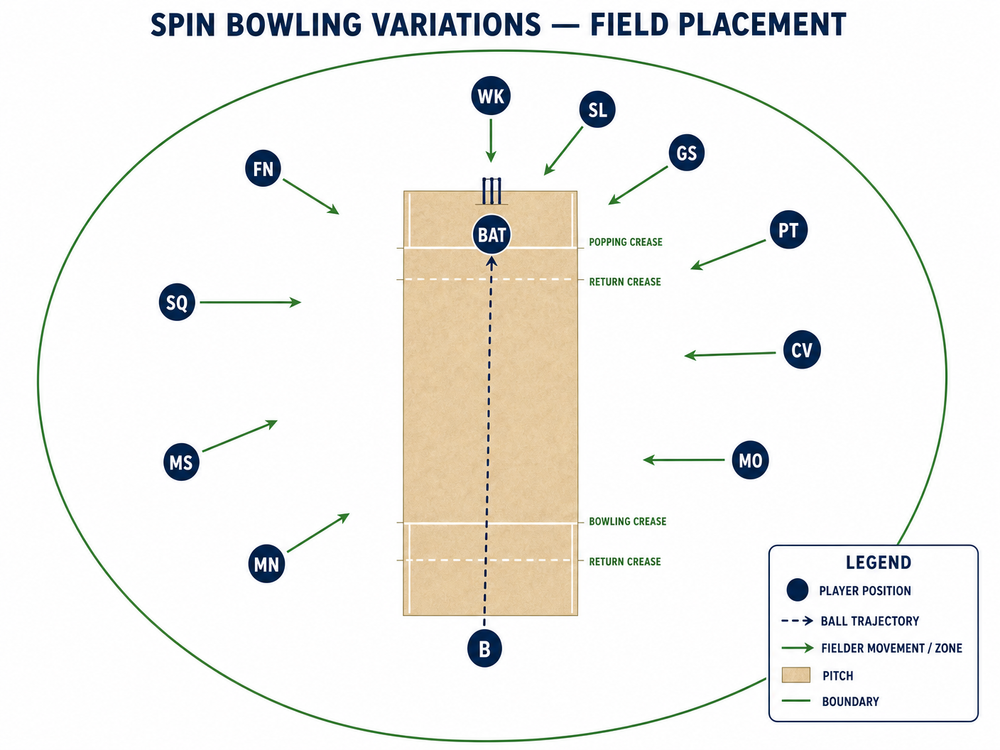
- Bowler (B): Operating from their preferred end.
- Wicketkeeper (WK): Standing up to the stumps.
- Batsman (BAT): Fully kitted, ready to face the deliveries.
- Coach: Standing behind the net or alongside the umpire's position to observe the bowler's action and release.
3. Step-by-Step Instructions
- Warm-up Phase (Stock Ball Focus): The bowler starts by bowling 2-3 overs of their stock delivery (e.g., standard off-break or leg-break). The goal is to hit the target markers consistently and establish a rhythm.
- The 'Call' System: The coach or wicketkeeper calls out a specific variation just as the bowler begins their run-up. For example, 'Arm Ball' or 'Googly'.
- Execution with Disguise: The bowler must execute the called variation while attempting to keep their run-up, gather, and initial arm rotation as identical to their stock ball as possible.
- Batsman Feedback: After each delivery, the batsman provides feedback on whether they could 'read' the variation from the hand or if they were deceived by the flight or spin off the pitch.
- Target Practice: Incorporate the target zones. The coach calls both the variation and the target zone (e.g., 'Topspinner, Zone 2').
- Match Scenario: Set a hypothetical field (as shown in the diagram below) and challenge the bowler to bowl a 6-ball over using at least two different variations, explaining their tactical reasoning for each ball based on the field.
4. Key Coaching Points
- Consistent Action: Emphasize that the run-up, jump, and non-bowling arm must remain identical across all variations. The magic happens at the wrist and fingers at the very last moment.
- Arm Speed: A common tell for a variation (especially a slower ball or topspinner) is a drop in arm speed. Ensure the bowler maintains their standard arm speed.
- Release Point: While the grip changes, the release point should ideally remain the same to avoid giving the batsman early cues.
- Follow-through: A strong, complete follow-through is essential for imparting maximum revolutions on the ball, regardless of the variation.
- Tactical Awareness: Teach the bowler why they are using a variation, not just how. For example, using an arm ball when the batsman is sweeping repeatedly.
5. Common Mistakes
- Telegraphing the Delivery: Changing the grip too early in the run-up or altering the gather, allowing the batsman to spot the variation.
- Loss of Accuracy: Focusing too much on the spin/variation and neglecting line and length. A poorly executed variation is often a boundary ball.
- Overuse: Bowling too many variations in a single spell, making them predictable. The stock ball must remain the primary weapon.
- Slowing Down the Action: Consciously or subconsciously slowing the arm speed to ensure the variation 'works', which immediately alerts the batsman.
6. Variations & Progressions
- Progression 1: Blind Batting: Have the batsman face away until the bowler reaches the delivery stride, forcing them to react purely to the ball out of the hand rather than the run-up.
- Progression 2: Point System: Introduce a scoring system where hitting the target zone earns 1 point, and successfully deceiving the batsman (e.g., beating the edge or inducing a false shot) earns 2 points.
- Variation: The 'Double Bluff': The coach calls a variation, but the bowler intentionally bowls their stock ball to see if the batsman pre-meditates based on a perceived 'tell'.
7. Age Adaptations
- Under 10 / Under 12: Focus purely on mastering one stock delivery and perhaps one simple variation (like a faster, straighter ball). Do not introduce complex variations like the doosra or googly yet. Emphasize fun and basic accuracy.
- Under 14 / Under 16: Introduce the concept of disguise. Work on 1-2 distinct variations (e.g., topspinner and arm ball). Begin incorporating basic tactical scenarios.
- Open / Senior: Full implementation of the drill. High focus on subtle disguise, tactical field settings, and executing under pressure against quality batsmen.
