

Basketball
Mastering the Flex Offense: A Comprehensive Guide to Continuity Play
Learn how to implement the classic Flex Offense to create high-percentage scoring opportunities through continuous motion, screening, and precise cutting.
What you need
1 Basketball, Half-court (FIBA dimensions: 28m x 15m)
1. Overview
The Flex Offense is a classic, structured continuity offense built on the principles of ball movement, precise screening, and relentless player motion. Designed to create high-percentage shots—primarily layups and open jump shots—it forces the defense to constantly react to back-screens (the "flex cut") and down-screens. This offense is highly effective because it is positionless; all five players rotate through every spot on the floor, making it difficult for the defense to predict the next action. It is an excellent system for teams that lack dominant size but possess high basketball IQ, good passing skills, and patience.
2. Setup
Equipment Needed:
- 1 Basketball
- Half-court (FIBA dimensions: 28m x 15m)
- 5 Players
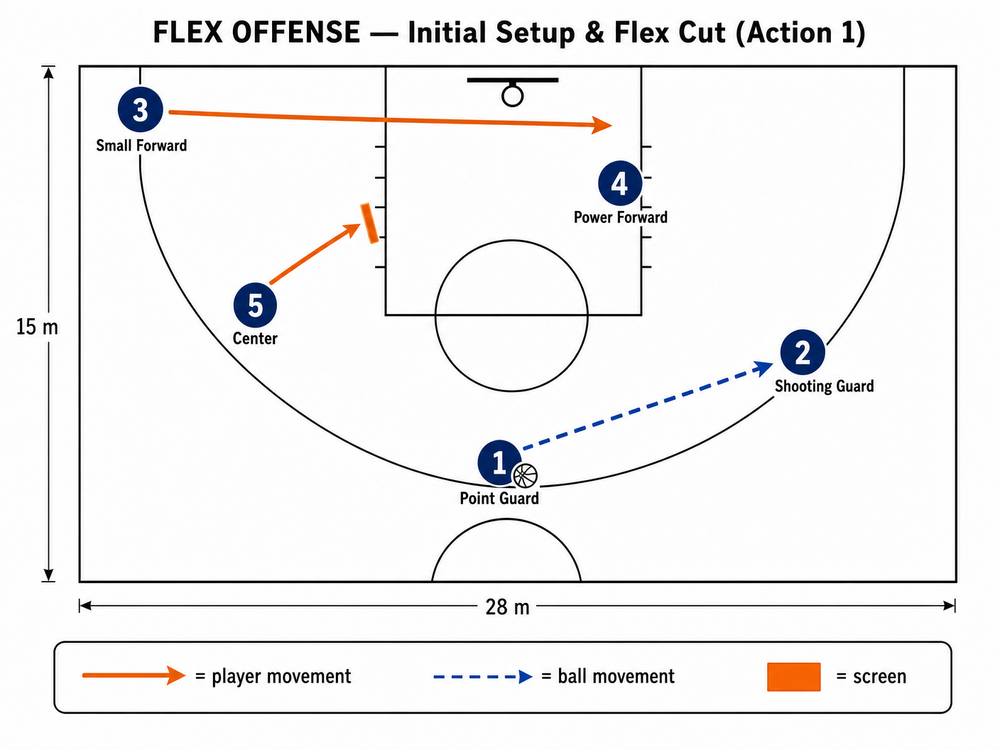
Initial Alignment:
The Flex Offense typically begins in a 4-out, 1-in or a 3-out, 2-in alignment, often referred to as a "1-4 High" or a standard "Flex" alignment.
- Player 1 (Point Guard): Top of the key with the ball.
- Player 2 (Shooting Guard): Right wing, near the three-point line extended from the free-throw line.
- Player 3 (Small Forward): Left corner, deep along the baseline.
- Player 4 (Power Forward): Right low block.
- Player 5 (Center): Left elbow (high post).
3. Step-by-Step Instructions
Action 1: The Initial Flex Cut
- The Entry Pass: Player 1 initiates the offense by passing the ball to Player 2 on the right wing.
- The Flex Screen: As the pass is made, Player 5 steps down from the left elbow to set a solid back-screen (the "flex screen") for Player 3 in the left corner.
- The Flex Cut: Player 3 uses the screen set by Player 5, cutting hard along the baseline under the basket toward the right low block.
- The First Look: Player 2 looks to pass to Player 3 for an immediate layup as they come off the screen.
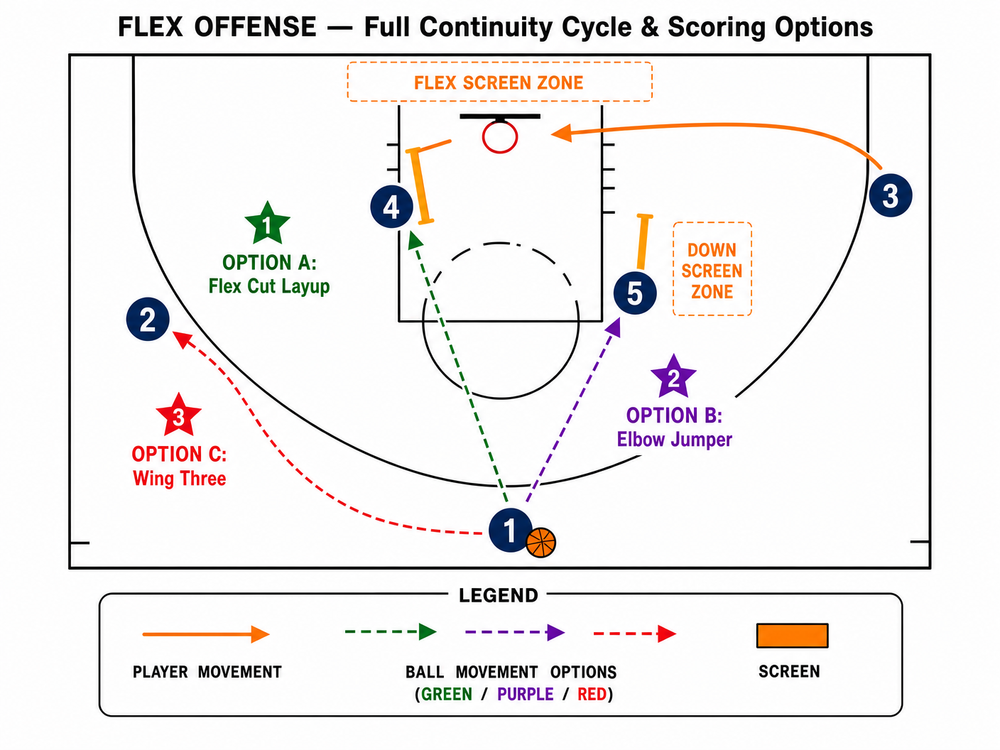
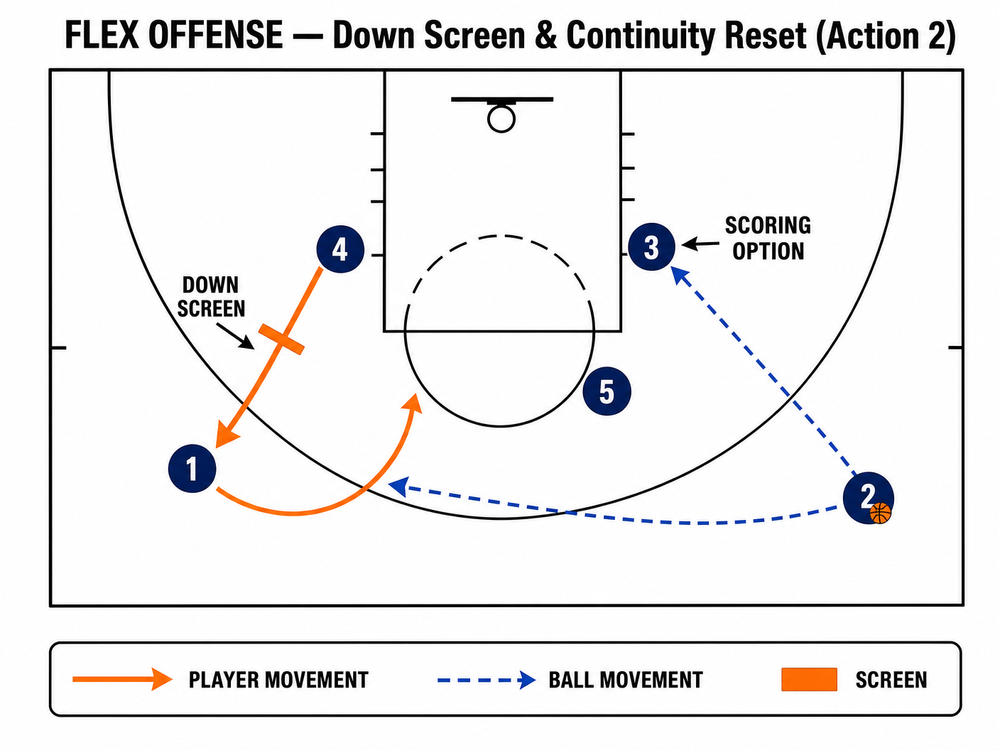
Action 2: The Down Screen and Continuity Reset
- The Down Screen: If Player 3 is not open for the layup, they settle on the right low block. Immediately, Player 1 (who made the initial pass) moves down to set a down-screen for Player 5 (who just set the flex screen).
- The Pop: Player 5 uses the down-screen from Player 1 and pops up to the top of the key.
- The Reversal Pass: Player 2 passes the ball to Player 5 at the top of the key.
- The Reset: Player 1, after setting the down-screen, steps out to the left wing. The offense is now perfectly mirrored on the opposite side of the floor.
Action 3: Continuous Motion
- The Second Flex Cut: With the ball now at the top of the key with Player 5, Player 5 passes to Player 1 on the left wing.
- The Mirror Action: As the pass is made, Player 4 (now on the right low block) sets a flex screen for Player 2 (in the right corner).
- The Cut: Player 2 cuts along the baseline to the left low block looking for the pass from Player 1.
- The Cycle Continues: If Player 2 isn't open, Player 5 sets a down-screen for Player 4, who pops to the top of the key, and the cycle repeats indefinitely.
4. Key Coaching Points
- Screening Angles: The effectiveness of the Flex Offense relies entirely on the quality of the screens. Screeners must have a wide base, be stationary upon contact, and angle their bodies so the cutter is directed straight to the basket.
- Patience and Timing: Cutters must wait for the screen to be fully set before moving. Rushing the cut ruins the spacing and allows the defense to slip through.
- Read the Defense: Cutters must read how the defense plays the screen. If the defender goes over the screen, curl to the basket. If they go under, pop out for a jump shot.
- Vocal Communication: Players must talk on every screen. Calling out names and actions ensures everyone is synchronized.
- Passing Accuracy: Crisp, accurate passing is vital. Passes should hit the cutter in stride, away from the defender.
5. Common Mistakes
- "Going Through the Motions": Players simply running to spots without actually looking to score. Every cut must be a threat to score.
- Slipping Screens Too Early: Screeners leaving their position before the cutter has used the screen, resulting in ineffective picks and offensive fouls.
- Poor Spacing: Players creeping too close together, which clogs the passing lanes and allows one defender to guard two offensive players.
- Telegraphing Passes: Staring down the cutter, allowing the defense to anticipate and intercept the pass.
6. Variations & Progressions
- Flex to Pick and Roll: Instead of reversing the ball for continuity, the player at the top of the key can transition immediately into a high pick-and-roll with the player who just set the down-screen.
- Flex Post Entry: If a mismatch occurs on the low block after a flex cut, isolate the post player rather than continuing the motion.
- Dribble Entry: Instead of a pass to initiate the offense, the point guard can dribble toward the wing, pushing the wing player down to the corner to start the flex action.
7. Age Adaptations
- Under 10s: Focus solely on the basic mechanics of passing, cutting, and basic screening without contact. Simplify the continuity to just one side of the floor.
- Under 12s/14s: Introduce the full continuity but emphasize the fundamental footwork of setting and using screens. Allow for more freedom if the play breaks down.
- Under 16s/Open: Demand precise timing, aggressive screening, and reading the defense for secondary options. Introduce complex variations and quick-hitters out of the flex alignment.
