

Basketball
Mastering the Flex Offense: A Complete Continuity Play Guide
Learn how to implement the classic Flex Offense continuity play to create high-percentage scoring opportunities through continuous screening and cutting.
What you need
Basketballs, Half court (28m x 15m FIBA markings), Cones (optional, for marking spots during initial teaching)
1. Overview
The Flex Offense is a timeless, pattern-based continuity offense designed to create high-percentage scoring opportunities near the basket and open perimeter jump shots. It relies on continuous ball movement, precise spacing, and a relentless series of screens—specifically the "flex cut" (a cross-screen along the baseline) followed immediately by a down screen.
This offense is highly effective because it forces the defense to constantly communicate and switch, often leading to mismatches or defensive breakdowns. It is particularly useful for teams that lack a dominant low-post scorer, as it emphasizes teamwork, passing, and equal opportunity scoring. The continuity aspect means the pattern can be run seamlessly from side to side until an open shot presents itself.
2. Setup
To effectively run the Flex Offense, you need a standard basketball court (28m x 15m FIBA dimensions) and a team that understands fundamental spacing and screening angles.
Player Positions:
- Player 1 (Point Guard): Starts at the top of the key or slightly offset to one side.
- Player 2 (Shooting Guard): Positioned on the wing (free-throw line extended) on the strong side.
- Player 3 (Small Forward): Starts in the deep corner on the weak side baseline.
- Player 4 (Power Forward): Positioned on the strong side low block.
- Player 5 (Center): Positioned at the weak side elbow (high post).
Proper spacing is critical. Players on the perimeter should be approximately 4 to 5 meters apart to ensure passing lanes remain open and defenders have to cover significant ground to help.
3. Step-by-Step Instructions
The Initial Action (The Flex Cut)
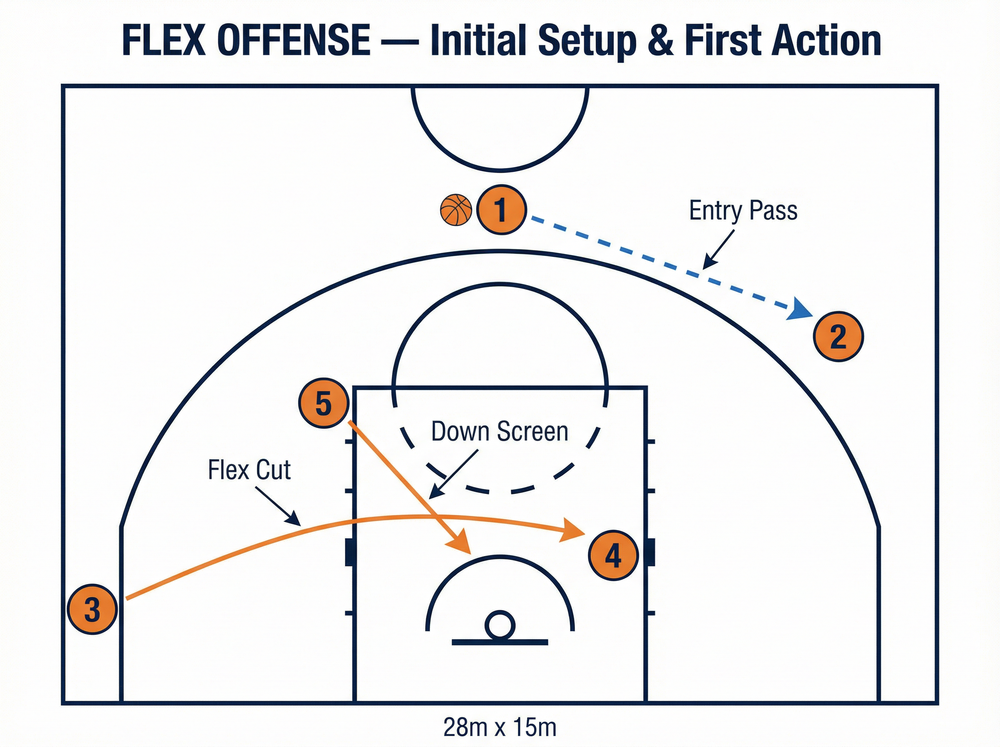
- Entry Pass: The play initiates with Player 1 passing the ball to Player 2 on the wing.
- The Flex Screen: As soon as the pass is made, Player 5 (at the weak side elbow) moves down to set a cross-screen on the strong side low block for Player 4. However, the primary action is the flex cut. Player 4 steps out slightly, and Player 3 (in the weak side corner) uses a screen set by Player 5 on the baseline to cut hard across the paint toward the strong side low block.
- Looking for the Cutter: Player 2 receives the pass and immediately looks inside to Player 3 cutting off the flex screen. If Player 3 is open, Player 2 delivers a crisp bounce pass or entry pass for a layup.
The Second Action (The Down Screen)
- Setting the Down Screen: If Player 3 is not open on the initial cut, they post up momentarily on the strong side block. Immediately after setting the flex screen for Player 3, Player 5 turns and sets a down screen for Player 1 at the top of the key.
- Using the Down Screen: Player 1 uses Player 5's down screen, cutting hard toward the ball-side elbow or wing area.
- Scoring Options: Player 2 looks to pass to Player 1 coming off the down screen for an open jump shot. Alternatively, Player 2 can look to feed Player 5, who may seal their defender in the post after setting the screen.
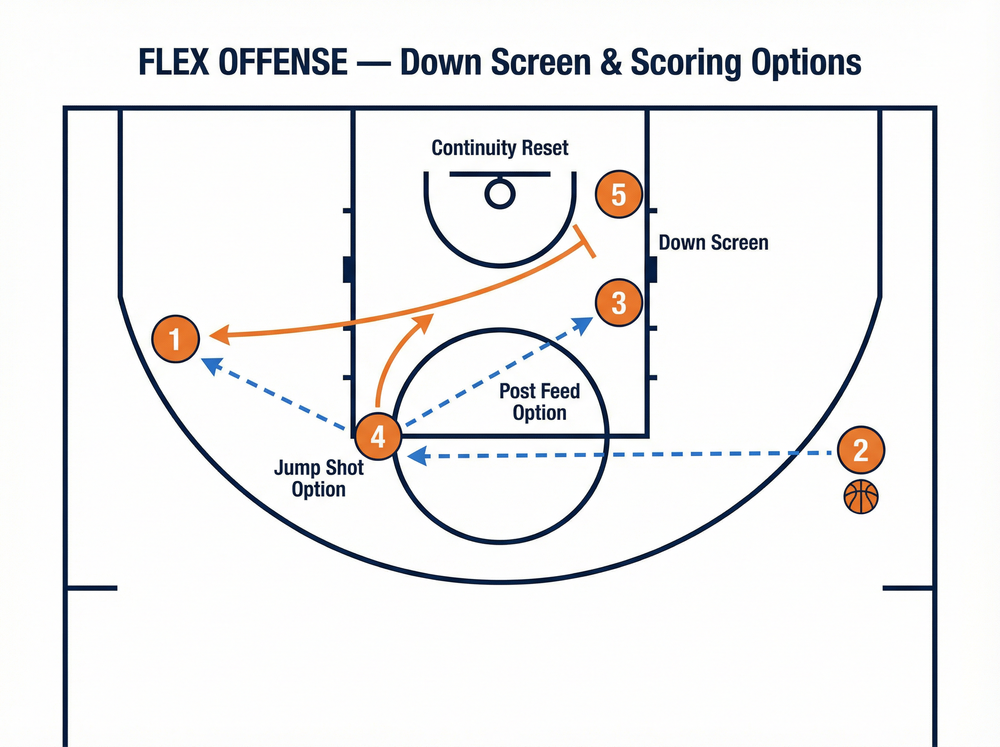
Continuity and Reset
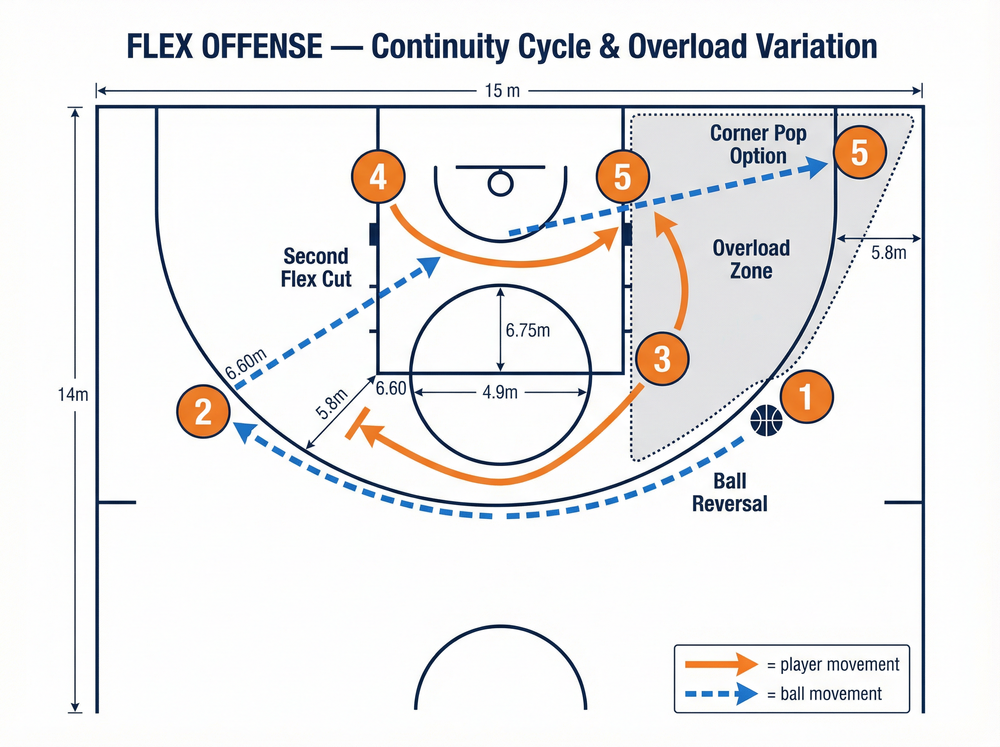
- Ball Reversal: If neither the flex cut nor the down screen produces an open shot, Player 2 passes the ball to Player 1 (who has popped out to the top/wing area).
- Continuing the Pattern: Player 1 then reverses the ball to Player 4, who has popped out to the weak side wing.
- The Next Cycle: The action immediately repeats on the opposite side. Player 2 (now in the corner) will make the flex cut off a screen set by Player 5 (now at the elbow), and Player 3 will set the down screen for Player 1. This continuous, rhythmic motion is the hallmark of the Flex Offense.
4. Key Coaching Points
- Screening Angles: Screeners must set wide, solid bases and anticipate the path of the defender. The flex screen should be set right on the edge of the paint to force the defender to go over or under.
- Patience and Timing: Cutters must wait for the screen to be set before moving. Rushing the cut ruins the spacing and allows the defense to recover easily.
- Read the Defense: Cutters must read how the defense plays the screen. If the defender trails, curl tightly. If the defender goes under, pop out for a jump shot.
- Pass Fakes: Perimeter players must use pass fakes to shift the defense and open up passing lanes to the cutters and post players.
- Vocal Communication: Screeners should call out the screen to help the cutter time their movement perfectly.
5. Common Mistakes
- Poor Spacing: Players creeping too close to the paint clog the driving lanes and make it easier for one defender to guard two offensive players.
- Slipping Screens Too Early: Screeners often slip to the basket before making solid contact, rendering the screen ineffective and leaving the cutter covered.
- Staring Down the Cutter: The ball handler must scan the entire floor. Staring directly at the flex cutter telegraphs the pass and invites defensive steals.
- Lack of Hard Cuts: If players jog through the cuts, the defense will not be forced to react or switch, neutralizing the offense's effectiveness.
6. Variations & Progressions
- Flex to Pick and Roll: If the initial flex cut is covered, instead of running the down screen, the screener (Player 5) can immediately step up and set a ball screen for the wing player (Player 2), transitioning seamlessly into a side pick-and-roll.
- Dribble Entry: Instead of an initial pass to the wing, Player 1 can dribble at Player 2, forcing a shallow cut or backdoor cut, which then initiates the flex screening action from a different angle.
- Post Feed and Split: If the ball is successfully entered into the post (to Player 3), the perimeter players can execute a "split cut" action, crossing paths to confuse the defense while the post player looks to score or pass.
7. Age Adaptations
- Under 10s / Under 12s: Focus purely on the fundamental movements: passing, cutting, and basic spacing. Introduce the concept of a cross-screen without the complex continuity. Emphasize making layups off the initial cut.
- Under 14s: Introduce the full continuity pattern. Spend significant practice time on the technique of setting and using both the flex screen and the down screen. Teach basic reads (curl vs. pop).
- Under 16s / Open: Implement advanced reads and counters. Teach players how to react when the defense switches all screens or denies the wing entry pass. Incorporate the variations mentioned above to keep the offense unpredictable.
