Mastering the UCLA Cut: A Fundamental Entry Play for All Levels
Learn how to execute the classic UCLA Cut, a highly effective entry play that creates immediate scoring opportunities and flows seamlessly into continuity offenses.
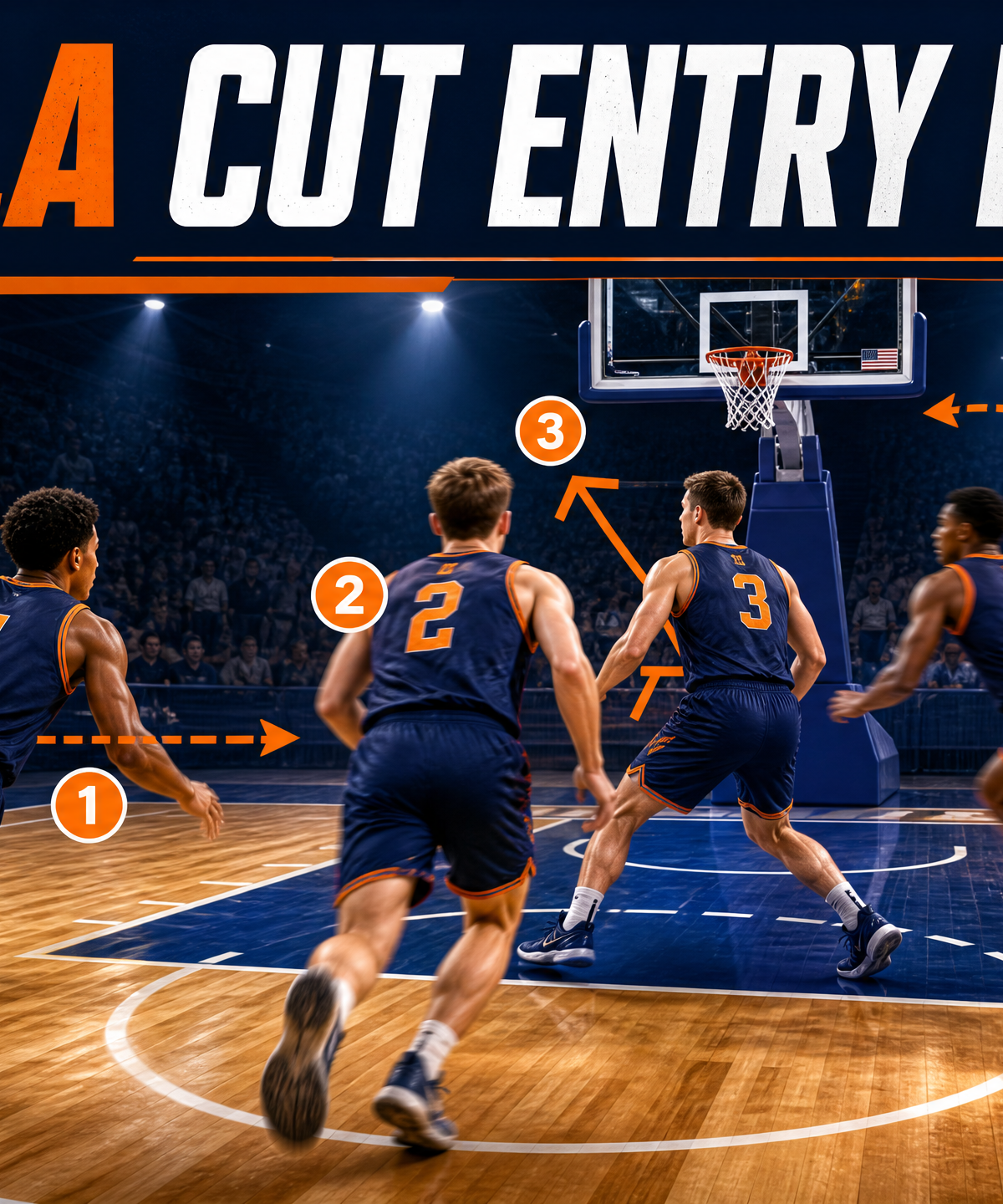
Equipment Needed
1. Overview
The UCLA Cut is one of the most fundamental and enduring actions in basketball. Popularized by legendary coach John Wooden during his tenure at UCLA, this entry play is designed to create a high-percentage scoring opportunity right at the rim. It is highly versatile, easy to teach, and serves as an excellent initiator for various continuity offenses, such as the Flex or standard motion principles.
This play is best used when you need a quick basket against man-to-man defense, to punish an over-aggressive defender denying the wing pass, or simply to get the ball moving and force the defense to shift early in the possession.
2. Setup
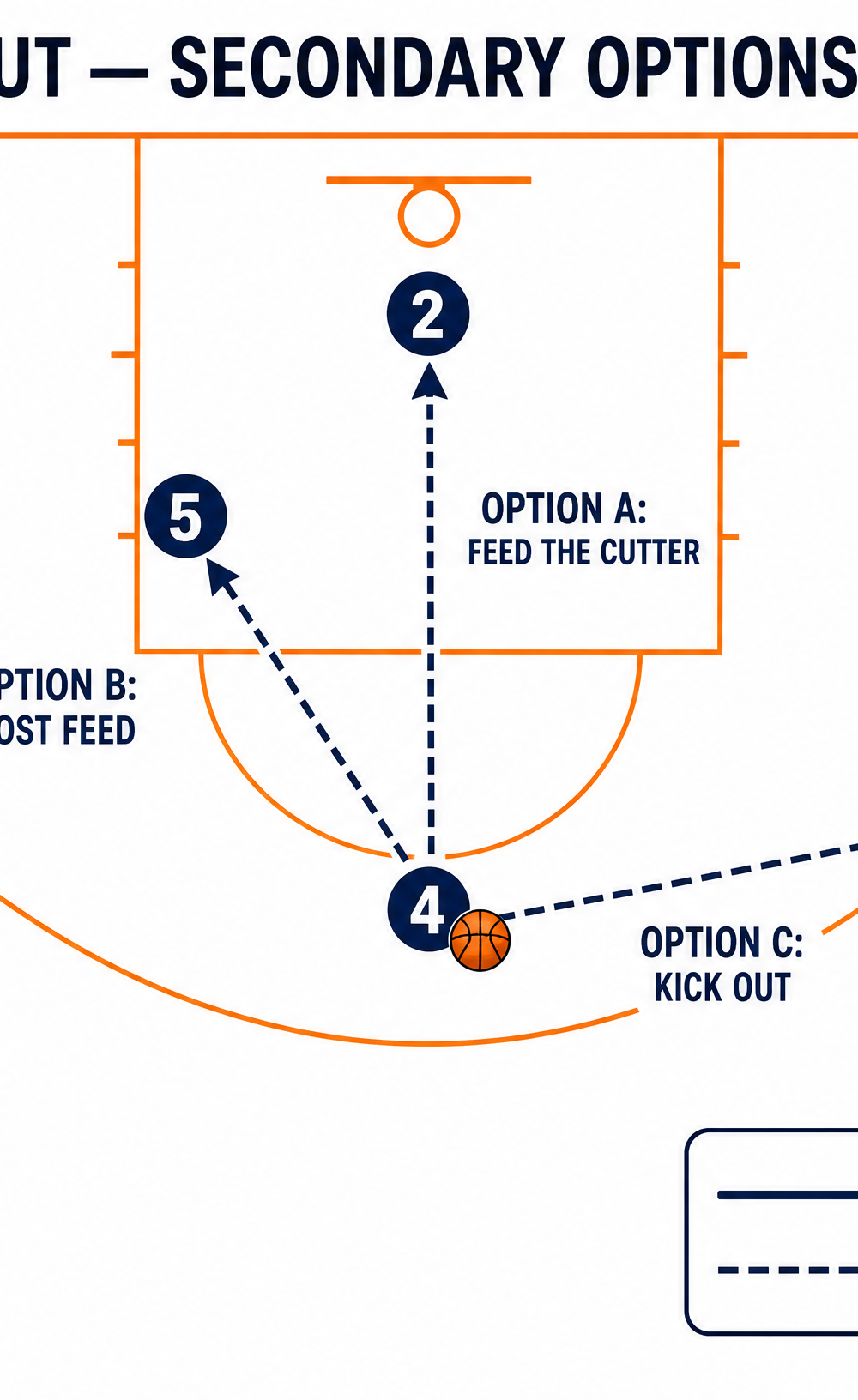
Court Dimensions: Standard FIBA full court (28m x 15m) or half court for practice.
Equipment Needed: 1 basketball, optionally cones to mark starting spots for beginners.
Player Positions (Initial Setup):
- Player 1 (Point Guard): Starts at the top of the key with the basketball.
- Player 2 (Shooting Guard): Positioned on the right wing, outside the three-point arc.
- Player 3 (Small Forward): Positioned on the left wing, outside the three-point arc.
- Player 4 (Power Forward): Positioned at the right high post (elbow), near the free-throw line extended.
- Player 5 (Center): Positioned at the left low post block.
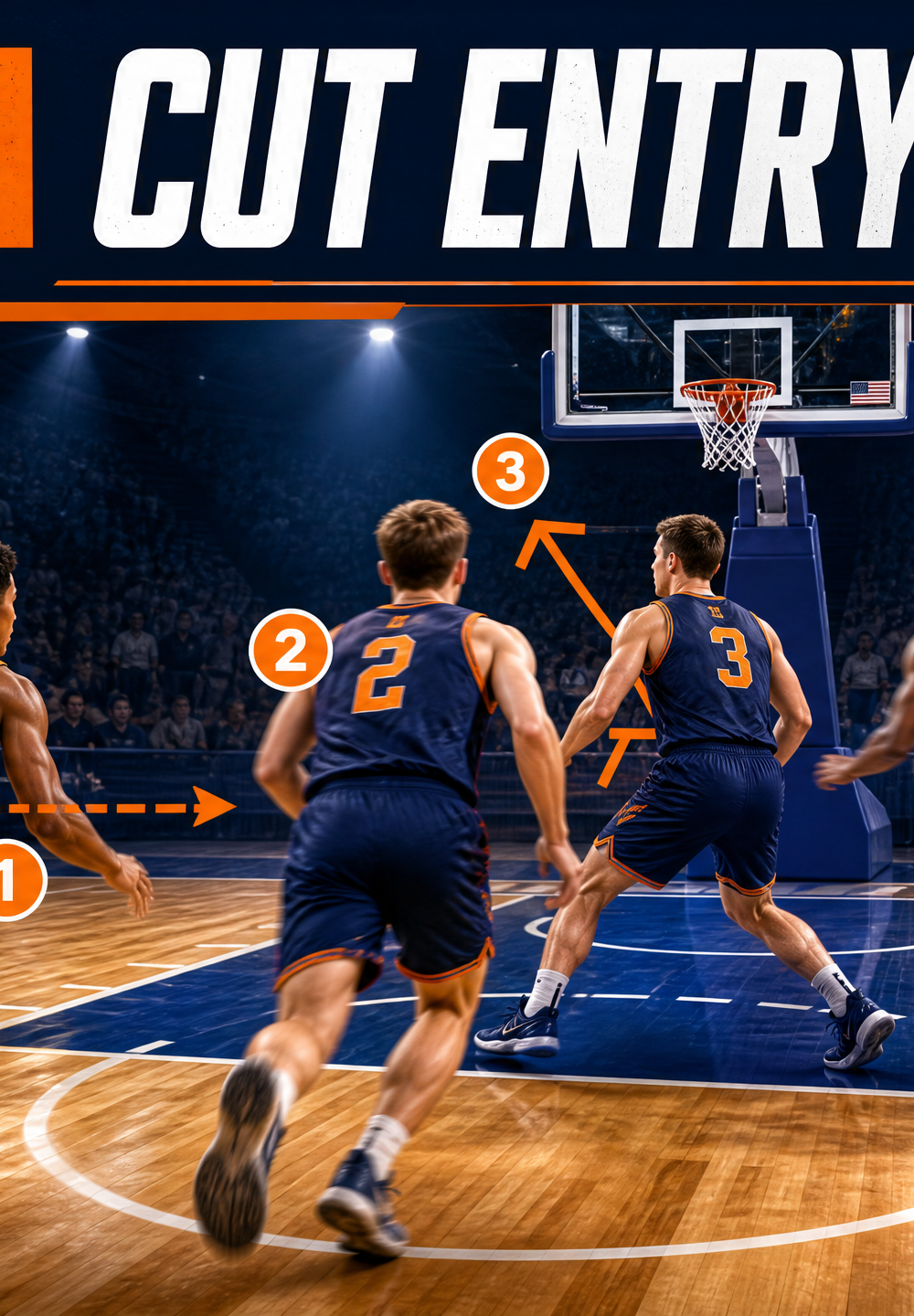
3. Step-by-Step Instructions
Phase 1: The Entry Pass
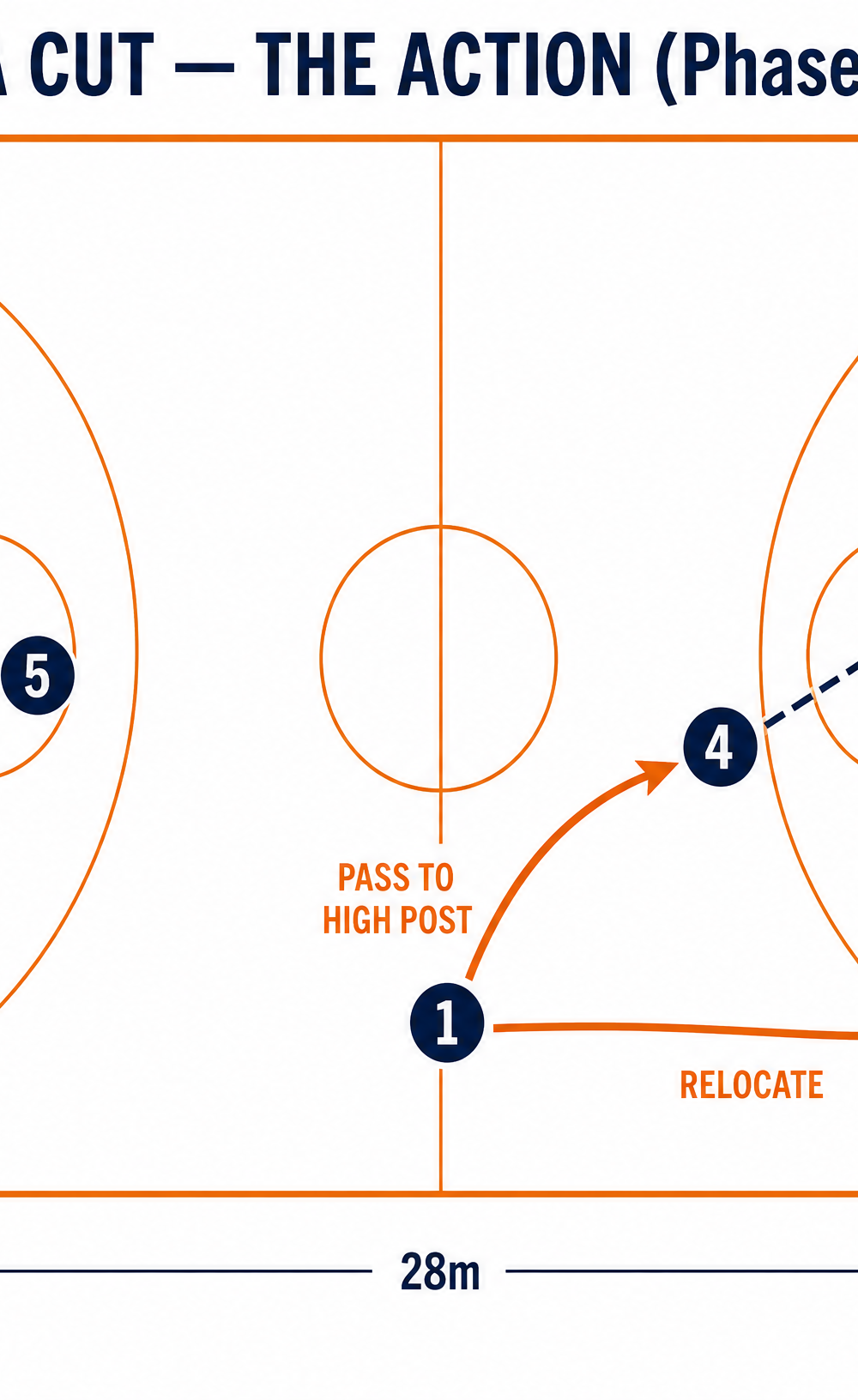
- Player 1 initiates the offense by dribbling slightly to the right side of the floor to improve the passing angle.
- Player 4 steps up to the high post/elbow area to receive the pass.
- Player 1 makes a crisp, direct pass to Player 4 at the high post.
Phase 2: The UCLA Cut
- As soon as the pass is made, Player 1 sets up their defender with a quick jab step away from the intended path.
- Player 4 catches the ball and immediately pivots to face the basket (triple threat position), looking for the cutter.
- Player 1 uses a back screen set by Player 4 (or simply cuts hard off Player 4's hip if no formal screen is set) and sprints aggressively down the lane toward the basket. This is the 'UCLA Cut'.
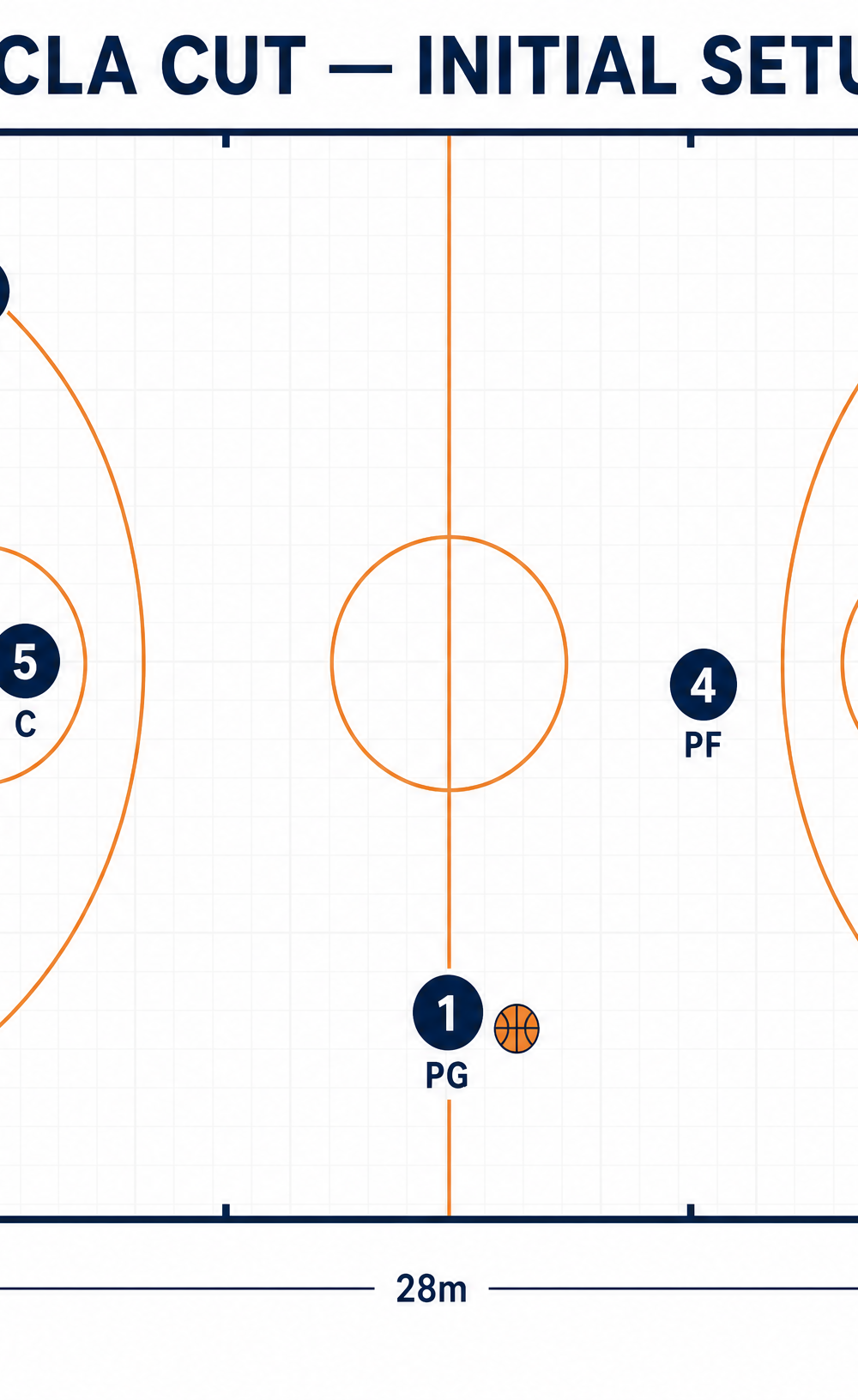
Phase 3: Secondary Options & Continuity
- Option A (Feed the Cutter): If Player 1 is open on the cut, Player 4 delivers a bounce pass or lead pass for an uncontested layup.
- Option B (Post Feed): If the cut is covered, Player 1 clears out to the strong-side corner or weak-side block. Player 4 can then look to feed Player 5 sealing their defender on the low block.
- Option C (Kick Out): If neither interior option is available, Player 4 can kick the ball out to Player 2 or Player 3 on the wings to initiate the next phase of the offense (e.g., a pick-and-roll or a reversal).
4. Key Coaching Points
- Timing is Everything: The cutter (Player 1) must wait for Player 4 to catch and face before initiating the hard cut. Cutting too early ruins the spacing and passing angle.
- Sell the Cut: Player 1 must aggressively set up the defender before using the screen. A sudden change of pace is critical to get separation.
- High Post Vision: Player 4 must catch, pivot, and immediately get their eyes on the rim and the cutter. They must be a willing and capable passer.
- Read the Defense: If the defender goes under the screen, Player 1 should pop back out for a jump shot. If the defender trails, the hard cut to the rim is the primary read.
5. Common Mistakes
- Poor Passing Angles: Player 1 failing to improve the angle before passing to the high post, leading to deflected passes.
- Rushing the Cut: Player 1 cutting before Player 4 has secured the ball and turned to face the basket.
- Weak Screens: Player 4 setting a soft or illegal screen. They must establish a wide, solid base.
- Lack of Post Presence: Player 5 failing to engage their defender, allowing the help defense to easily collapse on the cutter.
6. Variations & Progressions
- Progression 1: Add a Dribble Handoff (DHO): If the cut is covered, Player 4 can immediately flow into a dribble handoff with Player 2 or Player 3 on the wing.
- Progression 2: The 'Blind Pig' Action: If the defense aggressively denies the pass to the high post, Player 4 can backcut to the rim while Player 5 flashes to the high post to receive the entry pass.
- Variation 1: Wing Entry: The play can be initiated with an entry pass to the wing (Player 2 or 3) followed by a pass to the high post, rather than directly from the point guard.
7. Age Adaptations
- Under 10s: Focus heavily on the fundamentals of the pass and the hard cut. Remove the formal screen aspect and just focus on the 'pass and cut' principle.
- Under 12s-14s: Introduce the back screen and the concept of reading the defender (going over vs. under). Emphasize proper footwork on the catch at the high post.
- Under 16s & Open: Run the action at full game speed. Incorporate advanced reads, counter-movements (like the Blind Pig), and seamless transitions into complex continuity offenses.