The 'Middle Outlet' Press Break: Beating Full-Court Pressure
Master a reliable, structured press break that utilizes the middle of the floor to safely advance the ball and create high-percentage scoring opportunities against aggressive full-court pressure.
Equipment Needed
1. Overview
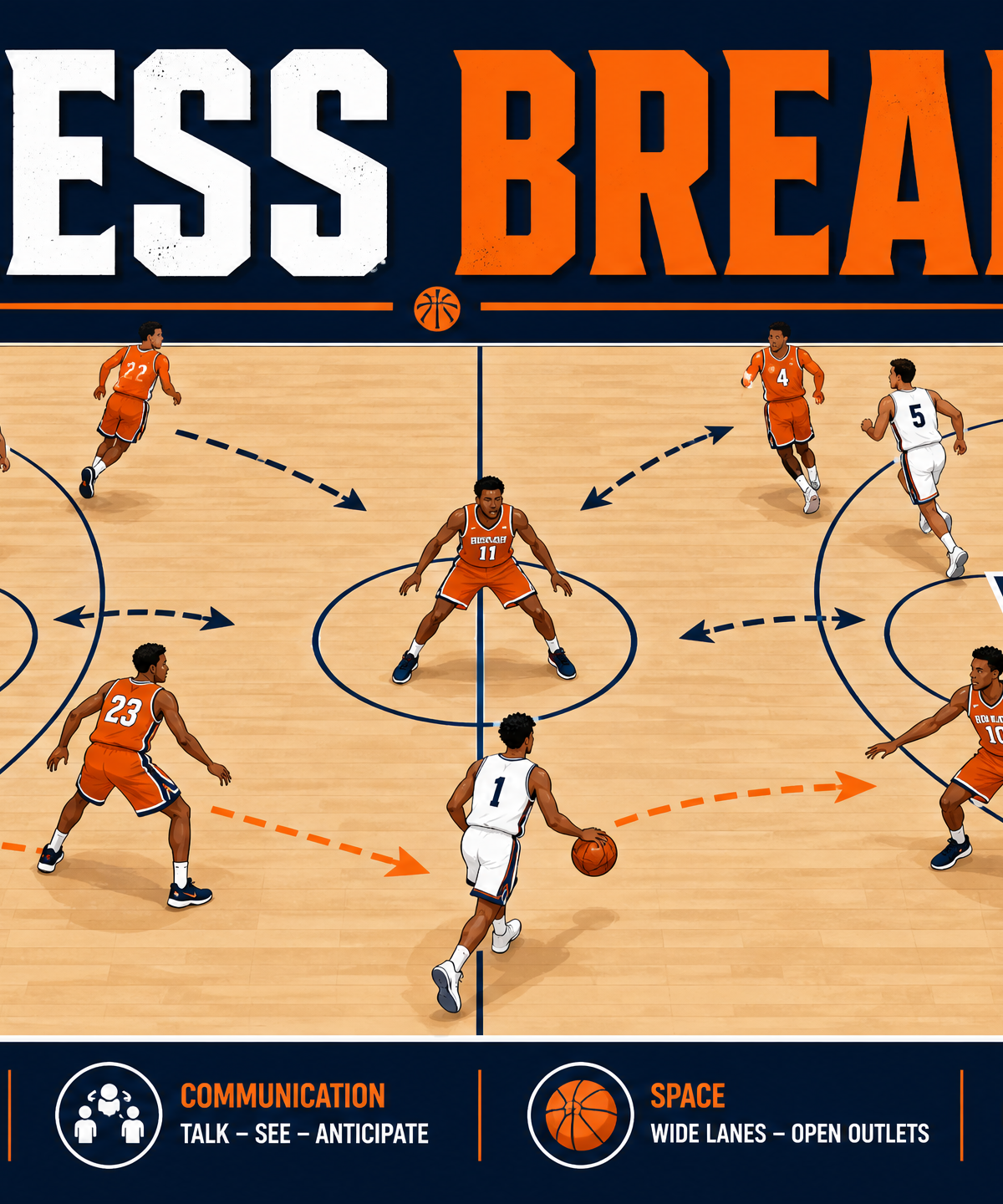
Full-court pressure can disrupt an offense, force turnovers, and swing the momentum of a game in seconds. The 'Middle Outlet' press break is a structured, highly effective set play designed to counter aggressive man-to-man or zone presses. Instead of relying solely on a point guard's dribbling ability, this play utilizes floor spacing, sharp passing, and strategic positioning to safely advance the ball up the 28m FIBA court.
The primary objective is not just to survive the press, but to punish it. By drawing defenders to the sidelines and flashing a big man to the middle of the floor, the offense creates a numerical advantage in the frontcourt, leading to high-percentage scoring opportunities.
2. Setup
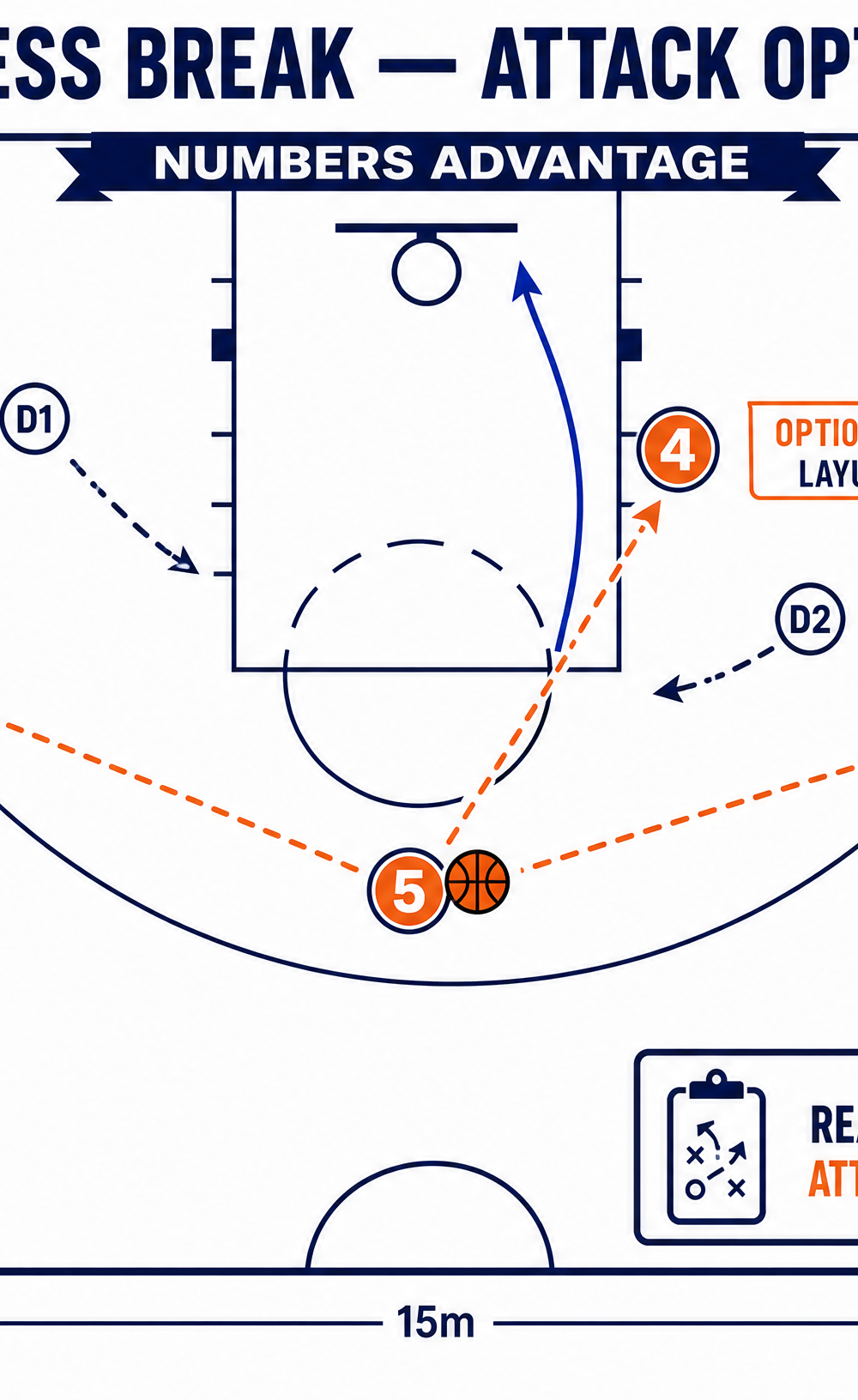
Court Dimensions: Standard FIBA court (28m x 15m).
Equipment Needed: 1 Basketball, 5 offensive players, 5 defensive players (or cones for initial walk-throughs).
Player Positions (Initial Setup):
- 1 (Point Guard): Inbounds the ball from the baseline (center).
- 2 (Shooting Guard): Positioned on the right sideline, free-throw line extended.
- 3 (Small Forward): Positioned on the left sideline, free-throw line extended.
- 4 (Power Forward): Positioned near half-court on the right side.
- 5 (Center): Positioned near half-court on the left side.
3. Step-by-Step Instructions
Phase 1: The Inbound and Initial Read
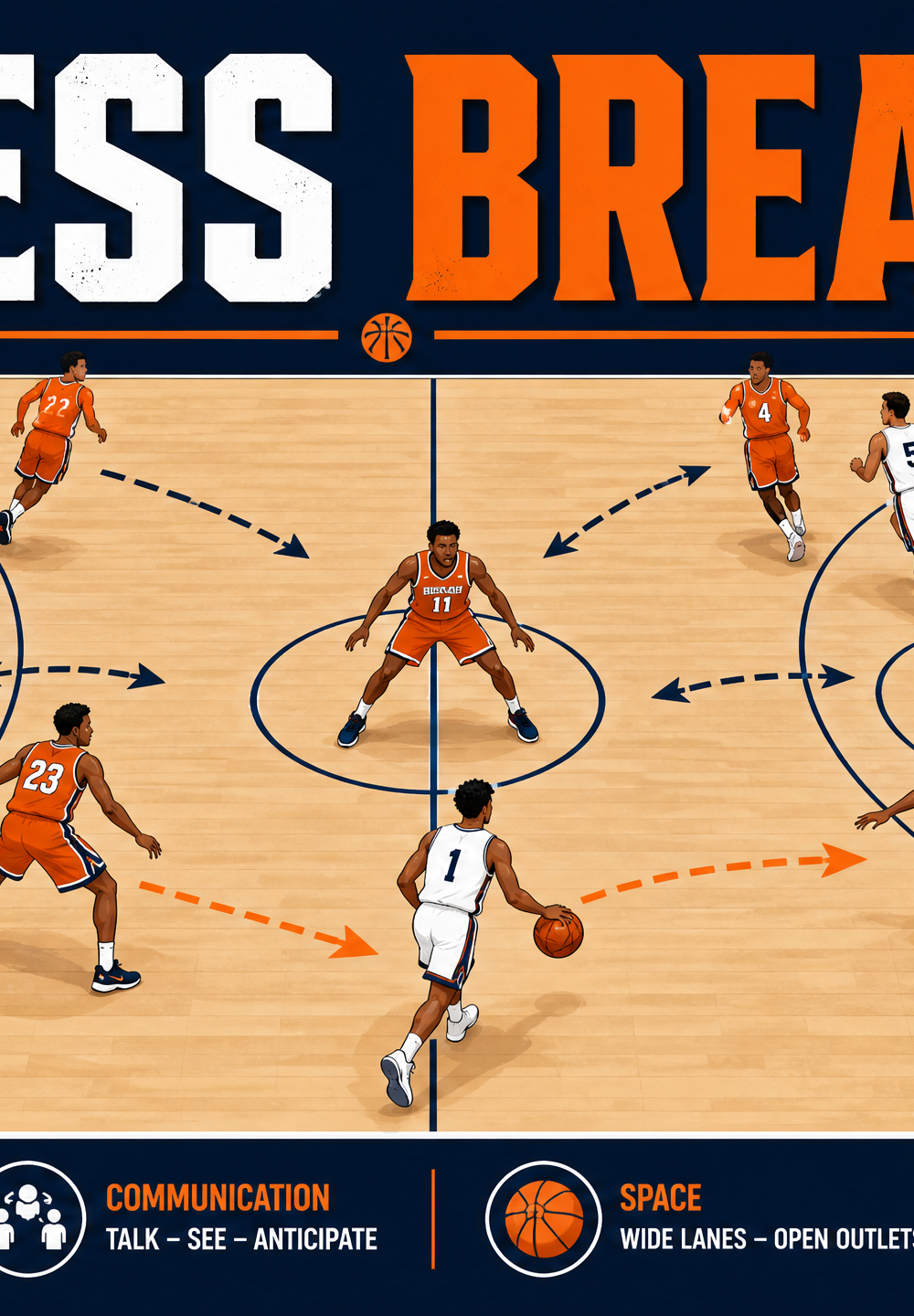
- The play begins after a made basket by the opposition. 1 takes the ball out of bounds quickly.
- 2 and 3 make sharp V-cuts to get open on their respective sidelines. They must present clear passing targets.
- 1 reads the defense and passes to the open guard (let's assume the pass goes to 2 on the right side).
Phase 2: The Middle Flash and Advance
4. As soon as 2 catches the ball, 1 immediately steps inbounds and cuts up the weak-side sideline (or stays behind the ball as a safety outlet, depending on the defensive trap).
5. Simultaneously, 5 (the Center) flashes hard to the middle of the floor, right around the center circle. This is the critical 'Middle Outlet'.
6. 4 sprints toward the offensive basket, putting pressure on the rim.
7. 2 pivots and delivers a crisp, two-handed overhead pass to 5 in the middle of the floor.
Phase 3: Attacking the Advantage
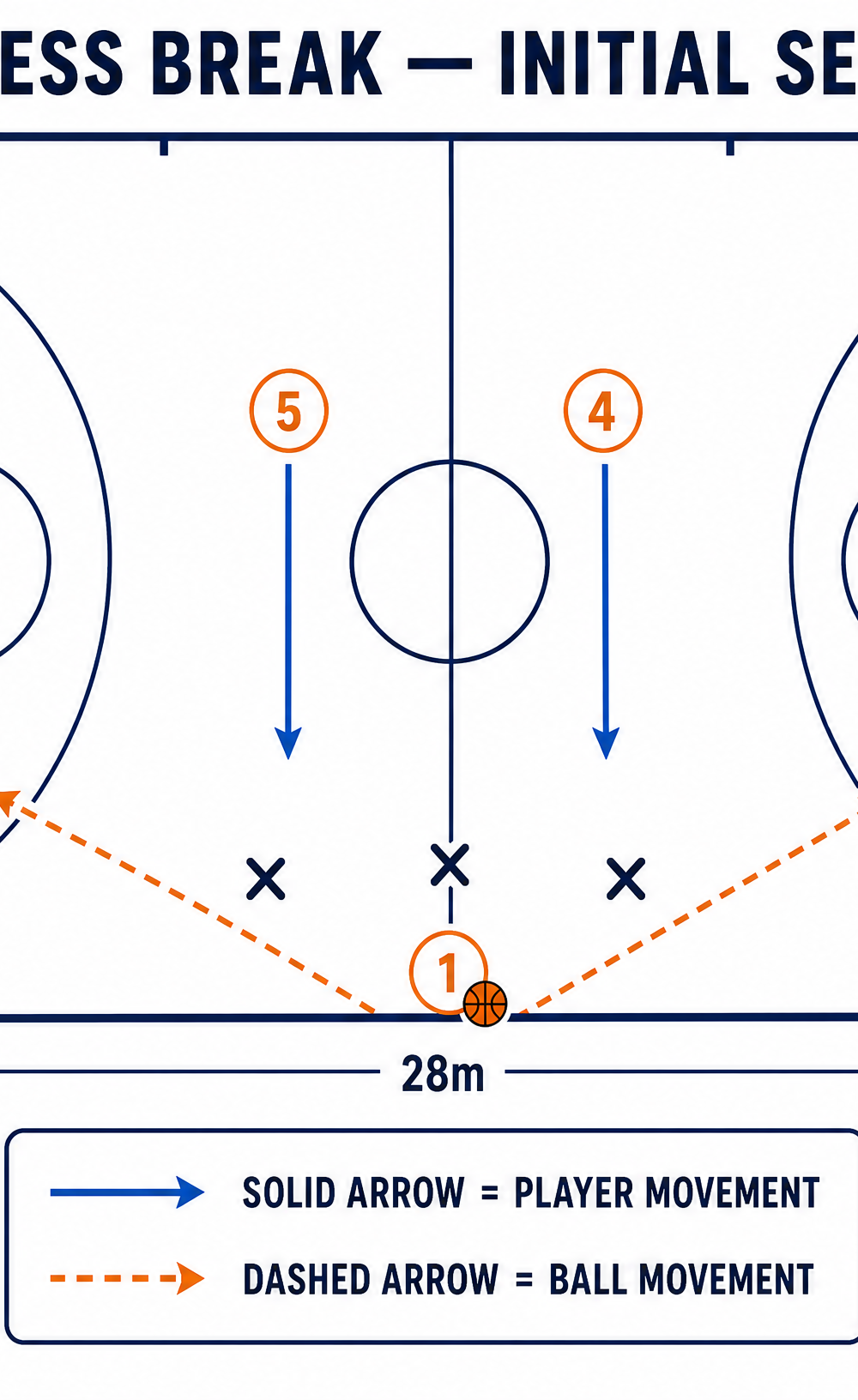
8. Upon catching the ball in the center circle, 5 immediately turns to face the offensive basket. The offense now has a numbers advantage (often a 3-on-2 or 2-on-1).
9. 5 evaluates the floor and makes a quick decision:
- Option A: Pass to 4 cutting hard to the rim for a layup.
- Option B: Pass to 2 (who sprints up the wing after passing) for an open three-pointer.
- Option C: Pass to 1 (trailing on the opposite wing) for a pull-up jumper or secondary drive.
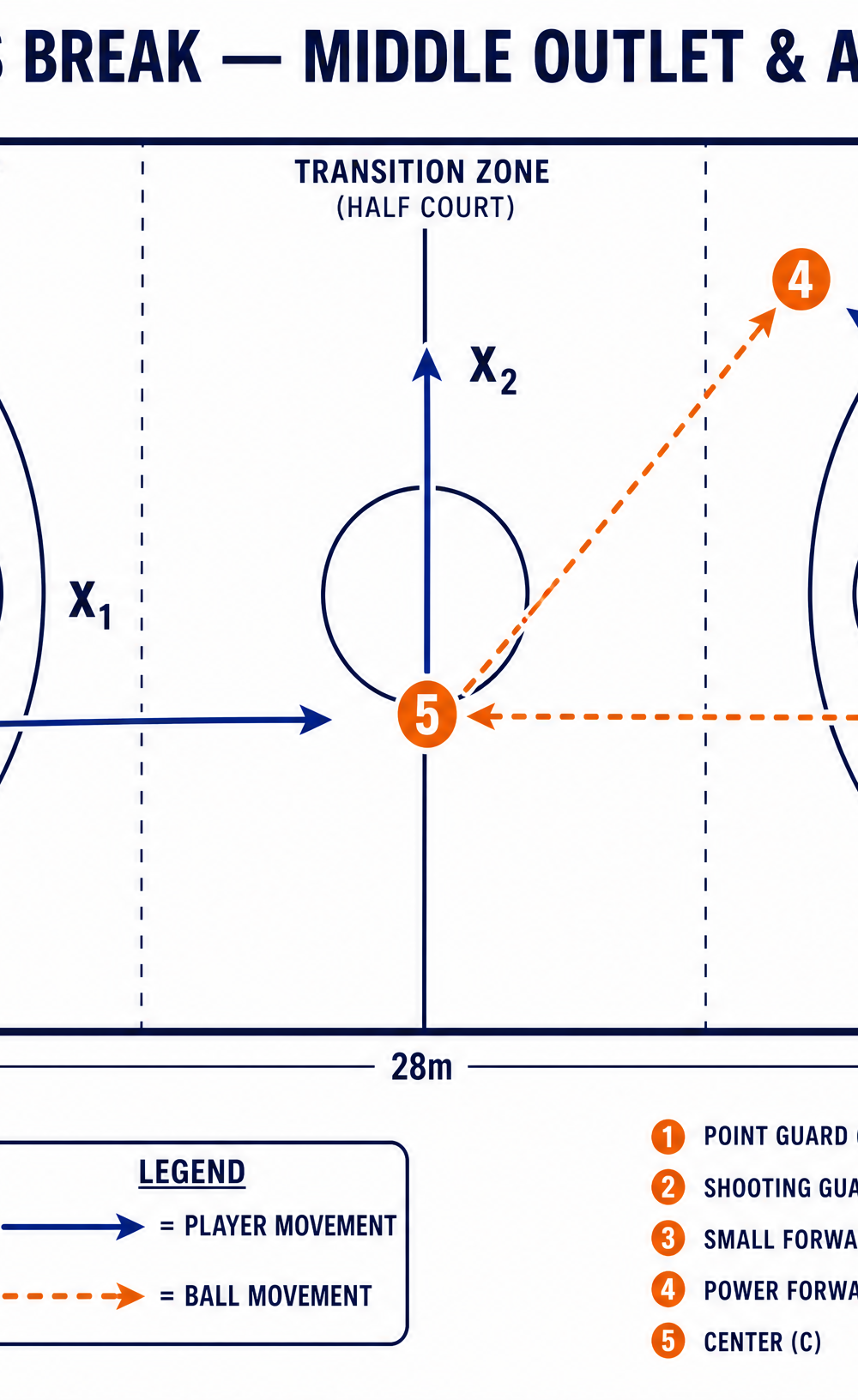
4. Key Coaching Points
- Meet Every Pass: Receivers (especially 2 and 3 on the initial inbound) must aggressively step toward the ball. Never wait for the ball to come to you against a press.
- Keep the Ball Off the Floor: Emphasize passing over dribbling. The ball moves faster in the air than on the bounce, and dribbling into a trap is the most common cause of turnovers.
- The Middle Man Must Be Big and Strong: Player 5 needs to be a strong target who can catch the ball securely, pivot under pressure, and make accurate reads down the floor.
- Look Before You Turn: When 5 catches the ball in the middle, they must look up the floor immediately. The scoring opportunity disappears if the middle man hesitates.
- Maintain Spacing: Players must stay wide to stretch the defense. If players bunch up, one defender can guard two offensive players, making the press more effective.
5. Common Mistakes
- Panicking and Rushing: Players often speed up their internal clock against pressure. Teach them to stay composed, pivot strongly, and use shot fakes to move defenders.
- Inbounding Under the Backboard: The inbounder (1) should take the ball out slightly off-center to improve passing angles and avoid hitting the backboard on a long pass.
- Weak Passes: Looping, slow passes will be intercepted. All passes must be sharp, direct, and ideally two-handed (chest or overhead) for maximum velocity and accuracy.
- Turning the Back to the Defense: When 2 or 3 catch the inbound pass, they must immediately face up the court to see the floor. Turning their back allows the trap to close in blindly.
6. Variations & Progressions
- Progression 1 (No Dribble Drill): Run the entire press break in practice without allowing any player to dribble. This forces players to rely entirely on spacing, cutting, and passing.
- Progression 2 (Add a Trailer): If the defense drops back quickly, have player 3 trail the play as a secondary option for a top-of-the-key three-pointer.
- Variation 1 (Four Across): Instead of a 2-1-2 setup, start with four players across the free-throw line extended and have them break in different directions to confuse the defense.
7. Age Adaptations
- Under 10s / Under 12s: Focus heavily on the fundamentals of pivoting and strong passing. You may need to shorten the distances (e.g., have 4 and 5 start closer to the three-point line rather than half-court) to accommodate shorter passing ranges.
- Under 14s / Under 16s: Introduce the concept of reading the defense. Teach player 5 how to recognize whether the defense is in a zone press or man-to-man, and adjust their attack accordingly.
- Open / Advanced: Focus on the speed of execution and the transition from breaking the press directly into early offense or secondary break actions without pausing to set up a half-court play.