

Netball
Penalty Pass Advantage Play: Overloading the Goal Circle
Master the penalty pass in the attacking third with this set play designed to overload the defense and create a high-percentage scoring opportunity.
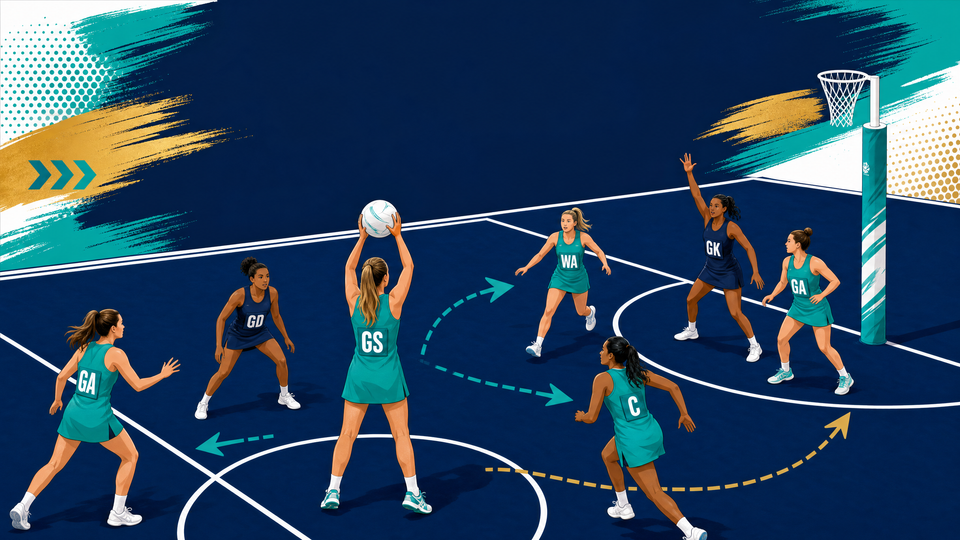
What you need
1 Netball, Netball Court, Bibs (Attacking and Defending)
Overview
The Penalty Pass Advantage Play is a highly effective offensive set piece designed to capitalise on a penalty awarded in the attacking third, just outside the goal circle. When an opposition player is penalised (e.g., for contact or obstruction) and forced to stand out of play (0.9m away), the attacking team gains a momentary numerical advantage (a 7v6 situation on court, but effectively a 4v3 in the immediate attacking zone).
This play aims to exploit that advantage by using coordinated, simultaneous movements from the Goal Attack (GA), Goal Shooter (GS), and Wing Attack (WA) to overload the top of the goal circle, confuse the remaining defenders, and deliver a clean, high-percentage pass to a shooter in a scoring position.
Setup
Equipment Needed:
- 1 Netball
- Full netball court (30.5m x 15.25m)
- Bibs for two teams (Attacking: C, WA, GA, GS. Defending: GD, GK, WD)
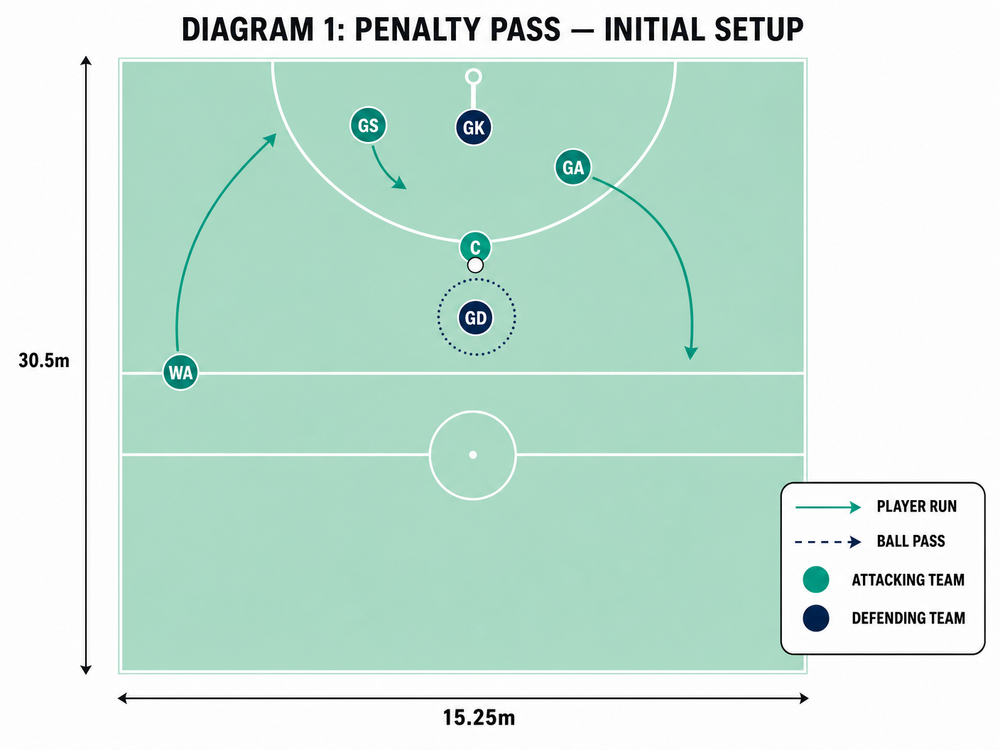
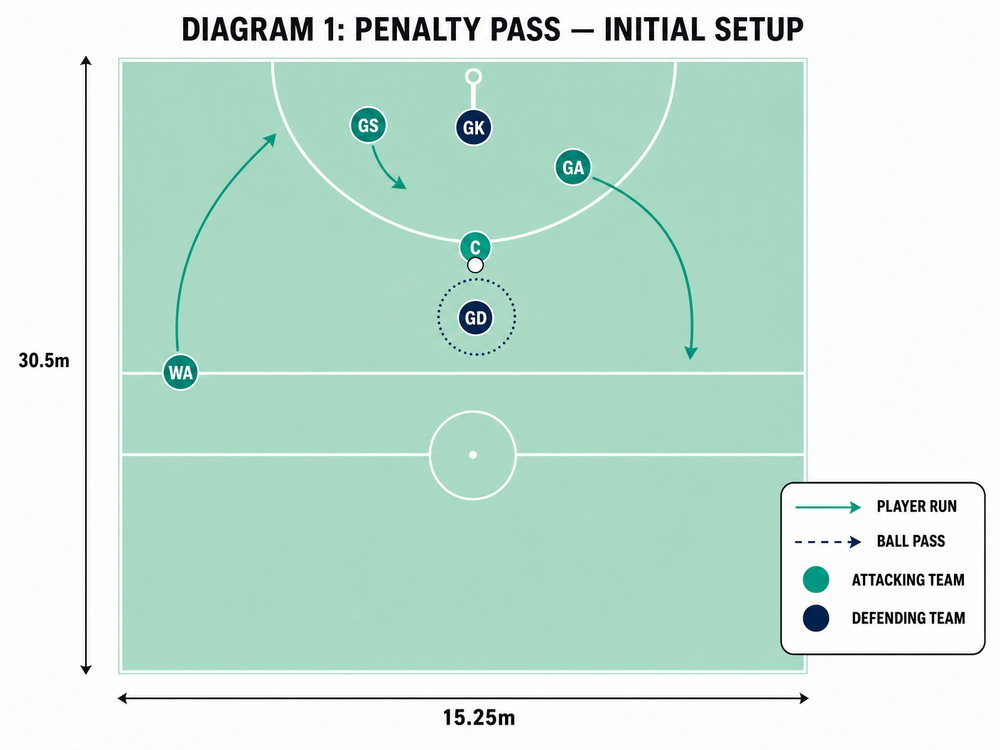
Court Setup & Initial Positions:
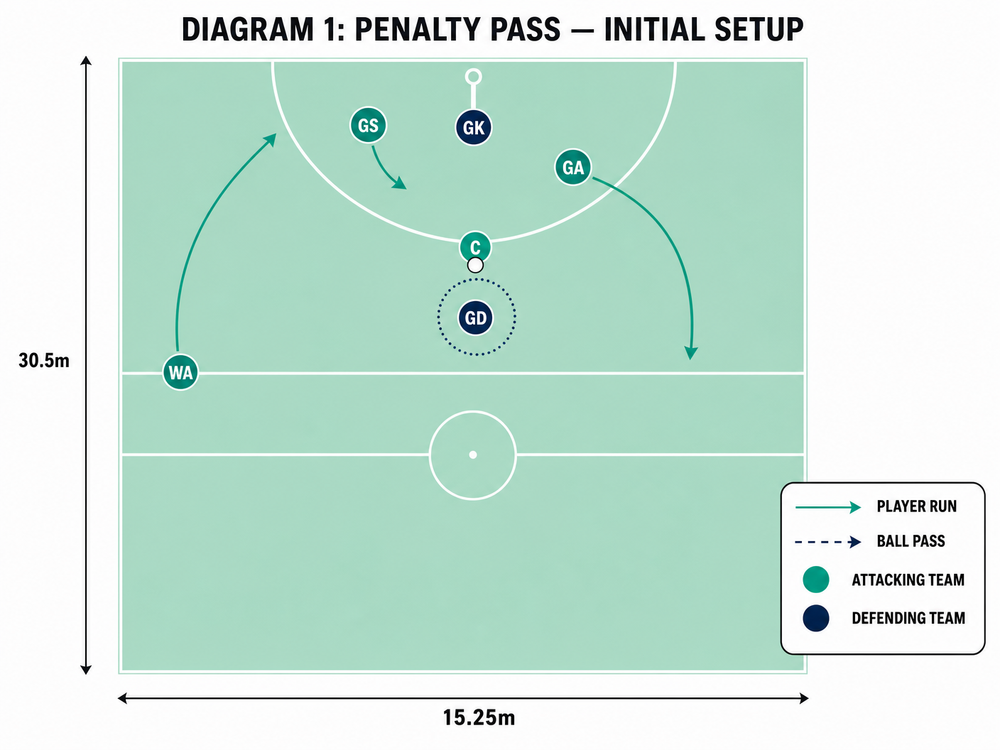
This play is initiated when the Centre (C) or another attacker is awarded a penalty pass near the top edge of the goal circle.
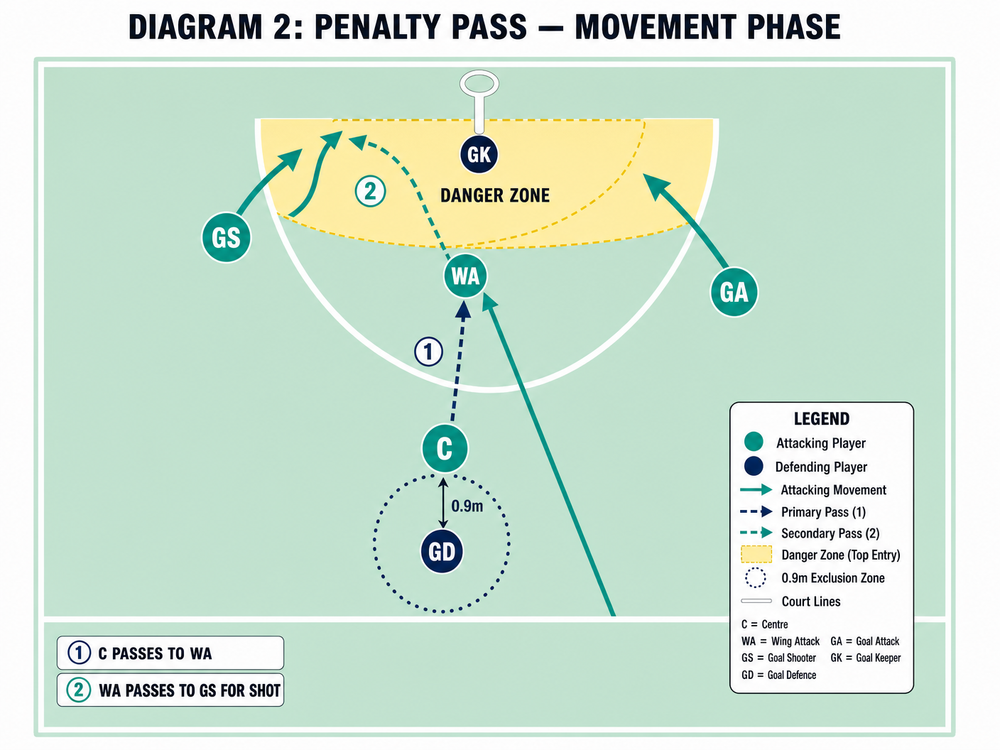
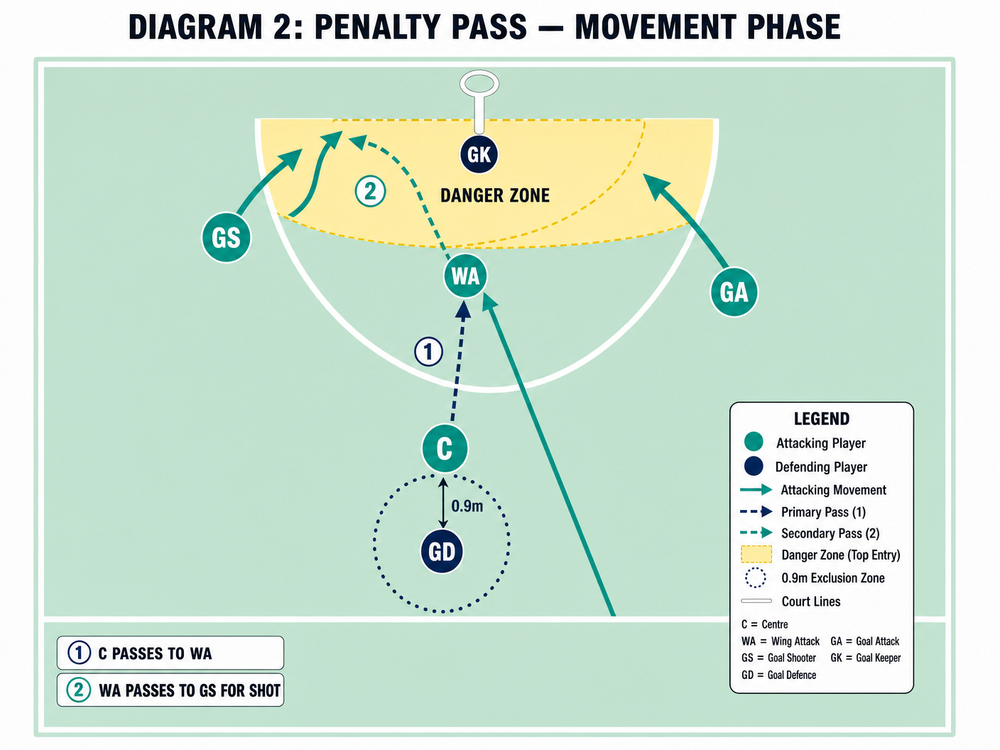
- Centre (C): Standing at the penalty spot, holding the ball, ready to pass.
- Goal Defence (GD - Opposition): Standing out of play, 0.9m away from the C.
- Wing Attack (WA): Positioned wide on the transverse line, creating width.
- Goal Attack (GA): Positioned on the right side of the goal circle, ready to drive.
- Goal Shooter (GS): Positioned deep on the left side of the goal circle, engaging the Goal Keeper (GK).
Step-by-Step Instructions
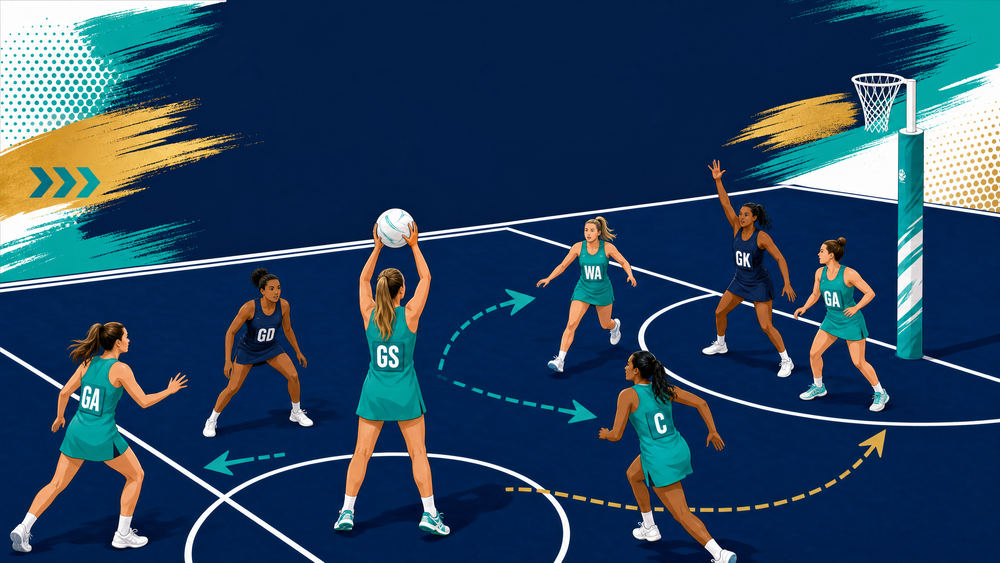
- The Set: The C steps up to the penalty mark and waits for the umpire's whistle. The GD is positioned 0.9m away, out of play. The attacking players (WA, GA, GS) hold their starting positions to draw the defenders out.
- The Trigger: On the umpire's whistle, the play begins. The C must not delay; quick execution is vital to prevent the defense from resetting.
- Simultaneous Movement:
- The GS makes a sharp, curved lead from the deep left toward the top-left of the goal circle.
- The GA drives hard and direct from the right side toward the top-right of the goal circle.
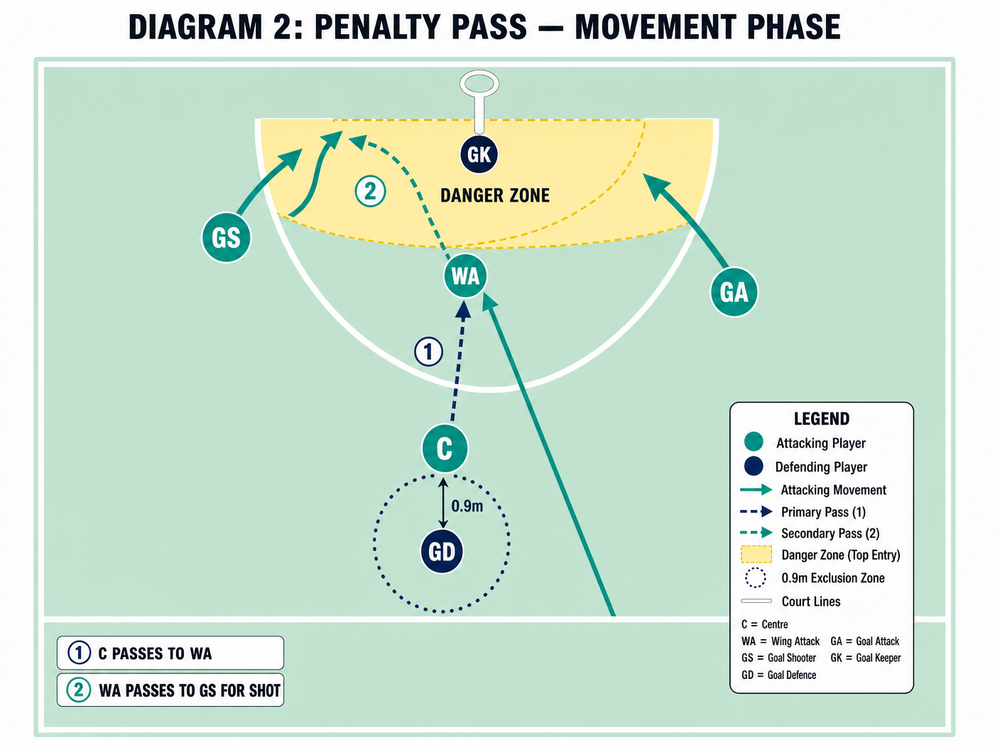
- The WA cuts diagonally from the transverse line into the space at the top-centre of the goal circle.
- The Primary Option: The C reads the defense. The primary target is the WA hitting the top of the circle. The C delivers a strong, flat pass to the WA.
- The Secondary Phase: As the WA receives the ball, the GS and GA continue their drives into the 'Danger Zone' (the top entry area of the goal circle). The WA immediately looks to offload a quick pass to either the GS or GA who have now established front position on their defenders for a shot.
Key Coaching Points
- Timing is Everything: The attackers must not move before the whistle, but must explode into action the millisecond it blows. Premature movement allows the defense to adjust.
- Decisive Drives: The GA and GS must commit fully to their drives. Half-hearted leads will not draw the defenders or create the necessary space.
- Vision of the Passer (C): The C must keep their head up and read the play. While the WA is the primary option, if the defense reads the play and covers the WA, the C must be ready to hit the GA or GS directly.
- Quick Release: The WA must catch and look into the circle immediately. Holding the ball allows the out-of-play GD to re-enter the play and disrupt the second pass.
Common Mistakes
- Crowding the Space: Attackers running the same lines or ending up in the same area. Emphasise maintaining spacing and hitting specific zones.
- Hesitation on the Whistle: Waiting to see what the defense does instead of executing the planned movement. The attack must dictate the play.
- Poor Pass Placement: The C throwing a loopy pass instead of a hard, flat pass. A slow pass gives the defense time to intercept.
Variations & Progressions
Variation: Quick Release to Goal Attack
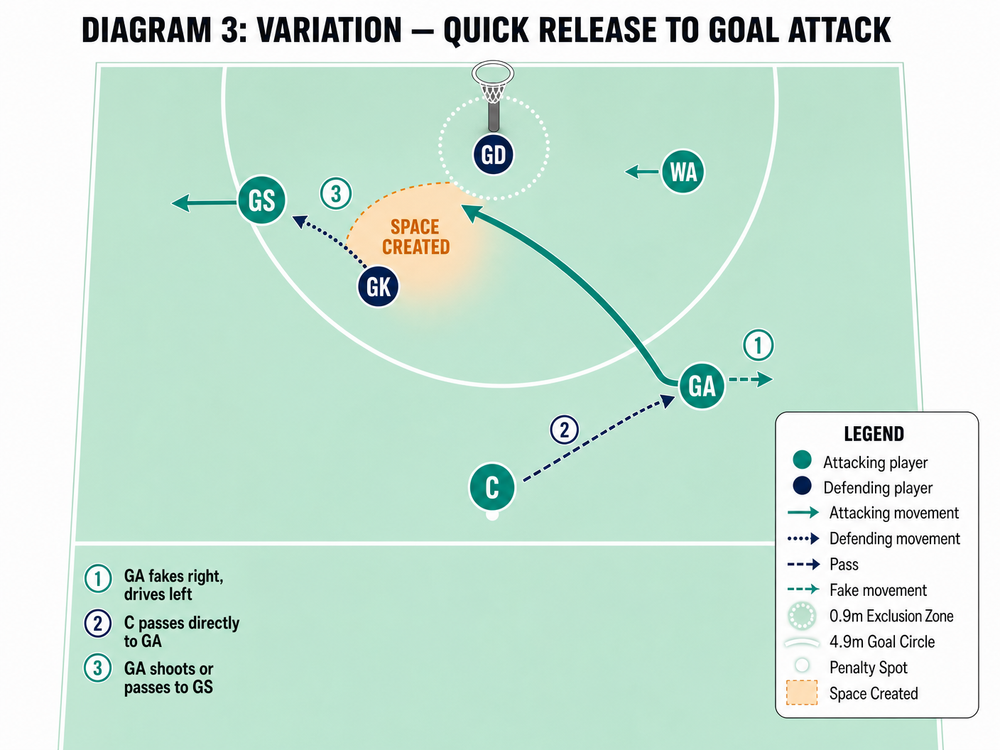
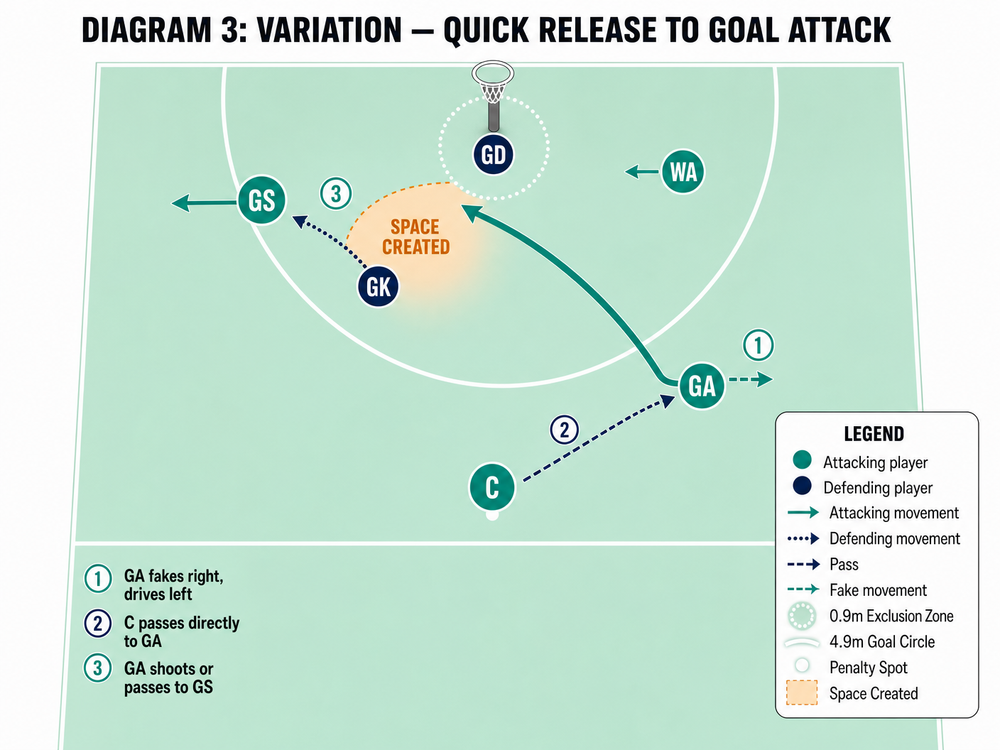
If the defense anticipates the pass to the WA, the GA can alter their movement. Instead of a straight drive, the GA fakes a drive to the right (drawing the defender), then cuts sharply back to the left, driving into the space created by the GS clearing out. The C bypasses the WA and passes directly to the GA for a quick shot.
Progression: Adding Defensive Pressure
Once the attacking team has mastered the basic movements without defense, introduce the WD and GK to apply active pressure. Finally, allow the GD to re-enter play immediately after the C releases the ball, forcing the attackers to execute under full match conditions.
Age Adaptations
- Under 10s / Under 12s: Simplify the play. Focus on just two players moving (e.g., WA and GA) rather than three simultaneous movements. Emphasise strong, straight drives and accurate passing over complex fakes.
- Under 14s / Under 16s: Introduce the variations and fakes. Focus on the speed of execution and the C's decision-making under pressure.
- Open / Advanced: Execute at high speed with full defensive pressure. The focus is on precision timing, reading the defense's micro-movements, and exploiting split-second gaps.
