

Cricket
New Ball Opening Attack Plan: The Outswing Corridor
Master the art of the new ball with this structured opening attack plan designed to exploit early swing and build relentless pressure.

What you need
1 New Cricket Ball, Full set of stumps and bails, Measuring tape (optional), Cones or markers (optional)
1. Overview
The 'New Ball Opening Attack Plan' is a fundamental set play designed to maximize the advantage of a hard, new cricket ball. In the opening overs of an innings, the primary objective is taking early wickets by exploiting swing, seam movement, and the natural bounce of the pitch. This plan specifically focuses on the 'Outswing Corridor'—a relentless line on or just outside the off stump, combined with an attacking field setting that invites the drive while punishing any slight misjudgment.
By consistently targeting the corridor of uncertainty (the area on the 4th stump line), the bowler forces the batsman to play at deliveries they might otherwise leave, significantly increasing the probability of inducing an edge to the slip cordon or the wicket-keeper. This set play is essential for setting the tone of the match, restricting early scoring opportunities, and establishing psychological dominance over the opening batsmen.
2. Setup
Equipment Needed:
- 1 New Cricket Ball (preferably a high-quality leather ball that promotes swing)
- Full set of stumps and bails at both ends
- Measuring tape (optional, for marking specific landing zones during practice)
- Cones or markers (for practice drills only, to highlight the corridor of uncertainty)
Pitch and Field Dimensions:
- Standard 22-yard cricket pitch.
- Full oval ground with a standard boundary rope (typically 65–80 meters from the center).
Player Positions (Attacking Outswing Field for a Right-Handed Batsman):
- Bowler: Operating from over the wicket.
- Wicket Keeper: Positioned at a distance suitable for the bowler's pace to take the ball cleanly at waist height.
- First Slip: Positioned slightly wider than standard to account for significant early swing.
- Second Slip: Next to First Slip, forming a tight catching cordon.
- Gully: Positioned to catch square edges or defensive pushes that fly off the shoulder of the bat.
- Cover Point: Saving the square drive and cutting off quick singles.
- Mid Off: Saving the straight drive and backing up the bowler.
- Fine Leg: Positioned fine to save boundaries off stray deliveries on the pads.
- Square Leg: Covering the pull shot or deflections off the pads.
- Mid On: Saving the straight drive on the leg side.
- Third Man: Providing cover for edges that fly through or over the slip cordon.

3. Step-by-Step Instructions
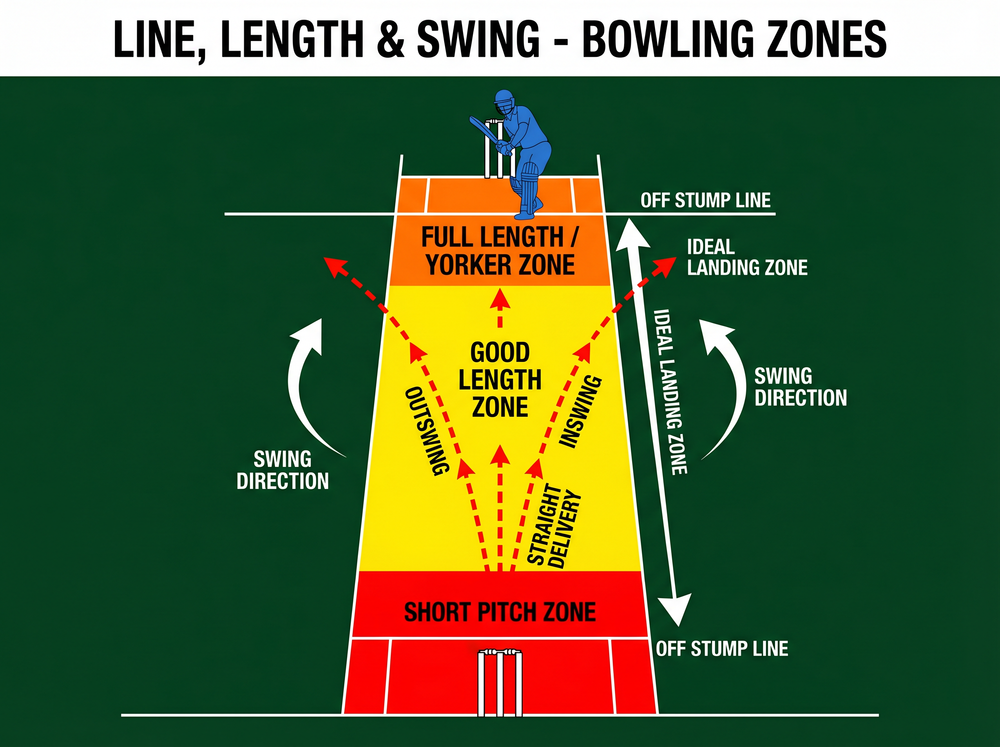
- Establish the Line and Length: The bowler begins their run-up with a clear focus on hitting the 'good length' zone, approximately 6 to 8 meters from the batsman's stumps. The target line is the 4th stump—just outside the off stump.
- The Release: The bowler releases the ball with an upright seam, angled slightly toward the slips, encouraging the ball to swing away from the right-handed batsman (outswing).
- The Corridor of Uncertainty: The ball pitches in the designated zone. If the line is perfect, the batsman is forced into a decision: play or leave. The late swing makes this decision incredibly difficult.
- The Trap: The batsman, tempted by the width or forced to defend their stumps, plays at the ball. The late outswing catches the outside edge of the bat.
- The Catch: The ball carries cleanly to the Wicket Keeper, First Slip, Second Slip, or Gully, completing the dismissal.
- The Follow-Up: If the batsman successfully leaves the ball, the bowler must maintain the discipline of that exact line and length, building dot-ball pressure. Occasional variations (like an inswinger or a bouncer) are used sparingly to keep the batsman guessing, but the default delivery remains the outswinger in the corridor.
4. Key Coaching Points
- Patience and Discipline: Emphasize to your bowlers that they do not need to take a wicket on every ball. Building pressure through consistent dot balls in the right area is often what leads to the mistake.
- Wrist Position: Ensure the bowler's wrist is firmly behind the ball at the point of release. A floppy wrist will kill the swing and lead to inconsistent lengths.
- Fielding Anticipation: The slip cordon and wicket-keeper must be in a ready, athletic stance on every delivery. They should expect the edge, not just react to it.
- Communication: The captain, bowler, and wicket-keeper must constantly communicate about what the ball is doing and adjust the field accordingly.
- Bowling in Partnerships: The bowler at the other end must maintain the same pressure. If one end is leaking runs, the pressure built by the opening attack is entirely lost.
5. Common Mistakes
- Searching for Magic: Bowlers often try too hard to swing the ball excessively, resulting in a loss of control over line and length.
- Bowling Too Short: If the ball is pitched too short, the batsman has time to adjust to the swing and can comfortably leave the ball or play it off the back foot.
- Static Fielders: Fielders in the slip cordon standing up too early or not watching the ball closely.
- Impatience: Abandoning the plan after conceding a boundary. The outswing corridor plan requires belief.
6. Variations & Progressions
- The Inswing Surprise: After establishing the outswing pattern, the bowler delivers a ball with the seam angled toward fine leg, swinging back sharply into the right-hander.
- The Effort Ball (Bouncer): A well-directed short ball aimed at the batsman's chest or head, pushing them onto the back foot.
- Changing the Angle: The bowler moves wider on the crease to alter the angle of delivery.
7. Age Adaptations
- Under 10s & Under 12s: Focus purely on hitting the pitch and keeping the arm straight. Use targets (cones or a towel) on the pitch. Do not overcomplicate with swing mechanics yet.
- Under 14s: Introduce basic grip and wrist position for outswing. Begin setting a basic slip cordon (one slip and a gully).
- Under 16s & Open: Full implementation of the plan. Focus on the nuances of late swing, setting up the batsman over an over, and maintaining physical conditioning.
