

Cricket
New Ball Opening Attack Plan: The Seam Masterclass
Equip your opening bowlers with a precise, aggressive set play designed to exploit the new ball, control the run rate, and take early wickets through disciplined line, length, and field placement.
What you need
1 new cricket ball, 6 markers/cones, Full match equipment
1. Overview
The "New Ball Opening Attack Plan" is a foundational set play designed for the first 6-10 overs of an innings. The objective is simple but critical: maximize the movement of the hard, shiny new ball to create early breakthroughs while maintaining relentless pressure on the opening batters. By combining disciplined bowling lines with aggressive, catching-oriented field placements, coaches can give their opening pair the best possible chance to dictate the tempo of the match from ball one. This plan is most effective when you have two bowlers with contrasting styles (e.g., one outswing bowler and one inswing/seam bowler) operating in tandem.
2. Setup
Equipment Needed:
- 1 new, high-quality cricket ball (red or white depending on format)
- 6 markers/cones (for practice sessions to mark target zones)
- Full match equipment for batters and fielders
Pitch & Field Setup:
- Use a standard 22-yard cricket pitch.
- The field is set in an attacking "Slip Cordon" formation.
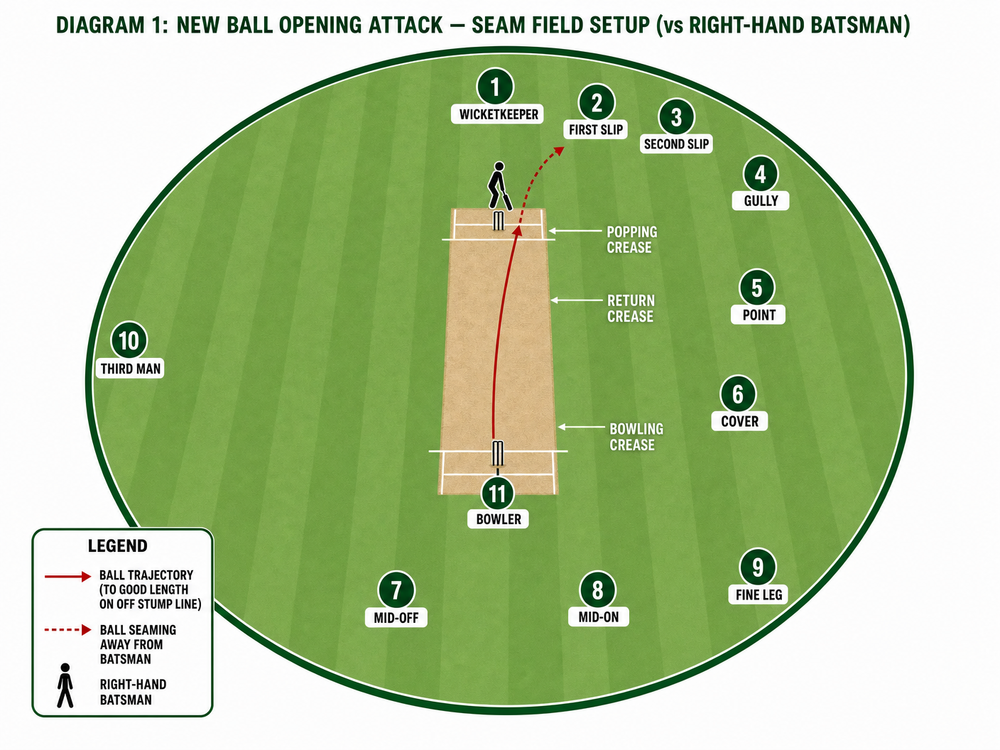
Player Positions (vs Right-Hand Batsman):
- Wicketkeeper: Positioned back for the pace bowlers.
- First Slip: Positioned approximately 1.5m to the keeper's right.
- Second Slip: Positioned 1m to the right of First Slip.
- Gully: Positioned at a 45-degree angle on the off-side to catch backward point/gully edges.
- Point: Square on the off-side to cut off the square cut.
- Cover: Mid-off-side to stop the cover drive.
- Mid-Off: Straight on the off-side to stop the straight drive and save the single.
- Mid-On: Straight on the on-side to stop the straight drive.
- Fine Leg: Square on the on-side boundary for the wayward delivery down leg.
- Third Man: Fine on the off-side boundary to protect against the thick outside edge.
- Bowler: Operating from the bowling crease.
3. Step-by-Step Instructions
Step 1: Establish the Line and Length (Overs 1-2)
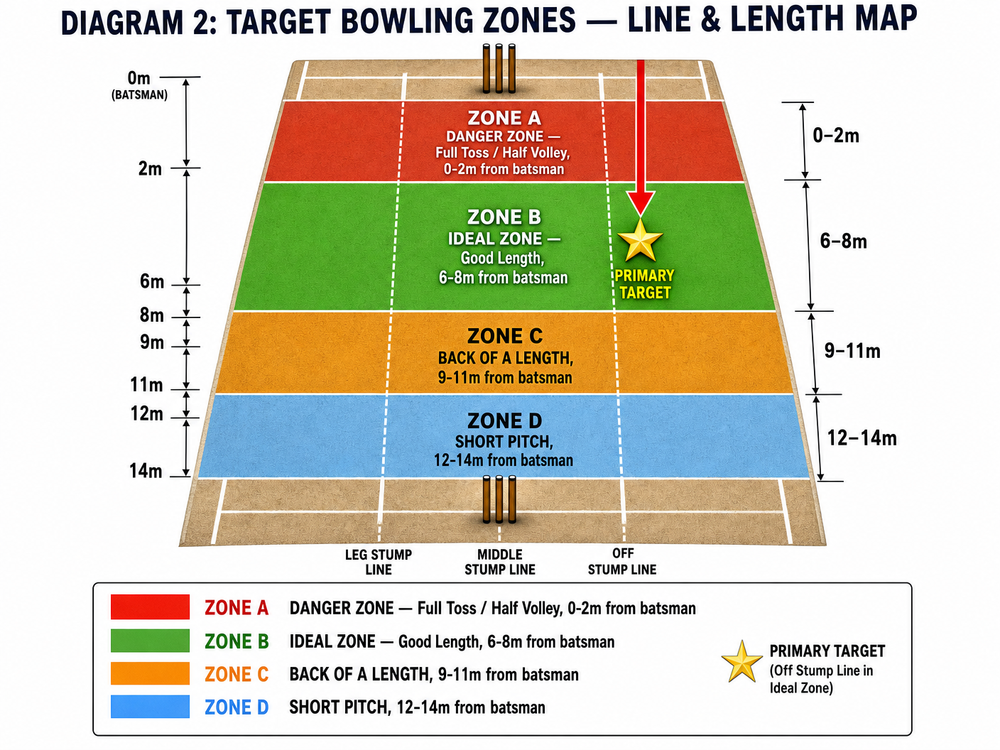
Both opening bowlers must immediately find the "Ideal Zone" (6-8m from the batsman) on an off-stump line. The goal is to make the batsman play at every delivery without offering easy runs. The bowler should aim for the top of off stump.
Step 2: Set the Trap with the Field (Overs 1-4)
Deploy the aggressive field setup shown in Diagram 1. Ensure the slips are staggered correctly (First Slip slightly deeper than Second Slip) and that Gully is positioned to cover the thick edge from a back-foot defensive shot or cut.
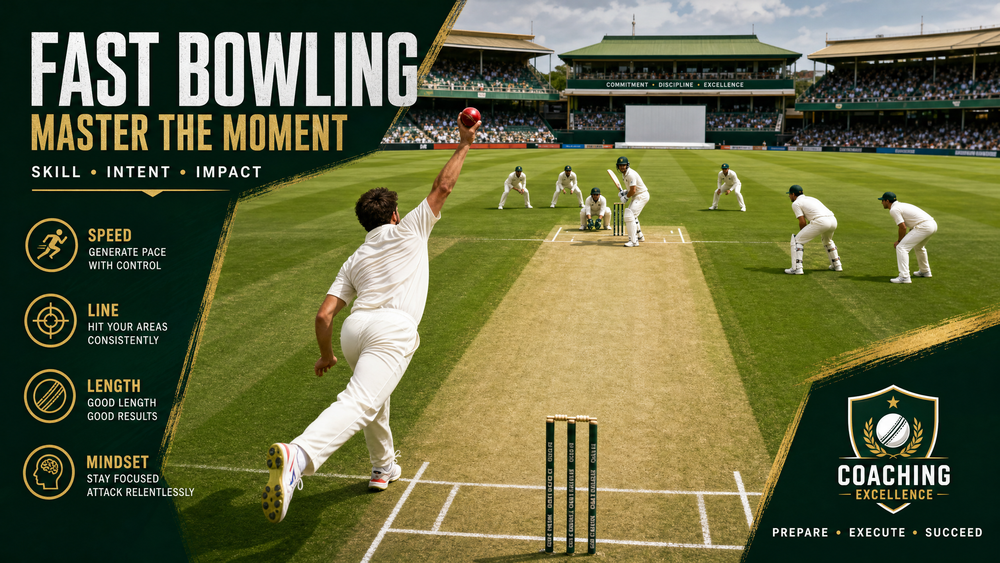
Step 3: The Outswing Assault (Bowler A)
Bowler A (the outswing specialist) pitches the ball on middle-and-off, allowing it to swing away late. The batsman is forced to play, and the late movement draws the outside edge, flying straight to the slip cordon.
Step 4: The Inswing/Seam Counter (Bowler B)
Bowler B (the inswing/seam specialist) operates from the other end. They pitch the ball slightly wider on the off-stump line, bringing it back sharply into the right-hander. This threatens the stumps (Bowled) and the pads (LBW), forcing the batsman to play across the line.
Step 5: Rotate and Relentless Pressure (Overs 5-6)
Maintain the contrasting attack. If a partnership begins to build, slightly adjust the field (e.g., move Third Man to a catching position like Fly Slip or add a Short Leg) to create a new problem for the batters.
4. Key Coaching Points
- Patience is a Weapon: Bowlers must resist the urge to bowl "magic balls" every delivery. Consistently hitting the 6-8m "Ideal Zone" is more effective than erratic pace.
- The "Top of Off" Principle: The primary target is always the top of off stump. This line forces the batsman to make a decision on every ball.
- Slip Cordon Discipline: Slips must stay low, watch the ball from the bowler's hand, and anticipate the edge. Soft hands are crucial for taking fast catches.
- Communication: The wicketkeeper is the captain of the fielding ring. They must communicate constantly with the slips and adjust their depth based on the bowler's pace and the pitch bounce.
- Bowling in Partnerships: Bowler A and Bowler B must work together. If Bowler A is beating the bat with outswing, Bowler B must maintain pressure with tight lines, not leak runs.
5. Common Mistakes
- Bowling Too Short (Zone D): Dropping short with the new ball wastes its swing potential and allows the batsman to easily cut or pull for boundaries.
- Searching for Swing (Bowling Too Full - Zone A): Over-pitching in an attempt to swing the ball results in easy half-volleys that the batsman can drive straight down the ground.
- Inconsistent Lines: Straying onto the leg stump line negates the slip cordon and gives away easy runs behind square on the leg side.
- Slips Standing Too Close: If the slips are too close, they won't have time to react to the fast edge. If they are too far back, the ball will drop short.
6. Variations & Progressions
Variation 1: The Left-Arm Angle
If one of the opening bowlers is a left-armer (over the wicket to a right-hand batsman), the angle naturally takes the ball across the batsman. Adjust the field by adding a backward point to cover the slice and potentially removing a slip if the ball isn't swinging.
Variation 2: The "Dry" Plan
If the pitch is flat and offering no movement, shift from an attacking "taking wickets" mindset to a "drying up runs" mindset. Remove a slip, push point deeper, and bowl a strict off-stump channel to build dot-ball pressure.
Progression 1: The Bouncer Trap
Once the batsman is comfortable lunging forward to the good length deliveries, the bowler executes a sharp, well-directed bouncer (Zone D) aimed at the badge of the helmet, followed immediately by a full, swinging delivery (Zone B) to catch them stuck on the crease.
7. Age Adaptations
- Under 10 / Under 12: Focus entirely on hitting the "Ideal Zone" (good length). Don't worry about swing or complex fields. A simple field with one slip and a gully is sufficient. Emphasize bowling straight.
- Under 14: Introduce the concept of bowling to a specific field. Teach the bowlers how to hold the seam upright to encourage movement off the pitch. Start using a two-slip cordon.
- Under 16 / Open: Full implementation of the plan. Bowlers should be actively trying to swing the ball both ways and setting their own fields in consultation with the captain. The focus is on executing the two-bowler partnership strategy.
