

Netball
Penalty Pass Advantage Play: Breaking the Defensive Wall
Master the art of exploiting a penalty pass in the attacking third with this structured set play designed to quickly break the defensive wall and secure a high-percentage shot.

What you need
Netball, Court, Bibs
1. Overview
When a penalty pass is awarded in the attacking third, the defending team is momentarily disadvantaged as the penalised player must stand out of play (0.9 metres away). This creates a temporary numerical advantage (7 vs 6) and opens up crucial space.
The Penalty Pass Advantage Play is a structured offensive set designed to exploit this exact moment. Instead of a predictable direct pass into the circle, this play uses coordinated dummy leads and wide drives to isolate the Goal Shooter (GS) or Goal Attack (GA) against a scrambling defence. It is highly effective when executed quickly before the defence can reset their zone.
2. Setup
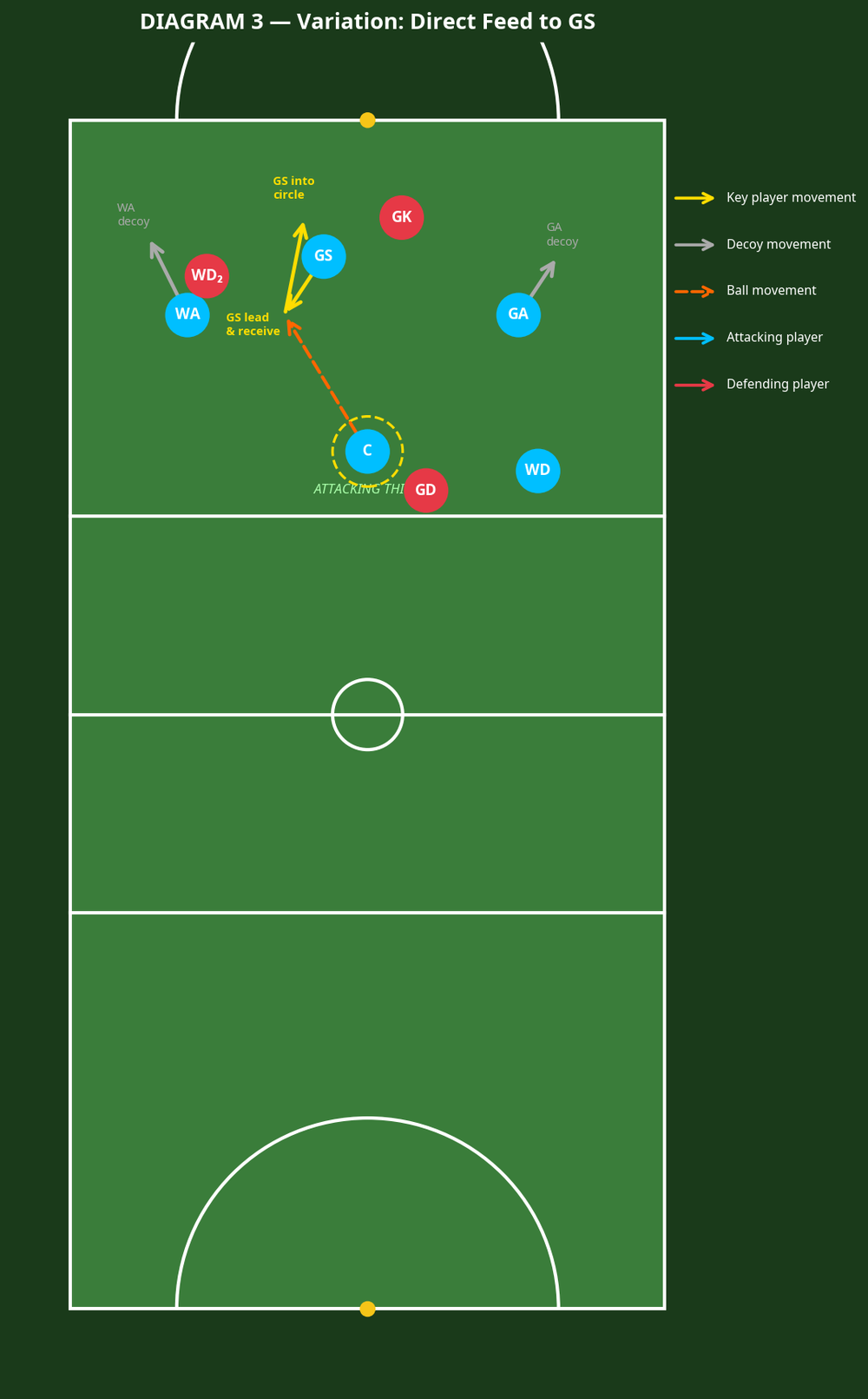
Court Area: Attacking Third (specifically near the top of the goal circle).
Players Involved: Centre (C), Wing Attack (WA), Goal Attack (GA), Goal Shooter (GS), Wing Defence (WD).
Initial Positions:
- C: Takes the penalty pass on the spot.
- WA: Positioned wide on the left side of the court, ready to drive.
- GA: Positioned near the top of the goal circle, slightly to the left.
- GS: Deep inside the goal circle, holding space against the Goal Keeper (GK).
- WD: Holding a supportive mid-court position to offer a reset option if needed.

3. Step-by-Step Instructions
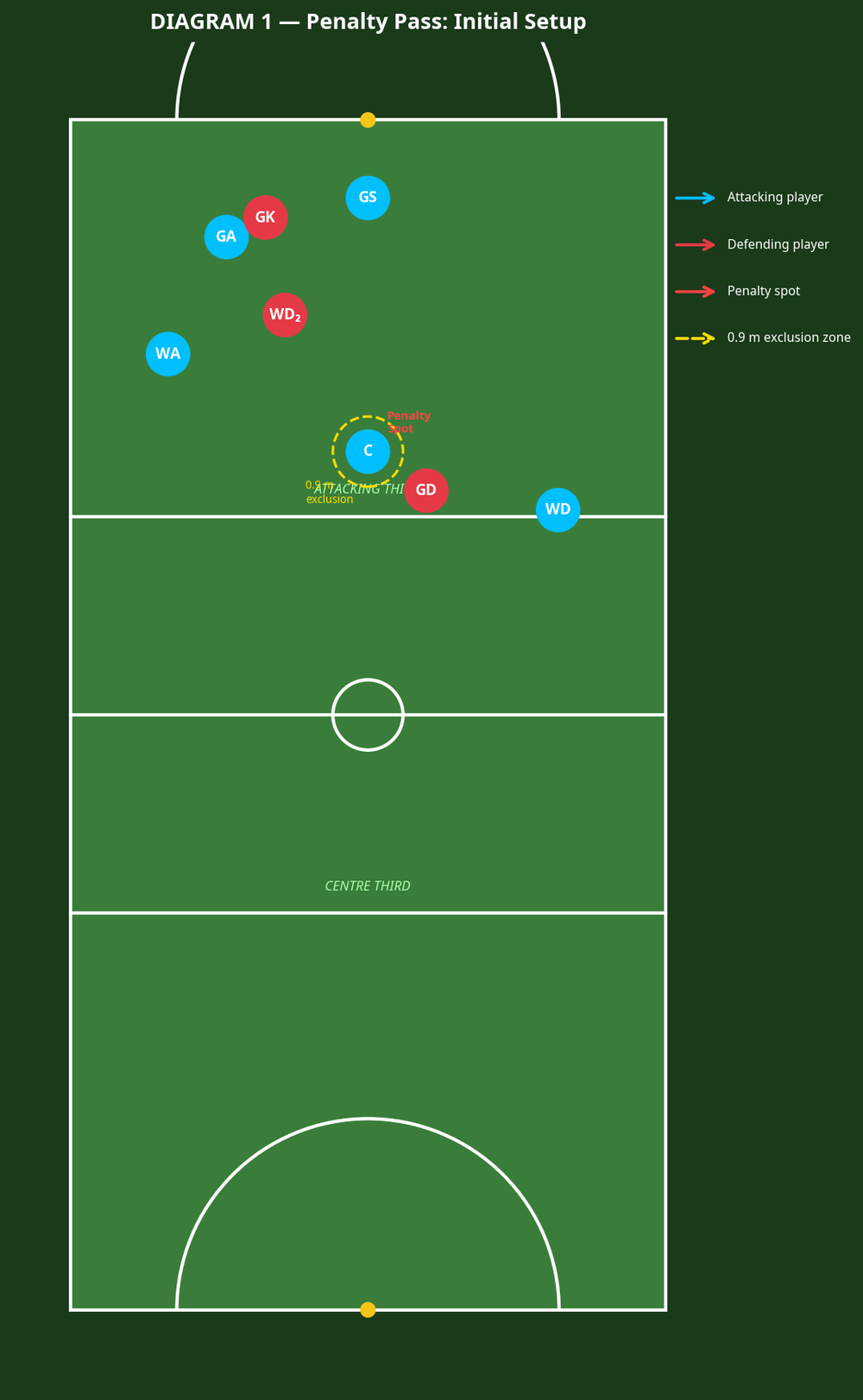
Phase 1: The Primary Option (WA Drive)
- As the umpire blows the whistle for the penalty, WA immediately makes a hard, angled drive towards the circle edge.
- C delivers a sharp, flat pass to WA on the run.
- Simultaneously, GA cuts across the top of the circle to clear space and pull the Goal Defence (GD) away from the primary passing lane.
- GS holds their ground, then makes a strong baseline drive to receive the feed from WA.
Phase 2: The Variation (Direct Feed to GS)
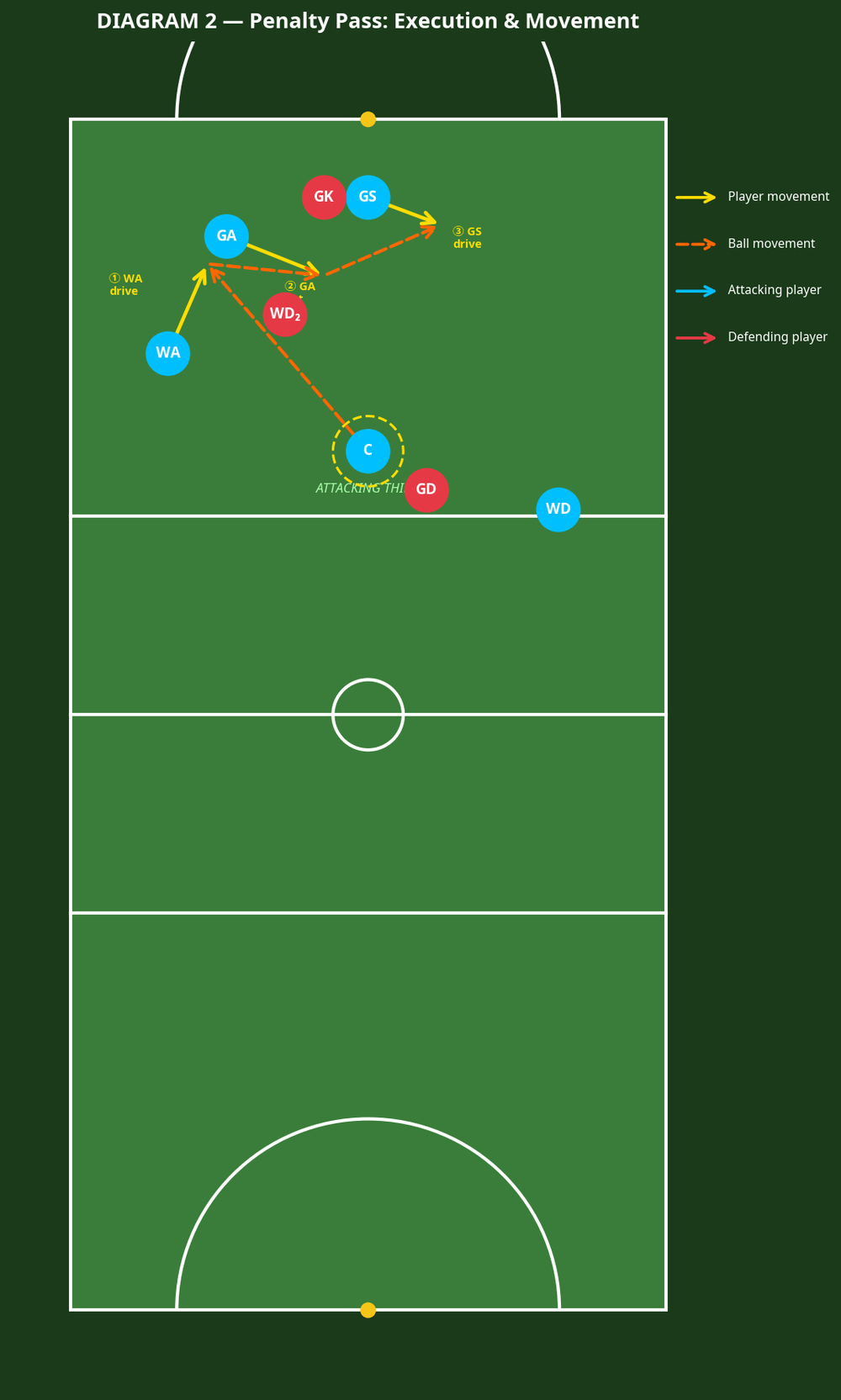
If the defence anticipates the WA drive and covers the wide channel:
- WA and GA both make aggressive decoy runs outward, dragging their defenders with them.
- This clears the central channel.
- GS immediately leads out of the circle towards the penalty spot to receive a direct, flat pass from C.
- Upon receiving the ball, GS quickly turns and passes to GA who has cut back into the circle, or takes the shot if within range.
4. Key Coaching Points
- Speed of Execution: The play must be initiated the moment the umpire blows the whistle. Hesitation allows the penalised defender time to re-enter play.
- Decoy Conviction: Players running decoy lines (WA and GA in the variation) must sprint at 100% effort to force defenders to commit.
- Pass Quality: The initial pass from the C must be flat, hard, and placed out in front of the driving receiver to maintain momentum.
- Court Balance: The WD must remain engaged but balanced behind the play to provide a safe reset option if the primary and secondary leads are covered.
- Eye Contact: The C must scan the court and make early eye contact with the intended receiver before the whistle.
5. Common Mistakes
- Telegraphing the Pass: The C stares directly at the primary receiver, allowing the defence to intercept.
- Weak Decoy Runs: Attackers jog through their decoy leads, meaning defenders can easily recover to cover the real intended target.
- Crowding the Space: The GA and GS make leads into the same area, bringing their defenders together and clogging the passing lane.
- Delaying the Start: Waiting for all players to perfectly set up before taking the penalty, which negates the advantage of the penalised defender being out of play.
6. Variations & Progressions
- The GA Wrap: Instead of cutting away, the GA wraps tightly around the C as the penalty is taken, receiving a quick hand-off pass to immediately attack the circle edge.
- The Reset Play: If the defence successfully covers all forward options, the C passes backward to the WD. The attacking team then resets and initiates a standard circle feed structure.
- Overload: Position both the WA and GA on the same side of the court to create a deliberate overload, forcing the defence to make a decision on who to cover.
7. Age Adaptations
- Under 10s / Under 12s: Focus purely on the speed of taking the penalty pass and finding the first available open player. Keep the structure simple (e.g., just one designated driver).
- Under 14s / Under 16s: Introduce the concept of decoy runs and secondary options. Emphasise the timing of the GS baseline drive.
- Open / Advanced: Execute the full play with multiple variations based on reading the defensive setup. Incorporate the GA wrap and overload concepts.
