

Football
Pressing Trigger and Recovery Drill
Master the art of high-intensity pressing and swift defensive recovery with this dynamic, game-realistic drill designed to sharpen your team's tactical discipline.
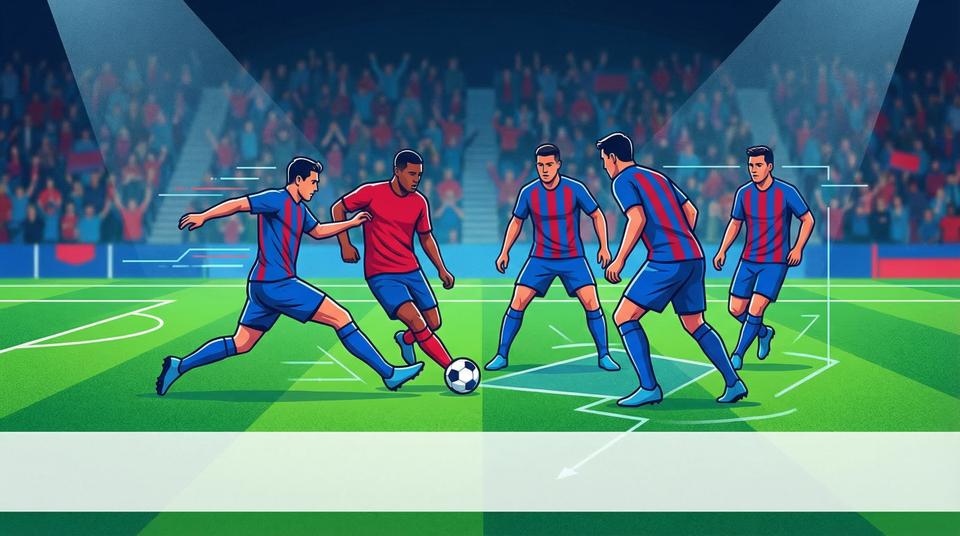
What you need
Full-size goal, Footballs, Bibs (2 colors), Flat markers, Cones
Overview
Modern football demands not only the ability to press aggressively high up the pitch but also the tactical discipline to recover quickly when the initial press is bypassed. The Pressing Trigger and Recovery Drill is designed to develop these dual capabilities. By simulating match-realistic scenarios, this drill teaches players how to recognize pressing triggers—such as a poor touch, a square pass, or the ball traveling to a specific player—and execute a coordinated team press. Crucially, it also emphasizes the immediate transition into a recovery phase, teaching players to sprint back into a compact mid-block when the opposition manages to break the first line of pressure. This drill is essential for teams looking to dominate possession through aggressive defending while maintaining defensive solidity against counter-attacks.
Setup

Proper setup is vital to ensure the drill replicates the spatial demands of an actual match.
- Pitch Dimensions: Utilize a full-width pitch (approximately 64-75m) and a length of 60-70m (from the penalty box to just beyond the halfway line).
- Equipment Needed: 1 full-size goal, plenty of footballs, bibs in two contrasting colors (e.g., Blue and Red), and flat markers or cones to define zones.
- Player Positions:
- Defending/Pressing Team (Blue): Set up in a 4-4-2 or your preferred defensive shape (e.g., GK, RB, CB, CB, LB, RM, CM, CM, LM, ST, ST).
- Attacking/Possession Team (Red): Set up to mimic an opponent building out from the back (e.g., GK, back four, and a midfield pivot).
- Zones: Mark out a 'Press Zone' in the attacking third and a 'Recovery Corridor' alongside a 'Compact Block' area in the middle third.
Step-by-Step Instructions

- Initial Phase (Build-Up): The coach serves the ball to the Attacking Team's goalkeeper or centre-back to initiate the build-up play from the back.
- Identifying the Trigger: The Defending Team (Blue) holds their shape until a predefined pressing trigger occurs. This could be a slow square pass between the centre-backs or a heavy touch by a receiving player.
- Executing the Press: Once the trigger is identified, the nearest player (usually a Striker, #11 or #12) sprints to press the ball carrier aggressively.

- Supporting the Press: Simultaneously, the surrounding players must step up to cut off immediate passing lanes. The winger (#10) closes the passing lane to the fullback, while the central midfielder (#8) steps up to mark the opposition pivot.
- The Bypass (Recovery Trigger): To practice recovery, the coach will occasionally instruct the Attacking Team to play a long lofted pass or a quick combination that successfully bypasses the initial press.
- The Recovery Sprint: The moment the press is broken, the Defending Team must immediately transition into recovery mode. Players must sprint back towards their own goal to re-establish a compact defensive shape behind the ball.

- Re-establishing the Block: Wide players (#7 and #10) sprint down the Recovery Corridors, while central midfielders (#8 and #9) drop back rapidly to form a solid mid-block in the Transition Zone, denying space centrally.
- Reset and Repeat: Once the ball is won by the Defending Team, goes out of play, or a shot is taken, the drill resets. Rotate players to ensure everyone experiences the physical demands of both pressing and recovering.
Key Coaching Points

- Aggressive but Controlled Approach: The initial press must be sprinting, but players should decelerate on approach to avoid being easily bypassed by a simple skill.
- Body Shape: When pressing, angle the run to force the opponent in one direction (usually towards the touchline or into a teammate's pressing trap).
- Communication: The player initiating the press must shout or signal to trigger the collective movement of the team.
- Recovery Mentality: The transition from pressing to recovering must be instantaneous. There should be no hesitation or disappointment; the immediate reaction must be a full sprint back into position.
- Compactness: When recovering, prioritize protecting the central areas first. Force the opposition wide where they are less dangerous.
Common Mistakes

- Pressing Alone: One player presses aggressively, but the rest of the team stays deep, creating massive gaps between the lines that are easily exploited.
- Jogging During Recovery: Players jog back rather than sprinting when the press is broken, allowing the opposition to counter-attack with a numerical advantage.
- Poor Trigger Recognition: Pressing at the wrong time (e.g., when the opponent has full control and options), making the press easy to play through.
- Over-Committing: Defenders diving in to win the ball rather than containing the player, leading to fouls or being easily beaten.
Variations & Progressions
- Progression 1 (Time Limit): Give the Defending Team a strict time limit (e.g., 6 seconds) to win the ball back once the press is triggered. If they fail, they must immediately drop into a recovery shape.
- Progression 2 (Added Attackers): Introduce an extra attacking player (an overload) to make the pressing phase more difficult and force the defending team to work harder on cutting passing lanes.
- Variation 1 (Different Triggers): Change the pressing trigger. For example, instruct the team to only press when the ball is played to the fullback, creating a wide trap.
- Variation 2 (Small-Sided Game): Adapt the drill into a smaller area (e.g., 40x30m) for an intense 5v5 or 6v6 scenario focusing on rapid transitions.
Age Adaptations
- Under-10 to Under-12: Focus heavily on the individual mechanics of pressing (body shape, speed of approach) rather than complex team triggers. Keep distances shorter to manage fatigue.
- Under-14 to Under-16: Introduce specific tactical triggers and emphasize the collective movement. Demand high-intensity recovery sprints.
- Under-18 and Open: Full pitch dimensions, complex tactical instructions, and high physical demands. Focus on communication, compactness, and rapid transitions.
