

Rugby
The Wall: Mastering Defensive Line Speed and Alignment
A comprehensive guide for Rugby coaches to develop an aggressive, organized, and effective defensive line that shuts down attacking plays before they start.

What you need
Rugby balls (3-4), Cones or pitch markers (8-10)
1. Overview
This drill, known as 'The Wall', is a cornerstone for developing an aggressive, organized, and effective defensive system. Its primary focus is to instill the principles of line speed, alignment, and connection. In modern Rugby, the ability to get off the line quickly and cohesively is non-negotiable. It reduces the time and space available to the attacking team, forcing errors and creating turnover opportunities. This drill is perfect for use in the main part of a session after a thorough warm-up, as it demands high intensity and concentration. It simulates the pressure of a real game scenario, training players to react collectively to the attacking side's formation and ball movement.
2. Setup

Setting up 'The Wall' correctly is crucial for its effectiveness. The dimensions and player positioning are designed to replicate a common phase-play situation in the middle of the park.
- Equipment: 8-10 cones or markers, 3-4 rugby balls.
- Pitch Setup: Mark out a 40-metre wide by 30-metre deep grid using cones. Within this grid, create three distinct zones:
- Ruck Zone (0-5m deep): This is where the attack originates. A ball is placed on the ground to simulate a ruck.
- Defensive Line Zone (5-15m deep): The defensive line sets up on the 5m line, facing the ruck.
- Attack Entry Zone (15-30m deep): This is the space the defense must close down.
- Player Positions:
- Defenders (7 players): A line of seven defenders (e.g., 1-Loosehead, 2-Hooker, 3-Tighthead, 4-Flanker, 5-No.8, 6-Flanker, 7-Fly-half) positioned on the 5m line.
- Attackers (3-5 players): Scrum-half (9) at the ruck, Fly-half (10) and Inside Centre (12) ready to receive.

3. Step-by-Step Instructions

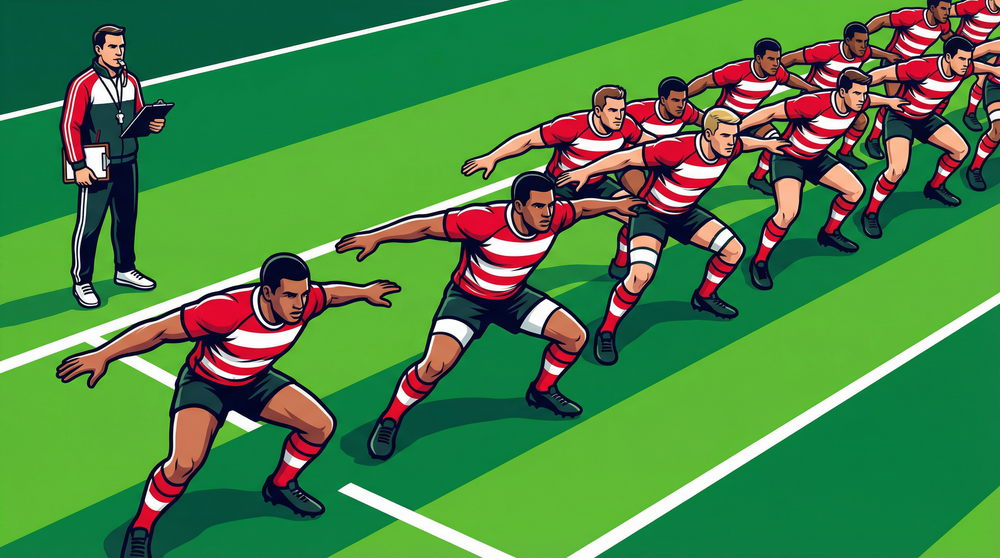
- Set the Line: The defensive line gets into position on the 5m line. Players should be in a 'ready position' — feet shoulder-width apart, knees bent, back straight, hands off the knees, eyes scanning the attack.
- Coach's Call: The coach yells "LINE SET!" This is the cue for defenders to get ready and for the attacking scrum-half to play the ball.
- The Trigger: The scrum-half passes the ball to the fly-half. This pass is the trigger for the entire defensive line to move up together.
- Line Speed: On the trigger, the defensive line advances aggressively as one unit. The goal is to close down the space of the attacking players as quickly as possible, maintaining spacing and alignment. Initial steps should be explosive.
- Alignment and Decision: As they advance, defenders adjust their alignment based on the attackers' positioning. Inside defenders press hard to force the play wide; outside defenders drift if the ball is passed wide.
- Two-Touch Tackle: The drill is run with a 'two-hand touch' rule. Once a defender makes a touch, they call "TOUCH!" and the ball carrier goes to ground and presents the ball. This keeps the drill flowing and focuses on positioning.
- Reset and Repeat: After the touch, the coach blows the whistle. Defenders retreat to the 5m line, reset, and prepare to defend the next phase. Run for 3-4 minutes, then rest and rotate groups.
4. Key Coaching Points

- Set Height Before Speed: Players must be in a low, powerful stance before they start moving. Coming up tall kills power and balance.
- Communicate from the Inside Out: The innermost defenders are the leaders. They set the line speed and their calls should be echoed outward. Use clear calls: "UP!", "HOLD!", "DRIFT!".
- Maintain Spacing — 'Don't Break the Chain': A 5-7 metre spacing must be maintained. If one player shoots out of the line, it creates a hole for the attack to exploit.
- Eyes Up, Scan the Attack: Defenders should not be ball-watching. Eyes should be up, scanning the attacker in front of them to anticipate passes, switches, or dummy runners.
- Win the Race to the Gain Line: The primary objective is to make the tackle behind the gain line. Emphasize winning the race to the advantage line and putting the attack on the back foot.
- Blitz vs. Drift: Teach players to recognize when to press hard (blitz) and when to drift. If the attack is narrow, the whole line can blitz. If the attack is wide, outside defenders must drift to cover the space.

5. Common Mistakes

- Getting Flat-Footed: Players waiting for the pass instead of being on their toes, ready to explode forward.
- Over-Chasing or 'Shooting' Out of the Line: An individual defender rushing up ahead of the line, creating a dog-leg and a gap for attackers.
- Losing Connection: Defenders becoming isolated from their inside or outside partners, creating easy channels for attackers to run through.
- Watching the Ball, Not the Player: Focusing solely on the ball allows attackers to use dummy passes and deception effectively. Coach players to watch the attacker's hips.
- Silent Defence: A quiet defensive line is an ineffective one. Lack of communication leads to disorganization and uncertainty.
6. Variations and Progressions

- Progression 1 — Add a Second Wave: Introduce a second wave of 2-3 attackers who join the play after the first pass. This forces the defensive line to quickly reorganize and realign after the initial press.
- Progression 2 — Introduce a Kicking Option: Allow the attacking fly-half to use a chip kick or grubber kick over the defensive line. This tests the backfield coverage and forces defenders to make a decision: press the kicker or drop back to cover the space.
- Variation 1 — Attacking Overload: Run the drill with an overload in attack (e.g., 7 defenders vs. 5 attackers). This puts more decision-making pressure on the defense to drift and cover the numbers disadvantage.
- Variation 2 — Live Tackle: For advanced teams, progress to full contact once the principles of alignment and line speed are firmly established with the two-hand touch rule.
7. Age Adaptations

- Under-12: Focus purely on line speed and moving up together as a straight line. Use a smaller grid (20m wide) and a simple 1-pass attack. The tackle is a two-hand touch on the shorts.
- Under-14: Introduce the concept of the 'drift' defence. Start with a coach acting as the fly-half to control the pass and ensure players understand when to press and when to drift.
- Under-16: Run the drill as described, with a strong emphasis on communication. Assign a 'defensive captain' in the middle of the line to lead communication. Introduce the 'blitz' defence as a specific call.
- Open Age/Senior: Run at full pace and intensity, including all progressions. Coaches can add specific game scenarios — defending off a scrum or lineout — to increase realism.
