

Rugby
Dynamic Support Angles & Line Breaks Drill
Develop your players' ability to read the game, run hard support lines, and exploit space created by the ball carrier in this multi-phase drill.

What you need
4-6 Rugby balls, 15-20 cones (mixed colours), Training bibs (2 colours), Tackle shields (optional for progressions)
Overview
Support running is the lifeblood of an effective Rugby attack. This comprehensive drill focuses on developing the timing, depth, and angles required for players to become genuine options for the ball carrier. By running hard, credible lines, support players not only offer offload opportunities but also actively manipulate the defence, holding defenders in place to create space elsewhere. Use this drill to sharpen your backline's attacking cohesion and teach forwards how to effectively run lines off the 9 and 10.
Setup
- Pitch Dimensions: 40m x 40m grid, divided into 10m attacking channels.

- Players: Groups of 6-8 (minimum 3 attackers, 2 defenders per repetition).
- Equipment: 4-6 Rugby balls, 15-20 cones (mix of colours for grid marking), bibs for defenders.
- Positions: Fly-half (10), Inside Centre (12), Outside Centre (13), and Fullback (15) as attackers. Rotating defenders (D1, D2).
Step-by-Step Instructions

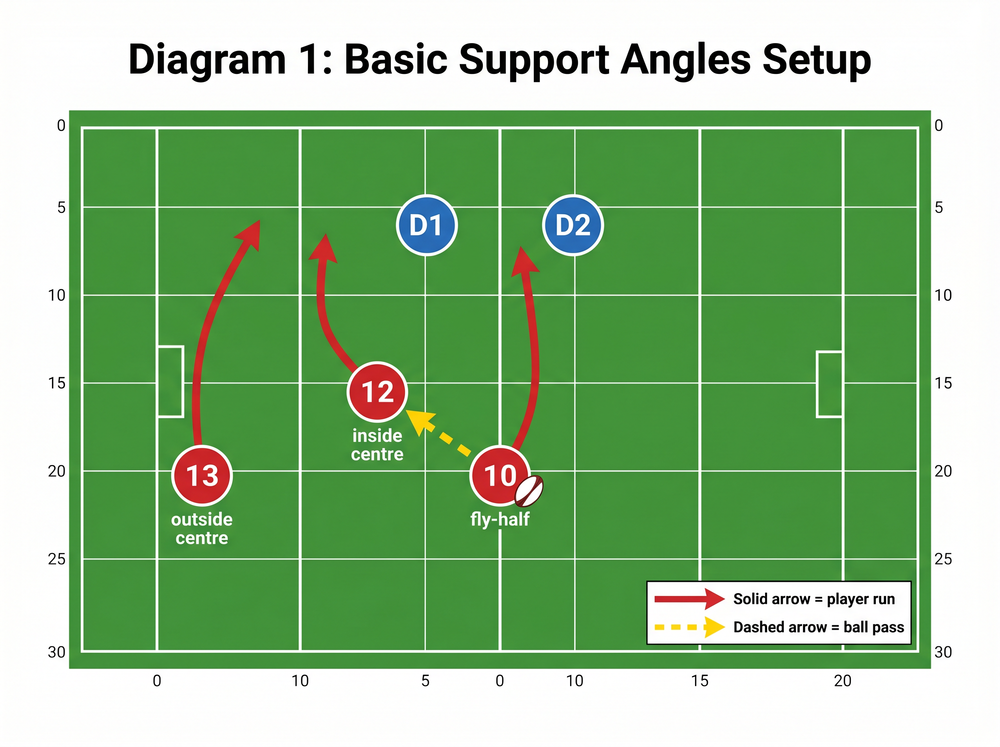
Phase 1: Basic Support Angles

- Set up a 30m x 20m grid. Position the fly-half (10) in the centre with the ball, the inside centre (12) 2m to the left, and the outside centre (13) 4m further left.
- Place two defenders (D1, D2) 8 metres opposite the attackers with passive tackle shields.
- On the coach's whistle, 10 attacks the line hard and straight, committing D1.
- 12 must run a hard, flat 45-degree angle off 10's shoulder, calling for the ball.
- 13 runs a wide sweeping arc to stay available on the outside.
- 10 executes a late, crisp pass to 12 as they punch through the gap.
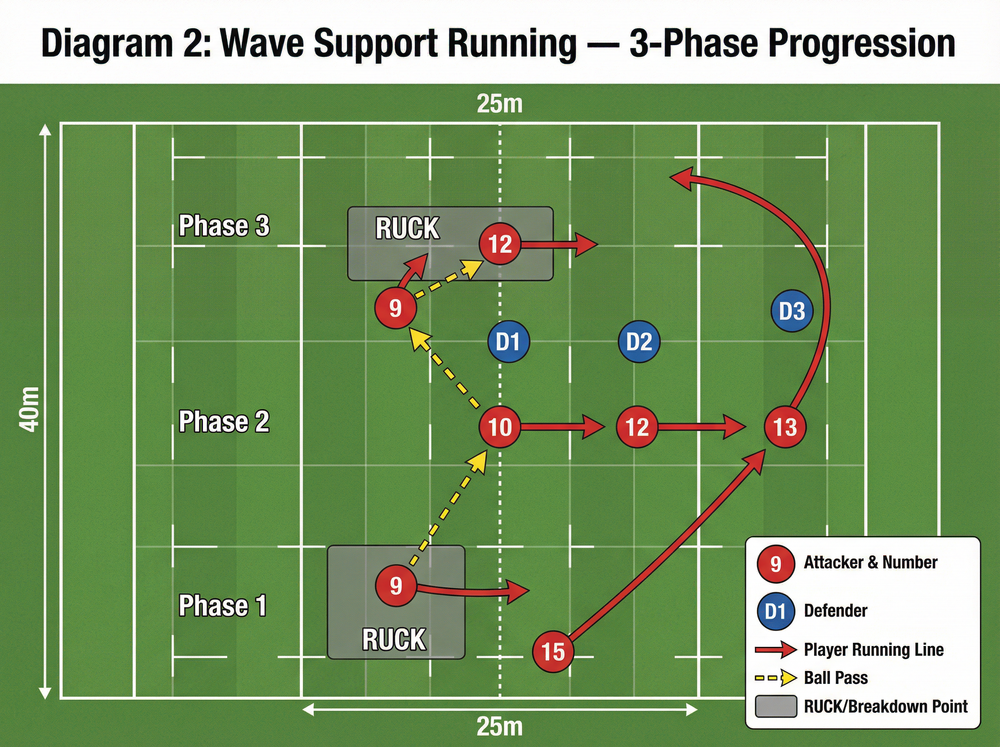
Phase 2: Wave Support Progression

- Expand the grid to 40m x 25m. Introduce a scrum-half (9) starting at a simulated ruck on the 25m line.
- 9 passes to 10. 10 takes the ball to the line, with 12 and 13 running their respective flat and wide support lines.
- 10 takes contact (simulated or live) from the first defensive wave. 9 must quickly arrive to clear the ball.
- From the breakdown, 12 becomes the primary receiver, with 13 shifting to the inside support role and the fullback (15) entering from deep to provide a wide option.
- The attack must seamlessly transition through three phases, maintaining depth and pace onto the ball.
Phase 3: Overload and Decision Making

- Set up an overload scenario on one side of the pitch (3 attackers vs 2 defenders).
- 10, 12, and 13 align in a staggered, deep attacking formation. 15 remains hidden in depth.
- As 10 attacks, they must read the defensive drift. If D1 bites in, 10 passes to 12. If the defence drifts wide, 10 takes the gap.
- The key is the 'dummy' run: 12 must run a line so convincing that it holds D2, creating a clear channel for 13 or 15 on the outside.
- Defenders play 'live' (touch or full contact depending on the session goal), forcing the attackers to make real-time decisions based on defensive cues.
Key Coaching Points
- Pace onto the Ball: Support players must arrive at pace. Standing still and waiting for the pass kills the attack.

- Depth is Crucial: Attackers must start deep enough to adjust their running line based on the ball carrier's movements and the defensive reaction.
- Communication: Early, loud, and specific calls (e.g., "Flat!", "Wide!", "With you!") are essential for the ball carrier to know their options.
- Commit the Defender: The ball carrier must run squarely at the defender's inside shoulder to fix them in place before passing.
- Run the Line, Not the Play: Support players must run their lines aggressively even if they don't expect the ball; this manipulates the defence.
Common Mistakes
- Overrunning the Ball Carrier: Support players getting ahead of the ball carrier, resulting in forward passes or removing themselves as an option.
- Drifting: Running sideways instead of attacking the gaps vertically, which makes it easy for the defence to drift and cover.
- Quiet Support: Failing to communicate, leaving the ball carrier isolated and unsure of where their help is.
- Passing Too Early: The ball carrier releasing the ball before committing the defender, allowing the defence to easily slide across to the next attacker.
Variations & Progressions
- Add a Sweeper: Introduce a fullback defender (15) to cover the backfield, forcing attackers to choose between passing and kicking if the line break is made.
- Conditioned Touch: Play a game of touch where a try is only awarded if the final pass is made to a player running a specific angle (e.g., an inside 'pop' pass).
- Fatigue Element: Have the attackers complete a down-and-up (burpee) or a 10m sprint before entering the drill to simulate late-game fatigue.
Age Adaptations
- Under 8 - Under 10: Focus purely on running straight and staying behind the ball carrier. Use brightly coloured cones to give them specific targets to run towards. Remove defenders initially.

- Under 12 - Under 14: Introduce passive defenders with tackle shields. Emphasize communication and the timing of the run. Start teaching the difference between 'flat' and 'deep' support.
- Under 16 - Open: Full contact, live decision-making. Defenders are instructed to mix up their defensive reads (blitz, drift, bite in) to challenge the attackers' scanning and execution.
