

Rugby
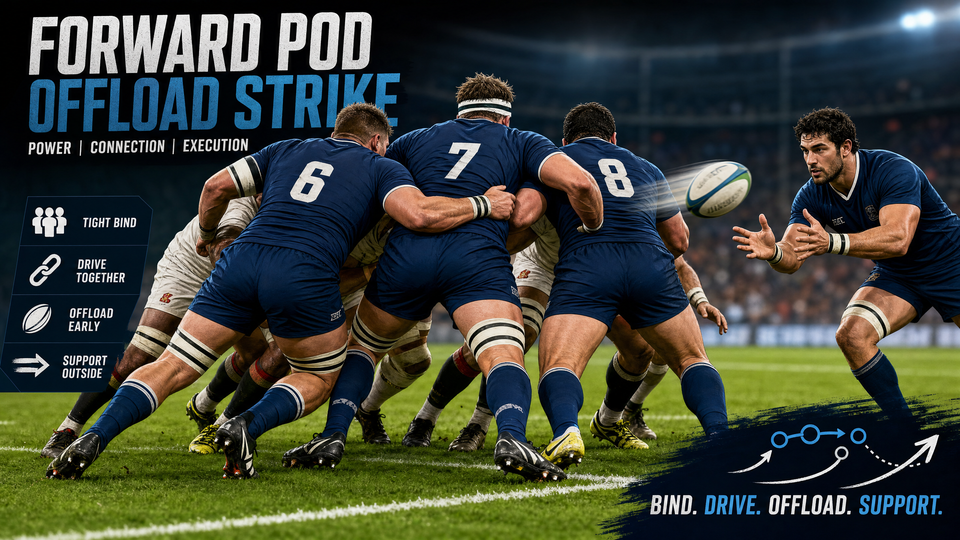
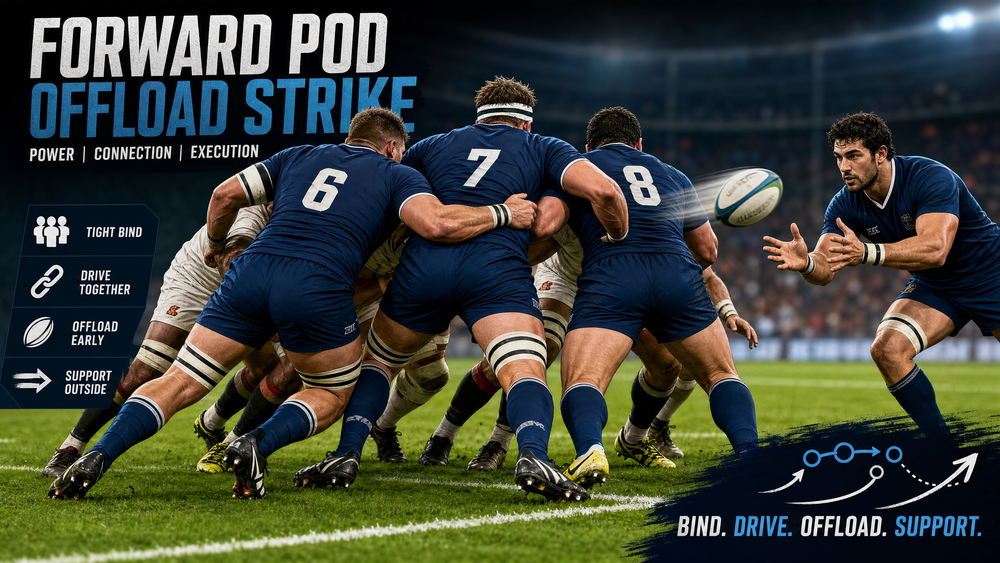
Forward Pod Strike: The 3-Man Drive with Outside Offload
Master the 3-man forward pod system to dent the gainline and unleash support runners with a perfectly timed offload.
What you need
Rugby balls, Cones/Markers, Tackle shields or hit shields (optional)
1. Overview
The 3-man forward pod with an offload option is a staple of modern attacking rugby. This set play is designed to achieve two critical objectives: first, to decisively cross the gainline by committing multiple defenders; and second, to exploit the space created on the outside shoulder through a well-timed offload.
By running a tight pod of three forwards (typically 4, 6, and 8) directly at the defensive line, you force the defense to compress. When the defense commits to stopping the powerful initial drive, space naturally opens up on the outside. A trailing support runner (often an agile forward like a 7 or a dynamic back) running a sharp line can receive the offload and break through the weakened defensive seam. This play is highly effective off slow ball or set pieces when you need to reset the attacking momentum and generate quick, front-foot ball for the next phase.
2. Setup
Pitch Setup:
This play can be executed anywhere on the pitch, but it is most effective between the 15m lines where the forwards have space to operate without being immediately pushed into touch.
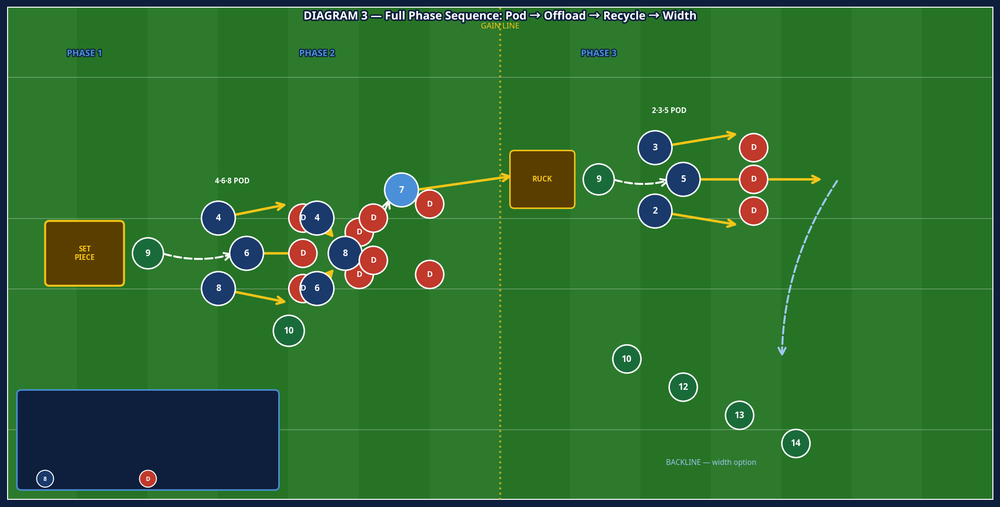
Player Positions:
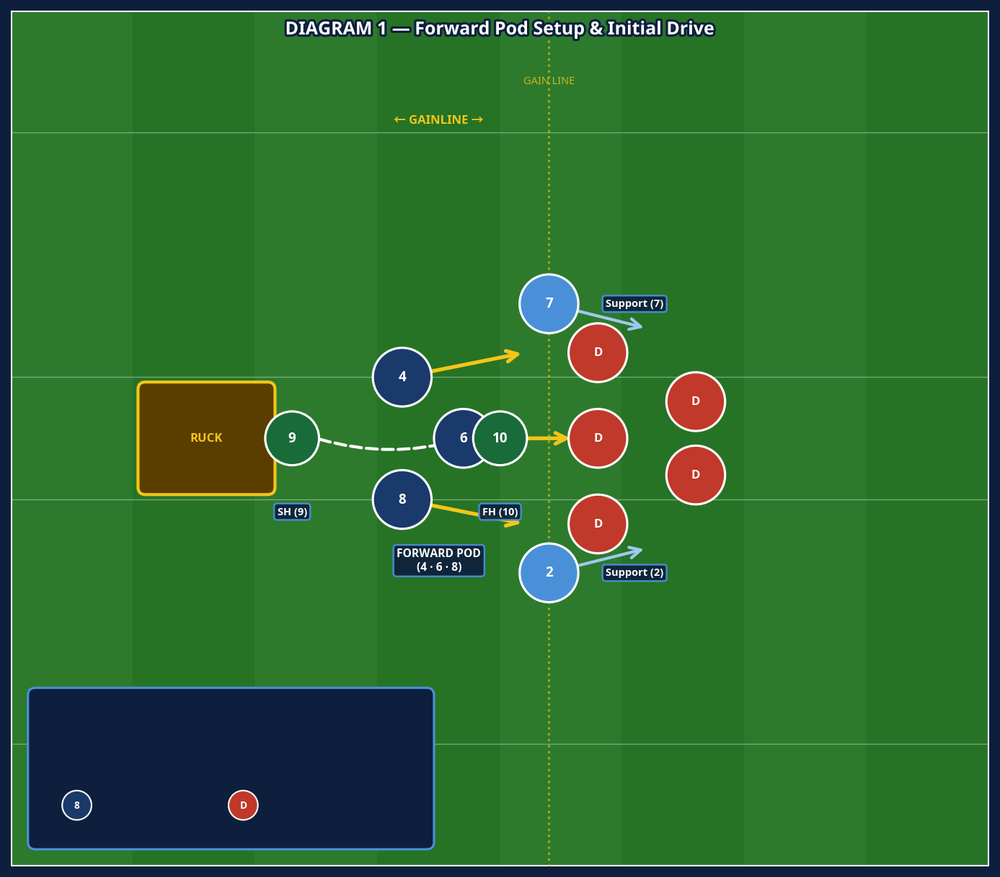
- Scrum-half (9): Positioned at the base of the ruck or set piece, ready to deliver a crisp, flat pass.
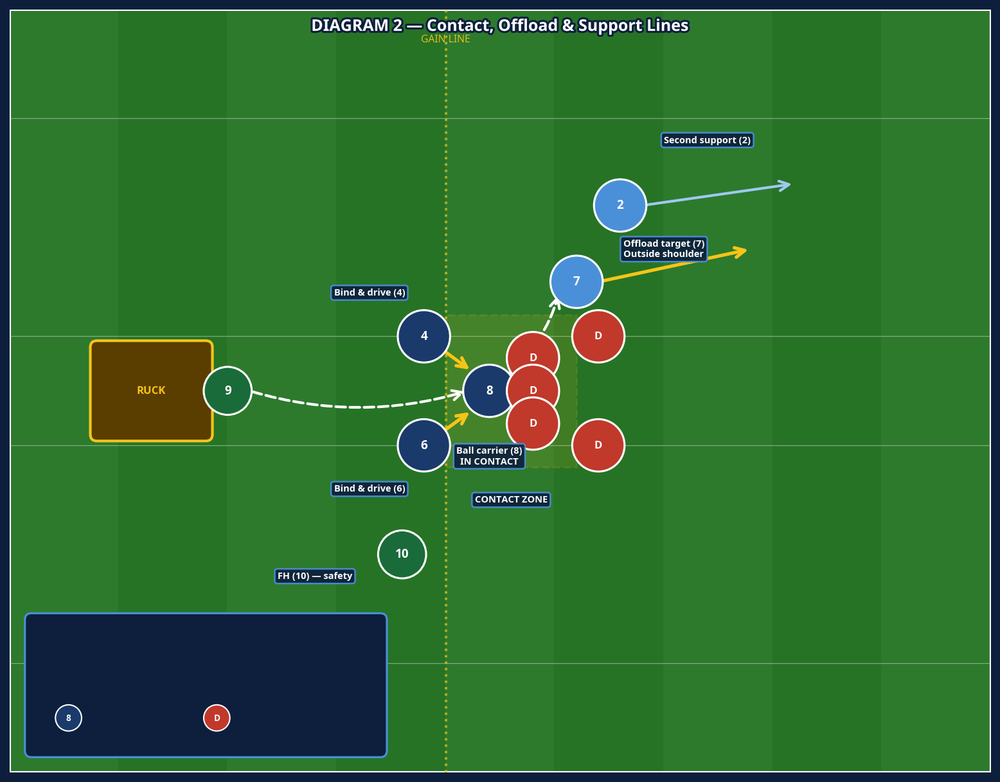
- The Pod (4, 6, 8): Three forwards aligned in an arrowhead or diagonal formation. The lead runner (8) is the primary ball carrier. The two support forwards (4 and 6) are positioned slightly behind and on either side to latch on and drive.
- Offload Target (7): Positioned wider and slightly deeper, tracking the outside shoulder of the ball carrier.
- Fly-half (10): Positioned deep as a safety option and to organize the next phase.
3. Step-by-Step Instructions
- The Approach: The scrum-half (9) identifies the pod and delivers a fast, flat pass to the lead forward (8). The pod must be moving forward before the ball is caught, attacking the gainline at pace.
- The Catch and Drive: The lead forward (8) catches the ball securely in two hands. As they approach the defensive line, they must lower their body height, target the space between two defenders (the seam), and prepare for contact.
- The Latch: Immediately upon contact, the two support forwards (4 and 6) must latch onto the ball carrier. One targets the hips/glutes to drive forward, while the other secures the ball carrier's torso to prevent a choke tackle and keep the momentum moving forward.
- The Offload Setup: As the pod drives through the contact zone, the ball carrier (8) must keep the ball alive by shifting it to their outside arm, away from the primary tacklers.
- The Support Run: The designated offload target (7) accelerates, running a hard line directly at the outside shoulder of the ball carrier. They must communicate clearly (e.g., "Pop! Pop!") to signal their arrival.
- The Execution: The ball carrier (8) executes a short, sympathetic pop pass or a one-handed offload out the back door to the arriving support runner (7), who bursts through the defensive line.
4. Key Coaching Points
- Pace onto the Ball: The pod must be running onto the ball, not waiting to catch it from a standing start. Momentum is the key to winning the collision.
- Body Height: The ball carrier must drop their body height just before contact to win the shoulder battle and avoid being held up.
- Immediate Latch: The support forwards (4 and 6) cannot be late. They must latch onto the ball carrier almost simultaneously with the defensive contact to ensure a dominant drive.
- Ball Presentation: The ball carrier must fight to keep their arms free in the tackle, presenting the ball on the outside hip to make the offload possible.
- Timing of the Support Run: The offload target (7) must time their run perfectly. If they arrive too early, they overrun the pass; if too late, the ball carrier will be taken to ground.
5. Common Mistakes
- Static Catching: Forwards catching the ball while standing still, allowing the defense to dominate the collision and drive them backward.
- Late Support: The latching forwards arriving too late, resulting in the ball carrier being isolated, turned over, or held up in a choke tackle.
- Forcing the Offload: The ball carrier attempting a low-percentage offload when wrapped up securely. If the offload isn't on, the priority must shift immediately to going to ground and presenting the ball cleanly for a fast ruck.
- Poor Communication: The support runner failing to call for the ball, leading to hesitation or a blind offload that results in a knock-on.
6. Variations & Progressions
- The Tip Pass: Instead of taking the ball into contact, the lead forward (8) tips the ball inside or outside to one of the supporting pod members just before the defensive line.
- The Pull-Back (Screen Pass): The lead forward (8) shapes to carry but instead passes the ball out the back to the fly-half (10) who is wrapping around behind the pod, shifting the point of attack wider.
- Adding a Second Wave: If the offload is successful, have a second pod ready to receive a subsequent offload or take a quick pass from the line-breaking runner to maintain the chaotic tempo.
7. Age Adaptations
- Under 10 / Under 12: Focus heavily on the basic catch-and-drive mechanics and safe body height in contact. Introduce the offload only as a secondary option once the primary drive is mastered. Emphasize two-handed carries.
- Under 14 / Under 16: Begin drilling the timing of the latch and the specific lines of the support runners. Encourage players to look for the offload, but reinforce the decision-making process (when to offload vs. when to take the tackle).
- Open / Senior: Execute at full game speed. Introduce complex variations like the screen pass or tip pass off the pod structure. Focus on micro-skills like dominating the initial collision to force the defense to over-commit, creating the space for the offload.
