

Rugby
Mastering the Offload: 3v2 Contact Progression Drill
Develop your players' ability to stay strong in contact, keep the ball alive, and execute precision offloads to support runners in a dynamic 3v2 scenario.

What you need
1 Rugby ball, 2-3 spare Rugby balls, 6 Cones, 1-2 Tackle shields, Bibs
1. Overview
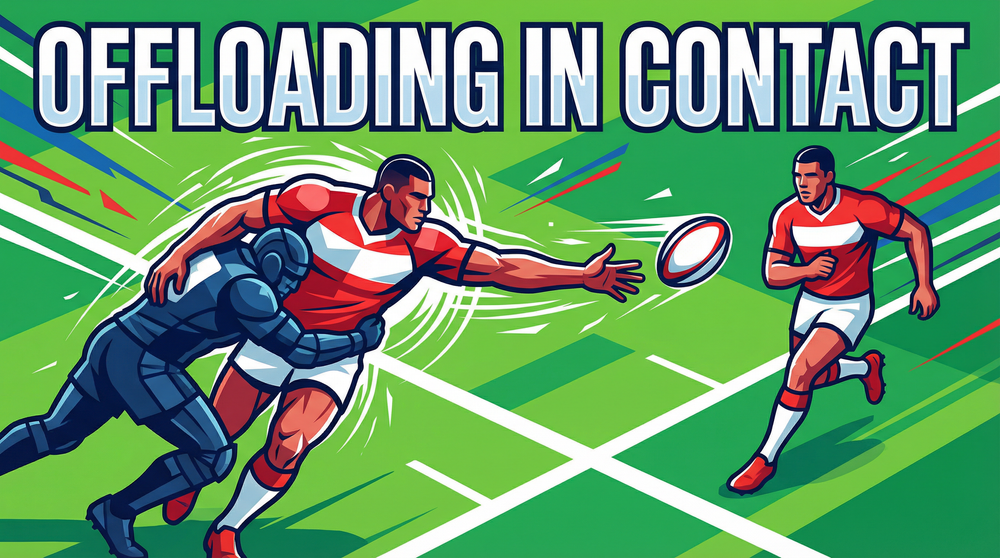
The ability to keep the ball alive through contact is one of the most devastating attacking weapons in modern rugby. This drill focuses on the ball carrier's body height, leg drive, and upper body control to free the arms for an offload. It also trains support runners to read the tackle situation, communicate effectively, and time their lines to receive the offloaded ball at pace. By progressing from a static 2v1 to a dynamic 3v2 overload, players will develop the decision-making skills necessary to exploit broken defensive lines and create scoring opportunities.
2. Setup

To run this drill effectively, you will need a clear section of the pitch and a few basic pieces of equipment. Set up a grid that is 20 metres wide by 15 metres long for the initial phases, expanding to 30 metres by 20 metres for the final progression.
Equipment Needed:
- 1 Rugby ball (plus 2-3 spares on the sideline)
- 6 Cones to mark the grid boundaries
- 1-2 Tackle shields or hit shields (for Phase 1)
- Bibs for the defending team
Player Positions:
- Attacking Team (Red): 10 (Feeder), 12 (Ball Carrier), 13 (Primary Support Runner), 11 (Secondary Support Runner/Wing).
- Defending Team (Blue): D1 (Primary Tackler), D2 (Secondary Defender).
3. Step-by-Step Instructions
Phase 1: The Initial Carry and Body Position
- The Feeder (10) starts with the ball 3 metres behind the Ball Carrier (12).
- On the coach's whistle, 10 passes the ball to 12, who is running forward at pace.
- The Tackler (D1), holding a tackle shield, steps forward to engage 12.
- 12 must drop their body height before contact, drive their legs through the shield, and fight to keep their shoulders square and the ball free from the tackler's grasp.
- The Primary Support Runner (13) trails 3 metres behind and slightly to the outside of 12, communicating their position loudly (e.g., "With you right!" or "Pop!").
- 12 executes a controlled offload to 13, who accelerates through the gap.
Phase 2: Live Contact and the Offload Window
- Remove the tackle shield. D1 is now making a live, wrap tackle below the waist on 12.
- 12 receives the ball from 10 and drives into D1. The focus is on taking the tackle on the terms of the attacker—stepping into the defender to dominate the collision.
- As D1 wraps the legs, 12 must stay on their feet for at least one second, turning their upper body slightly to face the support.
- 13 runs a line that starts deep and flattens out as they approach the offload window (the space immediately behind the tackle).
- 12 delivers a soft, sympathetic pop pass or a one-handed offload to 13.

Phase 3: Full Progression (3v2 Overload)
- Expand the grid to 30m x 20m. Introduce the Secondary Support Runner (11) wide on the right, and the Secondary Defender (D2) covering the outside space.
- 12 takes the ball into contact against D1 and executes the offload to 13.
- D2 must now make a decision: rush up to tackle 13 or drift wide to cover 11.
- 13 receives the offload and must immediately read D2. If D2 commits to the tackle, 13 draws the defender and passes to 11 to exploit the overlap. If D2 drifts, 13 accelerates through the gap.

4. Key Coaching Points
- Dominate the Collision: The ball carrier must lower their body height just before impact and use strong leg drive to maintain forward momentum. A static ball carrier cannot offload effectively.
- Ball Security: Carry the ball in two hands until the moment of contact, then secure it away from the defender's arms to keep it available for the offload.
- Fight to Stand: The ball carrier should resist going to ground immediately. Staying on the feet for an extra second creates the offload window.
- Support Timing and Depth: Support runners must not overrun the ball carrier. They should stay deep enough to react to the tackle and accelerate onto the offloaded ball.
- Communication: Support players must be vocal, giving the ball carrier clear instructions on where they are and when they want the ball.
5. Common Mistakes
- Forcing the Offload: Players often try to throw the ball away blindly when they are losing the collision. Coach them to take the tackle and present the ball if the offload is not clearly on.
- Flat Support Lines: Support runners who stand too flat will overrun the offload or receive the ball while standing still. Emphasise starting deep and arriving at pace.
- Poor Ball Presentation: If the offload isn't possible, the ball carrier sometimes forgets to secure the ball for the ruck. Always practice a strong ground presentation as the default fallback.
6. Variations & Progressions
- Add a Scramble Defender: Introduce a third defender starting 10 metres deep who can cover the line break if the offload is successful. This forces the support runners to make another decision after receiving the ball.
- Offload from the Floor: Progress the drill to practice offloading just as the ball carrier hits the ground (the 'SBW' or Sonny Bill Williams style offload). This requires excellent core strength and timing.
- Conditioned Game: Finish the session with a game of touch or grab rugby where an offload is worth double points, encouraging players to look for the pass in contact.
7. Age Adaptations
- Under 8s to Under 10s: Focus purely on the concept of passing before being tagged or wrapped. Use soft balls and remove heavy contact. Emphasise running into space rather than contact.
- Under 12s to Under 14s: Introduce tackle shields and focus heavily on body height and safe tackle technique. The offload should be a simple pop pass from a dominant carry.
- Under 16s and Open Age: Run the full 3v2 progression with live, competitive tackling. Focus on decision-making under pressure and executing complex offloads (e.g., one-handed or out the back).
