

Rugby
Penalty Corner Attack Play: The Driving Maul with Backline Release
Master the penalty corner driving maul with a timed backline release — a high-percentage try-scoring play that exploits defensive drift and creates overlaps near the touchline.

What you need
Rugby balls (4-6), Disc cones (20), Tackle bags (4), Coloured bibs (2 sets of 15), Whiteboard or cones grid for walkthrough, Full-size Rugby pitch or 30m x 40m training grid
Overview
The Penalty Corner Attack Play is one of the most reliable try-scoring weapons in a Rugby union team's arsenal. When a penalty is awarded within 10 metres of the opposition's try line and within 15 metres of the touchline, this play gives your team a structured, repeatable method to convert pressure into points. The play works by using a driving maul to commit the opposition's forwards into a narrow defensive channel, then releasing the ball to a backline that has space to work with on the open side of the field.
This play is most effective when the defending team is fatigued, when they have players in the sin bin, or when they are already under sustained territorial pressure. The key principle is simple: use the maul as a weapon and a decoy simultaneously. If the maul drives over the line, you score directly. If the defence collapses to stop the maul, your backs have a one-on-one or overlap situation on the open side. You win either way.
Use this play in the final 20 metres of the pitch, particularly when the penalty is awarded between the 5-metre line and the 22-metre line, within 15 metres of the touchline.
Setup

Equipment Required
| Item | Quantity | Purpose |
|---|---|---|
| Rugby balls | 4–6 | Main play and warm-up |
| Cones (disc) | 20 | Mark penalty spot, 5m and 10m channels |
| Tackle bags | 4 | Simulate defensive resistance in maul |
| Bibs (2 colours) | 15 | Differentiate attack and defence |
| Whiteboard / Cones grid | 1 | Pre-session walkthrough |
Pitch Setup
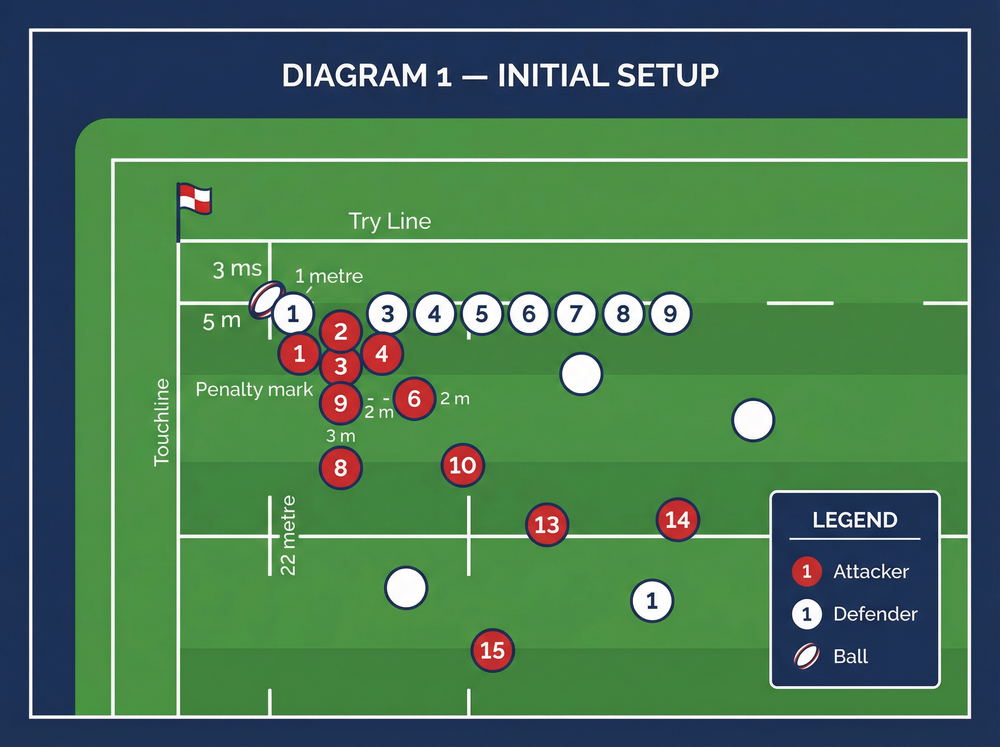
Set up in the corner of a full-size Rugby pitch (100m x 70m). Mark the penalty spot approximately 5 metres from the touchline and 8–12 metres from the try line. This is the optimal zone — close enough to score directly from the maul, far enough to give the backs room to work. If training without a full pitch, use a 30m x 40m grid with a marked try line and touchline.
Player Positions
| Position | Number | Role in This Play |
|---|---|---|
| Loosehead Prop | 1 | Front of maul pod, primary driver |
| Hooker | 2 | Binds into maul, provides ball security |
| Tighthead Prop | 3 | Front of maul pod, primary driver |
| Lock | 4 | Second row of maul, driving engine |
| Lock | 5 | Second row of maul, driving engine |
| Blindside Flanker | 6 | Maul pod, option to peel off |
| Openside Flanker | 7 | Floats wide, first receiver option |
| Number Eight | 8 | Controls ball at back of maul |
| Scrum-Half | 9 | Ball distributor, triggers backline |
| Fly-Half | 10 | First receiver from 9, orchestrates backline |
| Inside Centre | 12 | Hard flat runner, draws defenders |
| Outside Centre | 13 | Wide runner, exploits space |
| Right Wing | 14 | Finisher in wide channel |
| Left Wing | 11 | Positioned as decoy or support |
| Fullback | 15 | Sweeper and depth option |

Diagram 1 shows the initial player setup at the penalty mark, with the forward pod assembled and the backline spread infield.
Step-by-Step Instructions

Step 1 — Penalty Awarded: Immediate Communication (0–5 seconds)
The moment the penalty is awarded, the captain or designated caller shouts the play call (e.g., "CORNER! CORNER!"). All 15 players must hear this and begin moving to their positions without delay. Speed of setup is critical — the defending team needs time to organise, so your team must be ready to go within 30 seconds.
Step 2 — Forward Pod Assembly (5–15 seconds)
Props 1 and 3 position themselves at the penalty mark, binding tightly. Hooker 2 binds in behind them. Locks 4 and 5 bind into the second row. Flanker 6 and Number Eight 8 complete the pod at the rear. The ball is placed at the feet of Prop 1. The pod should be compact — no wider than 2 metres — with all players in a low, powerful body position, hips below shoulders.
Step 3 — Backline Positioning (5–15 seconds)
Simultaneously, Scrum-Half 9 positions 1 metre behind the back of the maul. Fly-Half 10 sets up 8 metres infield from the penalty mark. Inside Centre 12 aligns 3 metres outside 10. Outside Centre 13 aligns 3 metres outside 12. Wing 14 takes a position 5 metres outside 13, near the 22-metre line. Fullback 15 drops 10 metres behind the backline as a sweeper. Openside Flanker 7 positions 3 metres outside the maul as a short option for 9.
Step 4 — The Maul Drive (15–25 seconds)
On the signal from Number Eight 8 (a verbal call or tap of the ball), the pod drives forward as a single unit. All players must drive with their legs — low body position, short powerful steps, driving through the hips. The target is to gain 3–5 metres of ground and get within 3 metres of the try line. Number Eight 8 controls the ball at the back of the maul throughout the drive.
Step 5 — Decision Point (at 3 metres from try line)
Number Eight 8 reads the defence. There are two outcomes:
- Option A (Score Direct): If the maul has momentum and the defence is crumbling, 8 keeps the ball in the maul and drives it over the try line. Hooker 2 or a lock can also attempt to ground the ball if the maul reaches the line.
- Option B (Release to Backs): If the defence has committed numbers to stop the maul, 8 calls "BALL!" and passes to Scrum-Half 9.
Step 6 — Ball Release and Backline Attack
On receiving from 8, Scrum-Half 9 delivers a fast, flat pass to Fly-Half 10. Fly-Half 10 reads the defensive line: if Inside Centre 12's defender has been drawn in by the maul, 10 hits 12 on a hard flat line. If the defence is spread, 10 may skip a pass to 13 or use Flanker 7 on the short side. The backline attacks at pace, targeting the space created by the maul's gravitational pull on the defence.
Step 7 — Support and Continuity
Forwards who are not in the maul must immediately become support runners once the ball is released. Number Eight 8 and Flanker 6 should be within 5 metres of the ball carrier at all times. If the first ball carrier is tackled, the support runners must secure the ruck and recycle quickly for a second-phase attack.

Diagram 2 illustrates the maul drive in progress, the ball release to the Scrum-Half, and the backline attack pattern exploiting the space created on the open side.
Key Coaching Points

1. Speed of Setup is Non-Negotiable
The most common reason this play fails is slow setup. Drill your players to know their positions instinctively. Every second you give the defence is a second they use to organise a rush defence or a maul-killing counter. Time your setup in training — the target is pod assembled and backline set within 20 seconds of the penalty being awarded.
2. The Maul Must Be Legitimate and Powerful
A weak maul that stalls immediately gives the defence confidence and time. Emphasise that every forward in the pod must be driving with their legs, not just standing and holding. Low body position — hips below shoulders — is the single most important technical cue. Use the phrase: "Legs drive the maul, arms just hold it together."
3. Number Eight Controls the Tempo
Number Eight 8 is the quarterback of this play. They must communicate clearly — calling the drive, reading the defence, and making the decision to keep or release. Train 8 specifically on this decision-making under pressure. Use a coach standing behind the maul to call out defensive numbers ("3 defenders on the maul!") to simulate the decision environment.
4. Backline Must Hold Their Depth Until the Ball is Released
A common error is backs drifting forward prematurely, which compresses the attacking space and telegraphs the play. Backs must hold their depth (Fly-Half 10 at 8 metres, centres at appropriate depth) and only accelerate onto the ball once 9 has it in hand. The cue is the moment 8 calls "BALL!" — that is when the backline begins their run.
5. Fly-Half 10 Must Read the Defensive Line, Not the Ball
Fly-Half 10's eyes should be on the defensive line from the moment they set up. They are looking for the defender who has been pulled into the maul, creating the mismatch. Remind 10: "The maul has already done the work for you — find the gap and hit it."
6. Support Runners Must Be on the Shoulder, Not Behind
Forwards supporting the ball carrier after the release must be on the ball carrier's inside shoulder, within 2 metres. A support runner 5 metres behind is useless in a ruck situation near the try line. Emphasise: "Get to the ball carrier's hip before they hit contact."
Common Mistakes

Mistake 1 — Pod Too Wide or Loosely Bound
Coaches often see forwards spread out in the maul pod, with gaps between players. This allows defenders to split the maul and steal the ball. Correction: insist on tight binding before the drive begins. Use the cue: "If you can fit a hand between you and the player next to you, you're too far apart." Walk through the binding in slow motion before live reps.
Mistake 2 — Scrum-Half 9 Passes Too Early
If 9 releases the ball before the maul has committed defenders, the backline attacks against a fully organised defence. The maul needs to draw at least 3–4 defenders before the release is effective. Coach 9 to wait for the call from 8, not to release on instinct.
Mistake 3 — Backs Running Across the Field Instead of At the Defence
When the ball reaches the backline, centres and wings sometimes run sideways rather than at defenders, losing the momentum advantage. Reinforce that the first 3 metres of every back's run must be straight — directly at the defensive line — before any lateral movement.
Mistake 4 — Maul Collapses Under Pressure
If the defending team is well-drilled at maul-killing, your pod may collapse. Prevent this by ensuring all forwards in the pod are legally bound (hands on the body, not the jersey alone) and that the ball carrier at the back is protected. If the maul is being killed, Number Eight 8 should release early rather than risk a turnover.
Mistake 5 — Backline Decoys Not Committed
If Inside Centre 12 or Outside Centre 13 jog their dummy runs rather than sprinting at full pace, defenders will not be drawn. Every decoy run must be at full intensity. Remind backs: "If you're not convincing, you're not helping."
Variations & Progressions
Variation 1 — Blindside Crash & Offload (Pick-and-Go)
Instead of a full driving maul, use a small pick-and-go pod of Props 1 and 3 with Number Eight 8 picking from the base. Number Eight 8 drives hard at the corner, with Flanker 6 on the inside shoulder and Flanker 7 on the outside shoulder as offload targets. Fly-Half 10 and Inside Centre 12 run decoy lines infield to pull defenders. This variation is faster to execute and harder for the defence to read, but requires excellent offloading technique from 8.

Diagram 3 shows the Blindside Crash & Offload variation, with Number Eight targeting the corner and support runners providing offload options.
Variation 2 — Dummy Maul with Quick Tap
The team sets up as if executing the standard driving maul play. However, instead of driving, Scrum-Half 9 takes a quick tap at the penalty mark and hits Flanker 7 on a hard line between the maul pod and the touchline. This works best when the defence has seen the maul play before and is rushing up aggressively. The timing must be precise — 9 taps the moment the defence commits to the maul.
Progression — Add Live Defensive Pressure
Begin the drill with passive defenders (tackle bags or walking defenders) to build confidence in the pattern. Progress to semi-active defenders who can contest the maul but not steal the ball. Finally, run the play against a full defensive team with a live referee to simulate match conditions. Add a consequence: if the attack scores, the defence does 10 press-ups; if the defence holds, the attack does 10 press-ups. Competition sharpens execution.
Age Adaptations

Under 12 and Under 14
At younger age groups, remove the driving maul element entirely and focus on the core principle: using a forward pod to draw defenders and releasing to backs in space. Use a simple pick-and-go with two or three forwards, then a pass to the Scrum-Half and a two-on-one finishing drill. Reduce the number of players involved to 8 (3 forwards, 1 scrum-half, 4 backs) to simplify decision-making. Focus on communication, body position in contact, and passing accuracy rather than tactical complexity.
Under 16
Introduce the full maul structure but use passive defenders for the first 4–6 sessions. Teach Number Eight 8's decision-making role explicitly, using a coach as the "decision caller" before handing responsibility to the player. Introduce Variation 1 (Blindside Crash) once the base play is consistent.
Open Age and Senior
Run the play at full intensity against a live defence from the first session, as players will have the physical and technical foundation to handle it. Focus coaching time on the decision-making nuances — when to keep in the maul vs. release, how to read defensive numbers, and how to vary the play to prevent the opposition from scouting it. Introduce all three variations and develop a call system so the play can be selected and communicated in real time during a match.
