

Rugby
Mastering Support Running and Angles: The Ultimate Attacking Drill
Teach your players to anticipate line breaks, run intelligent angles, and keep the attack alive with this comprehensive support running drill.
What you need
4-8 Rugby balls, 12-20 Cones, Bibs (2 colors), Tackle bags (optional)
1. Overview
The "Support Running and Angles" drill is a foundational attacking exercise designed to teach players how to correctly position themselves to receive an offload or continue a phase of play. In modern Rugby, line breaks are only effective if support players are immediately available to exploit the gap. This drill trains players to anticipate line breaks, run intelligent angles (both inside and outside the ball carrier), and communicate effectively. Use this drill during the conditioning or tactical phase of your session to build attacking continuity and improve decision-making under pressure.
2. Setup
Pitch Setup:
- Mark out a primary grid of 20m x 15m for the basic drill (Drill 1).
- For the progressed variations, expand the grid to 30m x 20m (Drill 2) and eventually 40m x 25m (Drill 3).
- Use white or bright cones to mark the corners and zone boundaries.
Equipment Needed:
- 4-8 Rugby balls
- 12-20 Cones (preferably in two different colors to mark zones)
- Bibs (2 colors to differentiate attackers and defenders in progressed stages)
Player Positions:
- Attackers: Groups of 3-4 players (e.g., a Scrum-half [9], Fly-half [10], and two Centres [12, 13] or loose forwards [6, 7, 8]).
- Defenders: Introduce 2-4 defenders in the progression stages.
3. Step-by-Step Instructions
Phase 1: Basic Support Angles (Uncontested)
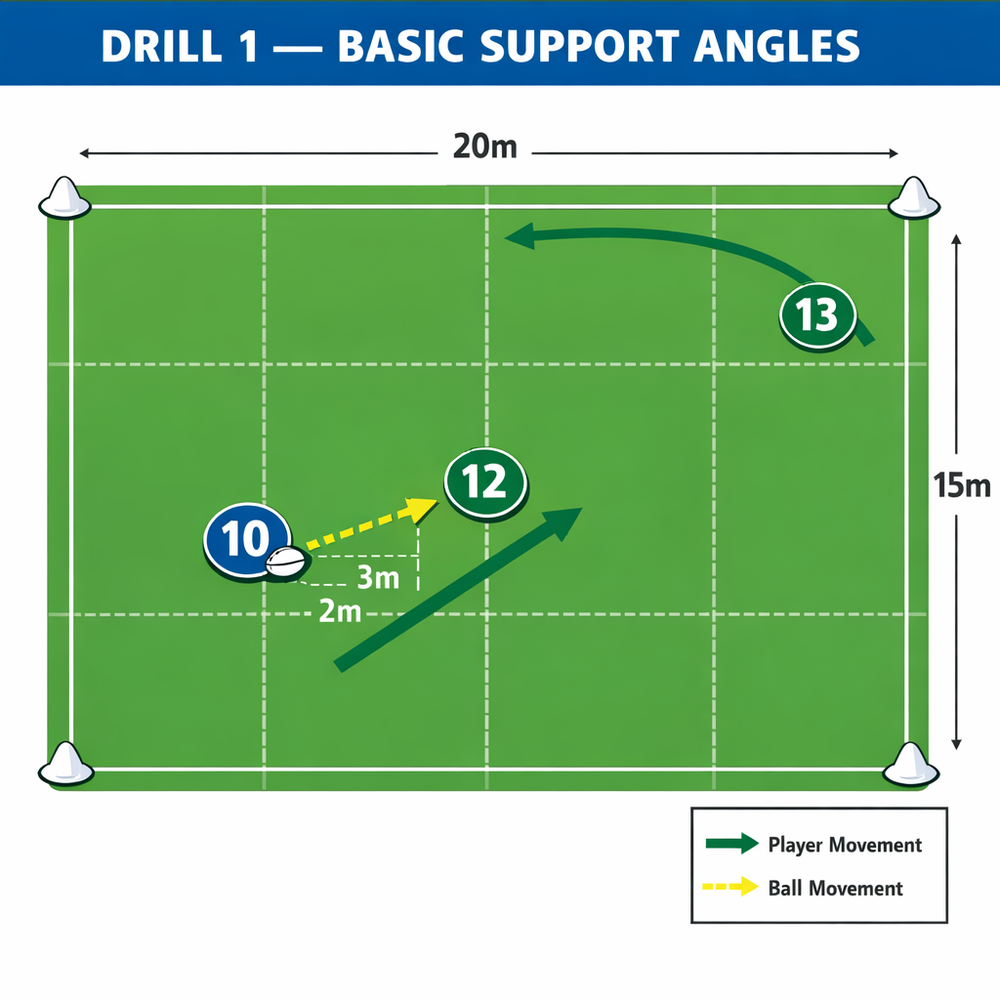
- Starting Position: Set three attacking players at one end of the 20m x 15m grid. The ball carrier (e.g., the 10) starts in the middle, with one support player (e.g., the 12) 3m behind and 2m inside, and another (e.g., the 13) 5m behind and 4m outside.
- Initiation: On the coach's whistle, the ball carrier runs straight forward at 70% pace.
- Support Movement: The support players must react to the ball carrier's line. The inside support (12) runs a hard 45-degree angle towards the ball carrier's inside shoulder. The outside support (13) runs a wider sweeping line, maintaining depth.
- The Pass: After running 10m, the ball carrier executes a pop pass or standard lateral pass to one of the support runners.
- Completion: The receiver catches the ball at pace and accelerates through the end of the grid. Reset and repeat, rotating positions.
Phase 2: Wave Support Running (With Static Defenders)
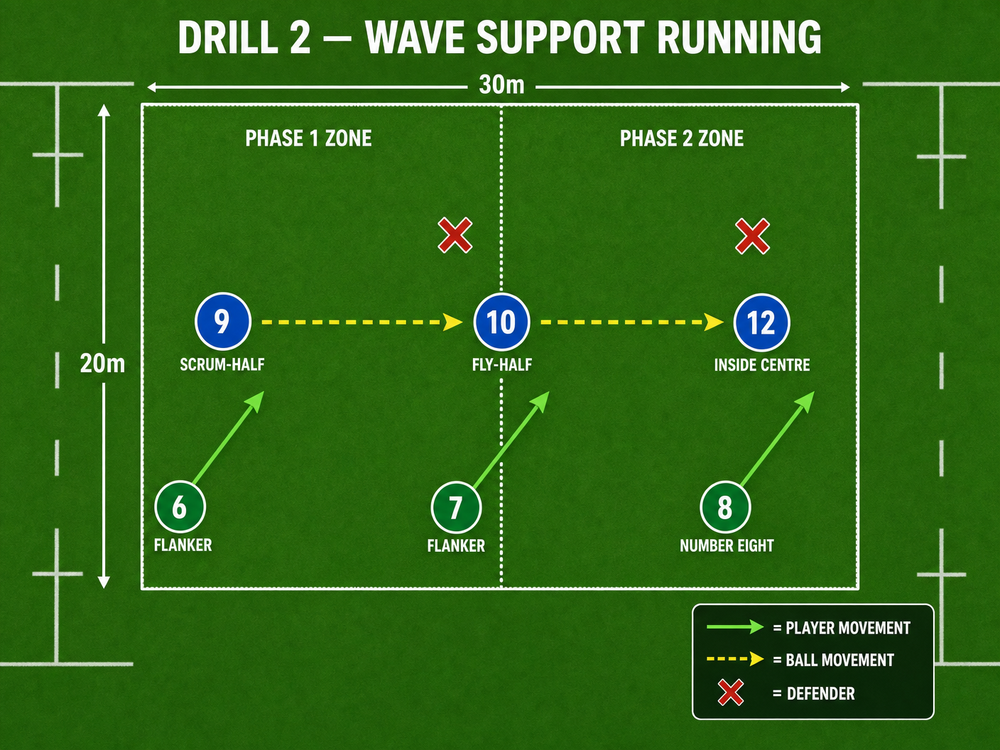
- Grid Expansion: Expand the grid to 30m x 20m. Place two static defenders (using tackle bags or passive players) in the middle of the grid.
- The Wave: Have a Scrum-half (9) pass the ball to the Fly-half (10). As the 10 receives the ball, they must attack the inside shoulder of the first static defender.
- Dynamic Support: Two support players (e.g., Flankers 6 and 7) must read the 10's movement. One must commit to an inside support line (cutting back against the grain), while the other stays wide.
- Decision Making: The 10 must draw the defender and make a decision to pass inside, pass outside, or take the tackle and present the ball cleanly for the support players to secure the ruck.
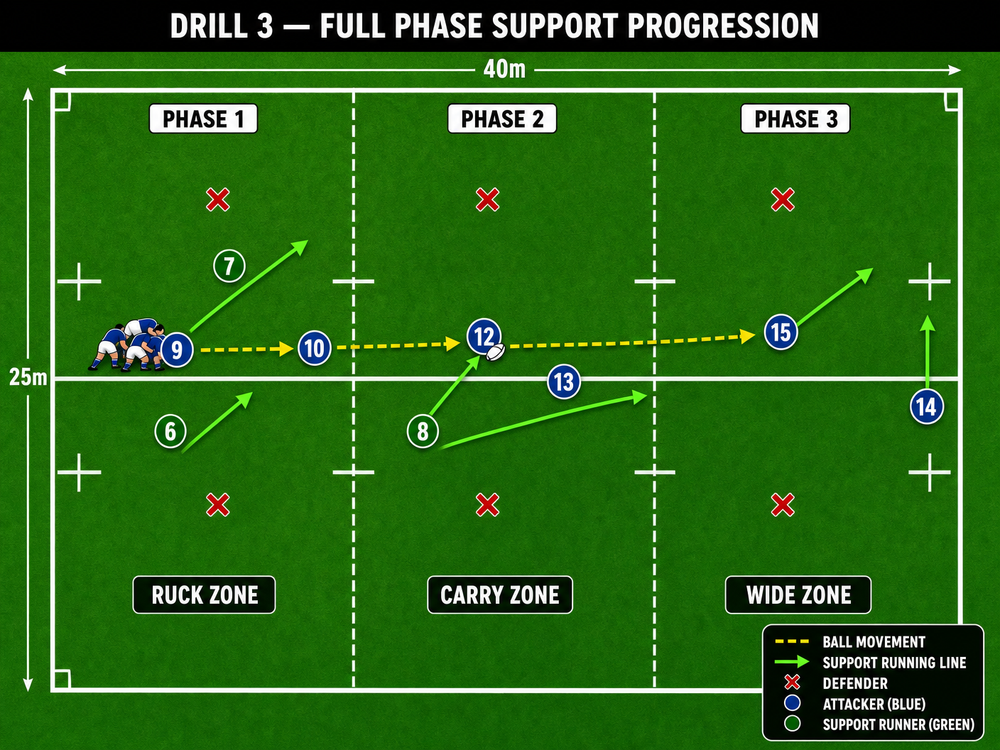
Phase 3: Full Phase Support Progression (Live Defense)
- Full Setup: Use the 40m x 25m grid. Introduce 3-4 live defenders who are allowed to move laterally but not advance past the gain line initially.
- Multi-Phase Attack: The attacking team must string together 3 continuous phases of play.
- Continuous Support: After the first tackle/ruck, the next wave of support players must immediately organize into an attacking pod or spread wide.
- Execution: Emphasize depth and angle of running. Support players must arrive at the ball carrier as they break the line or go to ground, not before or too late.
4. Key Coaching Points
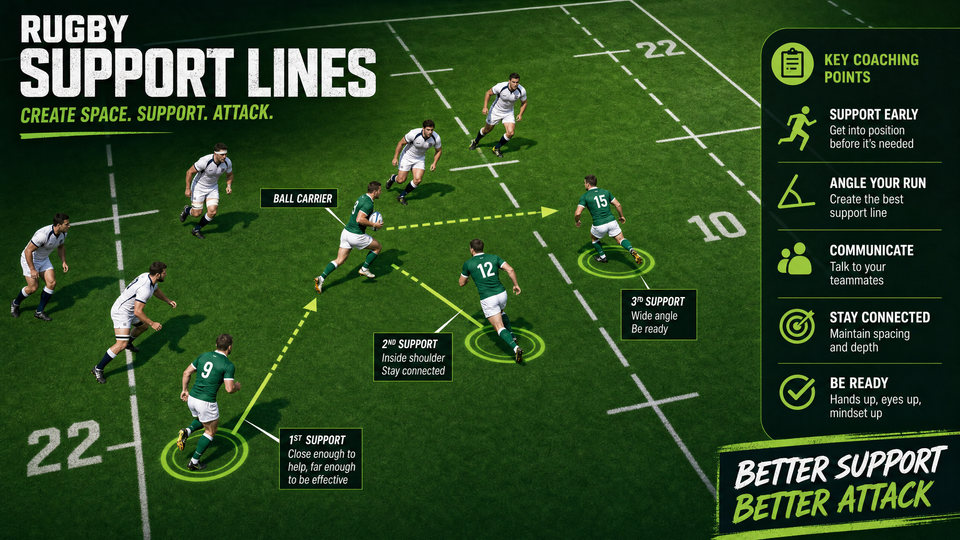
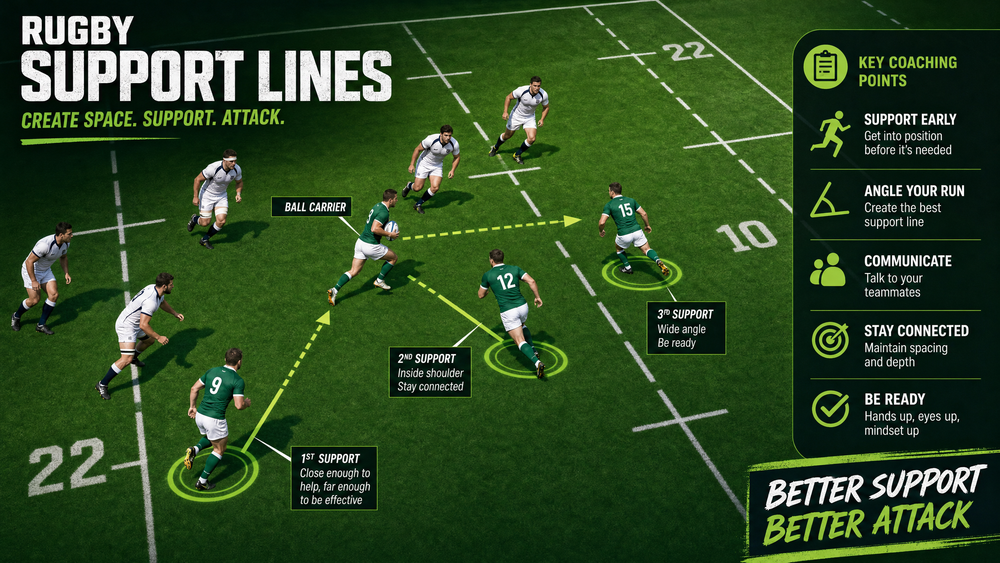
- Support Early: Players must anticipate the break and get into position before the ball carrier needs them. "Read the game, don't just react to it."
- Angle Your Run: Support runners should not run in a straight line behind the ball carrier. They must run at angles (e.g., 45 degrees) to hit the gap at pace and make the pass easier.
- Communicate: Support players must be the eyes and ears of the ball carrier. Demand loud, clear calls (e.g., "Inside!", "Outside!", "With you!").
- Stay Connected: Maintain proper spacing and depth. If a support player is too flat, the pass will be forward or easily intercepted. If they are too deep, they cannot exploit the line break.
- Be Ready: Hands up, eyes on the ball, and mindset prepared to receive an offload at any moment.
5. Common Mistakes
- Running Too Flat: Support players running parallel to the ball carrier, resulting in forward passes or getting caught behind the play.
- Ball Watching: Support players watching the ball rather than reading the defensive line and identifying the space to run into.
- Silent Support: Failing to communicate with the ball carrier, forcing the ball carrier to guess where their support is.
- Over-running the Play: Support players arriving too early and having to stop or slow down, killing the attacking momentum.
6. Variations & Progressions
- The "Offload Only" Rule: To increase difficulty, mandate that the ball carrier cannot go to ground and must execute an offload in the tackle. This forces support players to run tighter, more aggressive angles.
- Uneven Numbers: Run the drill with 4 attackers against 3 defenders to force the attack to find the overlap and require the support players to exploit the extra space.
- Fatigue Factor: Have the attacking group complete a burpee or a 10m sprint before starting the rep to simulate late-game fatigue and test their ability to run correct lines under physical stress.
7. Age Adaptations
- Under 8 - Under 10: Focus purely on Drill 1 (Uncontested). Emphasize running straight and passing backward. Use fun cues like "Follow the leader" for support lines.
- Under 12 - Under 14: Introduce Drill 2 with tackle bags. Focus heavily on communication and the concept of "inside" vs. "outside" support.
- Under 16 - Open: Utilize all phases, emphasizing Drill 3 with live, aggressive defense. Demand high-speed decision making, complex running lines (e.g., unders/overs lines), and elite communication.
