

Basketball
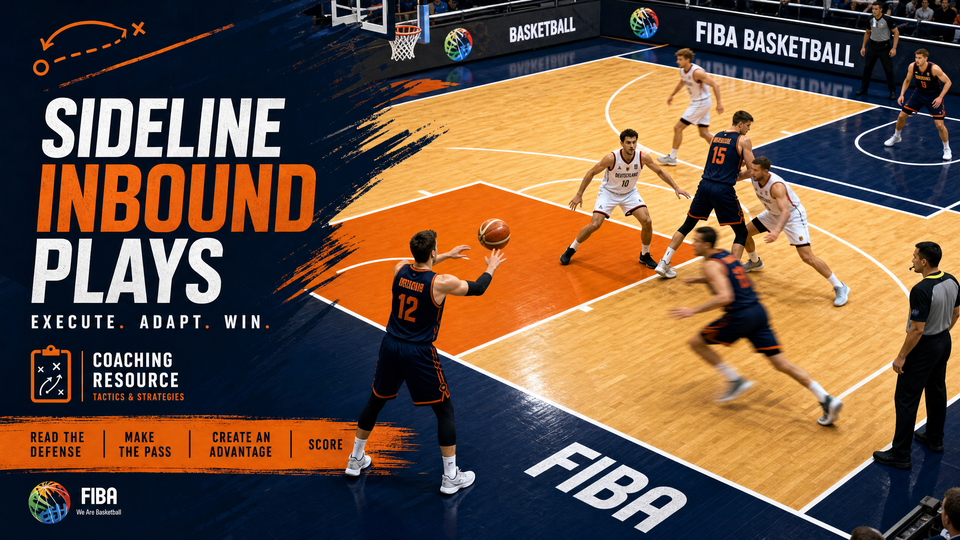
Sideline Screen & Dive: SLOB Play vs Man-to-Man
A highly effective sideline out-of-bounds play that utilizes a hard back-screen to create an immediate scoring opportunity at the rim against aggressive man-to-man defense.
What you need
1 Basketball, Half-court
1. Overview
The "Sideline Screen & Dive" is a highly effective sideline out-of-bounds (SLOB) play designed to exploit aggressive man-to-man defense. This set play creates an immediate scoring opportunity at the rim by utilizing a hard back-screen, while simultaneously offering a safe pressure-release pass to the point guard. It is particularly useful in late-game situations when the defense is overplaying passing lanes, or when you need a high-percentage look close to the basket.
By forcing the defense to communicate through a back-screen on the weak side of the floor, this play often results in defensive confusion, leading to an open layup or a high-low post-up situation.
2. Setup
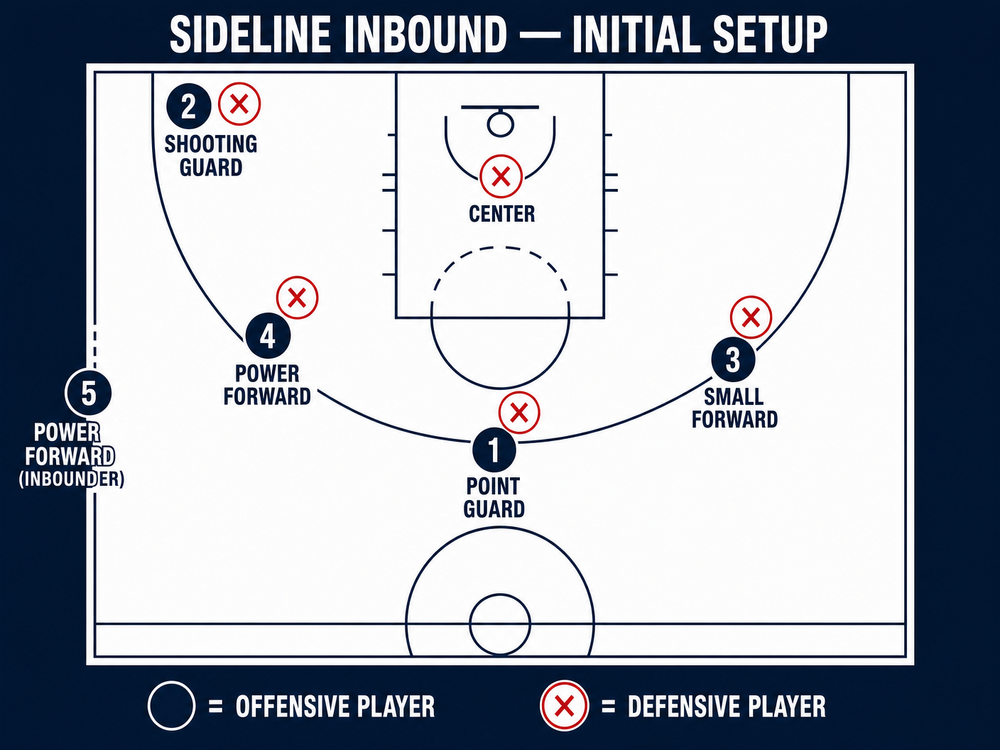
To execute this play effectively, ensure your team is aligned correctly on a standard FIBA regulation half-court (28m x 15m).
- Equipment: 1 Basketball, standard FIBA court markings.
- Starting Alignment:
- Player 5 (Center/Inbounder): Positioned out of bounds on the sideline, roughly parallel to the top of the key.
- Player 1 (Point Guard): Positioned at the top of the key, ready to initiate the V-cut.
- Player 4 (Power Forward): Positioned at the left elbow (ball-side).
- Player 2 (Shooting Guard): Positioned in the left corner (ball-side).
- Player 3 (Small Forward): Positioned on the right wing (weak-side), near the three-point arc.
3. Step-by-Step Instructions
Step 1: The Decoy Cut
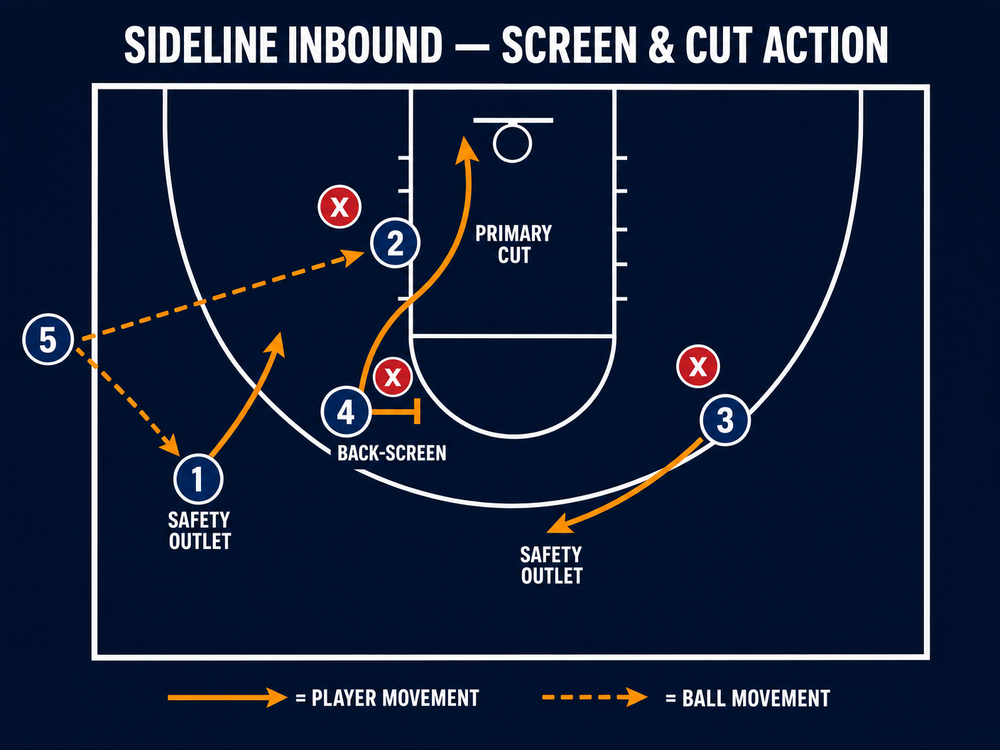
As the referee hands the ball to Player 5, Player 1 (Point Guard) initiates a hard V-cut toward the basket, then pops back out toward the sideline to drag their defender away from the primary action area. This serves as the safety outlet pass if the primary option is covered.
Step 2: The Setup and Screen
Simultaneously, Player 4 (Power Forward) steps down from the elbow to set a solid, wide-based back-screen for Player 2 (Shooting Guard) who is positioned in the corner. Player 4 must ensure their feet are set before contact to avoid an offensive foul.
Step 3: The Primary Cut (The Dive)
Player 2 reads the screen and makes a hard, explosive cut (the "dive") off Player 4's shoulder, heading directly toward the strong-side block. Player 2 must look for the ball immediately as they clear the screen.
Step 4: The Inbound Pass
Player 5 reads the defense. The primary look is the lob or direct pass to Player 2 cutting to the rim. If the defense switches or fights through the screen effectively, Player 5 immediately looks to Player 1 on the perimeter as the safety outlet.
Step 5: Secondary Action
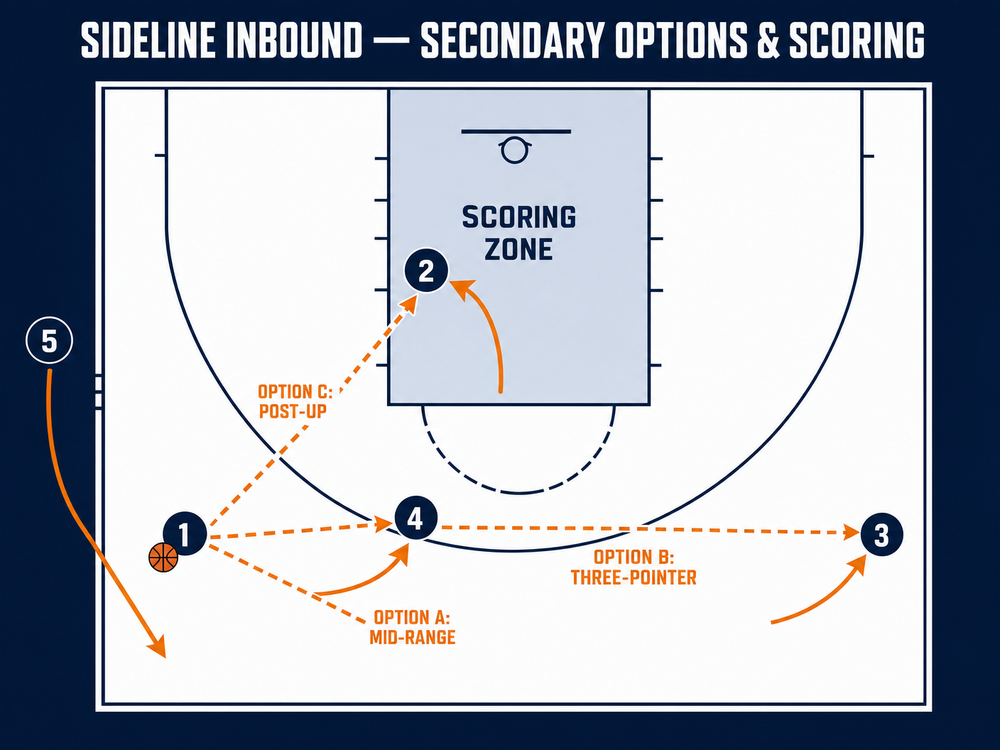
If the pass goes to Player 1 (the safety outlet), the play flows seamlessly into a half-court set. Player 4, after setting the screen, opens up to the ball and flashes to the elbow. Player 2 establishes deep post position on the block. Player 3 drifts to the weak-side corner to space the floor. Player 1 now has three options: feed the post (Player 2), pass to the elbow (Player 4), or swing the ball for a weak-side three-pointer (Player 3).
4. Key Coaching Points
- Screening Angle: Player 4 must set the back-screen at the correct angle—perpendicular to the baseline—to ensure Player 2 has a direct path to the basket. A poor angle allows the defender to slip under the screen.
- Patience on the Cut: Player 2 must wait for Player 4 to be completely set before initiating the cut. Leaving early will result in a weak screen or an offensive foul.
- Eye Contact: The inbounder (Player 5) and the cutter (Player 2) must establish eye contact before the pass is thrown.
- Strong Safety Cut: Player 1 must execute their V-cut with game speed. A lazy cut will allow their defender to sag and help on the primary action.
- Inbounder Spacing: Player 5 should step back as far as space allows out of bounds to improve their passing angle and vision over the defense.
5. Common Mistakes
- Moving Screen: The screener (Player 4) leans or shifts their feet just before contact, resulting in an offensive foul.
- Telegraphing the Pass: The inbounder stares down the primary cutter (Player 2) from the moment they receive the ball, allowing the defense to anticipate and intercept the pass.
- Lack of Spacing: Players 1 and 3 drift too close to the primary action, bringing their defenders into the passing lanes and clogging the paint.
- Soft Cuts: Player 2 jogs through the cut instead of sprinting, allowing the trailing defender to recover and contest the pass.
6. Variations & Progressions
- Progression 1 (Slip the Screen): If the defense starts aggressively switching the back-screen, have Player 4 "slip" the screen—faking the screen and immediately diving to the basket themselves while Player 2 pops out.
- Variation 1 (Hand-Off Action): If the ball is inbounded to the safety outlet (Player 1), Player 5 steps inbounds and immediately sprints to receive a dribble hand-off from Player 1, flowing into a pick-and-roll action.
- Variation 2 (Weak-Side Flare): While the primary action occurs, have Player 3 set a flare screen for Player 1 on the weak side, creating an open three-point look if the defense over-helps in the paint.
7. Age Adaptations
- Under 10s: Focus entirely on the V-cut and getting the ball inbounds safely to Player 1. Introduce the concept of moving without the ball.
- Under 12s - Under 14s: Introduce the back-screen action. Emphasize proper screening technique (wide base, arms crossed) and the timing of the cut.
- Under 16s - Open: Execute the full play with reads. Teach players how to react to defensive switches (slipping the screen) and how to flow directly into secondary half-court offense.
