

Basketball
Stack Inbound Under the Basket
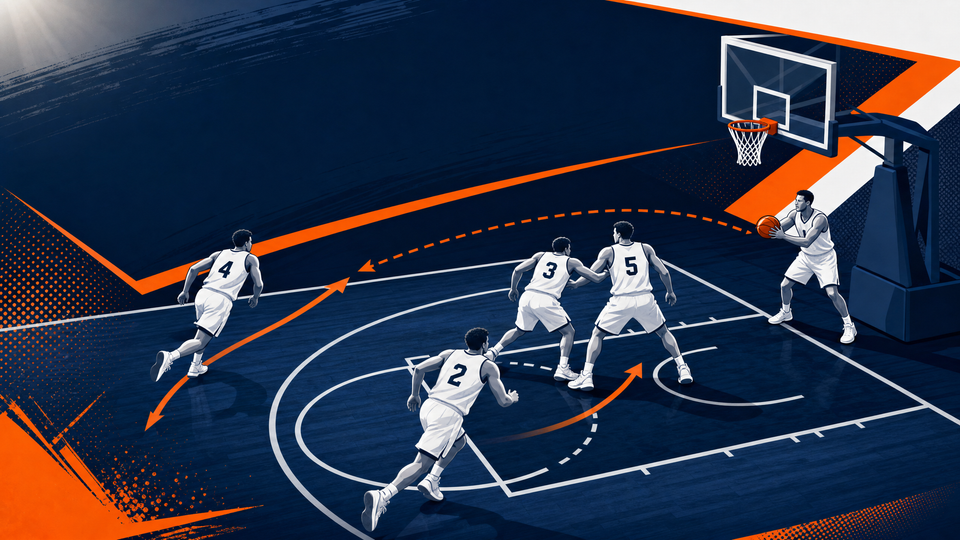
A highly effective baseline inbound play designed to create multiple scoring options, including an immediate layup or a wide-open corner three.
What you need
1 Basketball, Half Court
Overview
The Stack Inbound play is a fundamental yet versatile baseline out-of-bounds (BLOB) play. It is designed to create confusion for the defense through synchronized movement and screening, resulting in multiple high-percentage scoring options. This play is particularly effective against man-to-man defenses and can be run at crucial moments in the game when a quick basket is needed from under the hoop.
Setup

Court Dimensions: Standard FIBA Court (28m x 15m)
Equipment Needed: 1 Basketball, Half Court
Player Positions
- Player 1 (Point Guard): Positioned at the top of the key.
- Player 2 (Shooting Guard): Positioned on the right wing as a safety outlet.
- Player 3 (Small Forward): Stacked near the low block on the left side.
- Player 4 (Power Forward): Stacked near the low block on the right side, directly beside Player 3.
- Player 5 (Center): The inbounder, standing out of bounds directly under the basket at the center of the baseline.

Step-by-Step Instructions
- The Setup: Players 3 and 4 form a tight stack near the low blocks. Player 1 is at the top of the key, and Player 2 is spaced out on the right wing.
- The Initial Cuts: Upon the referee handing the ball to Player 5, Player 3 cuts hard to the left corner baseline. Simultaneously, Player 4 cuts to the right elbow.
- The Inbound Pass: Player 5 reads the defense. The primary target is Player 4 at the elbow. Player 5 delivers a crisp, two-handed chest pass to Player 4.
- Secondary Action: As soon as Player 4 receives the ball, Player 1 executes a hard back-cut from the top of the key straight toward the basket.
- Scoring Options:
- Option 1 (Primary): Player 4 passes to the cutting Player 1 for an uncontested layup.
- Option 2 (Secondary): If the defense collapses on Player 1, Player 4 looks to the left corner where Player 3 is positioned for a catch-and-shoot three-pointer.
- Option 3 (Tertiary): If nothing is open, Player 4 can pivot and pass to Player 2 on the right wing to reset the offense.
- Inbounder Movement: After passing, Player 5 immediately steps inbound to the left low block, ready for an offensive rebound or a dump-off pass.

Key Coaching Points
- Timing is Everything: The cuts by Player 3 and Player 4 must be simultaneous and explosive to force the defense to make quick decisions.
- Crisp Passing: The inbound pass from Player 5 must be accurate and away from the defender's reach. A weak pass will lead to a turnover.
- Hard Cuts: Player 1 must sell the back-cut. A slow or hesitant cut will allow the defender to recover.
- Read the Defense: Player 4 acts as the decision-maker once they receive the ball. They must quickly scan the floor and make the correct read based on defensive rotations.
- Inbounder Re-entry: Player 5 must not spectate after passing. Stepping onto the court immediately provides an additional rebounding presence or a safety valve.
Common Mistakes
- Telegraphing the Pass: The inbounder stares down their intended target, allowing the defense to anticipate and intercept the pass.
- Soft Cuts: Players jogging through their cuts rather than sprinting, which fails to create the necessary separation from defenders.
- Poor Spacing: Players crowding the paint or not utilizing the full width of the court, making it easier for a single defender to guard multiple options.
- Rushing the Decision: Player 4 panicking upon receiving the ball and forcing a pass instead of reading the defense calmly.
Variations & Progressions
- The Screen Option: Instead of a direct cut, Player 4 can set a down screen for Player 2, who cuts to the elbow to receive the inbound pass.
- The Lob Play: If the defense aggressively fronts the cutters, Player 5 can look to throw a lob pass directly to Player 1 or Player 4 cutting to the rim.
- Zone Adjustment: Against a zone defense, overload one side of the court to force the zone to shift, opening up gaps on the weak side.
Age Adaptations
- Under 10s: Focus heavily on the mechanics of the inbound pass and the basic cuts. Keep the reads simple (e.g., only look for Option 1).
- Under 12s/14s: Introduce the secondary reads. Emphasize the importance of the back-cut and spacing.
- Under 16s/Open: Run the play at full speed with all variations. Teach the players how to read the defense and make split-second decisions based on defensive rotations.
