

Football
Throw-In Play for Quick Advantage: The 'Overlap & Penetrate' Strategy
Master a dynamic throw-in routine designed to bypass disorganised defences, create overloads in the attacking third, and generate immediate goal-scoring opportunities.

What you need
1 Football, Standard pitch markings, Training bibs (for opposed practice)
1. Overview
Throw-ins are often viewed simply as a means to restart play, but they present a unique opportunity to catch the opposition off guard. The 'Overlap & Penetrate' throw-in strategy is designed to exploit the momentary disorganisation of defending teams during a restart in the middle or attacking third. By utilizing coordinated decoy runs and rapid combination play, this set piece creates numerical advantages (overloads) and clear passing lanes, allowing your team to transition swiftly into a dangerous attacking phase.
This play is particularly effective against teams that employ a strict man-marking system during throw-ins, as it relies on dragging defenders out of position to create exploitable space.
2. Setup
To execute this set play effectively, you need a standard pitch (100-110m x 64-75m) and a clear understanding of positional roles. The play is designed for the attacking half of the pitch, ideally between the halfway line and the edge of the final third.
- Equipment: 1 Football, standard pitch markings.
- Player Roles:
- Player 2 (Thrower): Typically a full-back with a strong, accurate throw.
- Player 7 (Decoy/Runner): A winger or wide midfielder with quick acceleration.
- Player 10 (Target/Playmaker): An attacking midfielder or forward with excellent close control and passing vision.
- Player 9 (Striker): Ready to make penetrating runs behind the defensive line.
- Player 11 (Weak-side Winger): Positioned to attack the far post or provide width.

3. Step-by-Step Instructions
Phase 1: The Setup and Decoy
- Initial Positioning: Player 2 sets up for the throw-in on the touchline. Player 7 positions themselves approximately 5 metres ahead of the thrower, closely marked by a defender. Player 10 starts 10 metres infield, slightly deeper than Player 7.
- The Trigger: The play initiates with a pre-determined signal from Player 2 (e.g., tapping the ball on their thigh or a specific verbal call).
- The Decoy Run: Upon the trigger, Player 7 makes a sharp, aggressive run back towards the thrower. This run must be convincing to draw their marker (Defender 4) out of the defensive line, creating a pocket of space behind them.
- The Delivery: Simultaneously, Player 10 makes a diagonal run forward into the space vacated by Player 7's marker. Player 2 executes a firm, accurate throw directly to the feet or chest of Player 10.
Phase 2: Combination and Penetration
- The Layoff: As Player 10 receives the ball, they must immediately secure it. Player 7, having completed their decoy run, spins sharply and bursts into the newly created space behind their original marker.
- The Penetrating Pass: Player 10 plays a quick, first-time layoff pass into the path of the advancing Player 7.
- The Overlap: Immediately after throwing the ball, Player 2 makes a rapid overlapping run down the touchline, providing an additional passing option and creating a 2v1 overload against the remaining wide defender.
- The Final Action: Player 7 now has multiple options: drive towards the penalty area, slide a through ball to Player 9 making a run behind the centre-backs, or use the overlapping Player 2 to deliver a cross to Player 11 at the far post.

4. Key Coaching Points
- Timing is Everything: The success of this play hinges on the synchronized timing of the decoy run and the throw. If Player 7 moves too early, the space closes; too late, and the throw is intercepted.
- Convincing Decoy Runs: Player 7 must sprint towards the ball as if they fully expect to receive it. A half-hearted run will not drag the defender out of position.
- Quality of the Throw: The throw from Player 2 must be firm and directed to the correct side of Player 10 (usually the foot furthest from the defender) to allow for a quick layoff.
- Immediate Support: Player 2's overlapping run after the throw is crucial. It forces the defence to make a decision, opening up passing lanes for Player 7.
- Awareness of the Next Phase: Player 10 must scan the field before receiving the throw to know exactly where Player 7 will be for the layoff.
5. Common Mistakes
- Telegraphing the Play: Players staring at their intended targets before the play begins, allowing the defence to anticipate the movement.
- Poor Weight on the Layoff: If Player 10's pass to Player 7 is too hard or inaccurate, the momentum of the attack is lost.
- Static Strikers: Player 9 failing to make a run behind the defensive line, allowing the centre-backs to step up and compress the space.
- Throw-in Foul: The thrower lifting a foot or failing to bring the ball completely behind their head in the rush to execute the play quickly.
6. Variations & Progressions
- The 'Dummy' Layoff: If the defence anticipates the layoff to Player 7, Player 10 can dummy the ball, letting it run across their body to turn and drive at the defence themselves.
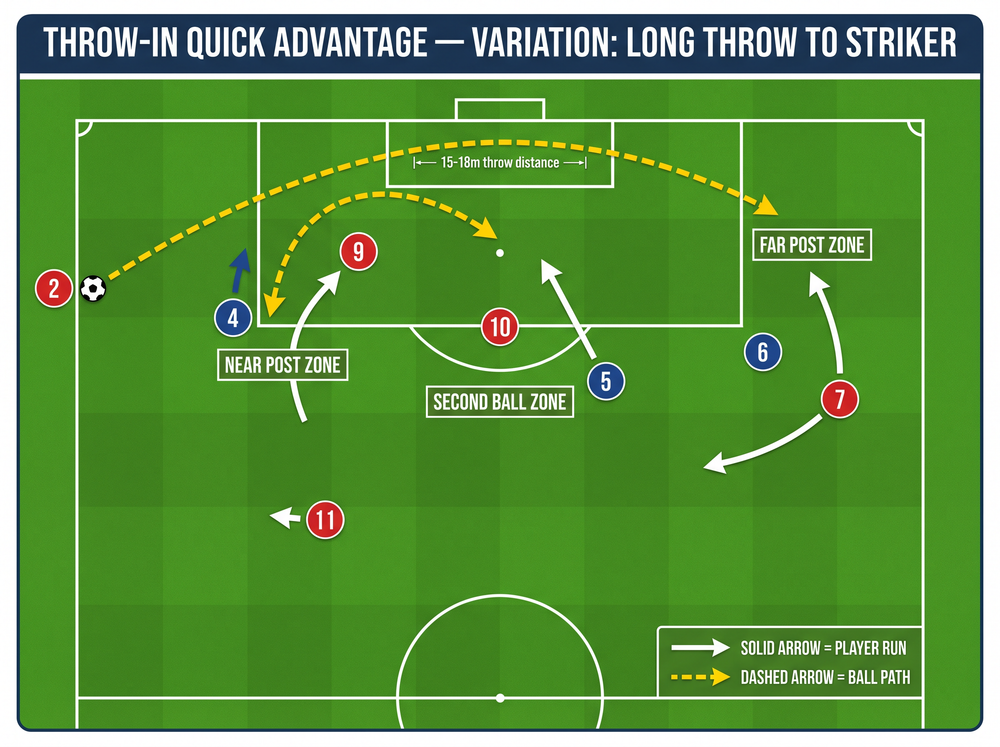
- Direct to Striker (Long Throw Variation): If Player 2 possesses a long throw, they can bypass the midfield combination entirely and throw directly into the penalty area for Player 9, with Players 7 and 10 attacking the second ball.

7. Age Adaptations
- Under 8 - Under 10: Focus purely on the mechanics of a legal throw-in and simple support play. Teach the concept of moving into space to receive the ball rather than complex decoy runs.
- Under 12 - Under 14: Introduce the basic decoy run and layoff combination. Emphasize the quality of the throw and the first touch.
- Under 16 - Open: Implement the full play, including the overlapping run and complex decision-making in the final third. Focus on the speed of execution and exploiting the overloads created.
