

Basketball
Mastering the UCLA Cut Entry Play: A Comprehensive Guide
Learn how to execute the classic UCLA Cut to create high-percentage scoring opportunities and initiate seamless offensive flow.

What you need
1 Basketball, Half-court with regulation markings, Cones (optional, for defensive simulation)
1. Overview
The UCLA Cut is a fundamental offensive action in basketball, popularized by legendary coach John Wooden. It is a simple yet highly effective entry play designed to get the ball into the high post and immediately create a scoring opportunity at the rim. The play relies on sharp passing, precise timing, and a solid back screen. It is an excellent way to initiate offense, disrupt the defense, and transition smoothly into secondary actions if the primary option is not available.
2. Setup

- Equipment: One basketball, 5 players (can use cones to simulate defenders in practice).
- Court Setup: Full half-court (28m x 15m FIBA dimensions).
- Player Positions:
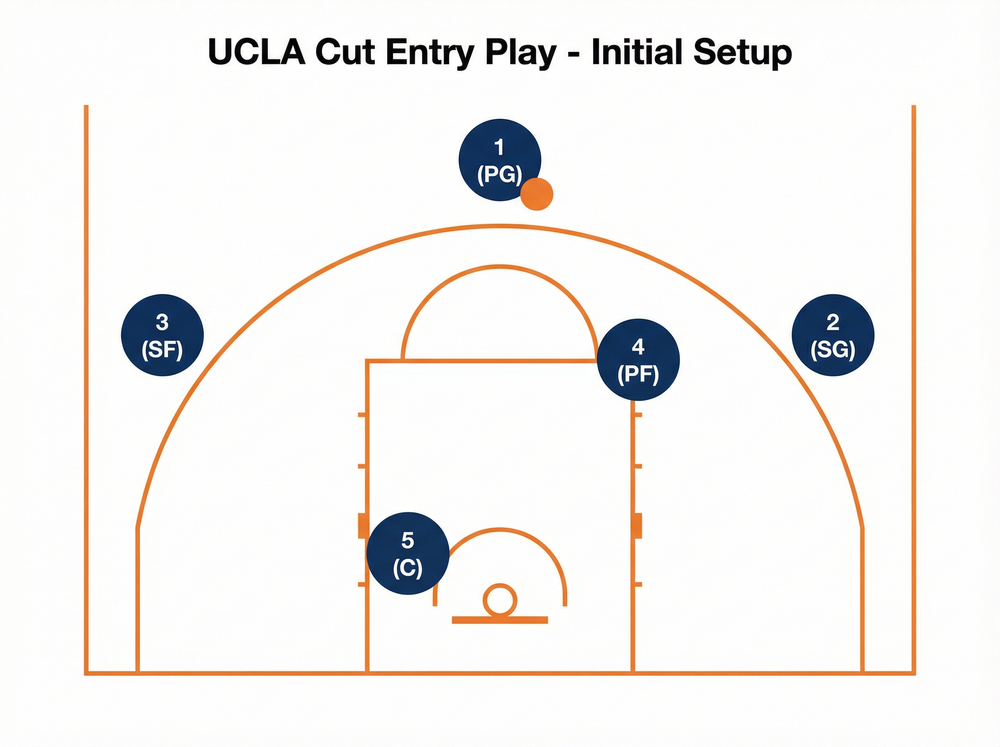
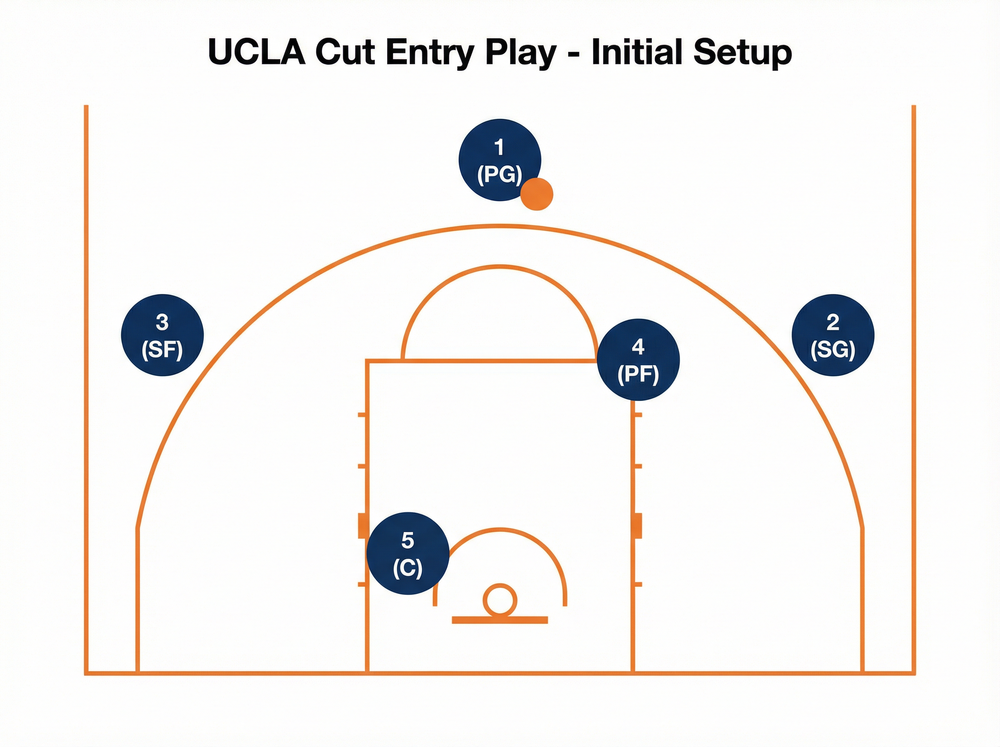
- Player 1 (Point Guard - PG): Starts at the top of the key with the ball.
- Player 2 (Shooting Guard - SG): Positioned on the right wing, near the three-point line extension.
- Player 3 (Small Forward - SF): Positioned on the left wing, near the three-point line extension.
- Player 4 (Power Forward - PF): Positioned at the right high post (elbow).
- Player 5 (Center - C): Positioned at the left low block.
3. Step-by-Step Instructions

Phase 1: The Pass and Cut
- The Entry Pass: Player 1 initiates the play by making a crisp, direct pass to Player 4 at the high post (elbow). This pass must be accurate and delivered away from the defender.
- The Setup: As the pass is made, Player 5 sprints up from the low block to set a back screen for Player 1. The screen should be set just outside the lane, roughly midway between the free-throw line and the top of the key.
- The UCLA Cut: Immediately after passing, Player 1 sets up their defender with a quick jab step away from the screen, then cuts hard off Player 5's shoulder directly toward the basket.
- The Look: Player 4 catches the ball, pivots to face the basket (triple threat position), and immediately looks for Player 1 cutting to the rim.
- The Primary Option: If Player 1 is open, Player 4 delivers a bounce pass or a precise chest pass leading Player 1 for an uncontested layup.

Phase 2: Secondary Options
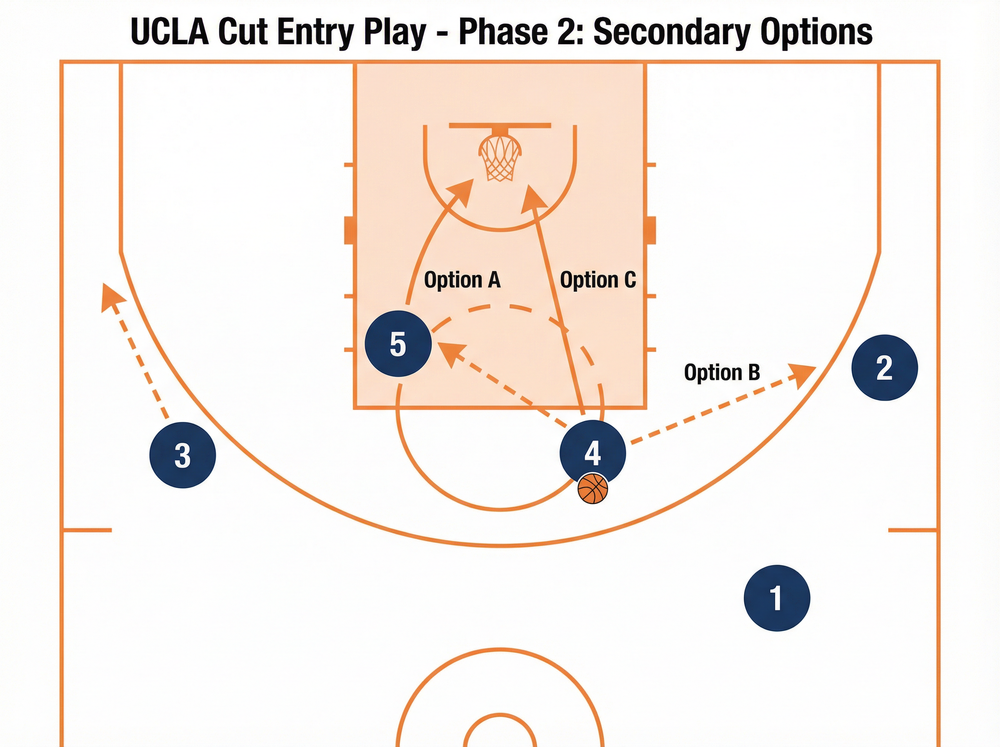
If the initial cut by Player 1 is covered, the offense must seamlessly transition into secondary actions.
- Clear Out: Player 1 continues their cut through the paint and clears out to the weak-side corner or wing.
- The Roll: After setting the screen, Player 5 can open up and roll to the basket, providing a secondary target for Player 4 (Option A).
- Wing Spacing: Player 2 and Player 3 maintain their spacing on the wings, ready for a kick-out pass if their defenders help inside (Option B).
- High Post Isolation: Player 4, now with the ball at the high post, can look to drive to the basket, shoot a mid-range jumper, or initiate a hand-off action with a guard (Option C).
4. Key Coaching Points

- Patience and Timing: The cut must happen after the screen is set. If Player 1 cuts too early, the screen is ineffective.
- Setting up the Cut: Player 1 must actively deceive their defender before using the screen. A slight hesitation or step in the opposite direction is crucial.
- Quality of the Screen: Player 5 must establish a wide, solid base and remain stationary. A moving screen will result in an offensive foul.
- Cutting Shoulder-to-Shoulder: Player 1 must cut tightly off Player 5's shoulder to prevent the defender from slipping through the gap.
- High Post Vision: Player 4 must immediately face the basket upon catching the ball to read the defense and deliver the pass on time.
5. Common Mistakes
- Telegraphing the Pass: Player 1 staring down Player 4 before the pass, allowing the defense to anticipate and deflect it.
- Weak Screens: Player 5 failing to make solid contact or moving while setting the screen.
- Rounding the Cut: Player 1 taking a wide, looping path to the basket instead of a sharp, direct angle.
- Lack of Floor Spacing: Players 2 and 3 drifting inward, clogging the driving lanes and making the cut less effective.
6. Variations & Progressions

- Dribble Entry: Instead of a pass, Player 1 can dribble toward the wing, triggering a different screening action or a hand-off.
- False Action: Run the play but have Player 1 reject the screen and cut back-door if the defender overplays the UCLA cut.
- Transition into Flex: If the initial cut fails, the team can immediately flow into a Flex offense continuity.
7. Age Adaptations

- Under 10 / Under 12: Focus heavily on the fundamentals of passing (chest and bounce) and the concept of cutting to the basket. Introduce the screen without defenders first to build confidence.
- Under 14 / Under 16: Introduce defensive reads. Teach Player 1 how to react if the defender goes over or under the screen. Emphasize the timing and angle of the cut.
- Open / Advanced: Incorporate counter-moves. If the defense switches the screen, teach the mismatch post-up for Player 5 or the isolation for Player 1. Add complex secondary actions based on the defense's reaction.
