

Basketball
The 1-4 Flat Press Break: Beating Full Court Pressure
Master the 1-4 flat press break to safely advance the ball against aggressive full-court man-to-man and zone pressure defenses.
What you need
Basketball, Full Court (28m x 15m), Practice Pinnies/Bibs
1. Overview
The 1-4 Flat Press Break is a highly effective offensive set designed to counter aggressive full-court pressure, whether man-to-man or zone. By aligning four players horizontally across the free-throw line extended area, this setup creates optimal spacing, multiple passing angles, and immediate attacking opportunities. The primary objective is not just to safely advance the ball past half court within the 8-second limit, but to punish the defense by creating a numbers advantage (like a 3-on-2 or 2-on-1) on the offensive end.
When facing a relentless press, teams often panic, bunch up, or make dangerous cross-court passes. The 1-4 Flat structure forces the defense to spread out, opening up the middle of the floor and the sidelines. This set play is best utilized when the opposing team employs a diamond press (1-2-1-1), a 2-2-1 zone press, or heavy full-court man-to-man denial.
2. Setup
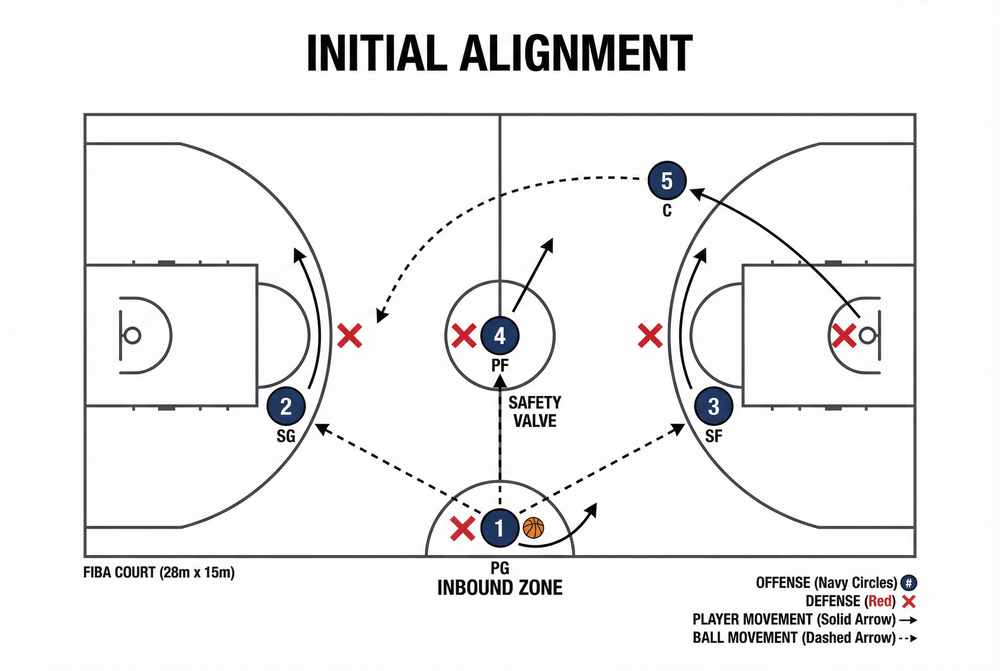
To execute this set play effectively, you need a full FIBA regulation court (28m x 15m) to practice realistic spacing and timing.
Equipment Needed:
- 1 Basketball
- 10 Players (5 Offense, 5 Defense for live repetition)
- Full Court (28m x 15m)
Initial Alignment & Player Positions:
As shown in the initial diagram, the offense sets up with one inbounder and four players stretched across the free-throw line extended.
- Player 1 (Point Guard): The inbounder. Positioned on the baseline, ready to move along the baseline to find an open passing window.
- Player 2 (Shooting Guard): Positioned on the left sideline, near the free-throw line extended.
- Player 3 (Small Forward): Positioned on the right sideline, near the free-throw line extended.
- Player 4 (Power Forward): Positioned at the left elbow or high post area.
- Player 5 (Center): Positioned at the right elbow or high post area.

3. Step-by-Step Instructions

Executing the press break requires precise timing, sharp cuts, and strong passes. Follow these steps to break the pressure efficiently:
Step 1: The Initial Break
Upon the referee handing the ball to Player 1 (PG) on the baseline, Players 4 and 5 cross each other at the free-throw line. Player 4 cuts aggressively toward the strong-side block, while Player 5 flashes to the weak-side high post. Simultaneously, Players 2 and 3 make V-cuts along the sidelines to get open.
Step 2: The Inbound Pass
Player 1 must read the defense. The primary target is Player 2 or Player 3 popping to the sideline. If the defense denies the wings heavily, Player 4 is the secondary target flashing to the middle. Let's assume Player 2 receives the inbound pass on the left sideline.
Step 3: Creating the Outlet and Spacing
As soon as Player 2 catches the ball, Player 1 immediately steps inbounds and trails behind the play as a "safety valve." Player 4 sprints toward the center circle to act as the primary middle outlet. Player 3 sprints up the right sideline to stretch the defense vertically. Player 5 clears out and sprints toward the offensive basket.

Step 4: Advancing the Ball (Phase 2)
Player 2 faces up and surveys the floor. The golden rule is "Look Middle First." If Player 4 is open at the center circle, Player 2 delivers a crisp chest pass. If the middle is closed, Player 2 can dribble up the sideline, look for Player 3 on a diagonal skip pass, or reverse the ball back to Player 1 (the safety) to swing it to the other side.
Step 5: Attacking the Advantage
Once the ball crosses the half-court line (ideally in the hands of Player 4 in the middle), the offense should be in a 3-on-2 or 2-on-1 situation. Player 4 pushes the ball toward the free-throw line, reading the remaining defenders. Players 3 and 5 fill the outside lanes, ready for a layup or an open jump shot.
4. Key Coaching Points

- Meet All Passes: Receivers must aggressively step toward the ball. Waiting for the pass allows the defense to recover and jump the passing lane.
- Look Middle First: The middle of the floor is the weakest point of any press. Penetrating the middle via pass or dribble collapses the defense and opens up the sidelines.
- Maintain Spacing: Players must stay wide. If players bunch together, one defender can guard two offensive players, playing right into the defense's hands.
- Use the Dribble with Purpose: Avoid unnecessary dribbling. Use the dribble only to advance into open space, improve a passing angle, or escape a trap. Never pick up your dribble unless you have a clear pass.
- Always Have a Safety: The inbounder (usually the PG) must trail the play. If the primary ball handler gets trapped, the safety provides an immediate release valve for a backward pass.
5. Common Mistakes

- Panicking Under Pressure: Players rush their decisions, leading to telegraphed passes or traveling violations. Emphasize poise and playing at your own pace.
- Throwing Cross-Court Passes: Long, looping passes across the court are easily intercepted. Keep passes short, crisp, and angled up the floor.
- Inbounder Standing Still: The inbounder often passes the ball and watches. They must immediately step inbounds and become an active participant as the safety valve.
- Getting Trapped in the Corners: The areas near the baseline and sidelines (the "coffin corners") are trap zones. Players catching the ball here must pivot strongly and face up immediately.
6. Variations & Progressions
- Progression 1: 5-on-0 to 5-on-5: Start by running the play with no defense to perfect the timing and cuts. Gradually introduce dummy defense (no stealing), then progress to live, full-speed pressure.
- Progression 2: Time Limits: Challenge the team to get the ball past half court and score a layup within 6 seconds, simulating game-like urgency.
- Variation 1: The 'Up' Call: If the defense is overplaying the initial entry pass, the coach can call 'Up.' Players 2 and 3 will run deep toward half court, while Players 4 and 5 pop out to the sidelines to receive the inbound pass.
- Variation 2: Dribble Entry: If the inbounder is a strong ball handler and the defense falls back slightly, the inbounder can pass to a forward and immediately receive a hand-off to dribble up the middle.
7. Age Adaptations
- Under 10 / Under 12: Focus heavily on the fundamentals of pivoting, strong passing, and meeting the ball. Simplify the movement so players just run straight lines to their spots. Use a smaller court if possible to reduce the physical demand.
- Under 14 / Under 16: Introduce the concept of reading the defense. Teach the players how to recognize whether the defense is playing man-to-man or zone, and adjust their cuts accordingly. Emphasize attacking the basket once the press is broken.
- Open / Senior: Execute at maximum speed. Implement multiple reads and counters. The focus shifts from merely surviving the press to aggressively punishing it with quick transition three-pointers or dunks.
