

Basketball
5-Out Motion Offense: The Ultimate Continuity Play
Master the 5-Out Motion Offense to create spacing, constant movement, and high-percentage scoring opportunities for your team.

What you need
1 Basketball, Half-court or Full-court
1. Overview
The 5-Out Motion Offense is a versatile and dynamic continuity play designed to maximize floor spacing and create high-percentage scoring opportunities. By positioning all five players outside the three-point line, this offense forces the defense to stretch, opening up driving lanes and creating mismatches. It relies heavily on constant movement, reading the defense, and executing fundamental basketball skills such as passing, cutting, and screening. This set play is highly effective against man-to-man defenses and can be adapted to exploit specific defensive weaknesses.
This continuity play is particularly valuable because it does not rely on a single star player; instead, it empowers all five players on the court to be threats. The constant motion makes it difficult for defenders to help off their assignments, and the continuous flow ensures that the offense never stagnates. Whether you are coaching a youth team learning the basics of spacing or an advanced squad looking to implement a read-and-react system, the 5-Out Motion Offense is a foundational strategy that can elevate your team's performance.
2. Setup

Proper setup is critical for the success of the 5-Out Motion Offense. The initial alignment dictates the spacing and timing of the subsequent actions.
- Equipment Needed: 1 Basketball, 5 Players, Half-court (14m x 15m) or Full-court (28m x 15m) depending on the drill focus.
- Court Setup: Utilize the standard FIBA court markings. Ensure players understand the specific spots they need to fill.
- Player Positions:
- Player 1 (Point Guard): Top of the key, initiating the offense.
- Player 2 (Shooting Guard): Right wing, free-throw line extended.
- Player 3 (Small Forward): Left wing, free-throw line extended.
- Player 4 (Power Forward): Right corner.
- Player 5 (Center): Left corner.

3. Step-by-Step Instructions
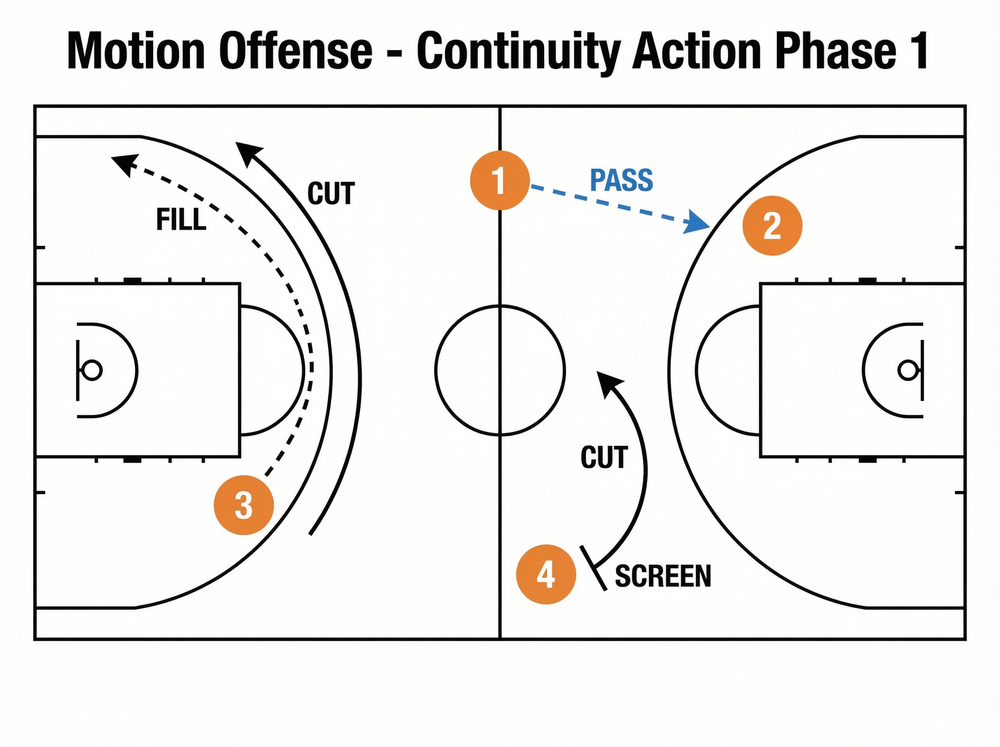
The beauty of the 5-Out Motion Offense lies in its simplicity and continuity. The fundamental rule is: Pass and Cut. When a player passes the ball, they must immediately cut to the basket, and the remaining players fill the open spots.
- Initiate the Offense: Player 1 brings the ball up the court and stops at the top of the key. The other four players assume their positions on the wings and in the corners, ensuring maximum spacing.
- The First Pass: Player 1 makes a crisp, accurate pass to Player 2 on the right wing.
- The Cut: Immediately after passing, Player 1 makes a hard, decisive cut toward the basket, looking for a return pass from Player 2 for a layup. This is the primary scoring option.
- Filling the Spots: As Player 1 cuts to the basket, Player 3 (left wing) must immediately fill the vacated spot at the top of the key. Player 5 (left corner) fills the left wing spot vacated by Player 3.
- Clearing Out: If Player 1 does not receive the pass on the cut, they must clear out to the weak-side corner (the spot vacated by Player 5).
- Continuity Action: The offense is now reset with Player 2 holding the ball on the right wing. Player 2 can now pass to Player 3 at the top of the key, and the action repeats (Player 2 cuts, Player 4 fills the wing, Player 1 fills the corner).

4. Key Coaching Points
To run this offense effectively, coaches must emphasize the following critical teaching points during practice:
- Spacing is Paramount: Players must maintain 15-18 feet of spacing at all times. If players bunch up, the driving lanes disappear, and the defense can easily help.
- Hard Cuts: Cuts must be made at game speed. A slow, looping cut will not get a player open and will disrupt the timing of the offense. Players should cut "face first" to the rim, always watching the ball.
- Read the Defense: Players must learn to read how their defender is playing them. If the defender overplays the passing lane, the offensive player should immediately execute a backdoor cut.
- Pass and Move: The golden rule of motion offense: never stand still after passing. The immediate cut is what forces the defense to react and creates openings.
- Patience and Ball Reversals: Encourage players to reverse the ball from one side of the court to the other. Multiple ball reversals force the defense to shift continuously, increasing the likelihood of a defensive breakdown.
5. Common Mistakes
Watch out for these frequent errors when implementing the 5-Out Motion Offense:
- Poor Spacing: Players drifting inward, clogging the paint and allowing defenders to easily play help defense.
- Standing and Watching: Players passing the ball and remaining stationary instead of immediately cutting to the basket.
- Weak Passing: Telegraphing passes or making slow, looping passes that are easily intercepted by the defense.
- Ignoring the Cutter: The player with the ball failing to look for the initial cutter, missing an easy layup opportunity.
- Cutting to the Same Spot: Two players cutting to the same area, creating confusion and offensive fouls.
6. Variations & Progressions
Once your team has mastered the basic "Pass and Cut" continuity, you can introduce these progressions to make the offense more complex and difficult to defend:
- Pass and Screen Away: Instead of cutting to the basket after a pass, the passer sets a screen for a teammate away from the ball. This creates open jump shots and forces defensive miscommunications.
- Dribble At / Backdoor Cut: If a player is being heavily denied on the wing, the ball handler can dribble directly at them. The wing player immediately executes a hard backdoor cut to the rim.
- Post Entry: While it is a 5-Out offense, players can briefly post up after a cut. If a mismatch occurs (e.g., a smaller defender switches onto a larger offensive player), the ball can be entered into the post for a quick scoring opportunity before the player clears out.
7. Age Adaptations
This offense can be adapted for various age groups and skill levels:
- Under 10 / Under 12: Focus strictly on the basic "Pass and Cut" rule. Emphasize spacing (staying on the designated spots) and making strong chest passes. Do not introduce screening away until the basic movement is mastered.
- Under 14 / Under 16: Introduce the "Pass and Screen Away" progression. Teach players how to read the defense (e.g., recognizing when to curl, fade, or straight cut off a screen). Emphasize ball reversals.
- Open / Advanced: Incorporate advanced reads, such as dribble hand-offs, ball screens, and exploiting specific defensive coverages (e.g., how to attack a switching defense versus a hedging defense).
