

Cricket
Aggressive Powerplay Field Setting: Maximizing Early Wickets
Learn how to deploy an attacking Powerplay field setting to maximize pressure, restrict scoring, and take crucial early wickets in limited-overs cricket.
What you need
New cricket ball, Full set of stumps and bails, Standard protective equipment, Markers/cones (for training)
1. Overview
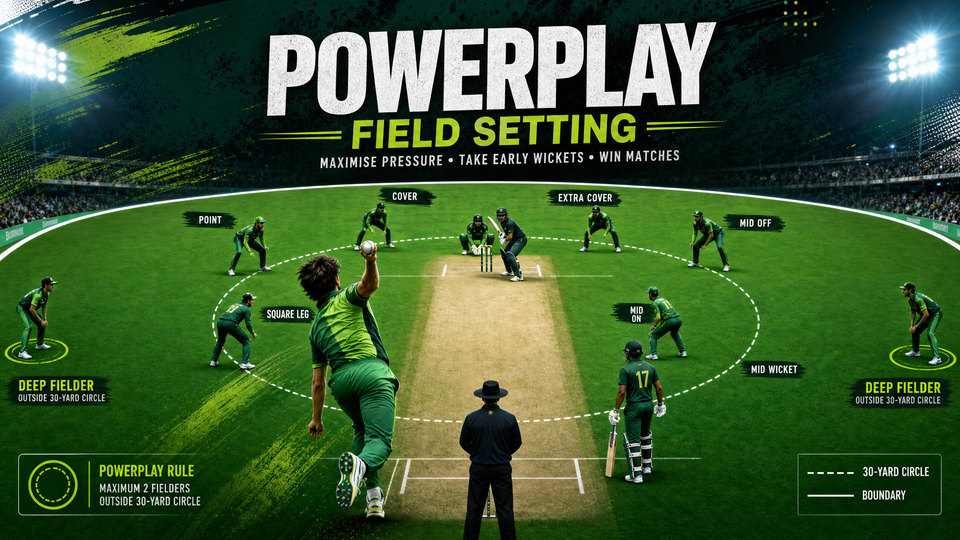
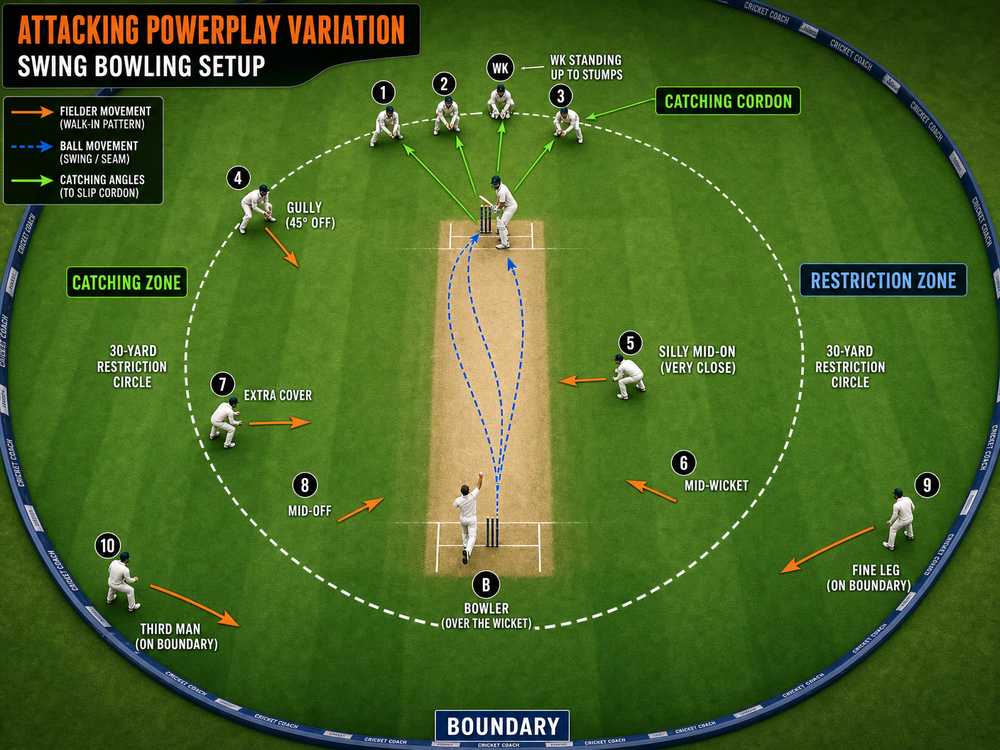
The Powerplay (typically overs 1-6 in T20s and 1-10 in ODIs) is a critical phase where fielding restrictions apply, allowing a maximum of two fielders outside the 30-yard circle. This set play focuses on an attacking Powerplay field setting designed to take early wickets by creating intense pressure on the opening batters. Rather than purely defending the boundaries, this strategy utilizes catching positions (slips and gully) and tight infield placement to exploit the new ball's swing and seam movement.
Use this play when your opening bowlers are generating movement, when defending a low total where early wickets are essential, or against aggressive opening batters who are prone to taking risks early in their innings.
2. Setup
Equipment Needed:
- New cricket ball (white ball for limited-overs)
- Full set of stumps and bails
- Standard protective equipment for wicket-keeper and close-in fielders
- Markers (cones) if practicing the 30-yard circle during training
Pitch & Field Setup:
- Standard 22-yard pitch.
- Clearly marked 30-yard fielding restriction circle.
- Clearly marked boundary.
Player Positions (Standard Right-Handed Batter):
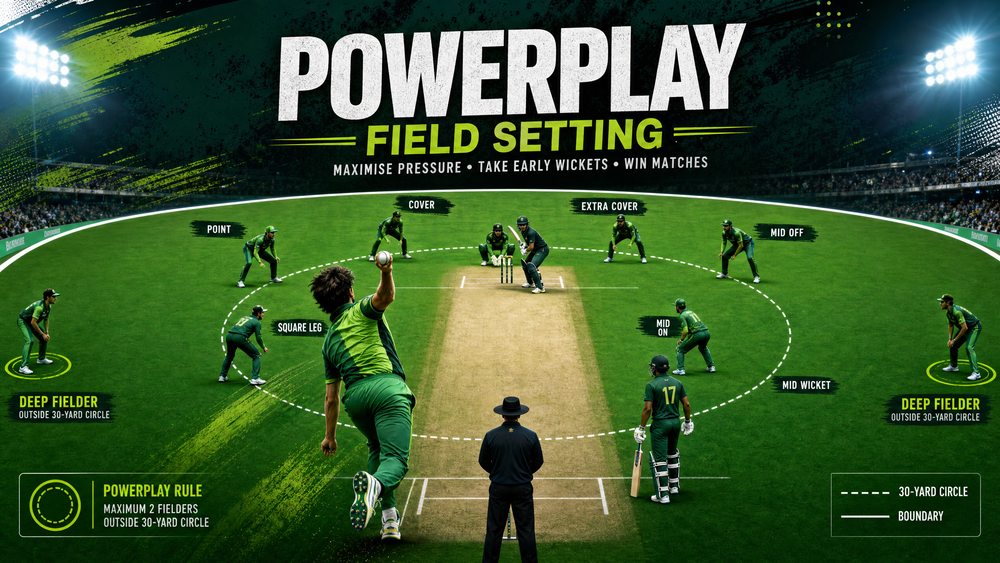
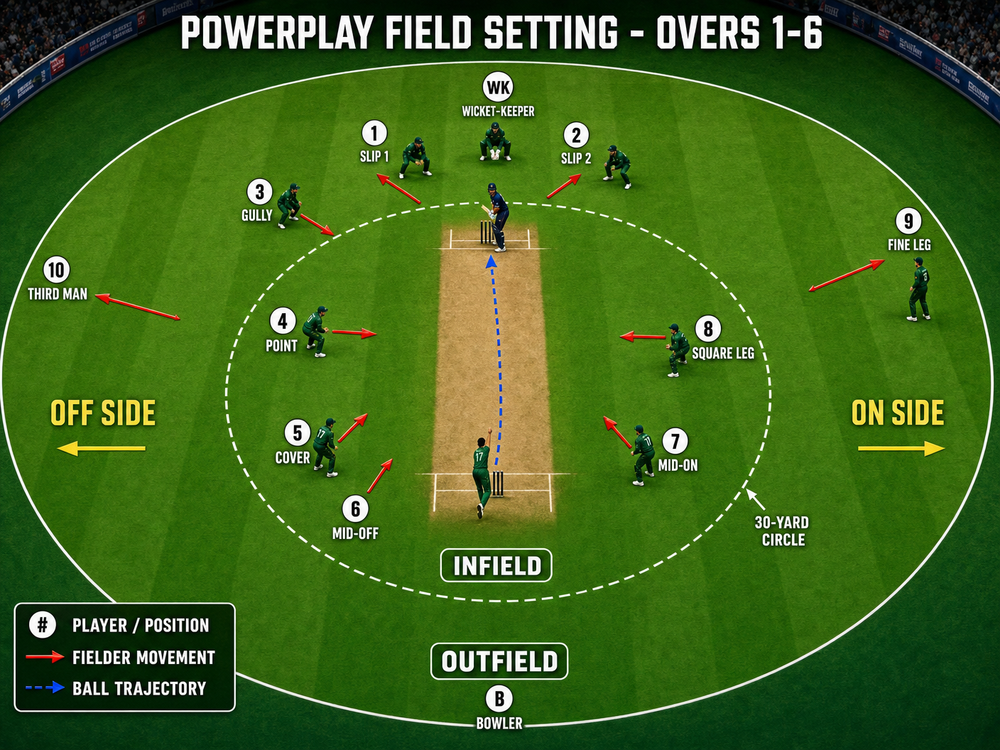
- Bowler (B): Operating over the wicket.
- Wicket-Keeper (WK): Standing back for pace, or up to the stumps for medium pace to restrict movement.
- First Slip (1): Traditional catching position.
- Second Slip (2): Slightly wider catching position.
- Gully (3): Positioned at approximately 45 degrees behind square on the off-side.
- Point (4): Square on the off-side, inside the circle.
- Cover (5): In front of square on the off-side, inside the circle.
- Mid-Off (6): Straighter on the off-side, inside the circle.
- Mid-On (7): Straighter on the leg-side, inside the circle.
- Fine Leg (9): Outside the 30-yard circle, deep behind square on the leg-side (Sweeper 1).
- Third Man (10): Outside the 30-yard circle, deep behind square on the off-side (Sweeper 2).
3. Step-by-Step Instructions
Step 1: Establish the Catching Cordon
Before the bowler begins their run-up, the captain must ensure the slip cordon (First Slip, Second Slip, and Gully) are perfectly aligned. They should be staggered slightly in depth to avoid collisions and positioned based on the pace and bounce of the pitch.
Step 2: Set the Infield Ring
Position Point, Cover, Mid-Off, and Mid-On strictly inside the 30-yard circle. These fielders must be vocal, alert, and ready to 'walk in' as the bowler delivers the ball. Their primary role is to cut off quick singles and build dot-ball pressure.
Step 3: Position the Boundary Riders
Place the two allowed fielders outside the circle at Fine Leg and Third Man. This provides insurance against edges and errant deliveries down the leg side, allowing the bowler to pitch the ball up and search for swing without fear of conceding easy boundaries behind the wicket.
Step 4: The Bowler's Execution
The bowler must bowl a full, attacking length (often termed 'top of off stump'). The goal is to invite the drive and utilize any available swing or seam movement to find the outside edge, bringing the slip cordon and gully into play.
Step 5: The Infield 'Walk-In'
As the bowler enters their delivery stride, all infielders (Point, Cover, Mid-Off, Mid-On) must take 2-3 aggressive steps towards the batter. This reduces the reaction time for the batter and physically shrinks the size of the inner ring, increasing perceived pressure.
4. Key Coaching Points
- Length is Critical: The bowler must pitch the ball up. Bowling short in this field setting wastes the slip cordon and allows the batter to easily rotate the strike or hit over the infield.
- Slip Spacing: Ensure slips are close enough to dive across each other but far enough apart to cover distinct zones. The wicket-keeper dictates the depth.
- Infield Energy: The fielders inside the circle must hunt in packs. High energy, loud encouragement, and aggressive walking-in are non-negotiable.
- Patience and Discipline: This is an attacking field, which means boundaries will happen. Bowlers must not panic after conceding a boundary and must stick to the plan of hitting the top of off stump.
- Communication: The captain and bowler must constantly communicate. If the ball isn't swinging, the field may need to be adjusted quickly to a more defensive setup.
5. Common Mistakes
- Bowling Too Short: The most frequent error. A short ball is easily pulled or cut, rendering the slips and full-length catching positions useless.
- Static Infielders: Fielders standing flat-footed inside the circle allow the batter easy singles. The 'walk-in' is essential for creating pressure.
- Poor Slip Positioning: Slips standing too deep (ball drops short) or too wide (edges go through the gaps). Positioning must adapt to the specific bowler's pace and the pitch's bounce.
- Over-Attacking Without Movement: If the pitch is flat and the ball isn't swinging, persisting with three slips and a gully for too long will leak runs rapidly.
6. Variations & Progressions
- The Squeeze (More Defensive): If the batters are scoring freely, remove Second Slip and move them to Square Leg or Mid-Wicket inside the circle to cut off the leg-side rotation.
- The Ultimate Attack (Extreme Pressure): Bring Fine Leg inside the circle and place them at Short Leg or Silly Point. Move Third Man to a catching position (e.g., Third Slip). This leaves zero fielders on the boundary—a high-risk, high-reward tactic for extreme situations.
- Pace Off Variation: If using a spinner in the Powerplay, remove the slips and place a Slip, Leg Slip, and tight inner ring to force errors through varied pace and flight.
7. Age Adaptations
- Under 10s / Under 12s: Focus purely on the basics. Use only one slip. Emphasize the importance of the infielders stopping the ball rather than aggressive 'walking in'. Ensure safety equipment is paramount.
- Under 14s: Introduce the concept of the 'walk-in' and building pressure. Start using two slips if the bowlers are consistently accurate.
- Under 16s / Open: Implement the full strategy. Focus on the tactical nuances, such as adjusting slip depth based on the pitch and bowler, and executing specific bowling plans to different types of batters.
