

Basketball
The 5-Out Press Break: Beating Full-Court Pressure with Spacing and Speed
Learn how to consistently beat full-court pressure using a 5-Out alignment that creates optimal spacing, forces the defence to scramble, and turns pressure into easy transition layups.
What you need
1 Basketball, Full Court (28m x 15m), Coloured Pinnies/Bibs
1. Overview
Full-court pressure can cause panic, turnovers, and a complete breakdown of offensive flow. The 5-Out Press Break is designed to counteract this by spreading the floor horizontally and vertically. By utilizing the entire 28m × 15m FIBA court, this setup forces the defence to cover maximum ground, creating large passing lanes and numerical advantages.
When executed correctly, this play doesn't just "survive" the press—it punishes it. The primary goal is to advance the ball quickly through passing rather than dribbling, turning defensive pressure into high-percentage scoring opportunities at the other end.
2. Setup
Equipment Needed
- 1 Basketball
- Full court (28m × 15m)
- 5 Offensive players (numbered 1-5)
- 5 Defensive players (for live execution)
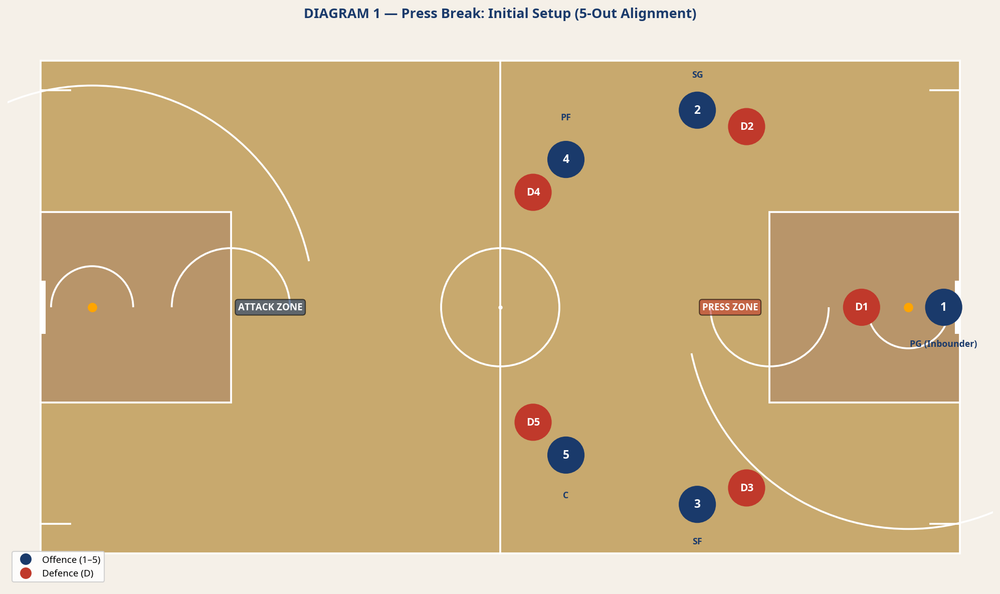
Player Positions (Initial Alignment)
- 1 (Point Guard): Inbounder, positioned under the basket.
- 2 (Shooting Guard): Positioned on the right sideline, near the free-throw line extended.
- 3 (Small Forward): Positioned on the left sideline, near the free-throw line extended.
- 4 (Power Forward): Positioned in the middle of the floor, just past the three-point line.
- 5 (Center): Positioned near half-court, serving as the deep release option.
3. Step-by-Step Instructions
Phase 1: The Inbound and Initial Read
- The Setup: The 1 (PG) takes the ball out of bounds. The 2, 3, 4, and 5 start in their designated 5-Out spots, ensuring they are wide and spaced.
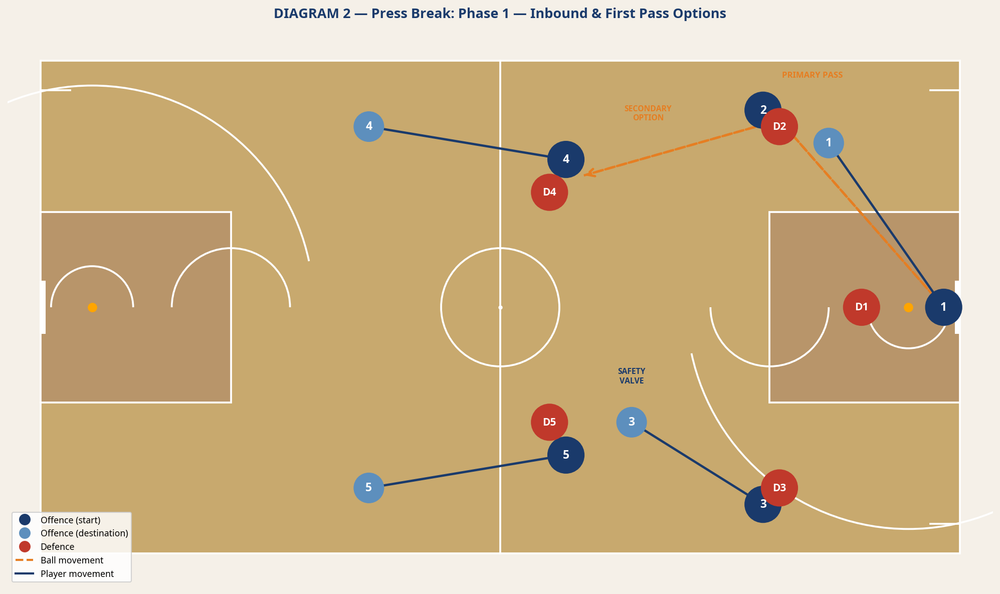
- The Primary Cut: The 2 (SG) makes a hard V-cut to get open on the strong side. The 1 passes the ball to the 2.
- The Sprint: Immediately after passing, the 1 sprints up the sideline, aiming to get ahead of the ball and drag their defender away.
Phase 2: Middle Penetration and Safety
- The Middle Flash: As the 2 receives the ball, the 4 (PF) flashes hard to the middle of the floor (around the jump circle). The 2 looks to pass to the 4.
- The Safety Valve: Simultaneously, the 3 (SF) moves towards the ball to act as a safety valve in case the pass to the middle is denied.
- The Deep Sprint: The 5 (Center) sprints down the opposite sideline, forcing the deepest defender to make a choice.
Phase 3: Advancing and Attacking
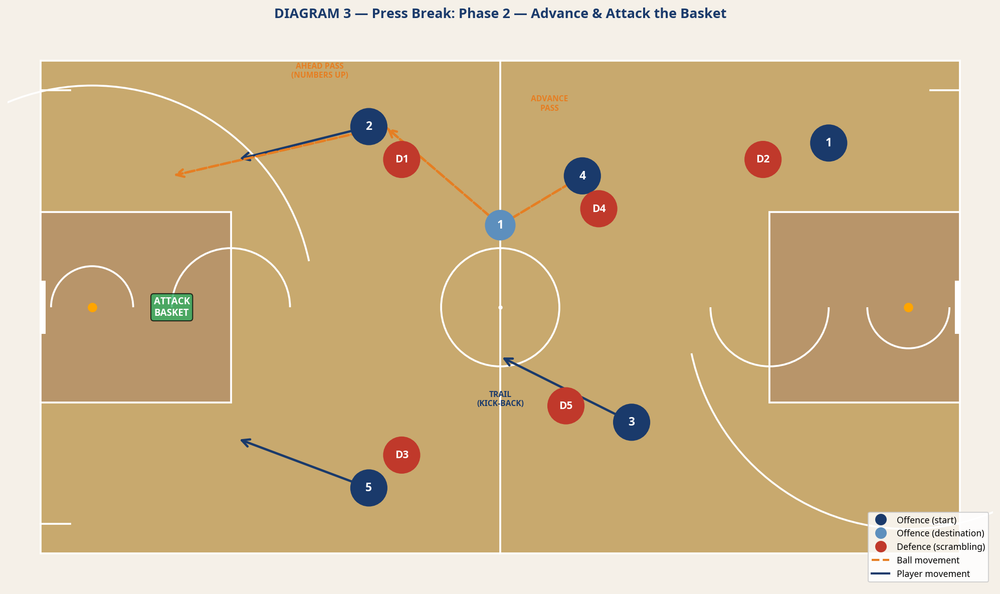
- The Advance: The 4 catches the ball in the middle. They immediately pivot and look up the floor.
- The Attack: The 1 (who sprinted up the sideline) or the 5 (sprinting down the opposite side) should be open. The 4 delivers a crisp, accurate pass ahead.
- The Finish: The receiving player (1 or 5) attacks the basket aggressively for a layup, creating a 2-on-1 or 3-on-2 advantage.
4. Key Coaching Points
- Pass, Don't Dribble: The ball moves faster in the air than on the ground. Emphasize advancing the ball through quick, decisive passes.
- Meet All Passes: Receivers must step towards the ball to prevent defenders from jumping the passing lanes.
- Maintain Spacing: Players must stay wide. If players bunch up, one defender can guard two offensive players.
- Look Middle First: The middle of the floor is the most dangerous area for a press. Getting the ball to the middle forces the defence to collapse, opening up the sidelines.
- Stay Calm: Panic leads to turnovers. Players must remain composed, read the defence, and trust the spacing.
5. Common Mistakes
- Dribbling into Traps: Players often try to dribble out of trouble instead of passing, leading to double-teams and turnovers.
- Hiding Behind Defenders: Offensive players must actively work to create passing angles, not stand behind their defenders hoping the ball finds them.
- Throwing Looping Passes: Soft, looping passes give the defence time to recover and intercept. Passes must be hard and direct.
- Forgetting the Safety: If the primary and secondary options are covered, the ball handler must know where the safety valve is to reset the play.
6. Variations & Progressions
- Progression 1 (4-on-4 Shell): Run the break without the 5 and their defender to focus on the initial inbound and middle flash reads.
- Progression 2 (Live Action): Start with passive defence (shadowing) and progress to full-contact, live pressure.
- Variation 1 (Dribble Entry): If the pass is denied, allow the inbounder (1) to dribble onto the court, triggering a specific rotation from the other players.
- Variation 2 (Clear Out): If the 2 is heavily denied, the 3 can flash across the court to receive the inbound, while the 2 clears to the opposite side.
7. Age Adaptations
- Under 10 / Under 12: Focus heavily on the fundamentals of passing and catching under pressure. Reduce the court size if necessary. Emphasize spacing and avoiding the dribble.
- Under 14 / Under 16: Introduce more complex reads, such as recognizing when to attack the basket versus pulling it out to set up the half-court offence. Emphasize quick decision-making.
- Open / Advanced: Incorporate secondary breaks and transition offensive sets seamlessly from the press break. The focus shifts to punishing the press for easy baskets every time.
