

Basketball
Ball Handling & Dribbling Circuit: Five-Station Full-Court Mastery
A high-intensity, five-station dribbling circuit that builds ambidextrous ball control, change-of-direction speed, and court-length composure under pressure — ready to run in your next session.

What you need
basketballs, cones, flat markers, stopwatch, whistle
Overview
The Ball Handling & Dribbling Circuit is a structured, multi-station drill designed to systematically develop every dimension of a player's dribbling arsenal — from stationary ball control at the elbows to full-court weave dribbling under simulated defensive pressure. Unlike isolated cone drills, this circuit forces players to transition between skill types without rest, mirroring the cognitive and physical demands of live game situations.
Use this drill as the primary ball-handling block in any practice session, ideally positioned after a dynamic warm-up and before your first team concept segment. It is equally effective as a pre-game activation routine for experienced squads. The circuit runs on a standard FIBA court (28m × 15m) and accommodates 5–15 players simultaneously, making it one of the most time-efficient drills in your toolkit.
Setup
Equipment Required
| Item | Quantity | Notes |
|---|---|---|
| Basketballs | 1 per player | Properly inflated to FIBA spec (7.5–8.5 psi) |
| Cones (tall, 30cm) | 10 | Orange preferred for visibility |
| Flat markers / spots | 5 | To mark station start points |
| Stopwatch / interval timer | 1 | Set to 45-second work intervals |
| Whistle | 1 | For transition signals |
Court Setup
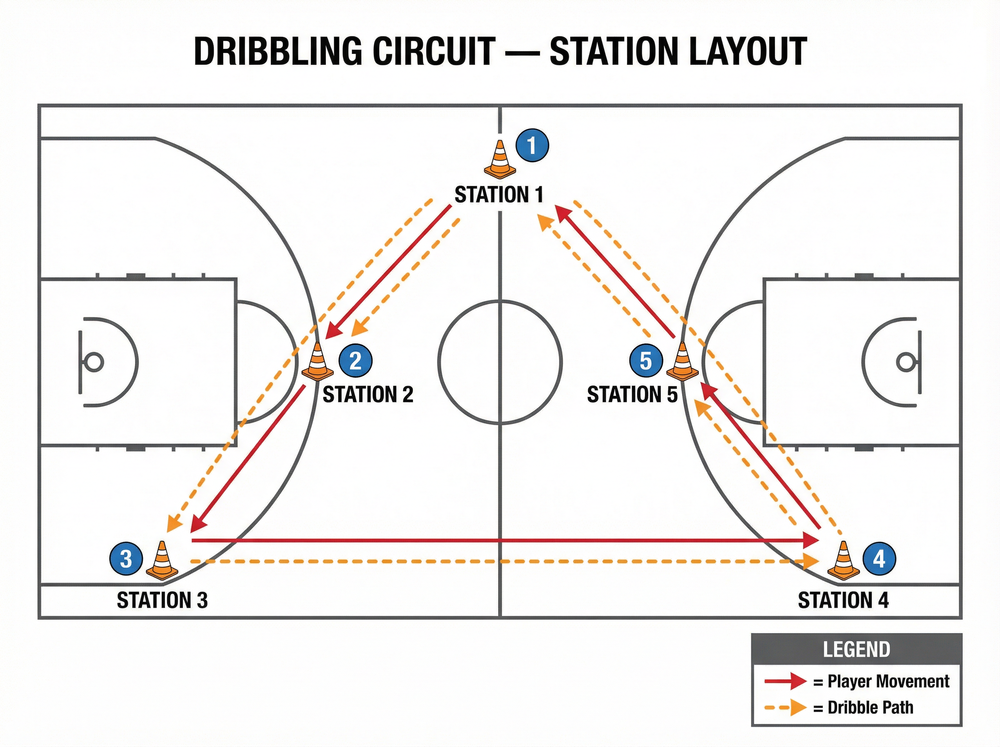
This drill uses the full FIBA court (28m × 15m). Place the five stations as follows, referencing the diagram below:
- Station 1 — Top of the Key (Offensive Half): Positioned at the top of the three-point arc, approximately 6.75m from the basket. This is the stationary two-ball dribbling station.
- Station 2 — Left Elbow: At the junction of the free throw line and the left side of the key (approximately 5.8m from the basket). Crossover and between-the-legs station.
- Station 3 — Left Corner Baseline: At the left corner, 0.9m inside the sideline on the baseline. Speed dribble and retreat dribble station.
- Station 4 — Right Corner Baseline: Mirror of Station 3 on the right side. Behind-the-back and spin move station.
- Station 5 — Right Elbow: Mirror of Station 2 on the right side. Hesitation and euro-step dribble station.
Diagram 1: Station layout across the full FIBA court. Solid arrows indicate player movement direction through the circuit; dashed arrows indicate dribble path at each station.
Players are distributed evenly across stations at the start. If you have more than 5 players, form queues of 2–3 at each station. The coach positions at the top of the key (near Station 1) to observe the full circuit.
Step-by-Step Instructions
Phase 1 — Stationary Activation (5 minutes)
- Send all players to their assigned starting station with one ball each. Players at Station 1 take a second ball from the equipment bag.
- On the coach's whistle, players begin their station-specific dribbling task (see station descriptions below).
- Each interval lasts 45 seconds of work followed by a 15-second transition to the next station (rotate clockwise: 1 → 2 → 3 → 4 → 5 → 1).
- Complete two full rotations through all five stations before moving to Phase 2.
Station-Specific Tasks (Phase 1):
- Station 1: Two-ball simultaneous dribble — both balls hit the floor at the same time. Maintain an athletic stance: knees bent to 90°, back flat, eyes up.
- Station 2: Crossover dribble in place — 10 reps, then switch to between-the-legs — 10 reps. Keep the dribble below knee height.
- Station 3: Speed dribble to the half-court line (14m) and back using the dominant hand, then repeat with the weak hand.
- Station 4: Behind-the-back dribble in place — 10 reps, then a spin move to the elbow and back — 2 reps each way.
- Station 5: Hesitation dribble — 3 steps forward, hard hesitation freeze, then explosive burst for 3 steps. Repeat for the full interval.
Phase 2 — Full-Court Pressure Circuit (10 minutes)
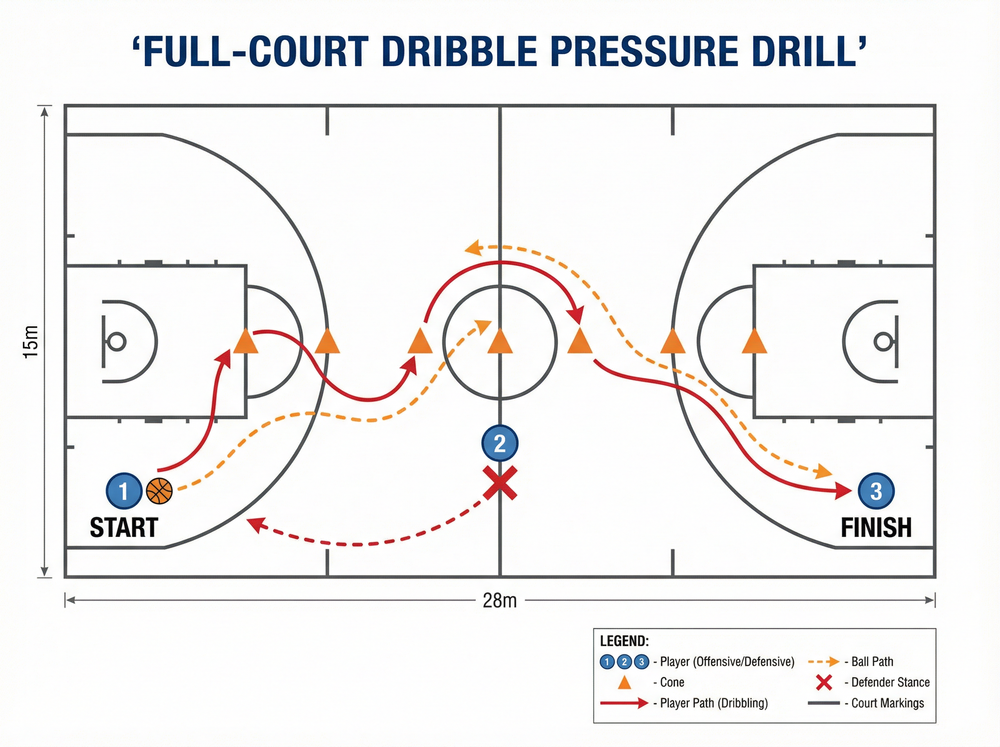
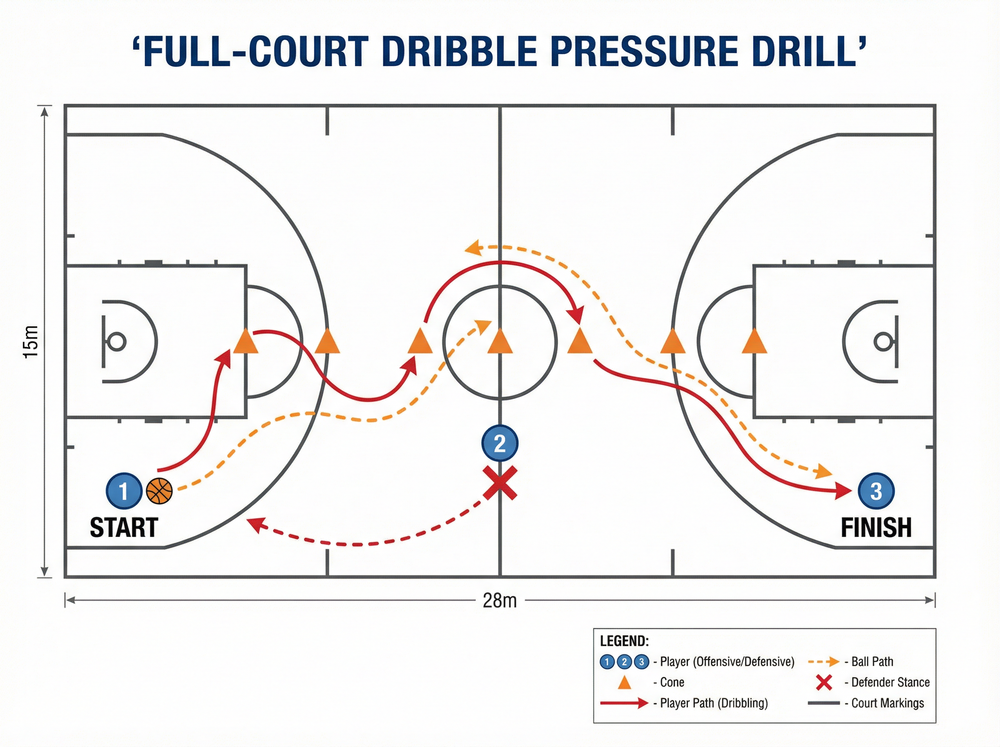
- Reorganise players into groups of three: one ball-handler (Player 1), one passive defender at half-court (Player 2), and one rebounder/feeder at the far baseline (Player 3).
- Player 1 starts at the baseline with the ball. On the whistle, they dribble the full 28m length of the court, navigating through six cones spaced evenly at approximately 4.5m intervals in a weaving S-curve pattern.
- Player 2 at half-court provides token defensive pressure — arms active, feet moving, but no stealing. This forces Player 1 to use a change-of-direction move (crossover, between-the-legs, or spin) to pass the defender.
- Player 1 finishes with a lay-up at the far end. Player 3 rebounds and becomes the new ball-handler. Rotate: 1 → 3 → 2 → 1.
- Run three complete rotations per group, then swap the passive defender role.

Diagram 2: Full-court dribble pressure drill. Player 1 weaves through six cones from baseline to baseline, executing a change-of-direction move past the passive defender (Player 2) at half-court before finishing with a lay-up.
Phase 3 — Competitive Finish (5 minutes)
- Run a timed relay: split the squad into two equal teams. Each player completes the full-court weave and lay-up, then passes to the next teammate. First team to complete all runs wins. Record times for future benchmarking.
Key Coaching Points
1. Eyes Up at All Times. The single most common indicator of a developing ball-handler is the head-down dribble. Demand that players find a target — a teammate, a coach, a mark on the wall — and hold their gaze there throughout every dribble sequence. Repeat the cue: "See the floor, not the ball."
2. Pad the Dribble, Don't Slap It. Players should dribble with their fingertip pads, not their palms. The contact point should be the top-front of the ball, pushing it down with a controlled, rhythmic motion. A palm dribble produces a slow, high bounce that defenders can time and steal.
3. Athletic Stance is Non-Negotiable. Feet shoulder-width apart, knees bent, hips low, weight on the balls of the feet. A player who dribbles upright cannot accelerate, change direction, or protect the ball effectively. Use the cue: "Sit in the chair" to remind players to maintain knee bend.
4. Protect the Ball with the Off-Hand. The non-dribbling hand should be raised as a shield between the ball and the nearest defender. This is not a foul — it is legal ball protection. Teach players to feel where their off-hand is at all times.
5. Change of Pace Before Change of Direction. Effective ball-handlers set up their moves with a speed variation — slow down to speed up. A crossover at full speed is predictable; a crossover after a hesitation is devastating. Reinforce this principle during the Phase 2 pressure runs.
6. Finish Strong — Every Rep. Every full-court run must end with a proper lay-up attempt. This builds the habit of converting after extended dribbling sequences, a critical game skill that is easily neglected in isolation drills.
Common Mistakes

Mistake 1 — Dribbling Too High. Players, especially younger ones, tend to let the ball bounce above waist height. This slows the dribble rhythm, makes the ball easier to steal, and limits change-of-direction speed. Correct by placing a cone at hip height as a visual ceiling, or by having the coach hold a hand at the target height and asking players to keep dribbles below it.
Mistake 2 — Travelling Through the Cone Weave. When fatigued or rushing, players will pick up their dribble mid-weave and take extra steps. Stop the drill immediately when this happens — do not let it slide. Use the cue: "If the ball stops, your feet stop." Reduce the speed demand temporarily until the habit is corrected.
Mistake 3 — Ignoring the Weak Hand. Left-handed dribbling feels uncomfortable for most right-handed players, so they unconsciously rush through weak-hand intervals or revert to their dominant hand. Assign a coach or senior player to watch specifically for this at Stations 3 and 4. Consider running a dedicated weak-hand-only set as a corrective measure.
Mistake 4 — Losing Stance Under Fatigue. As the circuit progresses, players straighten up and widen their dribble to compensate for tired legs. This is the moment the drill is working — push through it. Use the cue: "Low when it hurts most" and model the correct stance yourself.
Mistake 5 — Passive Defender Not Engaging. In Phase 2, the passive defender often becomes entirely passive — standing still and offering no challenge. Remind defenders that their role is to make the ball-handler think and react, not to steal the ball. Active feet, active arms, and verbal pressure are all required.
Variations & Progressions

Progression 1 — Add Live Defenders (Advanced)
Replace the passive defender in Phase 2 with a live, full-pressure defender who is permitted to steal the ball. The ball-handler must now use game-speed change-of-direction moves to protect possession. Restrict the ball-handler to a designated lane (2m wide) to prevent simply running around the defender.
Progression 2 — Two-Ball Full-Court Weave (Advanced)
Equip Player 1 with two basketballs for the full-court weave. Both balls must be dribbled simultaneously throughout the run. Remove the passive defender for this variation. This dramatically increases the cognitive load and coordination demand, and is an excellent challenge for your most skilled ball-handlers.
Regression — Half-Court Circuit (Beginner/Under-12)
For younger or less experienced groups, confine the entire circuit to one half of the court (14m × 15m). Reduce cone spacing to 2m, eliminate the passive defender, and extend work intervals to 60 seconds with 30-second rest periods. Focus exclusively on Stations 1, 2, and 5 (stationary and elbow work) before introducing the baseline stations.
Age Adaptations

| Age Group | Key Modifications |
|---|---|
| Under 10 | Use size 5 ball. Stationary drills only (Stations 1, 2, 5). No full-court running. 30-second intervals with 30-second rest. Focus on dominant hand only for first 4 weeks. |
| Under 12 | Use size 6 ball. Half-court circuit only. Introduce weak-hand dribbling from Week 2. No passive defender. 45-second intervals with 20-second rest. |
| Under 14 | Full circuit on full court. Introduce passive defender in Week 3. Both hands required from session 1. 45-second intervals, 15-second rest. |
| Under 16 | Full circuit with live defender option. Introduce two-ball variation for top performers. Timed relay competitive finish every session. |
| Open / Senior | Full circuit, live defenders, two-ball option, competitive relay with recorded times. Add verbal distraction from coaches during Phase 2 to simulate crowd/game noise pressure. |
Coach's Note: The Ball Handling & Dribbling Circuit is most effective when run consistently — 2–3 times per week over a 6-week block. Track relay times from Phase 3 each week and share improvements with the squad. Visible progress is one of the most powerful motivators in player development. The players who complain most about this drill in Week 1 are usually the ones who improve most by Week 6.
