

Basketball
Baseline Out of Bounds (BLOB) - The Screen & Dive
A reliable baseline inbound play utilizing a strong side screen to create an immediate scoring opportunity at the rim or an open perimeter shot.
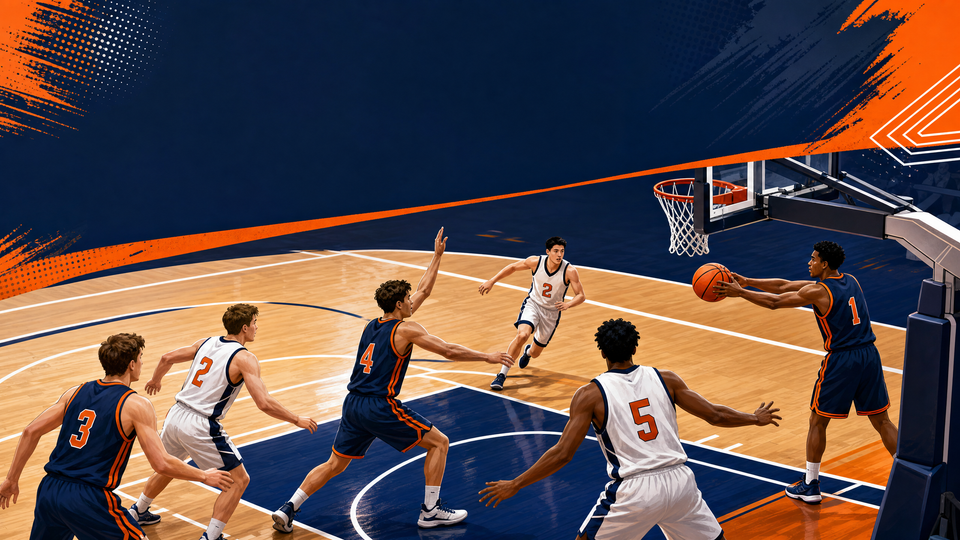
What you need
Basketball, Half-court
1. Overview
The 'Screen & Dive' is a highly effective Baseline Out of Bounds (BLOB) play designed to exploit defensive over-commitments near the basket. By utilizing a strong-side screen, this play creates an immediate, high-percentage scoring opportunity at the rim for a cutting big man, while simultaneously opening up a perimeter shot for a shooter spacing out. It is best used when you need a quick basket underneath or when the defense is aggressively denying the initial inbound pass.
2. Setup
Court Dimensions: Standard FIBA Court (28m x 15m)
Equipment Needed: 1 Basketball, full half-court setup.
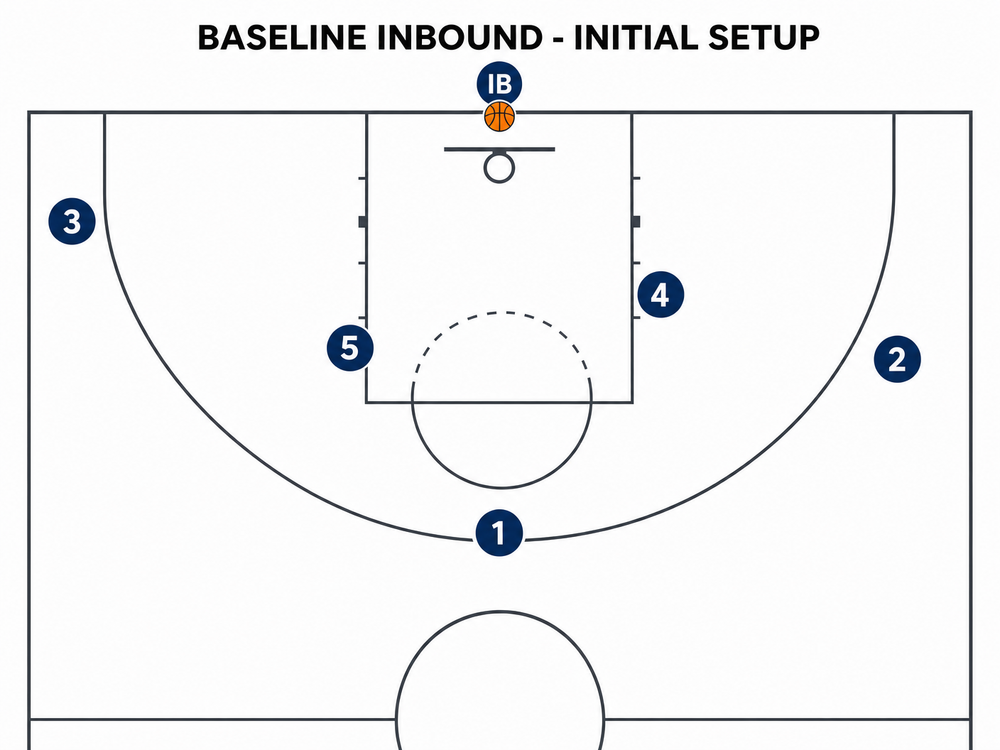
Player Positions (Initial Setup):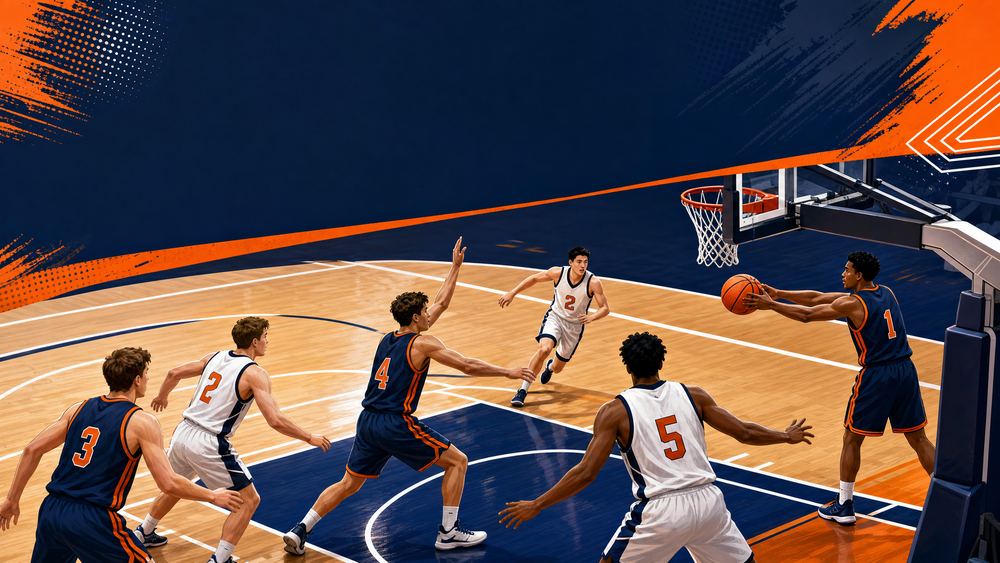
- Inbounder (IB): Positioned out of bounds on the baseline, centered with the basket.
- Player 1 (Point Guard): Positioned at the top of the key, serving as the safety valve.
- Player 2 (Shooting Guard): Positioned on the right wing, near the three-point line.
- Player 3 (Small Forward): Positioned in the deep left corner.
- Player 4 (Power Forward): Positioned on the right block, inside the paint.
- Player 5 (Center): Positioned at the left elbow.
3. Step-by-Step Instructions
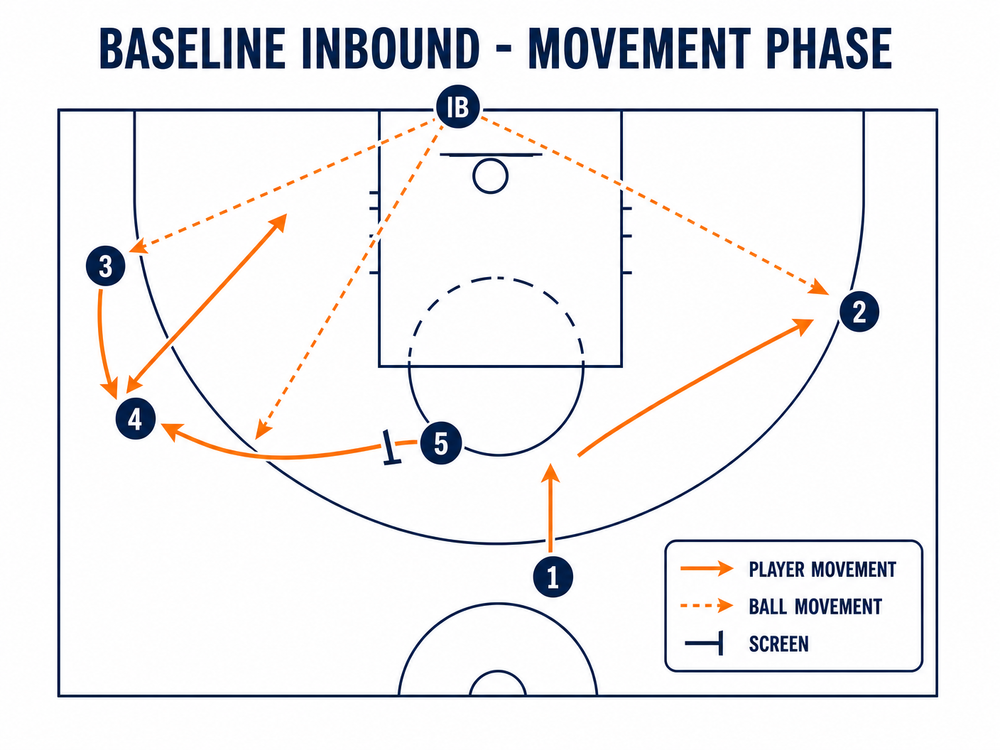
- The Initiation: The play begins when the Inbounder (IB) slaps the basketball. This is the visual and auditory cue for all players to begin their movements simultaneously.
- The Screen: Player 5 (Center) immediately drops down from the left elbow to set a hard, legal screen on Player 4's defender near the right block.
- The Cut: Player 4 (Power Forward) reads the screen and cuts hard underneath the basket, aiming for the ball-side (right) corner or directly to the rim depending on the defensive coverage. This is the primary scoring option.
- The V-Cut: Simultaneously, Player 3 (Small Forward) executes a sharp V-cut, sprinting from the left corner up towards the left elbow, and then quickly back-cutting towards the corner to draw their defender away from the paint.
- Spacing: Player 1 (Point Guard) dribbles up slightly to maintain spacing and act as a safety outlet. Player 2 (Shooting Guard) spaces out towards the opposite (left) wing, drawing their defender away from the strong side.
- The Pass: The Inbounder reads the defense:
- Option A (Primary): Pass to Player 4 cutting off the screen for a quick layup.
- Option B (Secondary): Pass to Player 3 popping out or back-cutting.
- Option C (Safety): Pass to Player 2 spacing out, or Player 1 at the top of the key to reset the offense.
4. Key Coaching Points
- Timing is Everything: The screen by Player 5 must arrive exactly as Player 4 is ready to cut. If the screen is too early, the defense recovers; if too late, an offensive foul is likely.
- Screen Angle: Player 5 must set the screen at an angle that forces Player 4's defender to go over the screen, not under it, ensuring Player 4 has a clear path to the basket.
- Sell the Cut: Player 4 must sprint hard. A slow jog will not force the defense to react, rendering the screen useless.
- Inbounder Patience: The inbounder must not panic. They have 5 seconds. They should look for the primary option first, but be fully prepared to hit the safety valve if the primary is covered.
5. Common Mistakes
- Illegal Screens: Player 5 moving while setting the screen. Emphasize a wide base and remaining stationary upon contact.
- Telegraphing the Pass: The inbounder staring directly at Player 4 the entire time, allowing the defense to anticipate the pass and intercept it.
- Poor Spacing: Players 1, 2, and 3 not moving to their designated spots, clogging the paint and making the pass to Player 4 impossible.
6. Variations & Progressions
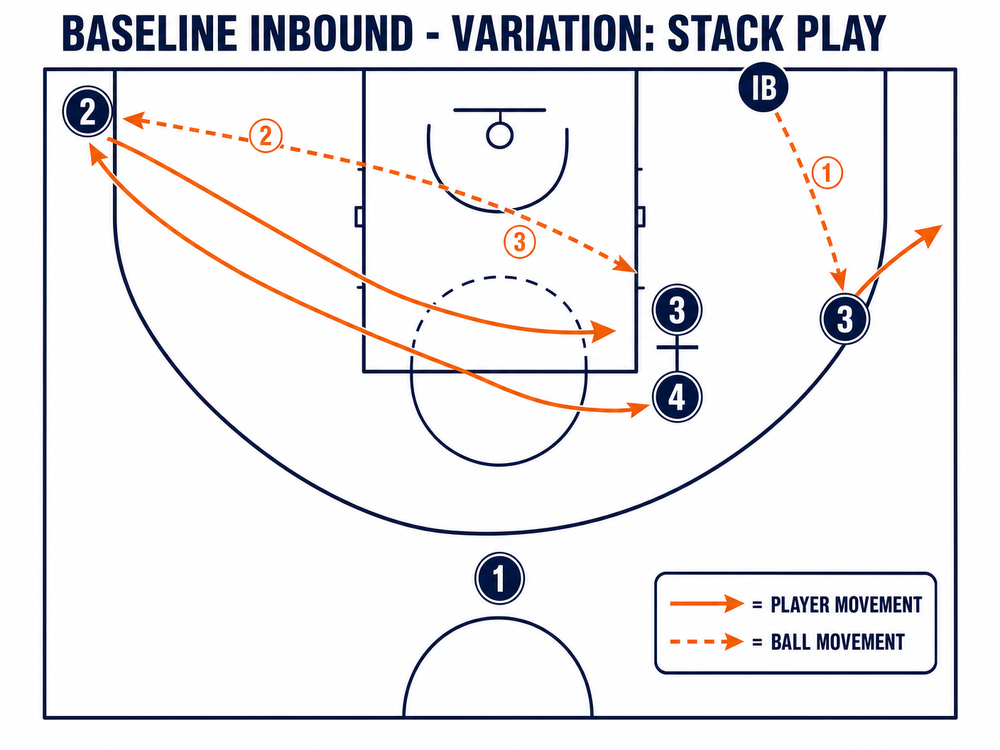
- The Stack Variation: Instead of starting spread out, place Players 3 and 4 in a vertical 'stack' on the ball-side block. Player 4 cuts baseline, while Player 3 pops out to the wing. This creates confusion and forces the defense to communicate quickly.
- Slip the Screen: If the defense anticipates the screen and switches early, Player 5 (the screener) can immediately 'slip' the screen and dive directly to the basket for a quick pass.
7. Age Adaptations
- Under 10s / Under 12s: Focus heavily on the fundamentals of setting a legal screen and making a crisp, two-handed chest or bounce pass from out of bounds. Simplify the secondary options; if the primary cut isn't there, immediately pass to the safety valve.
- Under 14s / Under 16s: Introduce the 'slip' variation. Teach players how to read the defense's reaction to the screen and make decisions on the fly.
- Open / Advanced: Incorporate complex dummy actions on the weak side to further misdirect the defense before the primary screen occurs.
