

Basketball
Fast Break 3-on-2 Transition Drill
Master the art of the fast break with this high-intensity 3-on-2 transition drill that sharpens decision-making, spacing, and finishing under pressure.

What you need
basketball, full court (28m x 15m FIBA), cones (optional, for lane markers), scrimmage vests / bibs
Overview
The Fast Break 3-on-2 Transition Drill is one of the most game-realistic and high-value drills in a basketball coach's toolkit. It replicates the most common numerical advantage scenario in live play — three offensive players attacking two retreating defenders — and demands that players execute at pace while making intelligent, split-second decisions.
This drill develops transition offense IQ, court spacing, ball-handling under pressure, and finishing at the rim or from the mid-range. Equally, it trains defenders to communicate, retreat efficiently, and delay the attack long enough for help to arrive. Run this drill during the transition and conditioning phases of your session, or use it as a competitive warm-up activity to raise the intensity of training from the outset.
It is suitable for intermediate to advanced players (U14 and above) and can be scaled in complexity to challenge elite senior groups. Coaches at all levels will find it immediately applicable to their next session.
Setup

Equipment
- 1 full FIBA-regulation court (28m x 15m)
- 4–6 basketballs (one per active group)
- Cones (optional, to mark wing lanes at approximately 3–4m from sideline)
- Scrimmage vests or bibs to differentiate offensive and defensive groups
Player Requirements
- Minimum: 5 players (3 offense + 2 defense)
- Optimal: 9–15 players (allows continuous rotation with minimal downtime)
Court Setup
Use the full court length (28m). Divide players into groups of three (offensive units) and pairs (defensive units). Offensive groups queue at one baseline; defensive pairs position themselves at the opposite end near the key. A coach or manager stands at half-court to initiate each repetition.
| Role | Position | Number |
|---|---|---|
| Ball Handler (Point Guard) | Centre lane, at or just past half-court | 1 |
| Left Wing (Shooting Guard / Small Forward) | Left lane, ~3–4m from sideline | 2 |
| Right Wing (Small Forward / Power Forward) | Right lane, ~3–4m from sideline | 3 |
| Top Defender | Free throw line extended, facing the attack | 4 |
| Basket Defender | Inside the key, protecting the rim | 5 |
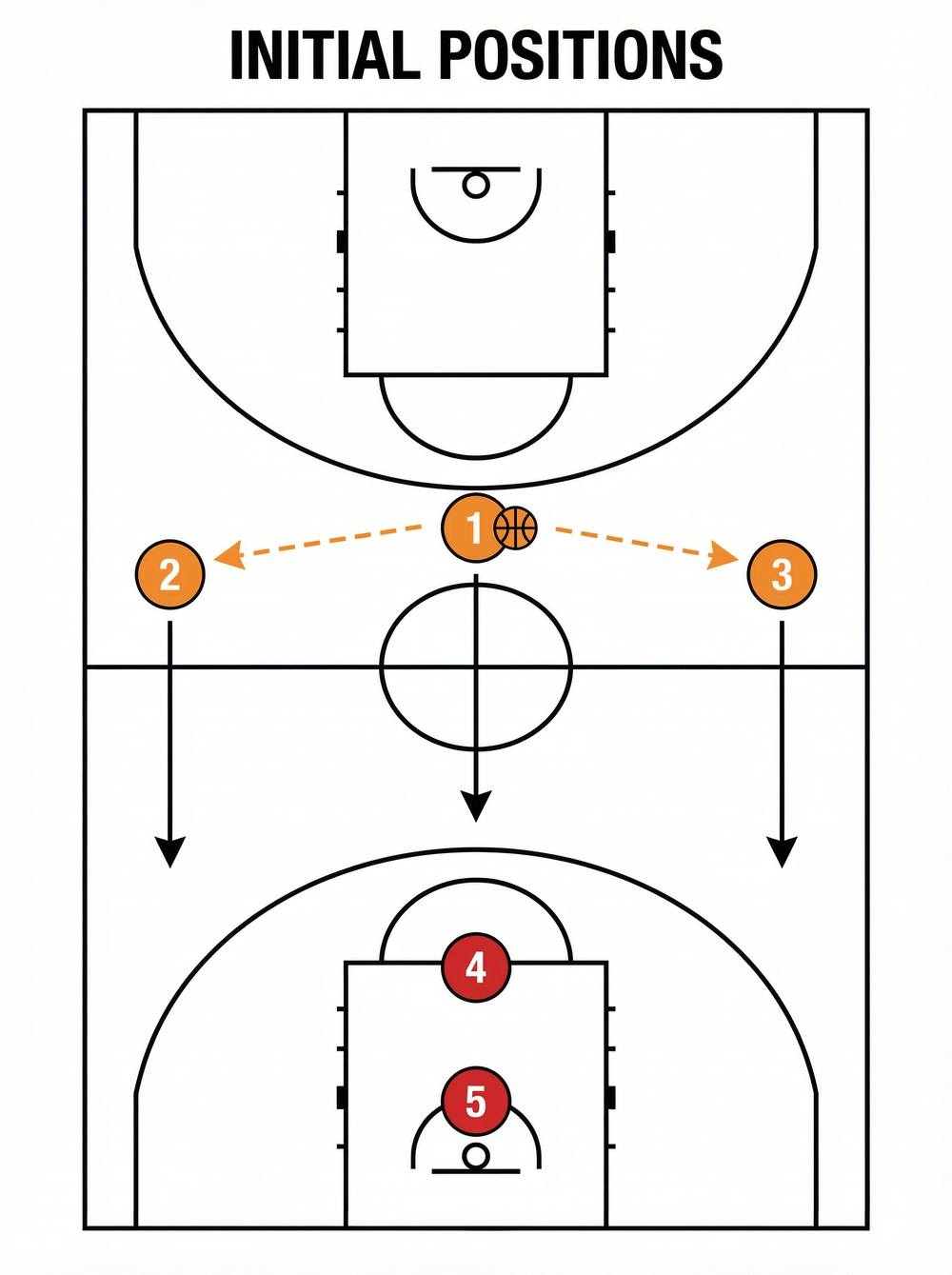
Diagram 1 — Initial Positions: Offensive trio (1, 2, 3) approaching from half-court; defenders (4, 5) in tandem formation at the attacking end.
Step-by-Step Instructions

Step 1 — Set the Defensive Tandem.
Before the drill begins, position your two defenders (4 and 5) in a tandem formation. Player 4 (the top defender) stands at the free throw line, facing half-court. Player 5 (the basket defender) stands inside the key, approximately 1.5m in front of the basket. Emphasise to defenders that their job is to delay, not gamble — they are buying time, not trying to steal the ball.
Step 2 — Initiate the Offensive Run.
The coach triggers the rep by passing or rolling a ball to Player 1 at half-court. On receiving the ball, Player 1 pushes the pace immediately. Players 2 and 3 sprint their respective lanes, maintaining a width of approximately 3–4m from each sideline. All three players should cross the half-court line in a controlled sprint, with Player 1 slightly ahead or level with the wings.
Step 3 — Approach the Defence at Speed.
Player 1 attacks the paint at pace, dribbling directly at the top defender (Player 4). The key teaching point here is that Player 1 must attack the gap between the two defenders, not drift wide. This forces Player 4 to make a commitment. Players 2 and 3 continue their lanes, filling the spaces on either side of the key at roughly the three-point line extended.
Step 4 — Read and React.
As Player 1 approaches the free throw line, they must read Player 4's decision:
- If Player 4 steps up to stop the drive: Player 1 delivers a crisp skip pass or direct pass to the open wing (Player 2 or 3) for an open three or mid-range shot.
- If Player 4 drops back to protect the rim: Player 1 pulls up for a free throw line jumper or continues to the basket for a layup.
- If Player 5 rotates out to cover a wing: Player 1 attacks the now-unprotected basket or finds the opposite wing cutting to the open block.

Diagram 2 — Attack Phase: Player 1 drives at the tandem, forcing a defensive decision. Dashed arrows indicate the two primary passing options to Player 3 (wing) or Player 2 (cutting to the block).
Step 5 — Finish the Possession.
The rep ends when the offense scores, the defense secures a stop (rebound or turnover), or the ball goes out of bounds. Insist on playing through contact and finishing every possession — no stopping mid-rep.
Step 6 — Rotate.
After each rep, the two defenders become the new offensive unit (they retrieve the ball and push the other direction), while the previous offensive trio splits — two become the new defensive tandem and one joins the back of the queue. This continuous rotation keeps the drill moving and adds a conditioning element.
Key Coaching Points

1. Maintain Lane Discipline.
Wings must stay wide throughout the approach. A common tendency is for wings to drift toward the ball, which collapses the spacing and makes the defender's job easier. Demand that Players 2 and 3 hold their lanes until a pass is made.
2. Attack the Gap, Not the Defender.
Player 1 should drive directly at the seam between the two defenders. Attacking a defender's outside shoulder allows them to recover; attacking the gap forces both defenders to make a decision simultaneously.
3. Make the Easy Play.
The 3-on-2 is a numbers advantage — the offense should win this scenario every time if they execute correctly. Reinforce that the ball handler does not need to be a hero. If the pass is open, make the pass. Encourage players to verbalise: "Pass or go" as they approach.
4. Defenders Must Communicate.
Player 4 calls out "I've got ball" as the offensive unit approaches. Player 5 calls "I've got basket." Without verbal communication, defenders will collapse on the same threat and leave a wing open. Make communication non-negotiable.
5. Finish Strong.
Do not accept lazy layups or hesitant shots. Every finish should be executed as if it is the final possession of a tied game. Reinforce proper footwork on layups and a balanced base on catch-and-shoot opportunities from the wing.
6. Transition Immediately After the Shot.
The moment the shot goes up, all five players must transition mentally. Offensive players crash the glass; defenders box out and push the other direction. This habit, built in training, translates directly to game situations.
Common Mistakes

Mistake 1 — Wings Drifting Inward.
Players 2 and 3 naturally want to get closer to the action. If they drift inside the three-point arc, they reduce the spacing and allow one defender to guard two players. Correction: Place cones along the wing lanes as visual guides. Stop the drill and reset if a wing drifts inside the cone before the pass is made.
Mistake 2 — Ball Handler Telegraphing the Pass.
Player 1 will often look directly at their intended target before passing, giving the defender time to rotate. Correction: Drill eye discipline — Player 1 should look baseline (or opposite wing) before delivering the pass. Use the cue: "Look away, pass away."
Mistake 3 — Top Defender Gambling for the Steal.
Player 4 will sometimes lunge at the ball handler in an attempt to steal, leaving both wings completely open. Correction: Emphasise that the defender's role is to slow the attack and force a pass, not to gamble. Reward defenders who force a second pass over those who attempt steals.
Mistake 4 — Offensive Players Slowing Down Before the Three-Point Line.
Players often decelerate as they approach the defense, losing the pace advantage that makes the fast break dangerous. Correction: Demand that all three offensive players maintain sprint pace until they are inside the three-point arc. Cue: "Attack at speed, decide at the arc."
Mistake 5 — Neglecting the Transition After the Shot.
Once a shot is taken, many players stop and watch. This is the moment that separates disciplined teams from undisciplined ones. Correction: Award a bonus point in competitive versions of the drill to any offensive player who secures an offensive rebound, reinforcing the habit of crashing the glass.
Variations & Progressions
Progression 1 — Add a Trailing Defender (3-on-2 + 1)
Introduce a third defender who starts at half-court and sprints to recover as the play develops. The offensive unit must now execute quickly before the trailing defender arrives, adding a time pressure element that mirrors real game scenarios. This progression is ideal for advanced groups and forces the ball handler to make faster decisions.
Progression 2 — Continuous Full-Court (Transition Both Ways)
After each possession, the defending pair immediately becomes the offensive unit and attacks the other end against two new defenders who sprint out from the baseline queue. This creates a continuous, high-intensity loop that builds conditioning alongside skill. Run this version for 4–6 minutes as a game-speed conditioning block.
Variation — Restricted Zone Finish
Place a cone or marker at the mid-range area and require the offense to finish inside the restricted arc (within 1.5m of the basket) — no pull-up jumpers allowed. This forces the ball handler to commit to the drive and teaches wings to cut hard to the block rather than settling for perimeter shots.
Age Adaptations
| Age Group | Modification |
|---|---|
| U10 / U12 | Walk or jog through the drill initially. Remove the second defender (make it 3-on-1) to reduce decision complexity. Focus purely on lane discipline and catching on the move. Use a smaller ball (size 5). |
| U14 / U16 | Run the drill at full pace with standard 3-on-2 setup. Introduce verbal communication requirements for defenders. Begin introducing the 3-on-2+1 progression once the base drill is mastered. |
| Open / Senior | Use the continuous full-court variation as a standard conditioning drill. Add shot clock pressure (8-second count from half-court crossing). Introduce defensive trapping options for the top defender to create more complex reads for the ball handler. |
Coach's Note: The 3-on-2 fast break is won or lost in the two seconds after the ball handler crosses the three-point line. Build habits in training that make the right decision automatic — and your team will convert transition opportunities at a significantly higher rate in competition.
