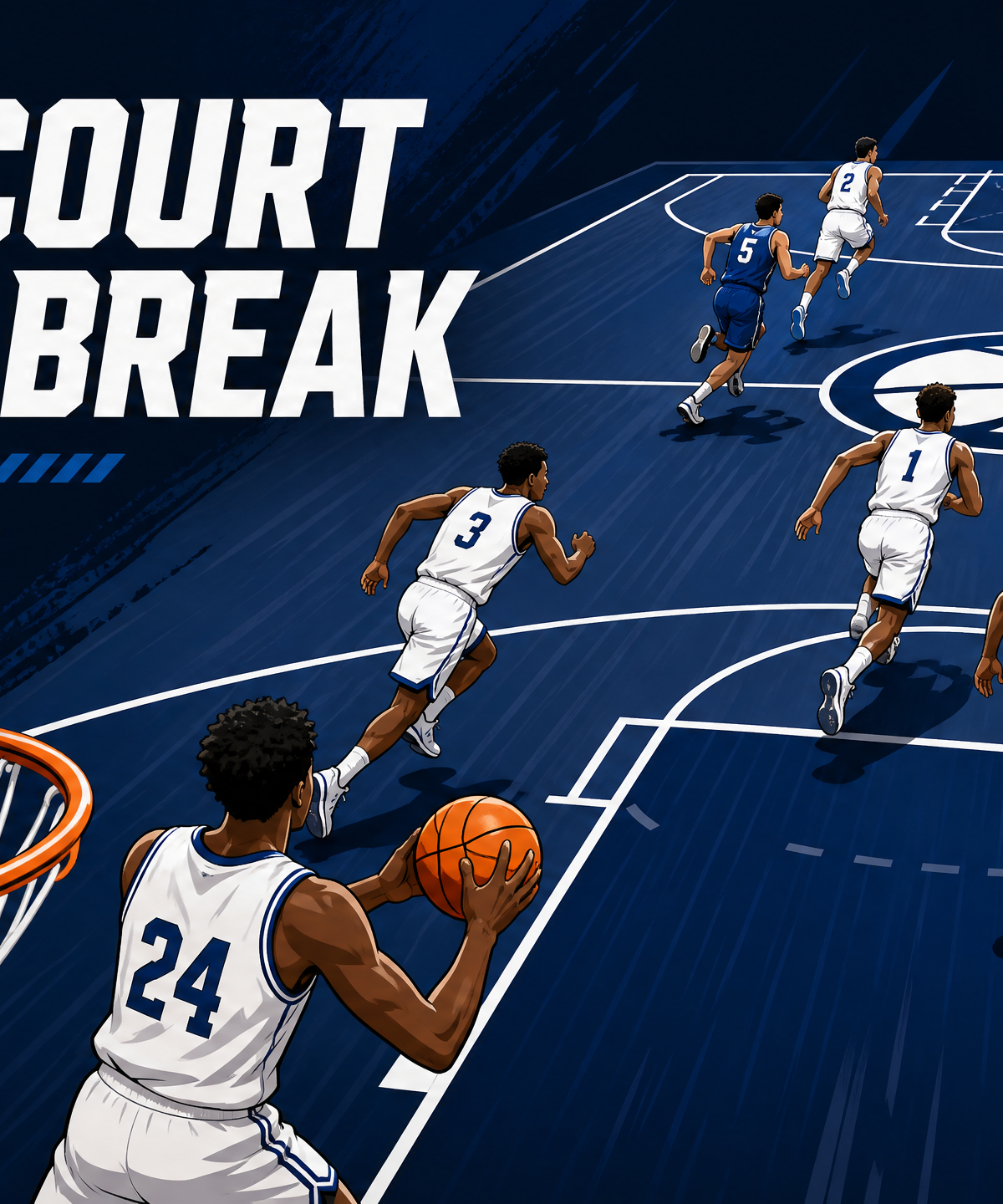
Mastering the Full Court Press Break: The 4-Across Strategy
Equip your team with the essential skills and tactical understanding to confidently dismantle any full-court pressure defense and convert it into high-percentage scoring opportunities.
Equipment Needed
1. Overview
Facing a well-organized full-court press can be one of the most intimidating experiences for a basketball team, often leading to rushed decisions, turnovers, and easy points for the opposition. The 4-Across Press Break is a fundamental, highly effective strategy designed to counter full-court pressure. This drill resource provides a comprehensive framework to teach your players how to maintain composure, utilize spacing, and exploit the numerical advantages created when the defense over-commits in the backcourt.
This drill focuses on the "4-Across" alignment, a proven setup that spreads the defense horizontally across the free-throw line extended, creating multiple passing lanes and forcing defenders to make difficult choices. By mastering this progression, your team will transform the press from a source of panic into a primary fast-break opportunity.
2. Setup
Equipment Needed:
- 1 Basketball
- 10 Players (5 Offensive, 5 Defensive)
- Full Court (Standard FIBA 28m x 15m)
Initial Alignment (The 4-Across):
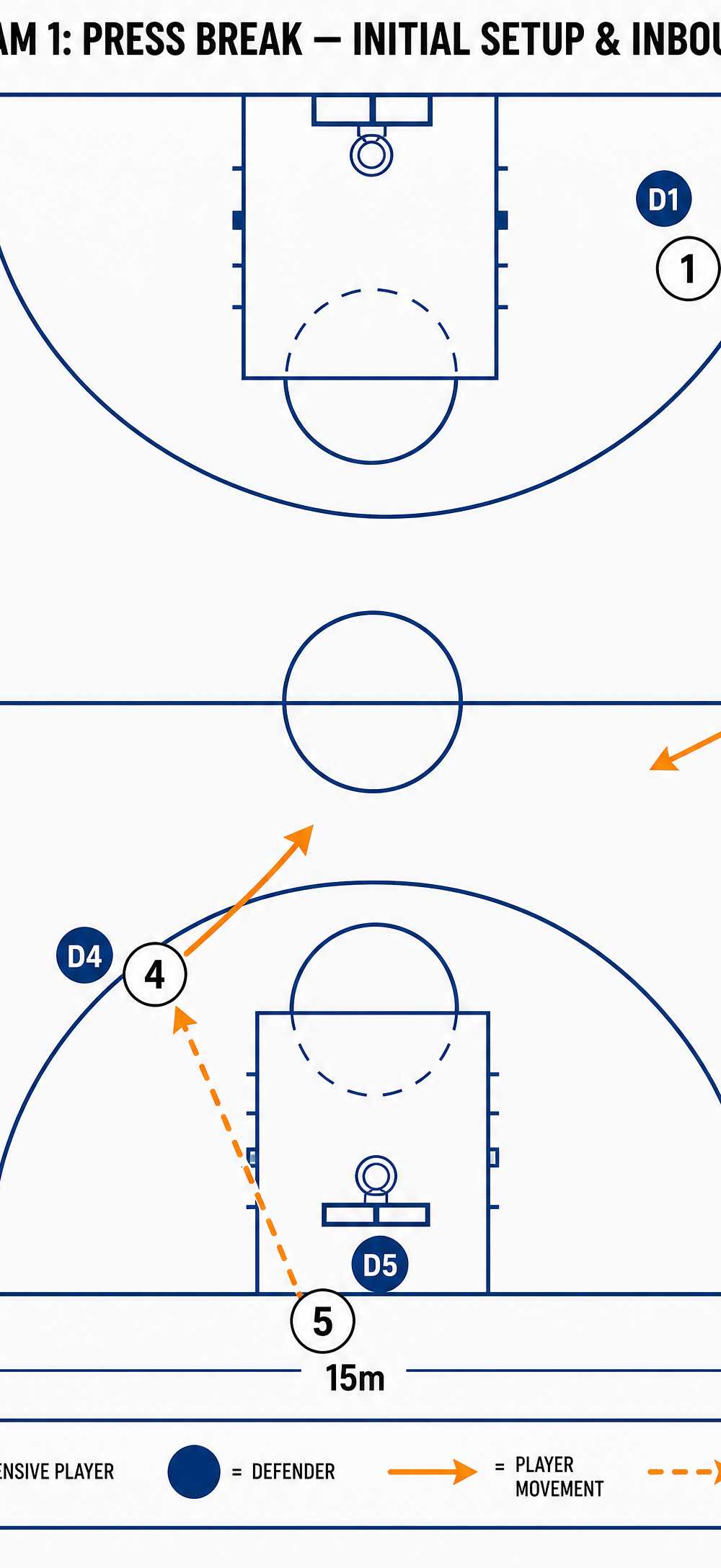
- Player 5 (Inbounder): Positions out of bounds on the baseline, directly under the basket. Their role is crucial; they must be patient, use the full 5 seconds if necessary, and read the defense.
- Player 4 (Primary Target): Sets up near the elbow (free-throw line extended) on the strong side (ball side).
- Player 3 (Secondary Target/Releaser): Positions on the far sideline, at the free-throw line extended.
- Player 2 (Middle/Sideline Threat): Starts near the half-court line, slightly shaded to the strong side.
- Player 1 (Deep Threat/Safety): Positions at the far three-point arc, ready to stretch the defense or flash middle if the primary options are denied.
Defenders (D1-D5) start in a standard man-to-man full-court press alignment, applying heavy pressure to the offensive setup.
3. Step-by-Step Instructions
Phase 1: The Inbound and Initial Break
- The Trigger: The drill begins when the referee (coach) hands the ball to Player 5 on the baseline.
- The V-Cut: Player 4 executes a sharp, aggressive V-cut to get open. They must take their defender deep toward the baseline before exploding back toward the ball.
- The Flash: Simultaneously, Player 3 flashes aggressively to the middle of the floor, providing a secondary target if Player 4 is heavily denied.
- The Inbound Pass: Player 5 reads the movement and delivers a crisp, two-handed chest pass or bounce pass to the open player (usually Player 4). Crucial: The pass must be away from the defender.
Phase 2: Middle Advancement and the Outlet
- Square Up and Read: Upon receiving the ball, Player 4 must immediately square up to the basket and read the floor. Never turn your back to the defense.
- The Sideline Sprint: Player 3 (or whoever did not receive the inbound) immediately sprints hard up the opposite sideline, staying wide to stretch the defense.
- The Middle Flash: Player 1 (Point Guard) reads the pass to Player 4 and flashes toward the middle of the floor, presenting themselves as the primary outlet.
- The Outlet Pass: Player 4 delivers a strong pass to Player 1 in the middle. If the middle is closed, Player 4 looks to reverse the ball back to Player 5, who has stepped inbounds and is trailing the play.
Phase 3: The Attack Phase and Finishing
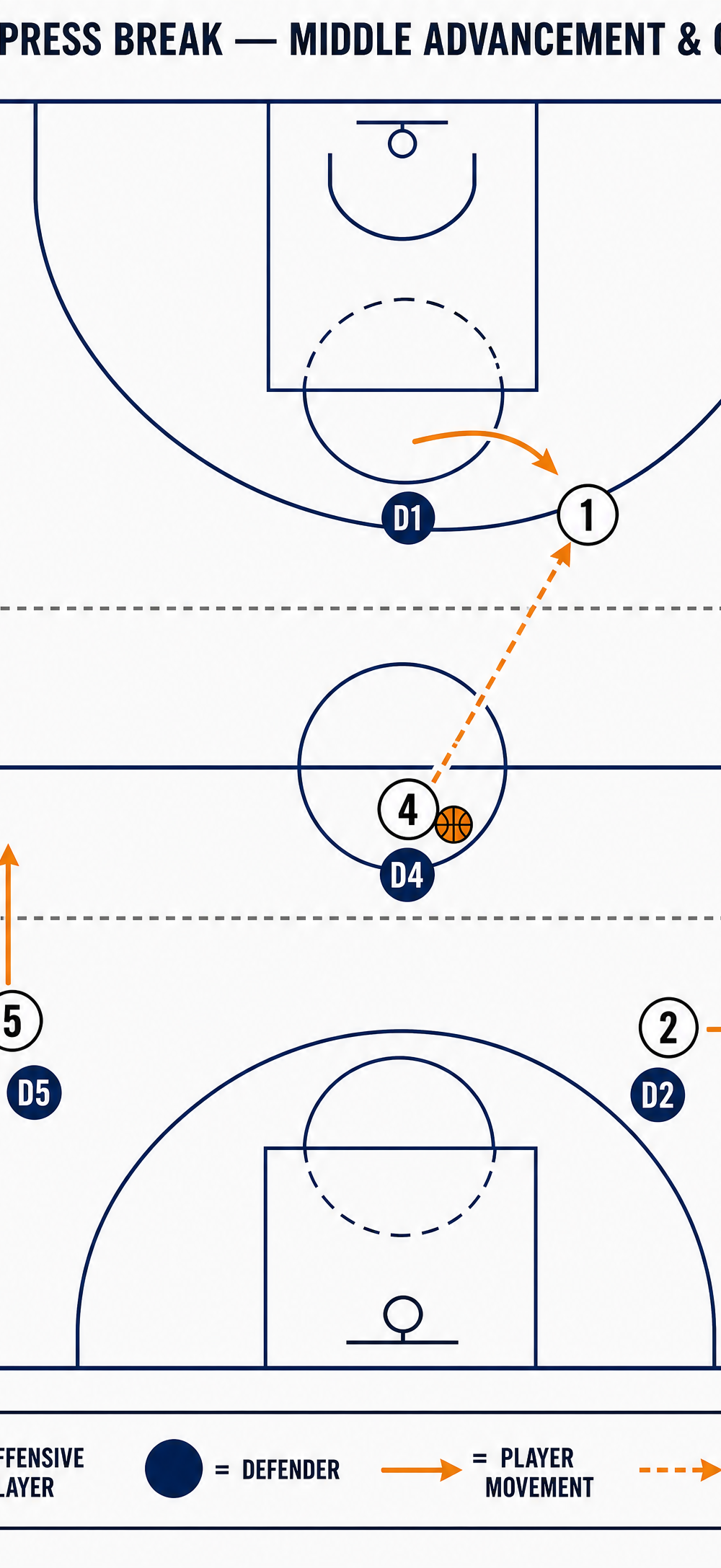
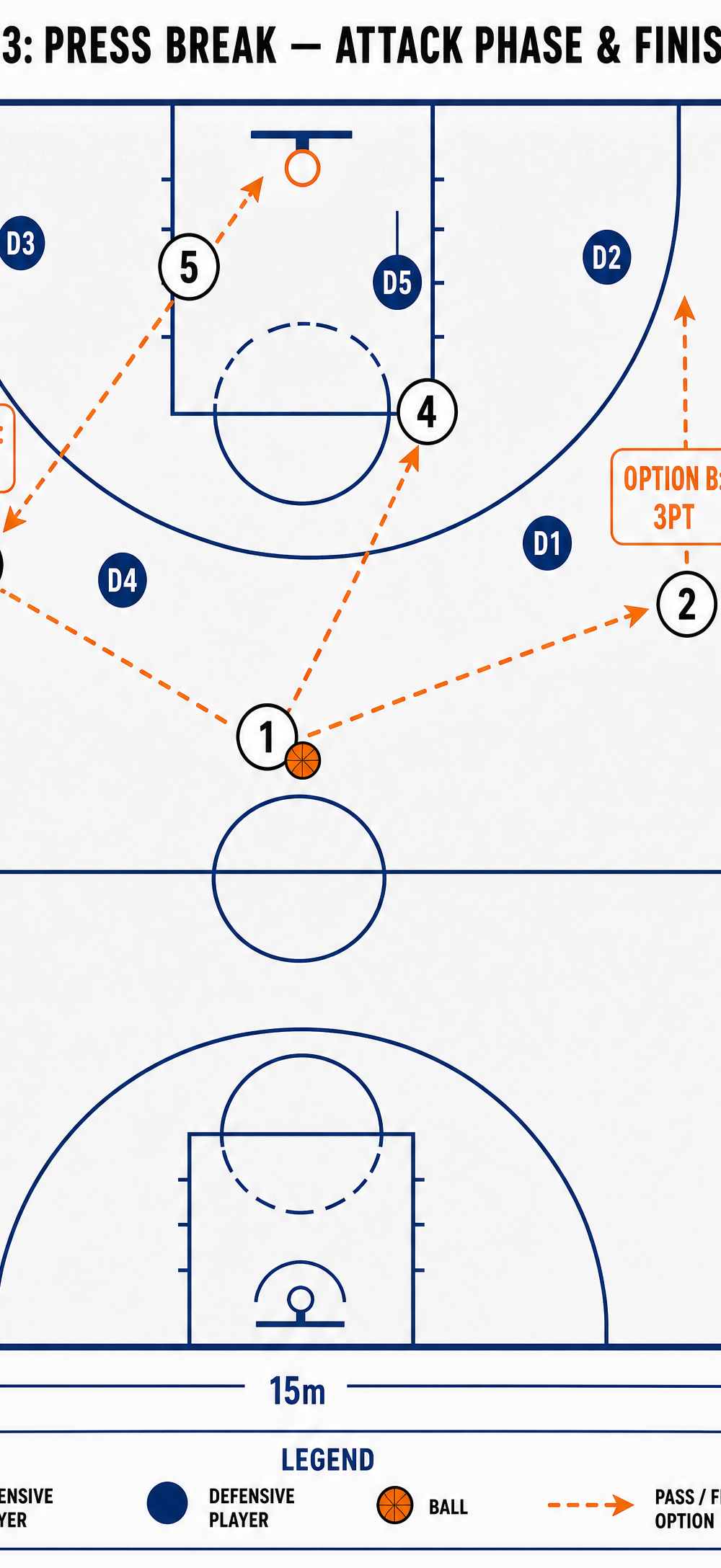
- Attack the Middle: Once Player 1 receives the ball in the middle, they must attack the defense with speed and purpose, keeping their head up.
- Fill the Lanes: Player 2 and Player 3 must sprint to fill the outside lanes (wings), staying wide to create spacing.
- The Trail: Player 4 and Player 5 sprint the floor as trailers, looking for secondary opportunities.
- Read the Advantage: As Player 1 crosses half-court, the offense should have a numerical advantage (e.g., a 3-on-2 or 2-on-1). Player 1 must read the retreating defenders:
- Option A (Layup): If the defense stays wide, Player 1 drives for a layup or dishes to a cutting wing (Player 2 or 3).
- Option B (Kick-out 3PT): If the defense collapses on the drive, Player 1 kicks the ball out to Player 2 or 3 on the wing for an open shot.
- Option C (Trailer/Mid-Range): If the initial options are covered, Player 1 can pull up for a mid-range jumper or drop the ball back to the trailing bigs (Player 4 or 5).
4. Key Coaching Points
- Patience on the Inbound: The inbounder (Player 5) is the quarterback of the press break. They must not panic. Teach them to use ball fakes and look off defenders to create passing angles.
- Meet the Pass: Receivers must aggressively attack the ball when it is passed to them. Never wait for the ball to come to you, as this invites interceptions.
- Square Up Immediately: The player receiving the first pass (Player 4) must instantly face up the court. Turning their back to the defense allows the trap to close and limits their vision.
- Spacing is Everything: The effectiveness of this break relies entirely on spacing. Players must stay wide and fill their designated lanes to stretch the defense and create gaps.
- Look to Attack, Not Just Survive: The goal of a press break isn't just to get the ball over half-court; it's to score. Encourage players to recognize the numerical advantage and attack the basket aggressively once the initial pressure is broken.
5. Common Mistakes
- Panicking and Rushing: Players often feel rushed by the pressure and throw wild, hopeful passes. Emphasize composure and using the full 5 seconds on the inbound.
- Dribbling into Traps: A common error is for the first receiver to immediately put the ball on the floor and dribble into the sideline or a corner trap. Pass the ball to beat the press; the ball moves faster than the defense.
- Poor Spacing: Players bunching up together allows one defender to guard two offensive players. Strict adherence to lane filling is mandatory.
- Inbounder Stepping Over the Line: A simple but costly mistake. The inbounder must be aware of their positioning on the baseline.
6. Variations & Progressions
- Progression 1: 5-on-0 (Dry Run): Start without defense. Walk through the alignments, cuts, and passes to ensure everyone understands their role and the timing.
- Progression 2: 5-on-3 (Advantage): Introduce three defenders to apply light pressure on the inbound and initial pass. This builds confidence and helps players recognize open passing lanes.
- Progression 3: 5-on-5 (Live): Full live drill. The defense can use different pressing styles (e.g., Diamond, 1-2-1-1, Man-to-Man) to challenge the offense to adapt.
- Variation: The 'Clear Out': If the defense is heavily denying the primary targets, Player 1 can clear out the deep space, allowing Player 2 or 3 to flash deep for a long baseball pass over the top of the press.
7. Age Adaptations
- Under 10 / Under 12: Focus heavily on the fundamentals: strong V-cuts, crisp passing (especially bounce passes against pressure), and meeting the ball. The tactical aspects (like the 4-across alignment) should be simplified. Emphasize spacing and avoiding the corners.
- Under 14 / Under 16: Introduce the full 4-Across alignment and the concept of reading the defense. Teach the primary and secondary options on the inbound. Emphasize the transition from breaking the press to attacking the basket.
- Open / Advanced: The drill should be run at game speed with intense, varied defensive pressure. Focus on quick decision-making, exploiting numerical advantages, and advanced reads (e.g., reversing the ball against a trap).