

Basketball
Mastering the Full-Court Press Break: The 5-Man Advance Drill
Equip your team to confidently dismantle high-pressure defenses with this structured, multi-phase full-court press break drill.
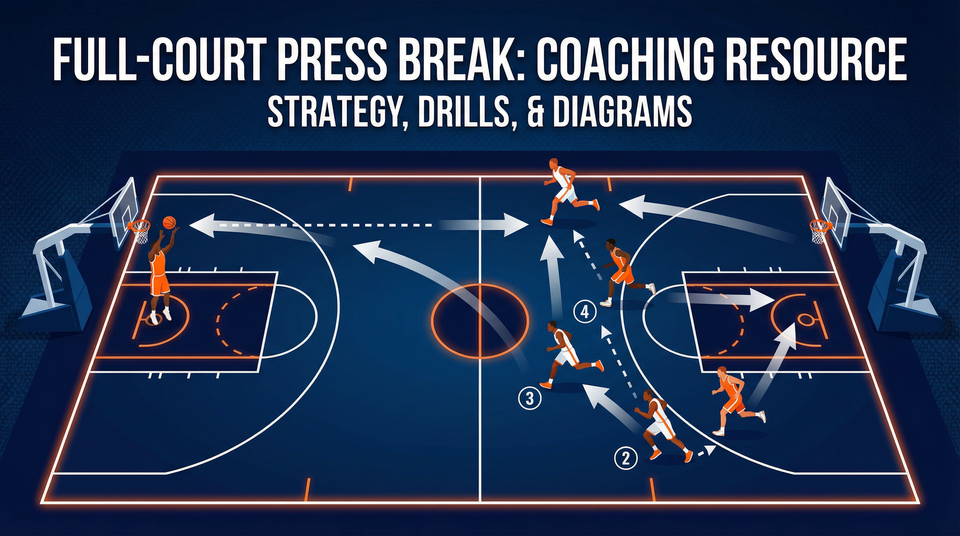
What you need
Basketballs, Reversible pinnies, Cones (optional)
1. Overview
Facing a well-organized full-court press can rattle even experienced teams, leading to turnovers, rushed decisions, and lost momentum. The 5-Man Advance Press Break Drill is designed to simulate high-pressure defensive scenarios and teach your players how to systematically dismantle a press.
This drill focuses on spacing, timing, and making decisive reads. By breaking the court down into structured zones, players learn that beating a press isn't about frantic dribbling, but rather about executing sharp cuts, maintaining floor balance, and utilizing crisp passing. It instills the confidence needed to turn defensive pressure into high-percentage scoring opportunities on the other end of the floor.
2. Setup
To effectively run this drill, you need a full FIBA-standard court (28m x 15m) to ensure realistic spacing and timing.
Equipment Needed:
- 1 Basketball per group.
- Reversible pinnies to clearly distinguish offense from defense.
- Cones (optional) to mark specific spacing zones along the sidelines.
Court Setup & Player Positions:
Divide your players into groups of five for the offense and three to five for the defense (depending on the progression level).
- Player 1 (Point Guard): Starts out of bounds on the baseline, ready to inbound the basketball.
- Player 2 (Shooting Guard): Positions near the right sideline at the free-throw line extended.
- Player 3 (Small Forward): Positions near the left sideline at the free-throw line extended.
- Player 4 (Power Forward): Sets up near the centre circle, acting as the primary release valve.
- Player 5 (Centre): Starts just inside the frontcourt, ready to flash to the ball or protect the deep rim area.
3. Step-by-Step Instructions
The drill is broken down into three distinct phases to ensure players understand their roles as the ball advances up the floor.
Phase 1: The Inbound & Initial Break

- The Setup: The drill begins with Player 1 on the baseline with the ball. The defense (X1, X2, X3) sets up in a trapping formation (e.g., a 1-2-1-1 or 2-2-1 press alignment).
- The V-Cut: Before the referee hands the ball to Player 1, Players 2 and 3 must execute sharp V-cuts. They walk their defenders down toward the baseline, plant their outside foot, and sprint back toward the free-throw line extended to get open.
- The Entry Pass: Player 1 must read the defense and deliver a crisp, two-handed chest pass or bounce pass to the open guard (let's assume Player 2).
- The Middle Flash: As the ball is in the air to Player 2, Player 4 (at the centre circle) immediately flashes toward the ball side to offer a middle outlet, preventing the defense from setting a sideline trap.
Phase 2: Mid-Court Advancement

- The Look Ahead: Upon catching the ball, Player 2 immediately faces up and looks up the court. The primary goal is to pass, not dribble.
- Sideline Sprint: Player 3 (on the opposite side) sprints hard up the left sideline to stretch the defense horizontally.
- The Inbounder's Release: After passing, Player 1 steps inbounds and trails the play slightly behind the ball, offering a safe backward passing option if Player 2 gets into trouble.
- Advancing the Ball: Player 2 has three options: pass ahead to Player 3 on the sprint, pass to the middle to Player 4, or reverse the ball to Player 1. If the pass goes to the middle (Player 4), the press is effectively broken, and the team transitions into an attacking mindset.
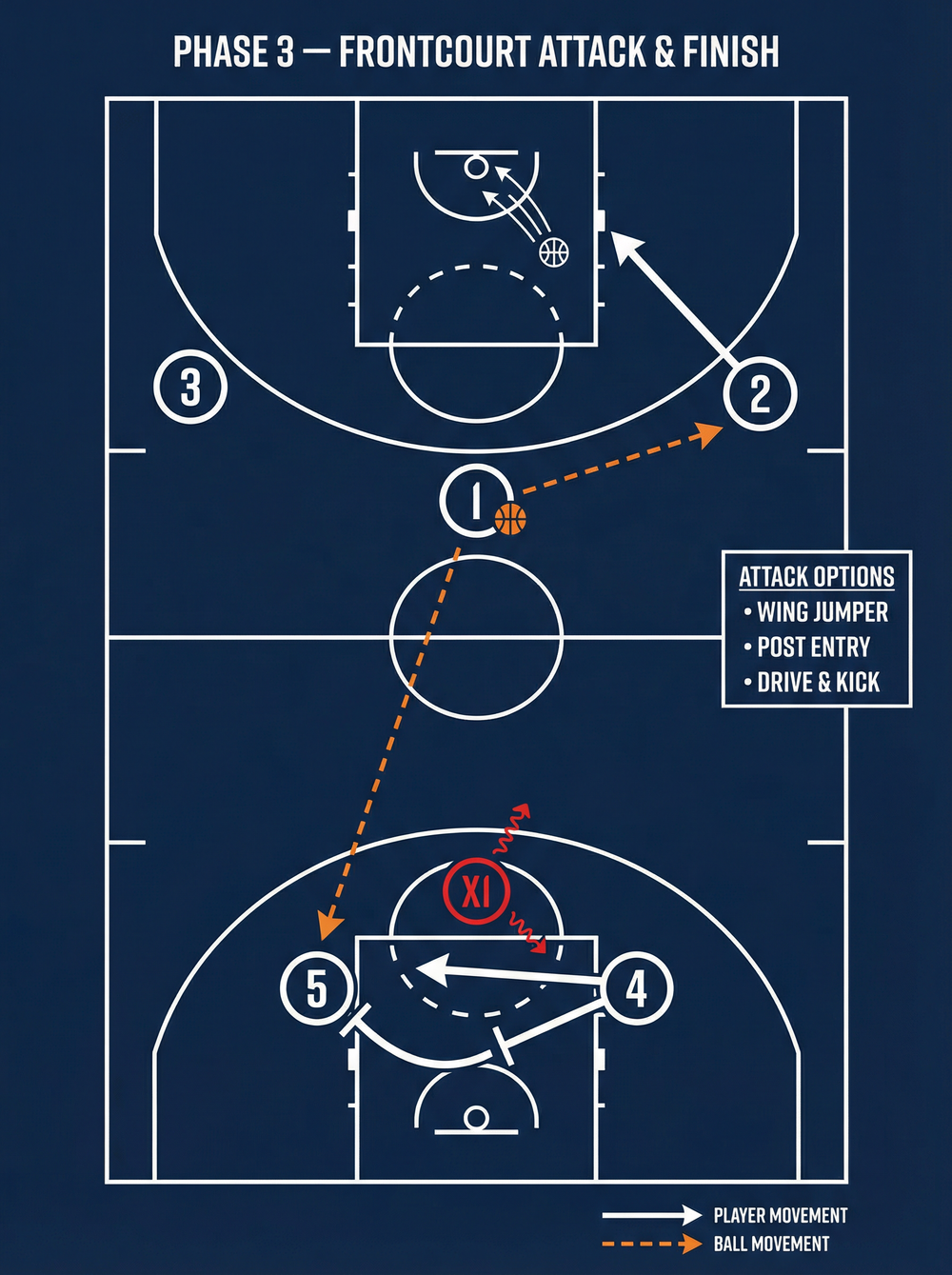
Phase 3: Frontcourt Attack & Finish

- Crossing Half-Court: Once the ball crosses the half-court line, the offense must look to capitalize on their numerical advantage.
- Floor Balance: If Player 4 has the ball in the middle, Player 2 and Player 3 should be filling the wide lanes (wings), while Player 5 establishes deep post position.
- The Attack: Player 4 attacks the retreating defender (X1). This forces the defender to commit.
- The Finish: Depending on the defender's choice, Player 4 can shoot a pull-up jumper, kick the ball out to Player 2 or 3 on the wings, or dump it down to Player 5 for a high-percentage layup. The sequence ends with a shot attempt and offensive rebounding positioning.
4. Key Coaching Points
- Pass Before You Dribble: The ball moves faster in the air than on the floor. Emphasize advancing the ball through crisp passing rather than isolation dribbling, which invites traps.
- Meet All Passes: Receivers must aggressively step toward the ball when catching. Waiting for the ball allows athletic defenders to shoot the gap for a steal.
- Maintain Floor Spacing: Players must stay wide and utilize the full 15-meter width of the court. Poor spacing allows a single defender to guard two offensive players.
- Look Middle First: The middle of the floor is the most dangerous area for a pressing defense. Always look to enter the ball to the middle flashing player (Player 4) to break the press wide open.
- Stay Poised: Teach players to use shot fakes and pass fakes to shift the defense. Panic leads to unforced turnovers.
5. Common Mistakes
- Catching and Putting the Ball on the Floor: The most common error is a player catching the inbound pass and immediately dribbling without looking up. This allows the defense to set their trap easily.
- Hiding Behind Defenders: Offensive players often jog through their cuts or stand still, making it impossible for the inbounder to find a passing lane. Sharp, purposeful cuts are mandatory.
- Throwing Looping Passes: Soft, lobbed passes over the top of the defense are easily intercepted. Passes must be thrown with velocity and purpose.
- Inbounder Stepping Over the Line: In the heat of the moment, the inbounder may step over the baseline before releasing the ball, resulting in an immediate turnover.
6. Variations & Progressions
- Add Defenders (Progression): Start the drill 5-on-3 to build confidence. Once the offense successfully breaks the press consistently, add a 4th and then a 5th defender to simulate a live-game scenario.
- Time Limit (Progression): Implement an 8-second rule constraint. The offense must cross half-court within 8 seconds, simulating the FIBA backcourt violation rule and adding realistic pressure.
- No Dribble Rule (Variation): To emphasize passing and spacing, run the drill where the offense is not allowed to dribble at all. They must break the press entirely through cuts and passes.
7. Age Adaptations
- Under 10 / Under 12: Focus heavily on the fundamental V-cuts and the inbound pass. Reduce the defensive pressure to a token level (shadow defense) to build confidence. Emphasize simply getting the ball safely over half-court rather than scoring quickly.
- Under 14 / Under 16: Introduce live, aggressive trapping. Focus on reading the secondary line of defense and making the correct reads when attacking the basket in transition.
- Open / Senior: Run the drill at full game speed with aggressive, physical defense. Incorporate specific reads based on your team's actual offensive playbook once the ball crosses half-court.
