

Basketball
Mastering the Full Court Press Break: The 5-Out Release Drill
Equip your team with the tactical spacing and precise passing needed to confidently shatter any full-court pressure defense.
What you need
1 Basketball, Full Court (28m x 15m), Training Bibs (2 colors)
1. Overview
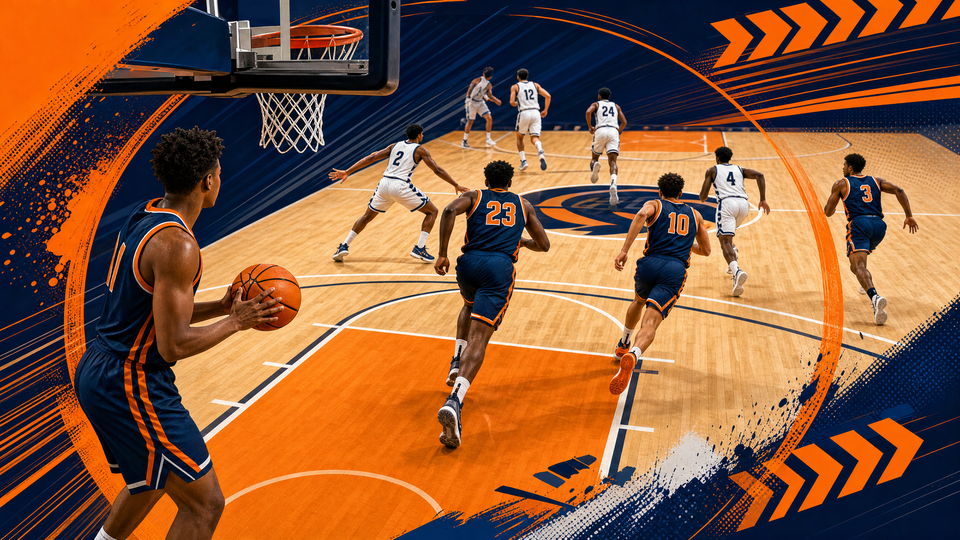
The Full Court Press Break Drill is an essential tactical exercise designed to help teams effectively and safely advance the ball against aggressive, full-court pressure defenses. Facing a full-court press can cause panic, leading to rushed passes and turnovers. This drill focuses on structured spacing, purposeful movement, and decisive passing to systematically break down the defense. It teaches players how to use the entire 28m x 15m FIBA court, creating reliable passing angles and exploiting the open space left behind by over-committing defenders.
2. Setup
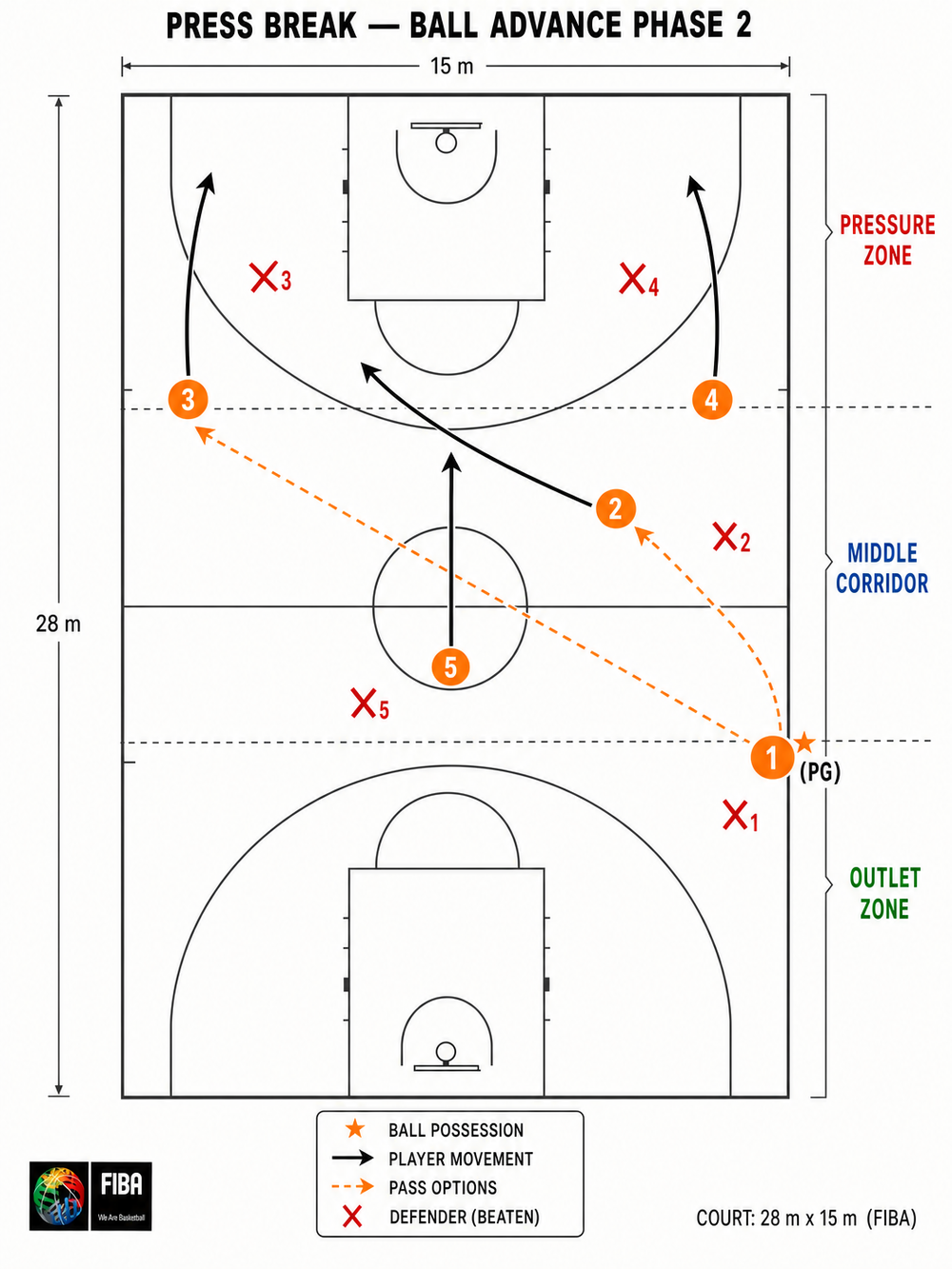
Court Dimensions: Full 28m x 15m FIBA court.
Equipment Needed: 1 basketball, 5 offensive players (numbered 1-5), and 5 defensive players (or coaches/cones for lower difficulties).
Player Positions:
- Player 5 (Center): The inbounder, positioned out of bounds under the defensive basket.
- Player 1 (Point Guard): Positioned near the left free-throw line extended.
- Player 2 (Shooting Guard): Positioned near the right free-throw line extended.
- Player 3 (Small Forward): Positioned near the left sideline at half-court.
- Player 4 (Power Forward): Positioned near the right sideline at half-court.
3. Step-by-Step Instructions
- Initial Alignment: Begin with Player 5 holding the ball out of bounds. Players 1, 2, 3, and 4 establish their starting positions, ensuring they are wide and visible.
- The V-Cut Release: On the referee's whistle (or coach's signal), Players 1 and 2 perform hard V-cuts toward the baseline and then pop back out to the free-throw line extended to receive the inbound pass.
- The Inbound: Player 5 reads the defense and makes a crisp, two-handed overhead or bounce pass to the open guard (e.g., Player 1).
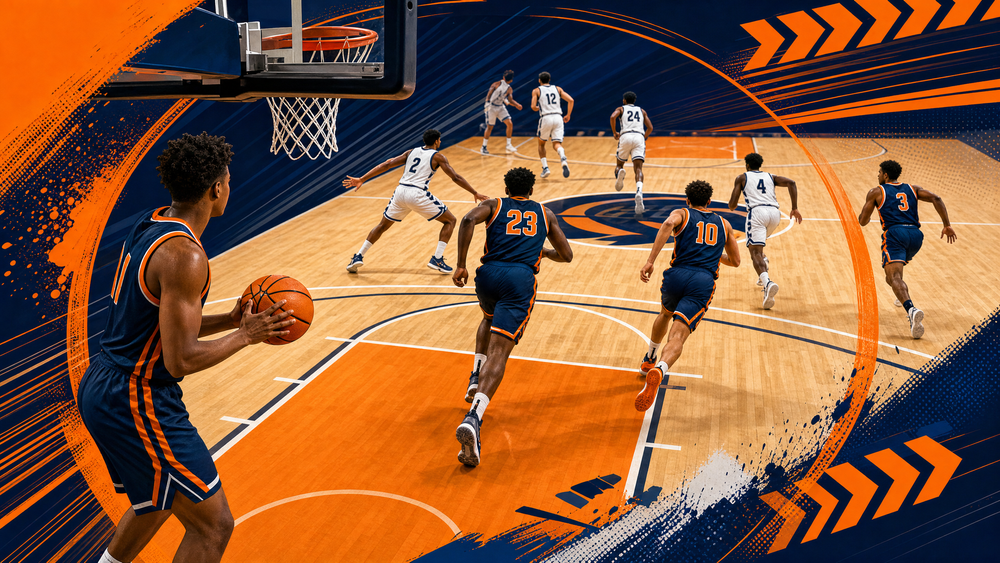
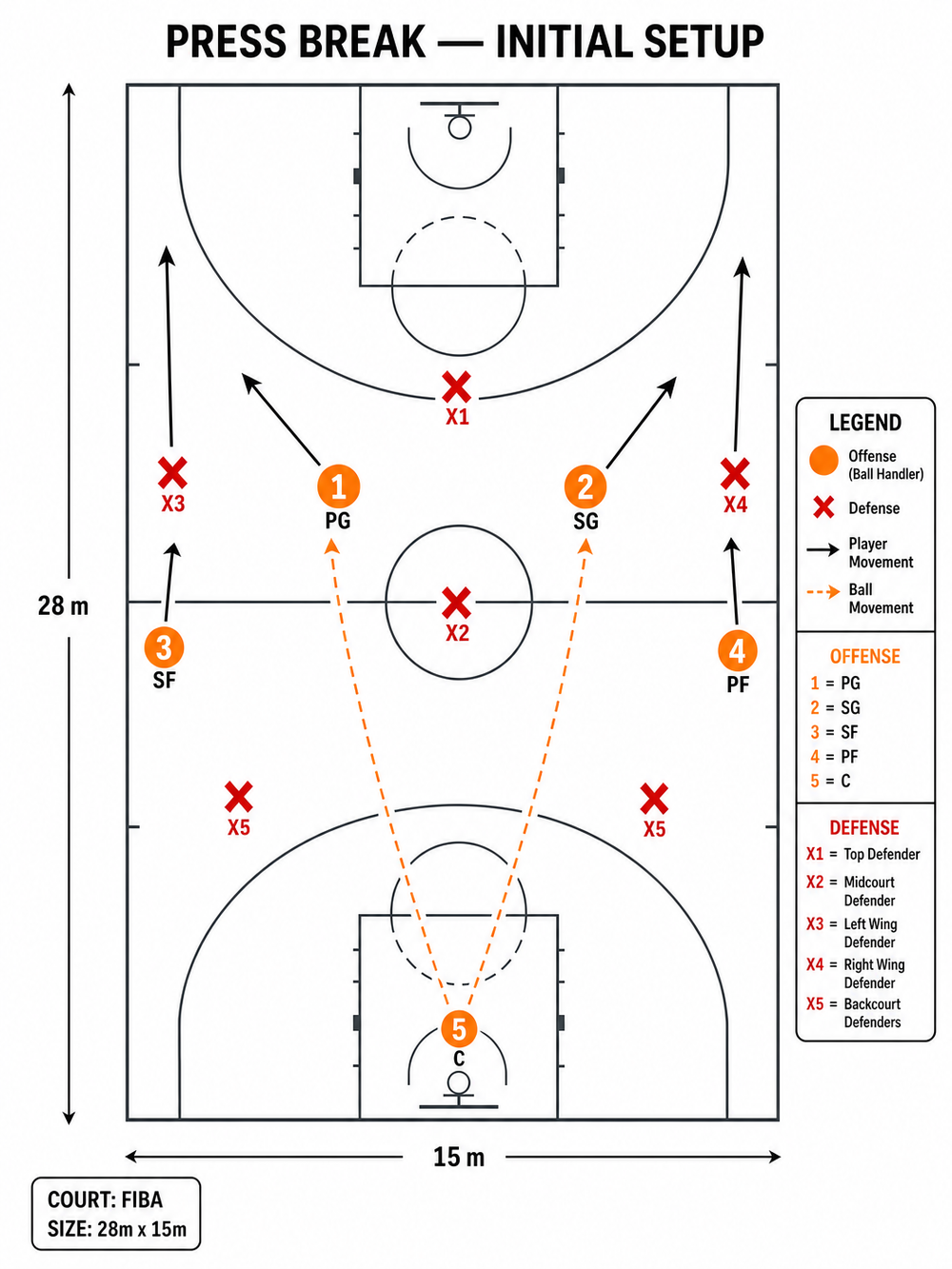
- Middle Flash: As soon as Player 1 secures the ball, Player 2 immediately flashes diagonally toward the middle of the court (the 'Middle Corridor') to offer a central relief option.
- Sideline Sprint: Simultaneously, Player 3 sprints down the left sideline toward the offensive basket, while Player 4 fills the right sideline lane.
- The Advance: Player 1 evaluates the options: pass to the middle (Player 2), hit the sideline runner (Player 3), or dribble up the sideline if the lane is completely clear.
- Trailer Support: Player 5 steps inbounds immediately after the pass and trails the play straight up the middle of the court, staying behind the ball as a safety valve.
- Execution: The team advances the ball across the half-court line within the 8-second limit and transitions smoothly into their half-court offense.
4. Key Coaching Points
- Meet Every Pass: Receivers must aggressively step toward the ball to prevent defensive deflections or interceptions.
- Look Middle First: The middle of the court is the most vulnerable area of a press. Always look to flash a player middle and pass to them; it breaks the press instantly.
- Keep Spacing Wide: Players must utilize the full 15m width of the court. Bunching up allows a single defender to guard two offensive players.
- Stay Behind the Ball: Always ensure there is at least one 'safety' player (usually the inbounder) trailing behind the ball handler to provide an emergency passing outlet.
- Use Pass Fakes: Encourage the inbounder and ball handlers to use strong pass fakes to shift the defense and open up passing lanes.
5. Common Mistakes
- Panicking and Rushing: Players speed up their mental clock and throw wild passes instead of pivoting and reading the floor.
- Dribbling Immediately: The ball handler puts the ball on the floor immediately upon catching it, inviting a trap before assessing passing options.
- Hiding Behind Defenders: Offensive players run in straight lines or fail to create clear passing angles, effectively hiding behind the defense.
- Throwing Weak Lob Passes: Lob passes over the top of the press hang in the air too long, giving the defense time to recover and intercept.
6. Variations & Progressions
- Progression 1: Add Live Defense: Start with 5-on-0 to learn the pattern, then progress to 5-on-3 (guarding the inbound and initial receivers), and finally full 5-on-5 live pressure.
- Progression 2: The Trap Scenario: Intentionally allow the defense to trap the first receiver (Player 1) to practice pivoting, staying strong with the ball, and finding the middle flash or safety outlet.
- Variation 1: 4-Across Setup: Change the initial alignment to four players lined up across the free-throw line, confusing a defense accustomed to the standard 2-up, 2-down look.
7. Age Adaptations
- Under 10s: Focus entirely on 5-on-0 execution. Emphasize basic V-cuts, strong passing, and simply getting the ball over half-court without dribbling.
- Under 14s: Introduce guided defense. Teach the concept of the 'middle flash' and the importance of not dribbling into corners.
- Under 18s / Open: Run full live 5-on-5. Emphasize quick decision-making, punishing the press with fast-break layups, and executing under high physical pressure.
