

Basketball
Box Stack Inbound Under the Basket — Scoring from Sideline Out-of-Bounds
Master the Box Stack inbound play to generate high-percentage scoring opportunities directly under the basket from a baseline out-of-bounds situation.

What you need
basketball, full-size or half-court with basket, cones or floor markers (optional for training)
Overview
The Box Stack Inbound is one of the most reliable and widely used set plays in basketball at every level of the game, from youth leagues through to professional competition. Designed specifically for baseline out-of-bounds (BLOB) situations under the offensive basket, this play exploits the congested space near the paint by using coordinated screening actions and timed cuts to create a layup or close-range shot within the first three seconds of the inbound.
Use this play whenever your team is awarded a baseline out-of-bounds under your own attacking basket — following a made basket, a defensive foul in the act of shooting, or any stoppage near the opponent's end line. The play is equally effective in late-game situations when you need a quick two points, or as a standard set piece to open the second half. Its compact structure means defenders have very little time to communicate switches or recover, making it particularly lethal against man-to-man defence.
Setup

Court: FIBA regulation half-court (28m × 15m). The action takes place in the offensive half, focused on the paint (4.9m wide × 5.8m deep) and the free-throw lane area.
Equipment Required: 1 basketball, cones or floor markers (optional for training), a full-size or half-court with a basket and backboard.
Players Required: 5 (one inbounder + four active players).
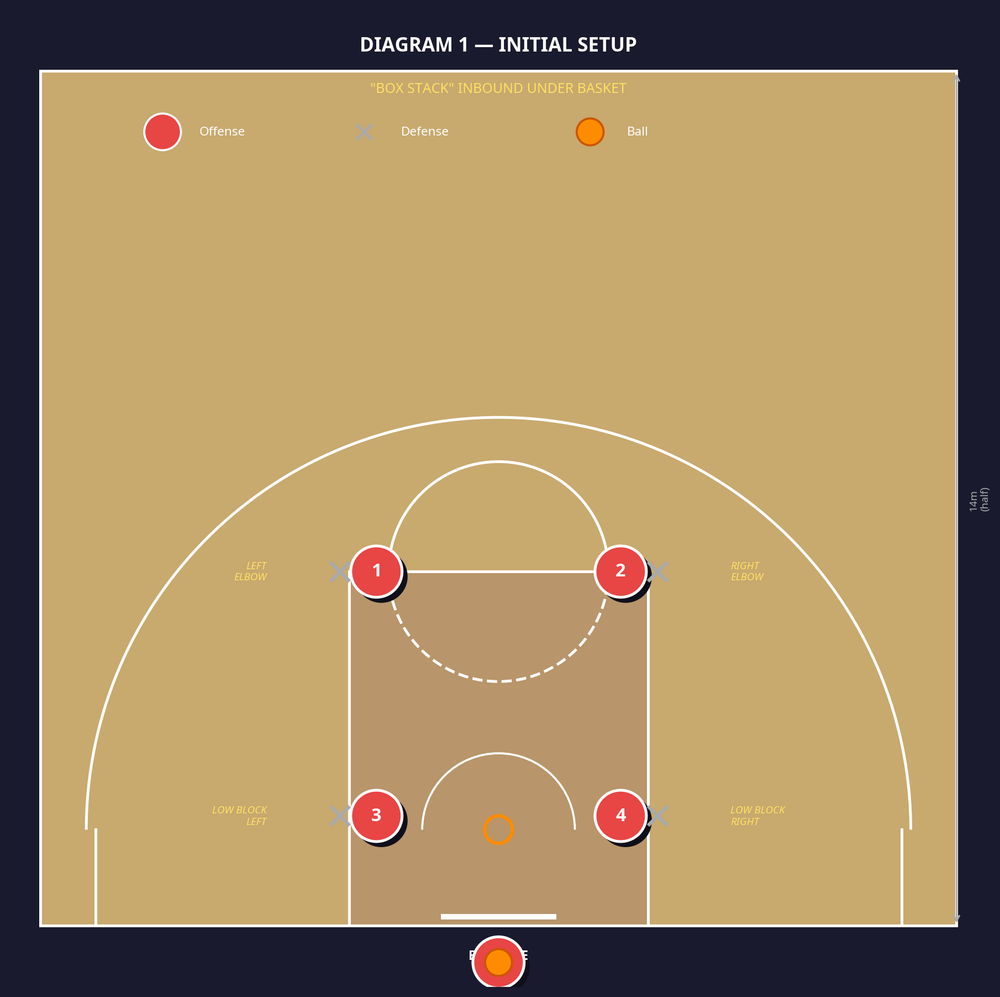
Formation — The Box:
All four active players form a tight box shape around the paint before the referee hands the ball to the inbounder. Spacing must be precise — defenders should have no room to deny or front any position.

| Position | Player | Starting Location | Role |
|---|---|---|---|
| 5 (Centre / Inbounder) | Power forward or centre | Out of bounds, directly behind the baseline under the basket | Inbounds the ball; reads the defence |
| 4 (Power Forward) | Your best finisher near the rim | Right low block, approximately 1.5m from the baseline | Primary cutter — baseline cut to rim |
| 3 (Small Forward) | Athletic wing or forward | Left low block, approximately 1.5m from the baseline | Sets screen for 4; flashes to elbow |
| 2 (Shooting Guard) | Perimeter shooter | Right elbow (junction of free-throw line and lane line) | Pops to right wing as third option |
| 1 (Point Guard) | Ball-handler / playmaker | Left elbow (junction of free-throw line and lane line) | Safety valve — steps to top of key |
Key spacing rule: Players 3 and 4 should be no more than 1m apart at the low blocks. Players 1 and 2 should align directly above them at the elbows, approximately 4m from the baseline. This tight box forces all four defenders into the paint, creating natural screening angles.
Step-by-Step Instructions

Step 1 — Inbounder Takes Position (0–1 sec)
Player 5 receives the ball from the referee and steps out of bounds directly behind the baseline, centred under the basket. Player 5 holds the ball at chest height, surveys the defence, and waits for teammates to set the box. The 5-second inbound clock begins.
Step 2 — Box Forms (1–2 sec)
Players 1, 2, 3, and 4 sprint to their designated box positions simultaneously. There should be no hesitation — the speed of formation is itself a pressure tactic that prevents defenders from organising. Each player makes deliberate contact with their defender using a legal body seal to hold position.
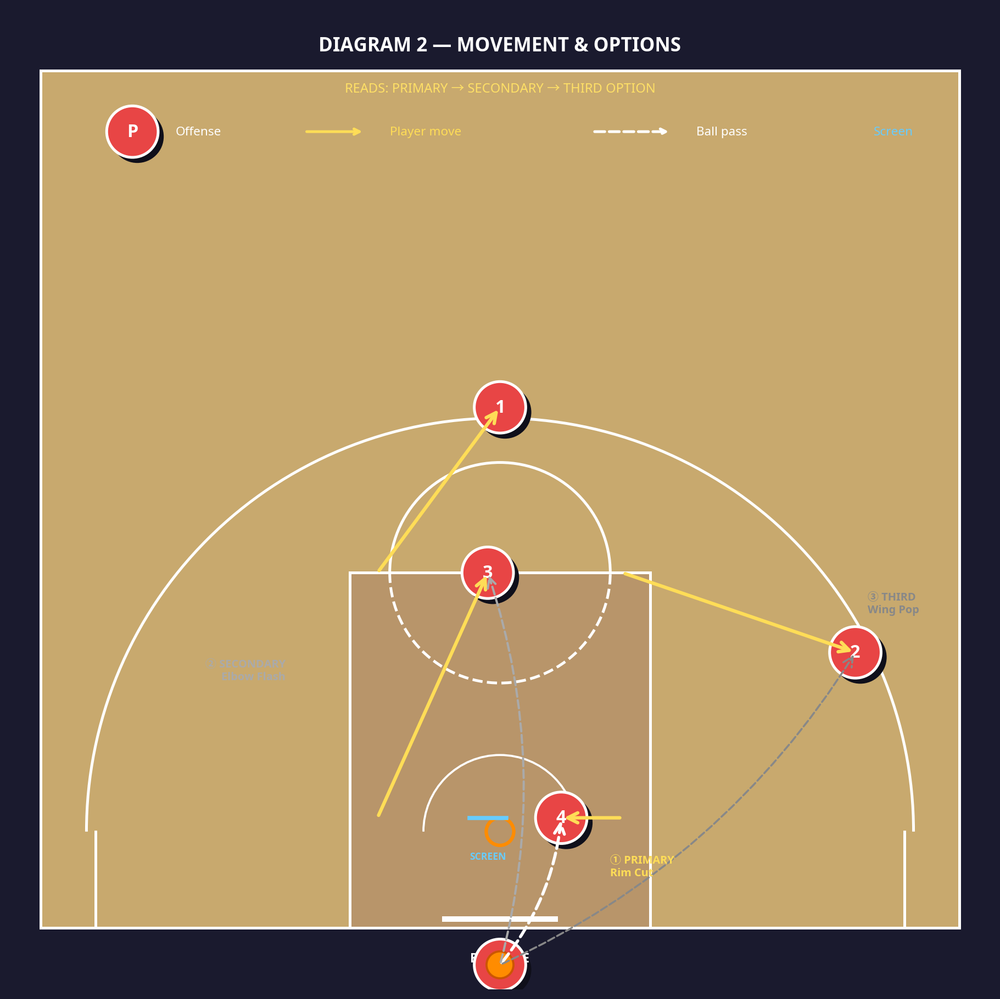
Step 3 — 4 Cuts Baseline, 3 Screens (2–3 sec)
On a verbal or visual signal from Player 5 (a head nod, a slap of the ball, or a called cue word), Player 4 makes a sharp baseline cut toward the rim, aiming to receive the ball at the restricted area for a layup or power finish. Simultaneously, Player 3 steps across and sets a legal screen on Player 4's defender, sealing them on the low block. The screen must be set with feet shoulder-width apart, arms crossed at the chest, and body stationary before contact.
Step 4 — 5 Delivers the Primary Pass (2–3 sec)
If Player 4's defender is caught by the screen, Player 5 delivers a firm, direct bounce pass or chest pass to Player 4 at the rim. The pass must be thrown before the defender can recover — timing is everything. Player 4 catches in a power position and finishes strong.
Step 5 — Read the Secondary Option (2–4 sec)
If the primary option is denied (defender fights through the screen or switches), Player 5 immediately looks to Player 3, who flashes hard to the ball-side elbow after setting the screen. Player 3 should be open at the free-throw line extended for a mid-range jumper or a drive into the lane.
Step 6 — Third Option and Safety Valve (3–5 sec)
If both interior options are covered, Player 2 pops to the right wing (approximately 1m behind the three-point line) for a catch-and-shoot opportunity. Player 1 steps back to the top of the key as the safety valve, ensuring the inbound is completed before the 5-second violation.

Key Coaching Points

The screen must be set before the cut begins. Player 3 cannot be moving when Player 4's defender makes contact. Teach your players to plant their feet, set their hips, and hold the screen for a full beat before releasing to flash to the elbow. A moving screen not only negates the play but hands possession back to the opposition.
Player 4's cut must be explosive and decisive. A tentative cut gives the defender time to recover. Emphasise a jab-step away from the basket before the cut — this sells the screen and creates a half-step of separation. The cut should be at full speed, targeting the near side of the restricted area circle.
Player 5 must read the defence, not the play. The inbounder is the quarterback of this set piece. Drill your 5 to identify which option is open before the signal is given, not after. If the primary is denied before the play even starts, go straight to the secondary. Hesitation kills the timing of every option.
All four players must move simultaneously. The power of the Box Stack comes from creating four simultaneous problems for the defence. If one player is slow to their spot, the entire structure collapses and defenders can help-side rotate freely. Emphasise "all five move on the signal" in every repetition.
Protect the ball on the inbound pass. In congested baseline situations, defenders will attempt to deflect or intercept the pass. Player 5 should use a strong, direct pass — not a lob — and aim for the receiver's hands, not their body. In training, penalise any pass that floats or arcs unnecessarily.
Communicate the call before setting up. Use a simple code word (e.g., "Box!", "Stack!") called by the point guard as the team transitions to the baseline. Every player must know the play before they step into position. Confusion at the setup stage is the most common reason this play fails at youth level.
Common Mistakes
Mistake 1 — Illegal Screen by Player 3
The most frequent error at all levels. Player 3 moves their feet or extends their arms as Player 4's defender makes contact, resulting in an offensive foul. Correction: In practice, isolate the screen-setting action and run it at half speed until the footwork is automatic. Use a cone to mark the exact spot where the screen must be set.
Mistake 2 — Player 4 Cuts Too Early
If Player 4 begins the cut before Player 3 has set the screen, the screen provides no benefit and the defender simply stays attached. Correction: Teach a clear, shared signal — both players must make eye contact before the cut begins. Use a verbal cue during training reps.
Mistake 3 — Inbounder Stares at the Primary Option
When Player 5 locks their eyes on Player 4 from the moment they receive the ball, the defence reads the play immediately and the primary option is taken away. Correction: Drill Player 5 to look away (toward Player 1 or 2) for one full second before delivering the pass. This "look-off" is a fundamental inbounding skill.
Mistake 4 — Players Drift Out of the Box Before the Signal
If players begin moving to their options before the inbounder signals, the defence has time to adjust. Correction: Enforce a strict "hold until signal" rule in every training repetition. Any player who moves early restarts the drill.
Mistake 5 — No Safety Valve Awareness
With 1–2 seconds remaining on the inbound clock, some teams panic and throw a risky pass rather than using Player 1 at the top of the key. Correction: Designate Player 1 as the "always open" option. Drill Player 5 to automatically look to the top of the key if no primary or secondary option is available within three seconds.
Variations and Progressions
Variation 1 — Flip the Action (Box Stack Left)
Mirror the entire play to the left side: Player 3 cuts baseline from the left block while Player 4 sets the screen and flashes to the right elbow. Running both directions in your playbook prevents the defence from loading up on one side and makes the play significantly harder to scout. Introduce this variation once the standard version is mastered.
Variation 2 — Double Screen (Stack Screen)
Instead of a single screen by Player 3, both Players 3 and 4 set a staggered double screen for Player 2, who cuts from the right elbow through the paint and out to the left corner for a catch-and-shoot three-pointer. This variation is most effective against teams that switch aggressively on the standard Box Stack, as the double screen creates a mismatch or a wide-open corner look.
Progression — Add Live Defence
Begin all reps without defence to build timing and confidence. Progress to passive defence (defenders shadow but do not contest), then semi-live (defenders contest but do not steal), and finally full live defence. Only move to the next level when the play succeeds at a rate of 70% or higher at the current level.
Age Adaptations

Under 10 (Minibasketball): Simplify to a two-player action — one inbounder and one cutter. Remove the screening component entirely and focus on the inbounder-to-cutter timing. Use a smaller ball (size 5) and a lowered basket (2.6m). The primary teaching objective is "move when the inbounder slaps the ball."
Under 12 / Under 14: Introduce the screen-and-cut action between Players 3 and 4, but keep the secondary and third options as simple outlet passes rather than designed scoring actions. Focus on legal screen technique and the inbounder's decision-making between two options. Run the play at three-quarter speed until footwork is consistent.
Under 16 / Open Age: Run the full five-player Box Stack as described, including all three scoring options and the safety valve. Add the "Flip" variation and introduce the double-screen progression. At this level, also teach players to read the defensive alignment before the play begins — if the defence is in zone, the play shifts to a different inbound set entirely.
