Mastering the Paint: Comprehensive Post Moves and Footwork Drill
Equip your players with elite low-post footwork, teaching them to establish position, read the defense, and execute unstoppable scoring moves around the basket.

Equipment Needed
1. Overview
Developing dominant post players requires more than just size; it demands impeccable footwork, balance, and the ability to read defensive positioning. The Mastering the Paint: Post Moves and Footwork Drill is designed to build a player's offensive arsenal from the inside out. This drill focuses on the fundamental movements required to score efficiently in the low post, emphasizing the drop-step, the jump hook, and the up-and-under counter move.
Use this drill during the skill development phase of your practice. It is highly effective for both traditional bigs (centers and power forwards) and guards who want to exploit mismatches in the paint. By isolating the footwork before adding live defense, players can build the muscle memory required to execute these moves under pressure during game situations.
2. Setup
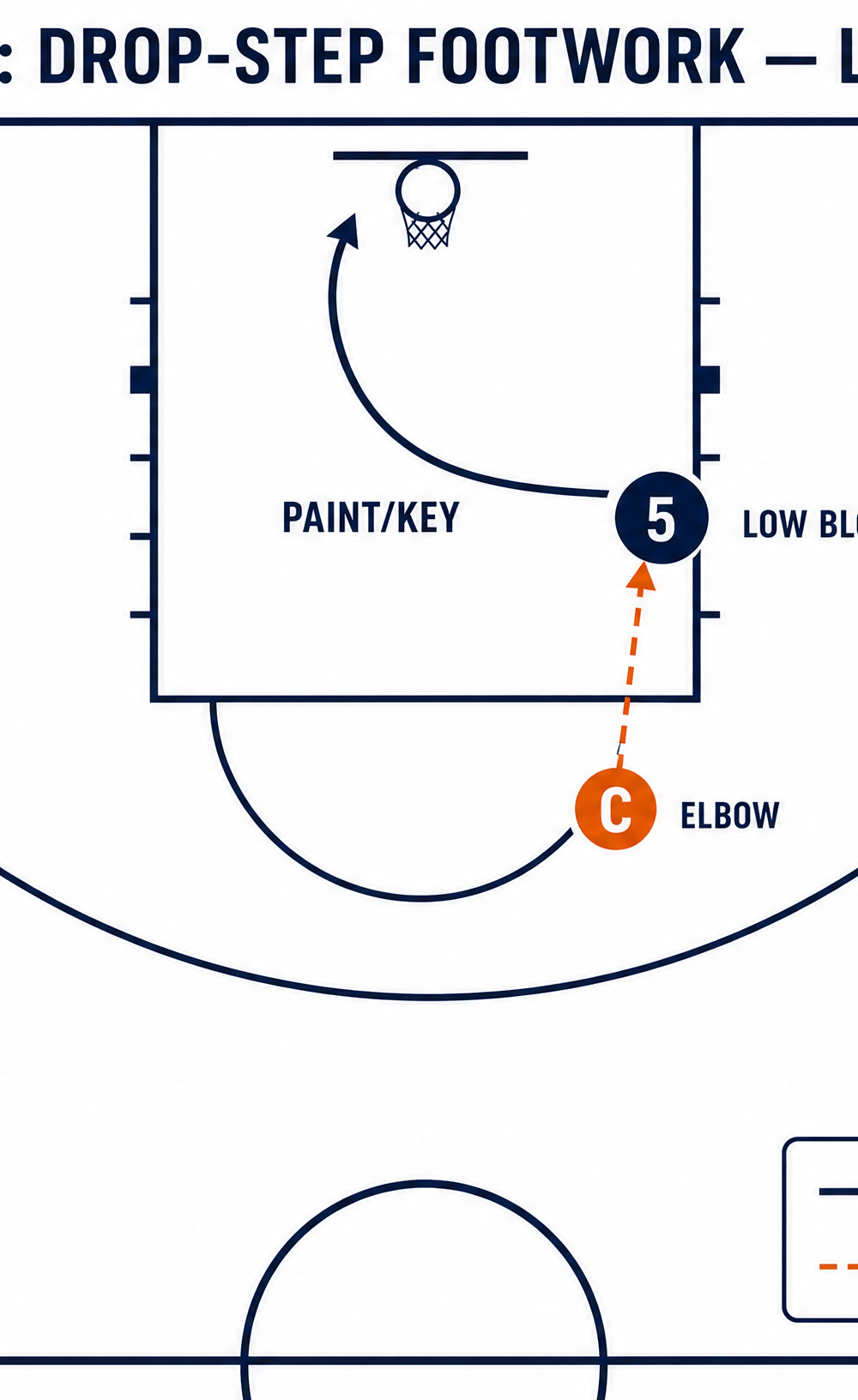
Proper setup is crucial for maximizing repetitions and ensuring game-like angles.
- Equipment: 2-3 basketballs per basket, standard FIBA court (28m x 15m), optionally use contact pads to simulate physical defense.
- Court Setup: Utilize one half-court. If you have a large team, use both ends of the floor to maximize reps.
- Player Positions:
- Post Player (5): Starts on the low block (either left or right side), establishing a wide base just above the first hash mark.
- Feeder/Coach (C/1): Starts at the elbow or top of the key with a basketball, ready to make a post-entry pass.
- Defender (X): Initially passive (or a coach with a pad), positioned behind the post player to dictate the read.
3. Step-by-Step Instructions
This drill progresses through three distinct phases to build complete post proficiency.
Phase 1: The Drop-Step (Baseline Finish)

- Establish Position: The Post Player (5) sprints to the low block, establishes a wide, balanced stance, and gives a target hand to the Feeder (C).
- Entry Pass: The Feeder (C) delivers a crisp bounce pass or chest pass to the Post Player's target hand.
- The Catch and Read: Upon catching the ball, the Post Player chin the ball to protect it and quickly checks the defender's position. In this phase, the defender is playing high side.
- The Move: The Post Player drop-steps toward the baseline. The baseline foot pivots backward toward the basket, sealing the defender on the high side.
- The Finish: The player takes one power dribble (if necessary), explodes upward off two feet, and finishes with a strong layup or dunk on the baseline side of the rim.
Phase 2: Post Entry & Move Selection (Middle Hook & Up-and-Under)
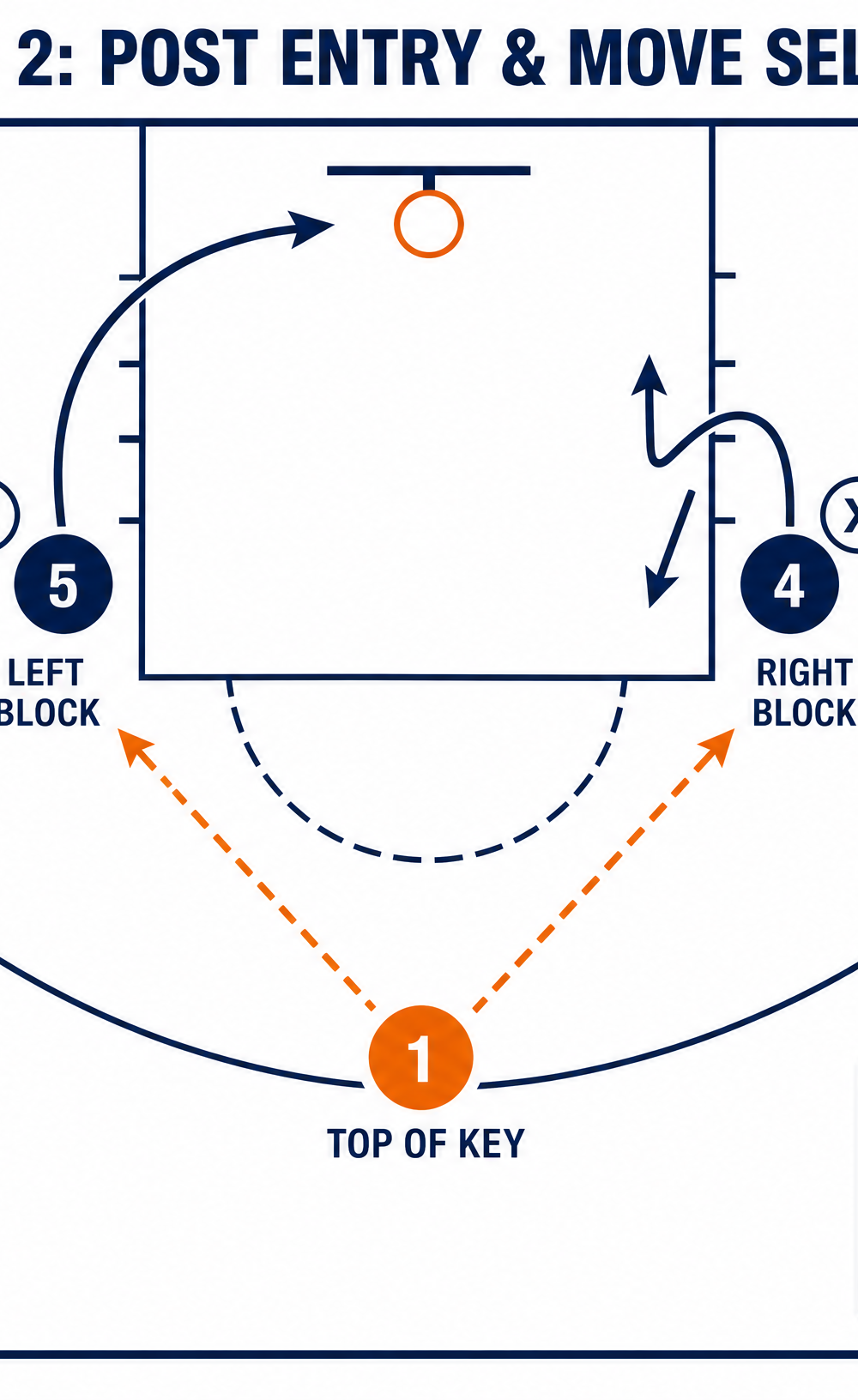
- Dual Block Setup: Position players on both the left (5) and right (4) blocks. The Point Guard (1) is at the top of the key.
- Middle Hook: Point Guard (1) enters the ball to the left block (5). The defender is playing baseline side. The Post Player (5) pivots on the baseline foot, swings the middle foot toward the center of the paint, and executes a sweeping hook shot.
- Up-and-Under: Point Guard (1) enters the ball to the right block (4). The defender is playing neutral. The Post Player (4) fakes the middle hook (showing the ball and shoulders going up). As the defender bites on the fake, the player steps through with their pivot foot toward the basket and finishes with a layup.
Phase 3: 3-Spot Post Progression Rotation
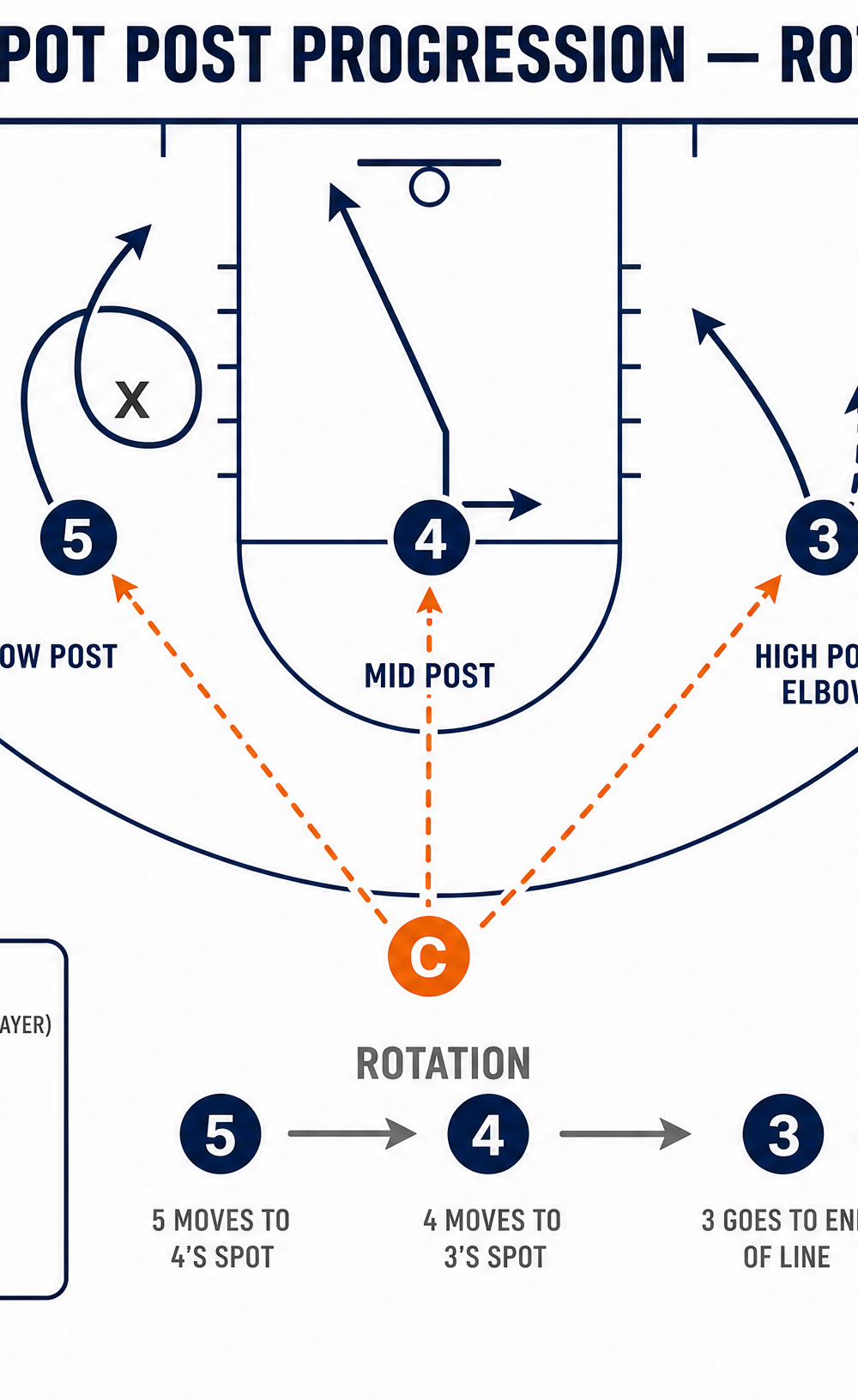
- Rotation Setup: Players are positioned at the Low Post (5), Mid Post (4), and High Post/Elbow (3). The Coach (C) is at the top of the key.
- Continuous Action: The Coach (C) passes to the Low Post (5) for a quick spin move finish. Immediately after, the Coach passes to the Mid Post (4) for a face-up jab and drive. Finally, the Coach passes to the High Post (3) for a shot fake and one-dribble pull-up.
- Rotation: After their shot, players rotate to the next spot: 5 goes to 4's spot, 4 goes to 3's spot, and 3 goes to the end of the line. This ensures all players practice scoring from different areas of the paint.
4. Key Coaching Points
To ensure your players get the most out of this drill, focus on these critical teaching aspects:
- Low and Wide Base: Players must catch the ball with their knees bent and feet wider than shoulder-width apart. A high center of gravity leads to getting pushed off the block.
- Chin the Ball: Immediately upon catching the entry pass, players must secure the ball under their chin with elbows out to protect it from digging guards.
- Read Before Reacting: Emphasize feeling the defender. If the defender is high, drop-step baseline. If the defender is low, turn middle for the hook.
- Explode Off Two Feet: For power finishes around the rim, players should gather and jump off both feet to absorb contact and maintain body control.
- Sell the Fake: On the up-and-under, the initial shot fake must be convincing. Eyes on the rim, ball goes up, forcing the defender to leave their feet.
5. Common Mistakes
Watch out for these frequent errors and correct them immediately:
- Catching Standing Up: Players often relax and stand tall when receiving the pass, making them easy to move and slow to react.
- Bringing the Ball Down: Dropping the ball below the waist after the catch exposes it to smaller, quicker guards who will strip it.
- Rushing the Move: Players frequently predetermine their move before reading the defense, resulting in turning right into the defender's chest.
- Weak Pivot Foot: Dragging or lifting the pivot foot before releasing the ball on the dribble, resulting in a traveling violation.
6. Variations & Progressions
Keep the drill fresh and challenging by implementing these variations:
- Add Contact (Progression): Have a coach or manager use a heavy contact pad to bump the post player as they catch the ball and as they go up for the finish. This builds toughness and focus.
- Live Defense (Progression): Transition from dummy defense to 1-on-1 live play. The feeder passes the ball, and the post player has a maximum of three dribbles to score against a fully active defender.
- Weakside Flash (Variation): Instead of starting on the block, have the post player start on the weakside block and flash hard across the lane to the strongside block to receive the entry pass, simulating game movement.
7. Age Adaptations
Tailor the drill to fit the developmental stage of your team:
- Under 10s / Beginners: Focus solely on the drop-step without a defender. Emphasize the footwork pattern (catch, pivot, step) without the ball first, then add the ball. Use a smaller ball and lower hoops if possible.
- Under 12s / Under 14s: Introduce the middle hook and basic reads (high vs. low defense). Start adding light, passive defense to help them understand spacing and angles.
- Under 16s / Advanced: Implement the full 3-spot rotation and up-and-under counter moves. Demand game speed, heavy contact, and quick decision-making on the catch.