

Basketball
5-Out Press Break: Attacking Full Court Pressure with Purpose
Master the 5-Out Press Break — a structured, high-percentage system that turns full court pressure into easy transition baskets through spacing, timing, and decisive passing.

What you need
basketball, full court, cones (optional for marking outlet zones), whiteboard or coaching tablet (for diagramming)
Overview
Full court pressure is one of the most psychologically disruptive defensive tactics a team can face. When applied well, it forces rushed decisions, creates turnovers, and shifts momentum dramatically. The 5-Out Press Break is a structured, system-based response that eliminates panic, establishes clear roles for every player, and transforms defensive pressure into offensive opportunity.
This play is built on three principles: spacing, timing, and attack mentality. Rather than simply surviving the press, this system actively looks to score from it. Coaches should install this play as a permanent part of their offensive system — not a panic measure — so that players respond to pressure with confidence and aggression.
When to use this play: Deploy the 5-Out Press Break any time the opposition applies a full court man-to-man or zone press, including after made baskets, free throws, and dead ball situations. It is equally effective against a 1-2-1-1 diamond press, a 2-2-1 zone press, or a scramble man press.
Setup

Court: Standard FIBA court, 28m x 15m. The play is initiated from the baseline following a made basket or dead ball.
Equipment needed: 1 basketball, full court access, cones (optional, for marking outlet zones during practice).
Player Positions at the Start:
| Position | Player | Starting Location |
|---|---|---|
| 1 — Point Guard (PG) | Ball-handler | Just inside half court, slightly ball-side |
| 2 — Shooting Guard (SG) | Wing | Right sideline, 3–4m inside the defensive half |
| 3 — Small Forward (SF) | Wing | Left sideline, 3–4m inside the defensive half |
| 4 — Power Forward (PF) | Trailer | Right elbow of the offensive end, ahead of half court |
| 5 — Centre (C) | Inbounder | Out of bounds on the baseline, inbounding the ball |
The key to the setup is width and depth simultaneously. Players 2 and 3 stretch the press horizontally by occupying the sidelines. Player 1 sits just short of half court as the primary outlet target. Player 4 is positioned ahead as the scoring threat. Player 5 is the calm, composed inbounder.

Diagram 1: Initial setup showing the 5-Out alignment. Player 5 inbounds to Player 1 (dashed red = ball movement, solid blue = player movement). Defensive pressure (red X) is spread across the court.
Step-by-Step Instructions

Step 1 — Inbound Trigger (0–2 seconds)
As soon as the basket is scored or the dead ball is called, Player 5 steps out of bounds and calls "PRESS!" — the team's signal to execute the press break. Players 2 and 3 immediately sprint to their sideline positions, approximately 6–7m from the baseline. Player 1 reads the defence and positions just inside half court on the ball-side. Player 4 sprints ahead to the offensive three-point arc.
Step 2 — Primary Outlet Pass (2–4 seconds)
Player 5 looks first to Player 1 as the primary outlet. Player 1 should create separation from their defender by making a hard V-cut — two steps toward the baseline, then a sharp cut back toward half court. The pass from Player 5 must be a crisp, two-handed chest pass or bounce pass to the chest of Player 1. Player 5 has 5 seconds to inbound the ball under FIBA rules — they must not hesitate.
Step 3 — Secondary Options (if primary is denied)
If Player 1 is denied, Player 5 looks to Player 2 on the right sideline (secondary outlet) or Player 3 on the left sideline. These players should be positioned behind their defenders, making themselves available for a lob or skip pass. Player 5 may also use a dribble handoff if a teammate cuts back to them, though this should be a last resort.
Step 4 — Middle Attack (4–6 seconds)
Once Player 1 receives the inbound pass, they immediately attack the middle of the court. The middle is the most dangerous area against a press because it splits the defence and opens both sidelines. Player 1 should dribble with purpose — head up, eyes scanning ahead — not sideways or backwards. Player 5 immediately sprints up the middle lane after releasing the inbound pass, becoming a trailer option.
Step 5 — Advance Pass and Finish (6–8 seconds)
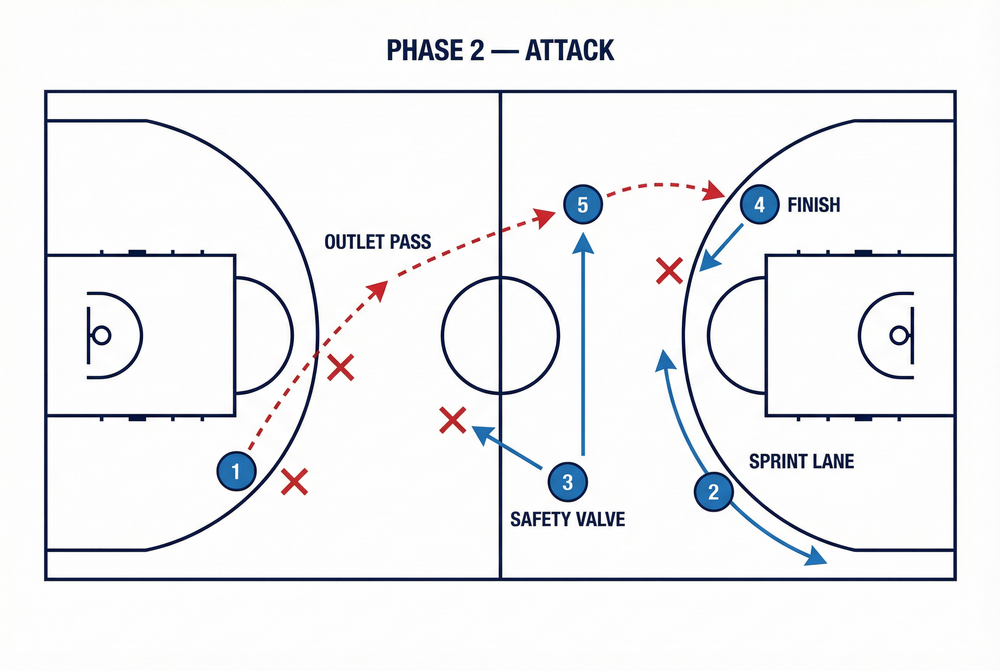
As Player 1 attacks the middle, they look ahead to Player 4, who should be at or beyond half court on the strong side. If Player 4 has a step on their defender, Player 1 delivers a leading pass into the space ahead of Player 4 for a layup or pull-up jumper. Player 2 continues sprinting the right lane as a secondary scoring option. Player 3 fills the left lane. Player 5 trails as the safety and rebounding option.

Diagram 2: Phase 2 — Attack. Player 1 has received the inbound and attacks the middle. Player 5 sprints the middle lane. Dashed red arrow shows the advance pass to Player 4 for the finish. Player 2 runs the right sprint lane. Player 3 holds the safety valve position.
Step 6 — Reset if Stalled
If the press is not broken cleanly by half court, Player 1 calls "RESET" and the team transitions into their half court offence. Players 2 and 3 fill the wings, Player 4 sets up at the high post, and Player 5 establishes in the low post. Do not force the press break into a bad decision — a clean reset is always better than a turnover.
Key Coaching Points

1. Composure is the weapon. The press is designed to create panic. Remind your players that a composed team beats the press every time. Slow your breathing, make eye contact, and execute the system. Panic leads to turnovers; composure leads to layups.
2. Attack the middle, not the sideline. The most common mistake is dribbling up the sideline, which traps the ball-handler. Player 1 must be coached to attack the middle of the court aggressively. The middle splits the press and forces defenders to make impossible rotation decisions.
3. The inbounder is a player, not a statue. After releasing the inbound pass, Player 5 must sprint immediately. They become the middle trailer and a critical passing option. An inbounder who stands still is wasting a 5-on-4 advantage.
4. Pass ahead, not sideways. Lateral passes keep the ball in the defensive half and allow the press to reset. Every pass in the press break should move the ball forward. Drill this relentlessly — if you can pass ahead, you pass ahead.
5. Read the numbers advantage. The press break should create a numbers advantage (3-on-2 or 2-on-1) in the offensive half. Players must be trained to recognise these situations and finish them. A missed layup from a press break is a coaching failure — it means the player was not prepared to finish under pressure.
6. Sprint lanes are non-negotiable. Players 2 and 3 must sprint their lanes every single time, regardless of whether they receive the ball. Their movement occupies defenders and creates the space for Player 1 and Player 4 to operate. Half-speed lane running destroys the play.
Common Mistakes

Mistake 1 — Dribbling into the corner trap. Player 1 drifts to the sideline instead of attacking the middle, and gets trapped by two defenders in the corner. Correction: Use cones to mark the middle corridor in practice. Reward players who attack through the middle and penalise sideline dribbling with a conditioning run.
Mistake 2 — Slow or hesitant inbound pass. Player 5 holds the ball too long, allowing the press to set up fully. Correction: Drill the inbound trigger under time pressure. Use a 4-second count (stricter than the FIBA 5-second rule) in practice to build urgency. The inbound pass should be released within 2 seconds whenever possible.
Mistake 3 — Players bunching together. Two or three players drift to the same area, eliminating spacing and making it easy for the defence to cover multiple players. Correction: Assign strict court zones to each player and hold them accountable. Use a "spacing check" at the start of each press break repetition in practice.
Mistake 4 — Forcing the long pass under pressure. Player 1 or Player 5 attempts a high-risk long pass to Player 4 when the defence is in position, resulting in a turnover. Correction: Teach players to read the defence before releasing. If Player 4 is covered, attack the middle and wait for the advantage to develop. Reinforce the "reset" option as a positive, not a failure.
Mistake 5 — Not finishing the press break. The play breaks the press successfully but the team slows down before reaching the basket, allowing the defence to recover. Correction: Finish every press break repetition in practice with a layup or pull-up jumper. Never stop the drill at half court. The press break is not complete until the ball goes through the basket.
Variations & Progressions
Variation 1 — Long Pass Option (Advanced)
For teams with an athletic Player 4 or Player 5 and a strong-armed inbounder, add a direct long pass option. Player 4 sprints the right lane from the moment the basket is scored, and Player 5 looks to throw a baseball pass to Player 4 in stride before the defence can recover. This is a high-risk, high-reward option that should only be used when Player 4 has a clear step advantage. Drill this as a specific trigger call — "LONG!" — so the team knows to look for it.
Variation 2 — Dribble Handoff Safety (Beginner)
For younger or less experienced teams, add a dribble handoff option where Player 1 comes back toward Player 5 if the primary outlet is denied. Player 5 dribbles in from out of bounds (after stepping in), and Player 1 takes the handoff and attacks. This simplifies the read for Player 5 and reduces the risk of a bad inbound pass. It is slower but more reliable for developing teams.
Progression — Live 5-on-5 with Scramble Defence
Once the play is mastered in a controlled drill environment, run it live against a full defensive press that is allowed to scramble and trap. The defence should be instructed to apply maximum pressure, including double-teaming the inbounder. This forces offensive players to make real-time decisions and builds the composure and communication skills needed in a game. Start with the defence at 70% intensity and build to 100% over multiple sessions.
Age Adaptations

Under 12 (Beginner): Simplify to a 3-player press break — remove Players 3 and 4 and focus only on the inbound-to-outlet-to-middle attack. Use a half court press break first to build confidence before moving to full court. Allow players to walk through the play at half speed before adding defenders. Emphasise spacing and communication over speed.
Under 14 / Under 16 (Intermediate): Introduce all five positions and run the play at game speed. Add the dribble handoff variation and the reset option. Begin running the play against live defence at 70% intensity. Focus on reading the numbers advantage and finishing at the basket.
Open / Senior (Advanced): Run the full play including the long pass option. Add defensive scramble pressure at 100% intensity. Introduce secondary actions after the press break — for example, if the defence recovers, Player 1 calls a specific half court set immediately. Time the press break execution (target: basket scored within 6 seconds of inbound) and track turnover rates to measure improvement.
