

Basketball
Sideline Inbound: 'Elevator' vs Man-to-Man Defense
A highly effective sideline out-of-bounds (SLOB) play designed to exploit aggressive man-to-man pressure and create high-percentage scoring opportunities at the rim.
What you need
1 Basketball, Half-court space
1. Overview
The 'Elevator' sideline inbound play is a staple for teams facing aggressive man-to-man defense. When defenders overplay the passing lanes, this set uses misdirection, solid screening, and decisive cuts to create an immediate scoring threat at the rim. It is best utilized in late-game situations or when you need a high-percentage look to break a scoring drought. The primary objective is to free up your best cutter (usually the 2-guard) for a layup, while secondary options provide reliable safety valves if the primary action is covered.
2. Setup
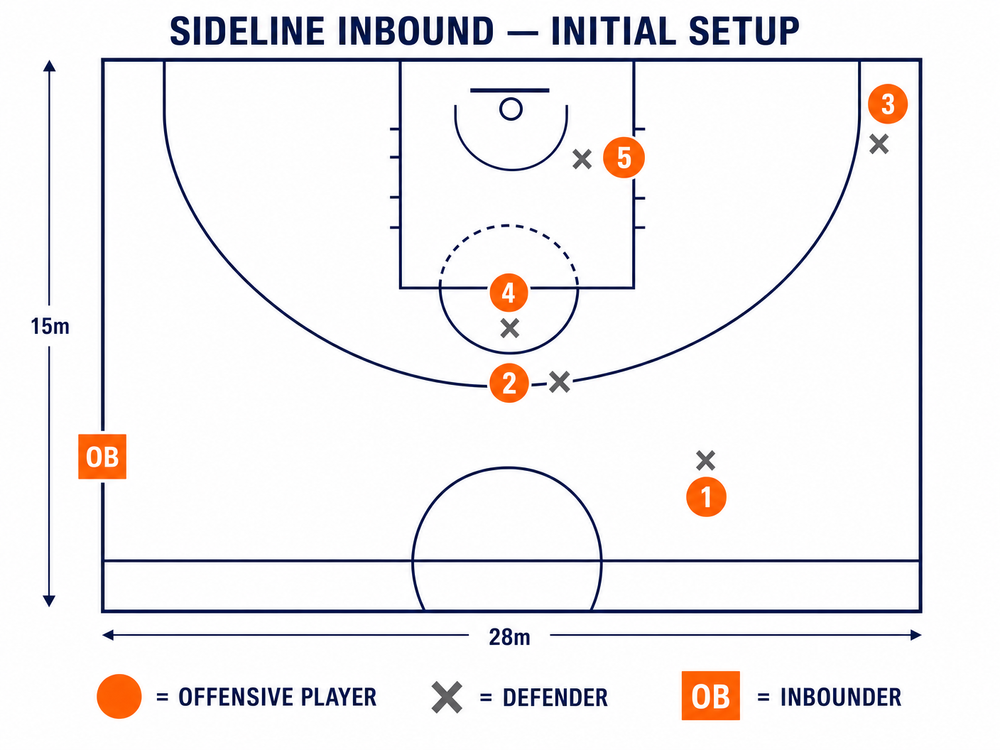
Court Dimensions: Standard FIBA Court (28m x 15m)
Equipment Needed: 1 Basketball, half-court space.
Player Positions (Initial Setup):
- 1 (Point Guard): Positioned near half-court on the weak side, acting as a decoy and safety outlet.
- 2 (Shooting Guard): Starts at the ball-side elbow (free throw line extended). This is your primary scorer for this play.
- 3 (Small Forward): Located in the strong-side corner, stretching the defense and keeping the help-side defender occupied.
- 4 (Power Forward): Positioned at the high post/free throw line area, ready to set the initial cross-screen.
- 5 (Center): Starts on the strong-side low block, serving as the primary screener for the main action.
- OB (Inbounder): Standing out-of-bounds on the sideline, at the mid-court level.
3. Step-by-Step Instructions
Step 1: The Misdirection
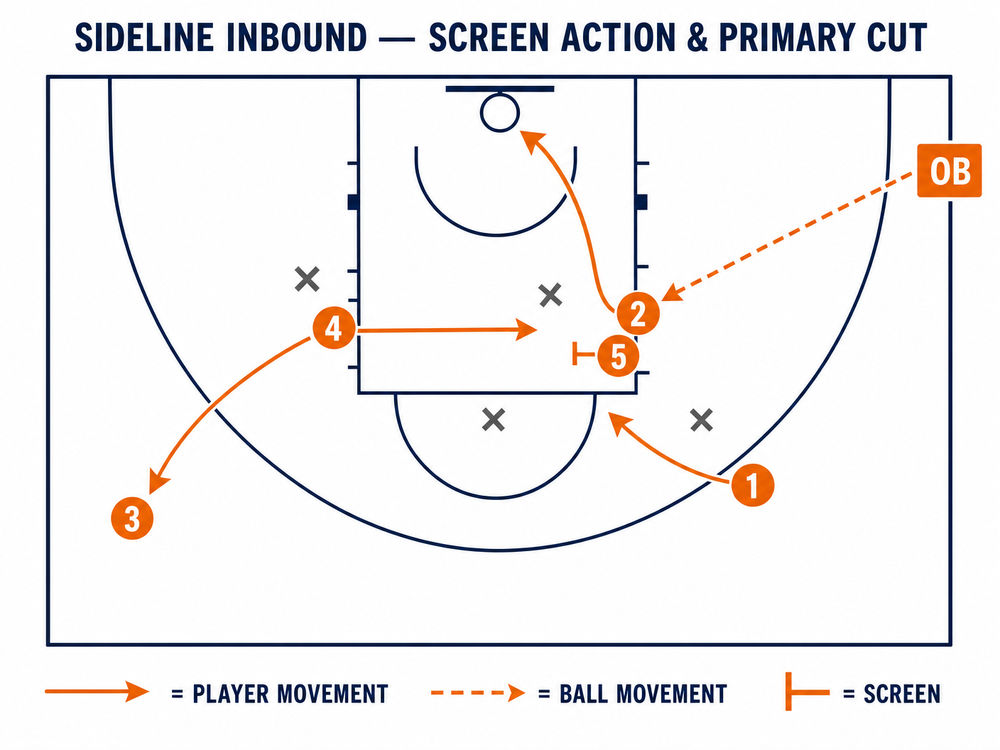
As the referee hands the ball to the inbounder (OB), Player 4 sets a hard cross-screen for Player 3. Player 3 uses the screen to cut across the baseline to the weak-side corner. This action is a decoy designed to draw the attention of the interior defenders and shift the defense's focus away from the ball side.
Step 2: The Primary Screen
Simultaneously, Player 5 steps up from the strong-side block to set a solid back-screen on Player 2's defender near the elbow. Player 5 must ensure they are set and stationary to avoid an illegal screen foul.
Step 3: The Hard Cut
Player 2 reads the screen set by Player 5. If the defender trails, Player 2 curls tightly around the screen and cuts hard and fast directly toward the basket. The inbounder (OB) delivers a crisp, accurate pass to Player 2 in stride for the layup.
Step 4: Secondary Options (If Primary is Covered)
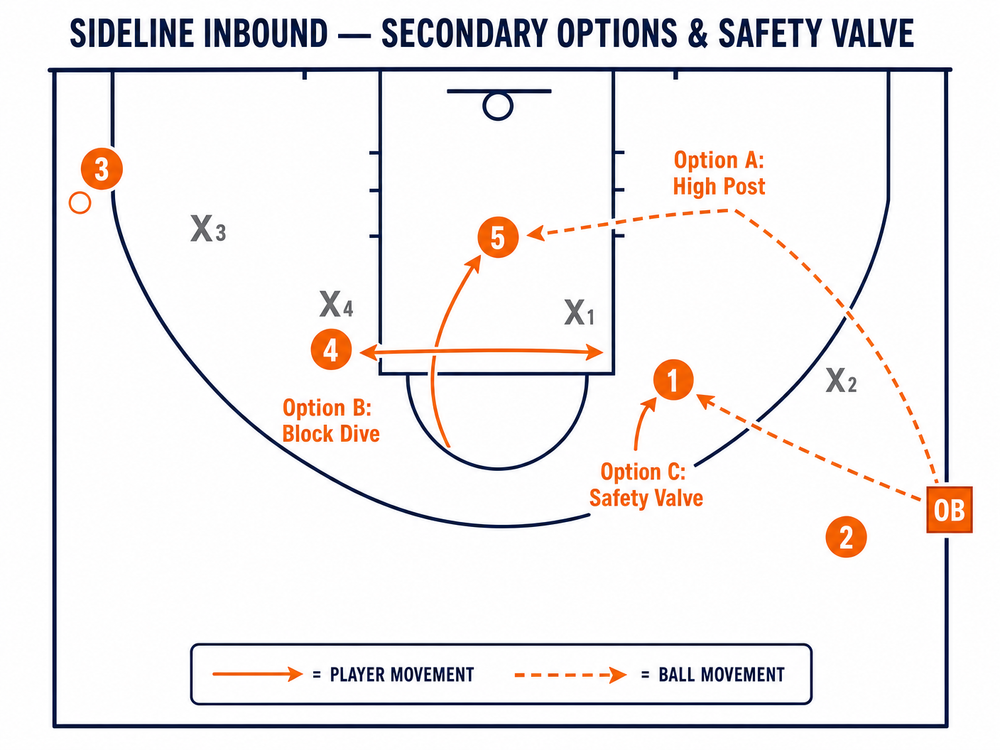
If the defense switches or fights through the screen to deny Player 2, the team must immediately transition to secondary options:
- Option A (The Roll): After setting the screen, Player 5 opens up to the ball and rolls to the high post area, presenting a large target for the inbounder.
- Option B (The Dive): Player 4, after setting the initial decoy screen, dives hard from the weak-side block to the strong-side block, looking for a quick entry pass.
- Option C (Safety Valve): Player 1 steps toward the ball-side elbow to receive a safe pass, allowing the team to reset the offense and initiate their regular half-court set.
4. Key Coaching Points
- Patience is Crucial: The inbounder must wait for the screens to develop. Rushing the pass often leads to turnovers.
- Screening Angles: Player 5 must set the back-screen at the correct angle, forcing the defender to make a difficult decision (go over or under).
- Cut with Purpose: Player 2 must sell the initial setup and then explode off the screen. A slow cut allows the defense to recover.
- Eye Contact: The inbounder and the cutter (Player 2) must establish eye contact before the pass is thrown to ensure timing and accuracy.
- Read the Defense: The inbounder must quickly process the defense's reaction to the primary screen and deliver the ball to the open option without hesitation.
5. Common Mistakes
- Illegal Screens: Screeners moving before the cutter passes, resulting in an offensive foul.
- Telegraphing the Pass: The inbounder staring down the primary option, allowing the defense to anticipate and intercept the pass.
- Weak Cuts: The cutter jogging through the play instead of sprinting, making it easy for the defender to stay attached.
- Spacing Issues: Players bunching up in the paint, clogging the driving lanes and making the pass difficult.
6. Variations & Progressions
- The 'Slip' Variation: If the defense anticipates the back-screen and attempts to switch early, Player 5 can 'slip' the screen and dive straight to the basket for an easy layup.
- The 'Pop' Variation: Instead of cutting to the basket, Player 2 can flare out to the three-point line after using the screen, creating an open jump shot opportunity.
- Adding a Dribble Handoff (DHO): If the pass goes to the safety valve (Player 1), Player 2 can immediately sprint toward Player 1 for a quick DHO to maintain offensive momentum.
7. Age Adaptations
- Under 10 / Under 12: Focus heavily on the fundamentals of setting legal screens and making accurate passes under pressure. Simplify the play by removing the initial decoy action (Player 4 and 3) and focusing solely on the primary screen and cut.
- Under 14 / Under 16: Introduce the 'Slip' and 'Pop' variations. Emphasize reading the defense and making quick decisions based on how the opponent defends the screen.
- Open / Advanced: Execute the play with maximum speed and precision. Incorporate the DHO progression and focus on exploiting specific defensive matchups.
