

Cricket
Bowling Run-Up Alignment Drill: Mastering the Approach
A fundamental fast bowling drill designed to build a straight, efficient, and balanced run-up corridor for maximum pace and accuracy.

What you need
10-12 Marker Cones, Cricket Balls, Stumps, Measuring Tape
1. Overview
The run-up is the foundation of every fast bowler's action. A misaligned or wavering approach bleeds momentum, reduces pace, and directly impacts accuracy at the crease. The Bowling Run-Up Alignment Drill is a core conditioning and technical exercise designed to build muscle memory for a perfectly straight, balanced, and efficient approach to the crease.
This drill forces the bowler to stay within a defined "corridor of alignment," ensuring their momentum is directed entirely toward the target zone. It is highly effective during pre-season conditioning or as a corrective measure for bowlers who tend to drift laterally during their approach. By restricting the lateral space, bowlers naturally correct their stride mechanics, leading to a more explosive and accurate delivery stride.
2. Setup
Proper setup is critical to the success of this drill. The goal is to create a visual and physical boundary that the bowler must navigate without disruption.
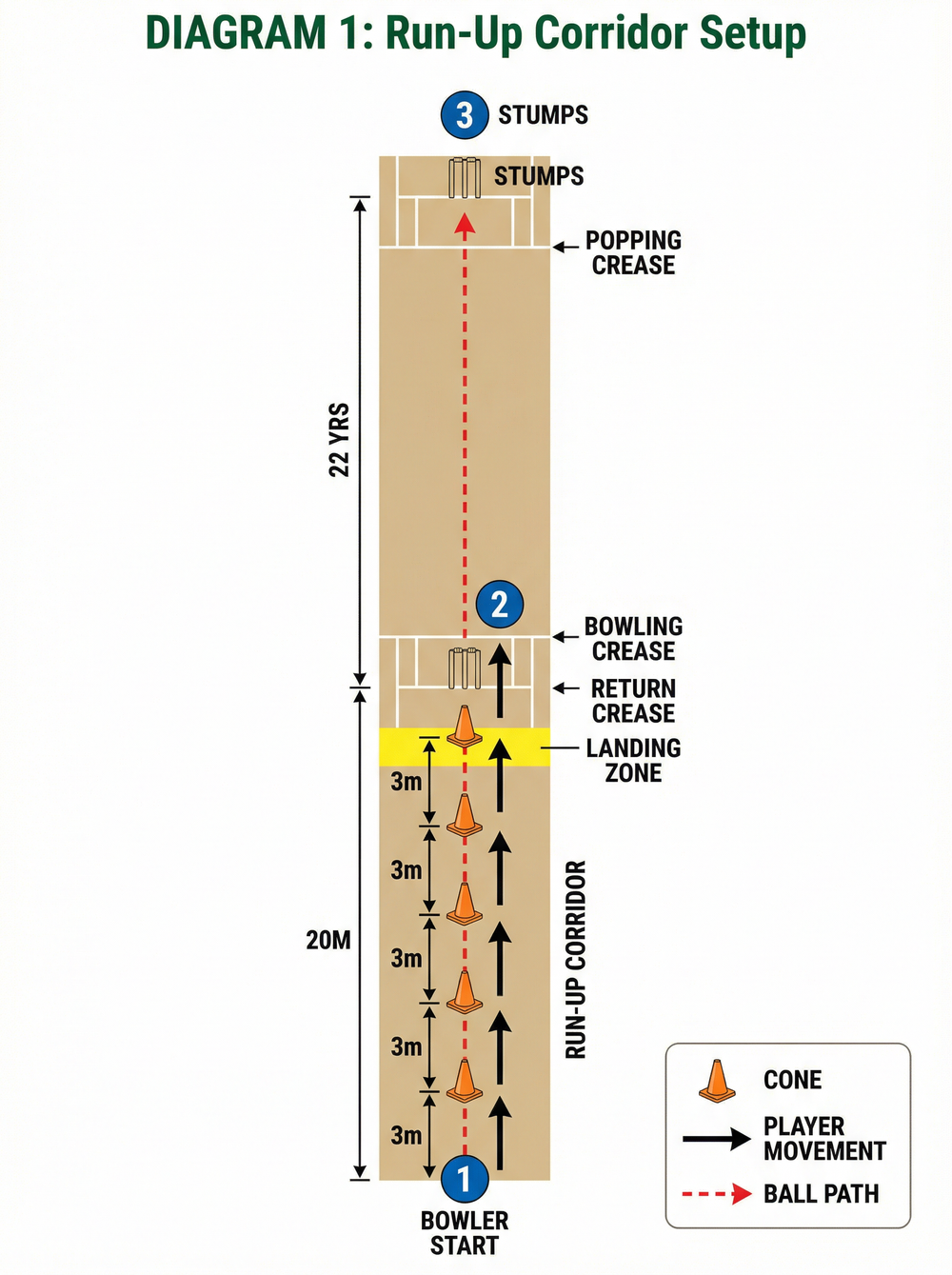
- Pitch/Field Setup: Utilize a standard 22-yard cricket pitch. The drill takes place entirely on the bowler's approach side, extending back from the bowling crease.
- Equipment Required: 10-12 marker cones (preferably bright orange or yellow for high visibility), a measuring tape, and a set of stumps at the batsman's end.
- The Corridor: Starting from the bowler's mark (Position 1), place two parallel lines of cones extending toward the bowling crease. The width of this corridor should be approximately 1.5 meters wide, narrowing slightly to 1 meter as it approaches the crease.
- Spacing: Place the cones roughly 3 meters apart along the length of the run-up (typically 15-25 meters depending on the bowler).
3. Step-by-Step Instructions
Follow these steps to execute the drill effectively during your coaching session:
- Establish the Mark: Have the bowler start at their standard run-up mark (Position 1). Ensure they are balanced and focused before beginning the approach.
- The Approach: On the coach's command, the bowler begins their run-up, accelerating smoothly through the marked corridor. The objective is to run completely straight, avoiding any contact with the cones on either side.
- The Delivery Stride: As the bowler reaches the bowling crease (Position 2), they must execute their gather and delivery stride while remaining centered within the final, narrowest section of the cones.
- The Follow-Through: The bowler delivers the ball (or a shadow delivery if focusing purely on the run-up) and must continue their follow-through straight down the pitch, avoiding the "danger area" but maintaining their forward momentum toward the target zone.
- Review and Repeat: The coach observes from a side-on or front-on position, providing immediate feedback on alignment, head position, and stride length. Repeat for sets of 6-8 approaches.
4. Key Coaching Points
When observing this drill, coaches should focus on the following critical elements:
- Head Position: The head must remain still and level throughout the approach. A bobbing or tilting head will cause the body to drift off the straight line.
- Arm Drive: Ensure the bowler is driving their arms in straight, linear lines parallel to the corridor. Pumping arms across the body will cause lateral rotation and misalignment.
- Foot Plant: The feet should land pointing straight down the pitch. Watch for feet that splay outwards, which bleeds forward momentum.
- Smooth Acceleration: The run-up should build in a smooth crescendo, reaching maximum controlled speed at the gather, rather than a frantic sprint from the start mark.
- Target Fixation: The bowler's eyes should be locked onto the target zone (e.g., the top of off-stump) from the very first step.
5. Common Mistakes
Watch out for these frequent errors and correct them immediately:
- Drifting Wide: The bowler consistently veers to the left or right, knocking over the cones. This often stems from poor head position or running on the heels.
- Over-Striding: Taking strides that are too long in an attempt to generate speed, leading to a loss of balance and a jarring impact at the crease.
- Decelerating at the Crease: The bowler slows down just before the gather, losing the kinetic energy built up during the approach. The run-up must flow seamlessly into the delivery stride.
- Looking Down: The bowler looks at the cones or their feet instead of the target, disrupting their posture and balance.

6. Variations & Progressions
To keep the drill challenging and adaptable, consider these variations:
- The Narrowing Corridor (Progression): Gradually move the cones closer together as the bowler becomes more proficient, demanding even tighter alignment.
- Blind Start (Variation): Have the bowler start facing away from the pitch, turn on command, and immediately begin their run-up. This tests their spatial awareness and ability to find their line quickly.
- Weighted Vest (Conditioning Progression): For advanced fast bowlers, performing the drill with a light weighted vest can build explosive power and core stability during the approach.
- Multi-Angle Approaches (Variation): Set up corridors for both over-the-wicket and around-the-wicket approaches, forcing the bowler to adapt their alignment to different delivery angles (as shown in Diagram 2).
7. Age Adaptations
This drill is fundamental but should be scaled appropriately for different age groups:
- Under 10s / Under 12s: Keep the corridor wider (approx. 2 meters). Focus purely on running in a straight line without a ball. Use fewer cones to avoid visual overload. Emphasize having fun and running smoothly.
- Under 14s / Under 16s: Introduce the ball and focus on the transition from the run-up into the gather. The corridor should be standard width. Begin emphasizing arm drive and head position.
- Open / Seniors: The corridor should be tight. Focus on maximizing speed and efficiency. Incorporate target bowling at the end of the run-up to ensure alignment translates to accuracy under match conditions.
