

Rugby
Box Kick Chase and Press Play: Mastering the Aerial Battle
Equip your team with the tactical knowledge to execute a devastating box kick chase, win the aerial battle, and dominate territory.
What you need
5-10 Rugby balls, Cones, Tackle shields (optional)
1. Overview
The Box Kick Chase and Press is a fundamental tactical play used to relieve pressure, gain territory, and contest possession in the opposition's half. Executed primarily by the scrum-half (9) from the base of a ruck or maul, this play relies on a highly coordinated chase line to pressure the catcher, force errors, or regain the ball. It is most effective when pinned deep in your own territory or when seeking to disrupt a disorganized defensive backline.
2. Setup
Equipment Needed:
- 5-10 Rugby balls
- Cones (to mark the target landing zone and starting ruck position)
- Tackle shields (optional, for simulating defensive pressure on the catcher)
Pitch Setup:
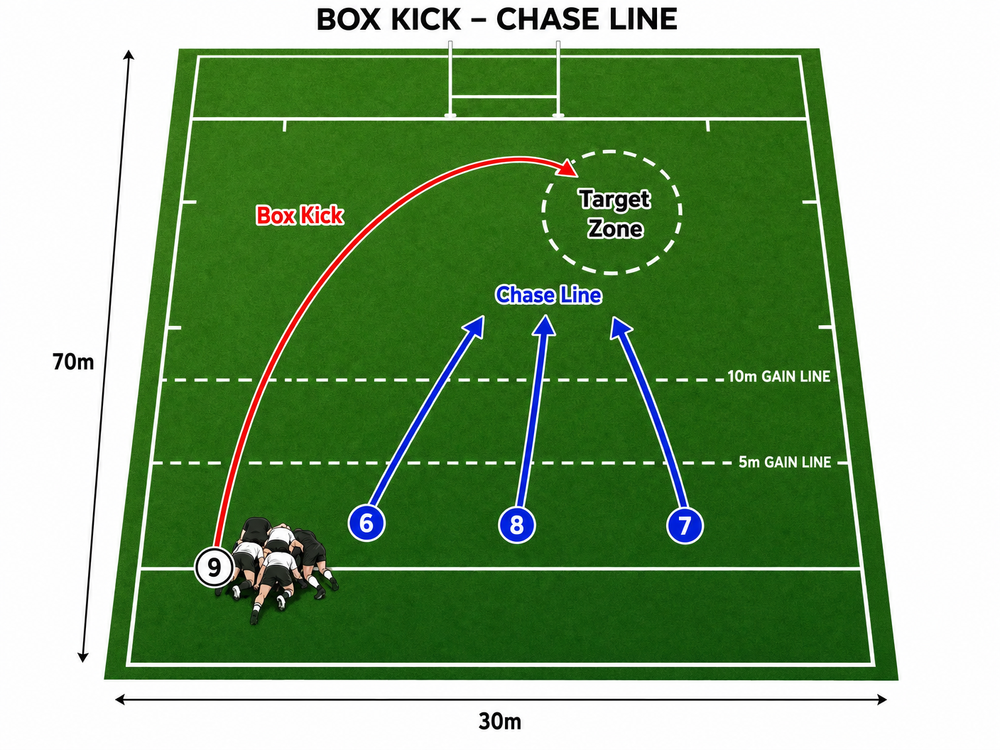
- Mark a starting ruck position near the touchline (e.g., 15m in from the left touchline).
- Place a 10m x 10m target landing zone box approximately 20-25m downfield and slightly infield from the ruck.
Player Positions:
- 9 (Scrum-half): At the base of the ruck, ready to execute the box kick.
- 6, 7, 8 (Loose Forwards): Positioned 2-3m behind the ruck, forming a staggered chase line on the blindside or openside, depending on the kick direction.
- Opposing Fullback/Winger (Catcher): Positioned in or near the target landing zone.
3. Step-by-Step Instructions
Step 1: The Setup and Call
- The scrum-half (9) assesses the defensive alignment and calls the box kick play (e.g., "Box" or a specific code word).
- The chase line (typically 6, 7, and 8, or designated wingers/centers) aligns 2-3m behind the ruck, ensuring they are onside.
Step 2: The Kick Execution
- The 9 steps away from the ruck, creating an angle to kick over the defensive line.
- The kick must have sufficient hang time (ideally 3.5 - 4.5 seconds) and travel 20-25m to allow the chasers to compete.
Step 3: The Chase Formation
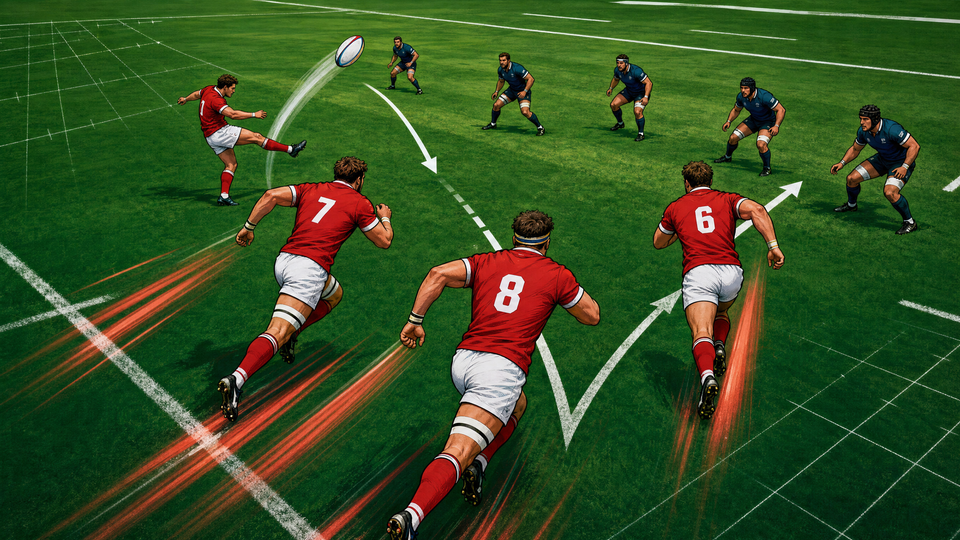
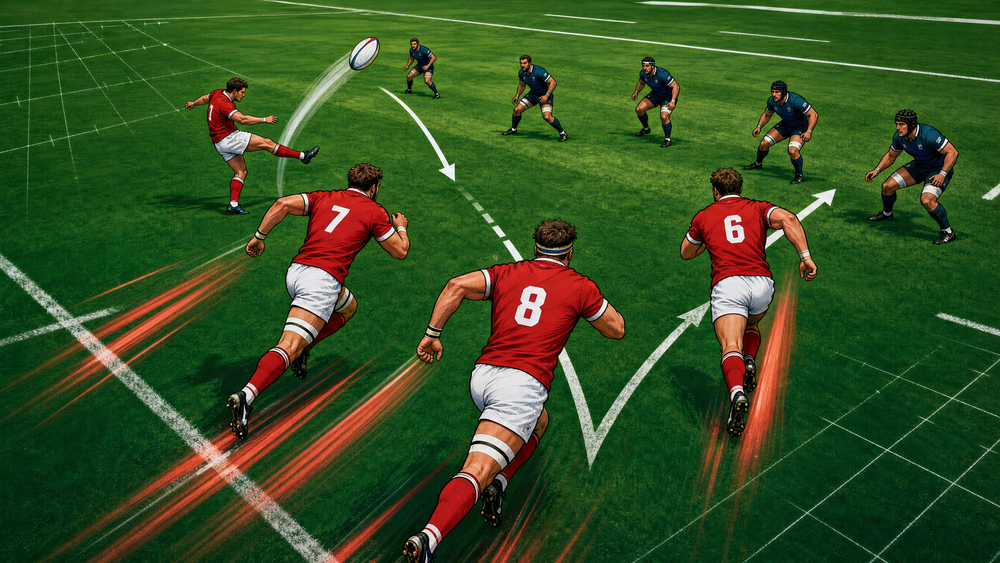
- As soon as the ball is kicked, the chase line sprints forward in a V-shaped or fan formation.
- The lead chaser (often the 7 or a winger) focuses on the ball and the catcher, aiming to contest in the air or make an immediate tackle upon landing.
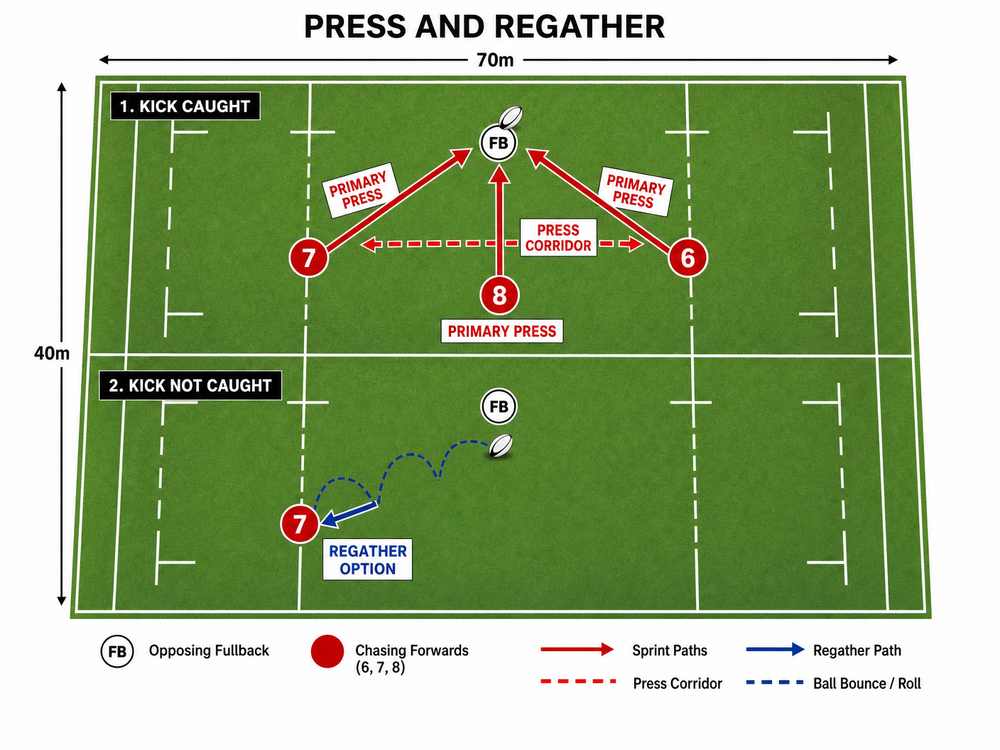
- The supporting chasers (6 and 8) fan out slightly to cut off escape routes and form a "press corridor."
Step 4: The Press and Regather
- Scenario A (Kick Caught): If the opposing catcher secures the ball, the lead chaser executes a dominant tackle. The supporting chasers immediately counter-ruck to win the turnover or slow down the ball.
- Scenario B (Kick Dropped/Bounced): If the ball hits the ground, the chasers must react instantly. The nearest player scoops the ball or kicks it ahead, while the others provide support.
4. Key Coaching Points
- Hang Time is King: A long kick with low hang time is a free counter-attack for the opposition. Emphasize height over distance.
- Stay Onside: Chasers must watch the kicker and only advance once the ball is struck. A penalty here ruins the play.
- The 'V' Formation: Chasers must not run in a straight line. Fanning out cuts off the catcher's lateral movement options.
- Communication: The lead chaser must call for the ball if they intend to catch it, or call "Man" if they are going for the tackle.
- Aggressive Counter-Ruck: If the tackle is made, the next arriving players must aggressively target the ball to force a turnover.
5. Common Mistakes
- Kicking Too Long: Overkicking the chase line allows the catcher time to secure the ball and initiate a counter-attack.
- Offside Chasers: Eagerness to get downfield leads to players starting ahead of the kicker.
- Passive Chase: Jogging instead of sprinting. The chase must be a 100% effort sprint to apply maximum pressure.
- Poor Kick Execution: Slicing the kick out on the full or failing to clear the defensive line.
6. Variations & Progressions
- Progression 1: Contested Catch: Introduce a defender with a tackle shield to challenge the catcher in the air.
- Progression 2: Live Defense: Add 2-3 defenders to block the chase line, forcing chasers to navigate traffic.
- Variation 1: The Short Box: A highly lofted kick traveling only 10-15m, designed specifically for a tall winger or forward to catch cleanly.
7. Age Adaptations
- Under 10/12: Focus heavily on the technique of the kick (drop punt or early box kick technique) and the concept of staying onside. Limit the distance to 10-15m.
- Under 14/16: Introduce the coordinated chase line and the decision-making process of when to kick versus when to run. Emphasize safe tackling techniques on the catcher.
- Open/Senior: Full tactical implementation, including complex chase patterns, blocking lines, and advanced counter-rucking strategies.
